Machine learning models are the quiet workers behind almost every smart app you use. They pick the videos on your home screen, sort your photos, translate languages, and warn your bank when a payment looks suspicious.
But what exactly is a model? How does it learn? And which type does what? This guide answers all three questions in plain English, with real examples you already know from daily life. No math, no code, and no hard words without a simple explanation next to them.
What Is a Machine Learning Model?
A machine learning model is a program that has learned patterns from data and can now make predictions or decisions on its own.
Here is the easiest way to picture it. An algorithm is a recipe: a set of steps for learning. A model is the finished dish: the result after the recipe has been used on real ingredients, which in this case is data. In our guide to machine learning algorithms, we walked through the recipes one by one. This article is about the finished dishes those recipes produce.
IBM’s overview of machine learning models makes the same point in more technical words: a model is the saved result of training, ready to do real work. Two things matter about that definition:
- The model is trained, not written. Nobody sat down and typed out rules like “if the email says free prize, block it.” The model found its own rules by studying examples.
- The model keeps the lessons, not the data. After training, the model is a compact file of learned patterns. It can predict answers for new data it has never seen before.
Think of a model like a trained dog. You do not program the dog. You show it what to do many times, reward the right behavior, and one day it simply knows. A machine learning model learns the same way, only from rows of data instead of treats.
How Machine Learning Models Work
Strip away all the technical language, and every model works in the same three steps.
Step 1: The Model Studies Examples
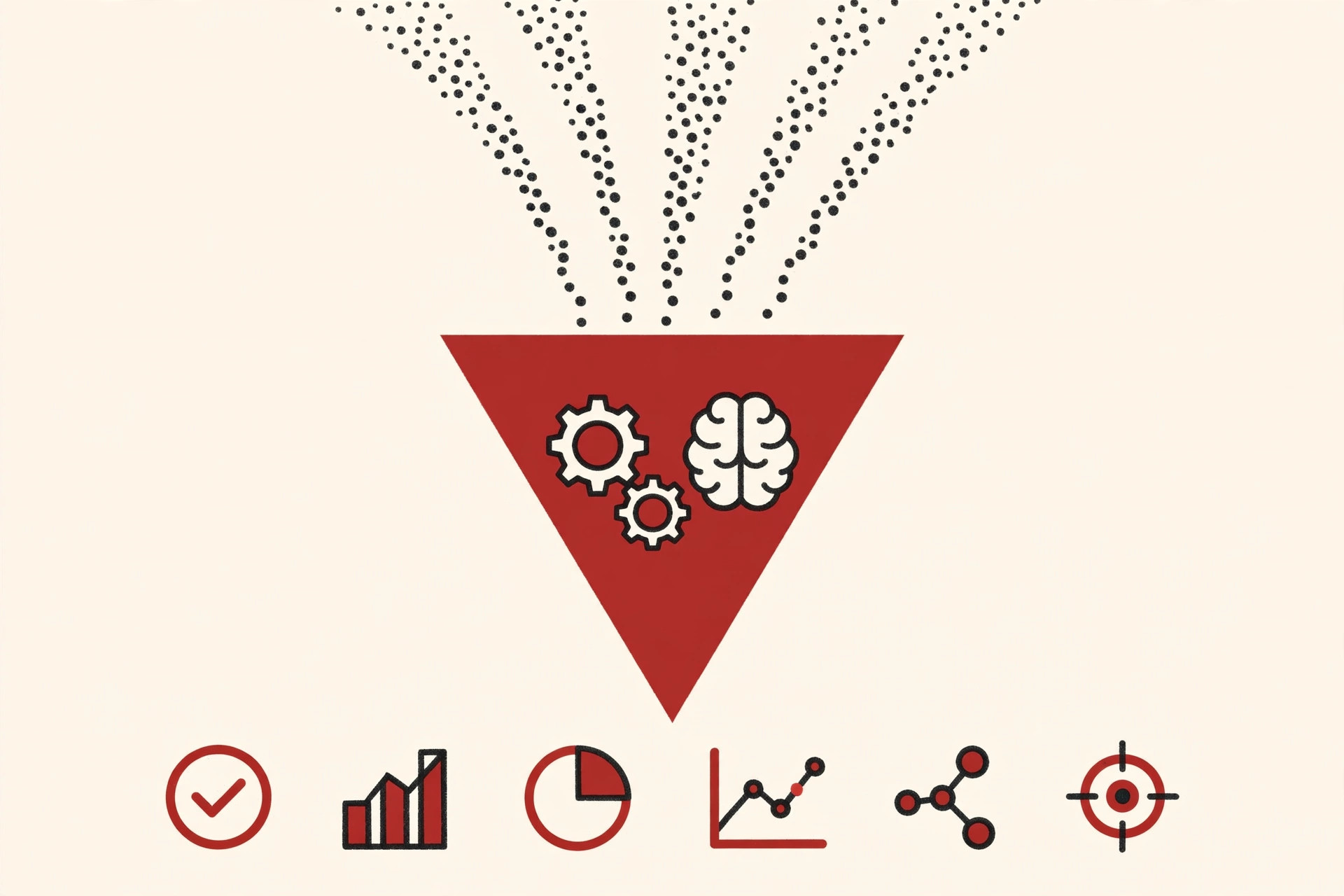
First, the model is fed data. That data might be photos, house prices, past sales, or millions of old emails. Each piece of data has details the model can study, like the size of a house, its city, and its age. Those details are called features, which is just a formal word for “facts the model is allowed to look at.”
Step 2: The Model Finds Patterns
Next, the model looks for connections. Do bigger houses cost more? Do spam emails use certain words more often? At first its guesses are terrible, but it checks each guess against the right answer, measures how wrong it was, and adjusts itself a little. Repeat that loop thousands or millions of times, and the guesses get very good.
Step 3: The Model Predicts New Answers
Once training ends, the model is ready for fresh data. Show it a house it has never seen, and it uses the patterns it learned to predict the price. This final step, making predictions on new data, is where the model earns its keep.
That is the whole idea. Everything else in this field, every tool and every headline, is built on top of those three steps.
The Model Training Process, Step by Step
Training is where a model is actually created. Teams follow a simple process, and knowing it helps you understand why some models work well and others fail.

- Collect the data. The team gathers examples related to the problem: past sales, labeled photos, old support tickets, anything relevant. More good data almost always beats a fancier method.
- Clean the data. Real data is messy. It has missing values, typos, and duplicates. The team fixes these problems, because a model happily learns from garbage and then produces garbage.
- Split the data. The examples are divided into two piles. The bigger pile is training data, used for learning. The smaller pile is test data, kept hidden until the end, like a final exam the model has not seen.
- Train the model. An algorithm studies the training data and builds the model, adjusting itself after every mistake.
- Test the model. The model takes its final exam on the hidden test data. If it still does well on data it has never seen, it has truly learned. If it only memorized the practice pile, it fails here, and that failure is valuable information.
- Tune and improve. The team adjusts settings, adds better data, or picks a different algorithm, then trains again. Most real projects repeat steps 4 to 6 several times.
- Put the model to work. The finished model is connected to a real product: an app, a website, or a business system. Good teams keep watching it afterward, because the world changes and old patterns slowly go stale.
If you want the technical version of these basics, Google Cloud’s introduction to machine learning walks through the same process with more depth.
Types of Machine Learning Models
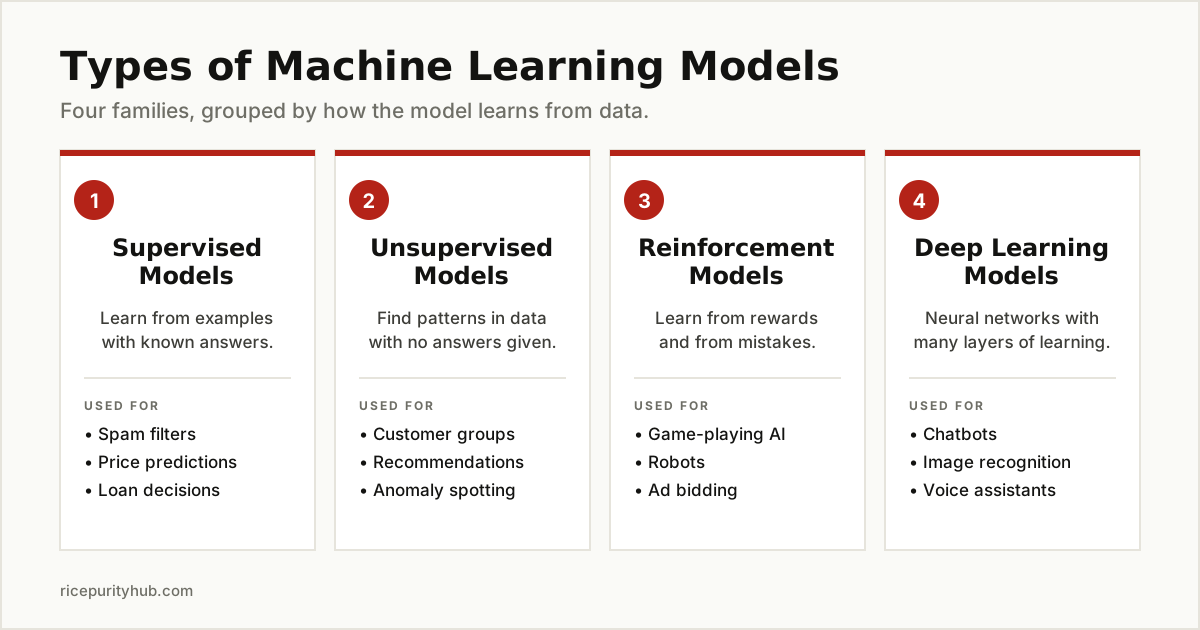
Models are usually grouped by how they learn. There are four families worth knowing, and almost every product you use runs on one of them.
Supervised Learning Models
Supervised learning models train on examples that come with the right answers attached, called labels. It is learning with a teacher and an answer key.
These models do two main jobs. Some predict a number, like a home price or tomorrow’s sales. Others sort things into groups, like spam versus normal email, or approved versus risky loans. Because they learn from clear answers, supervised learning models are the most common kind in business today, and the easiest to test for accuracy.
Unsupervised Learning Models
Unsupervised learning models get data with no answers at all. Their job is to find structure on their own: groups of similar customers, products that are often bought together, or transactions that look unusual.
Nobody tells these models what the groups should be. They are more like explorers than students, and they are often used first, to understand a pile of data before anyone tries to predict anything with it.
Reinforcement Learning Models
Reinforcement learning models learn by doing. The model tries an action, gets a reward when things go well and a penalty when they go badly, and slowly builds a winning strategy.
This trial and error style needs a huge amount of practice, so it shines in places where practice is cheap and safe: games, simulators, robot training, and systems that make millions of small decisions a day, like ad bidding.
Deep Learning Models
Deep learning models are built from neural networks, which are layers of simple math units loosely inspired by the human brain. Stack enough layers, feed them enormous amounts of data, and they become remarkable at images, speech, and language.
Our plain English guide to what a neural network is explains how those layers work. Deep learning powers tools that read and write text, which we cover in our natural language processing guide, and tools that understand photos and video, covered in our computer vision applications guide. If a product feels almost human, a deep learning model is probably behind it.
Machine Learning Models Cheat Sheet
Names can blur together, so here is the short version. These are the models you will hear about most often, what family they belong to, and the job each one is famous for.
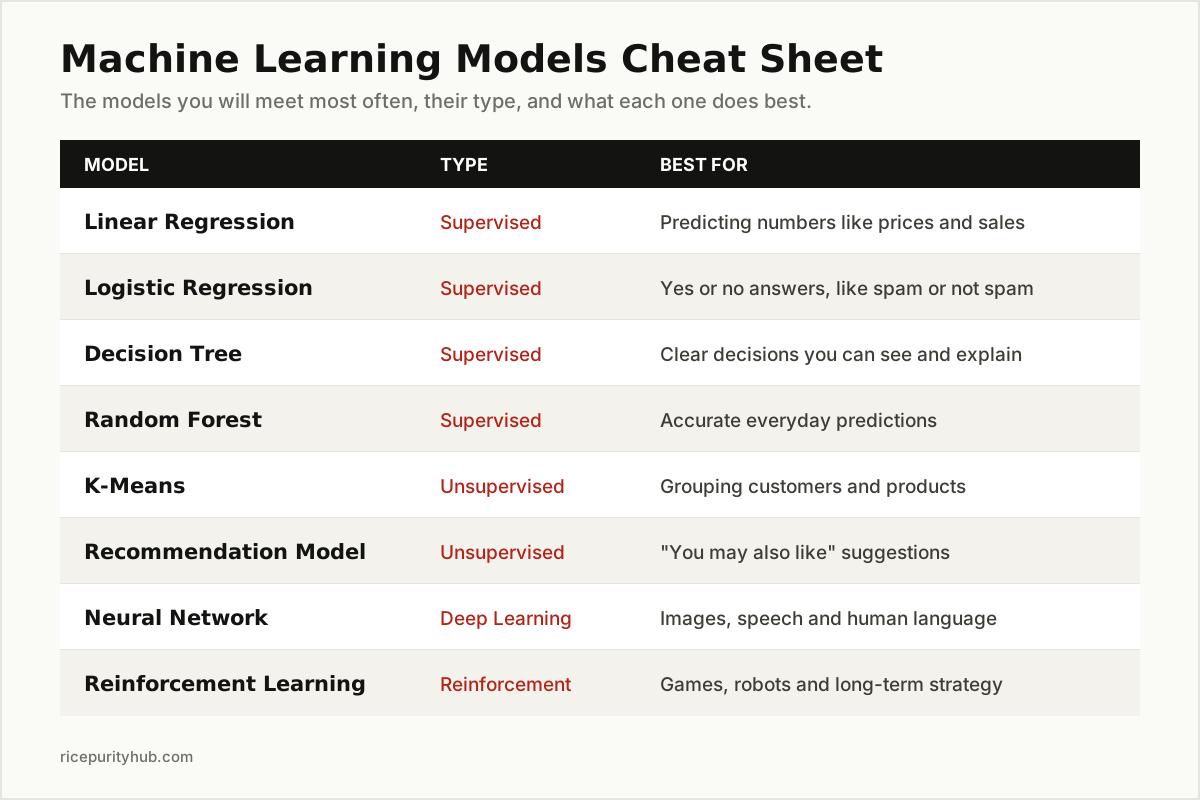
| Model | Type | Best For | Everyday Example |
|---|---|---|---|
| Linear Regression | Supervised | Predicting numbers | House price estimates |
| Logistic Regression | Supervised | Yes or no answers | Spam filters |
| Decision Tree | Supervised | Decisions you can explain | Loan approval checks |
| Random Forest | Supervised | Strong everyday accuracy | Fraud detection |
| K-Means | Unsupervised | Grouping similar items | Customer segments |
| Recommendation Model | Unsupervised | Suggesting what fits you | Netflix and Amazon picks |
| Neural Network | Deep Learning | Images, speech, language | Face unlock, voice assistants |
| Reinforcement Learning | Reinforcement | Strategy and control | Game AI, robot training |
Notice the pattern: simple models handle most everyday jobs, and the heavy deep learning models step in when the data is photos, sound, or language.
Machine Learning Model Examples in Real Life
If all of this still feels abstract, look at your phone. You probably used at least five different models before lunch today.

- Search results: When Google ranks pages for your question, models trained on billions of searches decide what you see first.
- Your streaming home screen: Netflix and YouTube use recommendation models that compare your history with millions of similar viewers.
- Face unlock: A deep learning model studied the shape of your face during setup, and now it recognizes you in a fraction of a second.
- Voice assistants: Siri and Alexa run speech models that turn your voice into text, and language models that turn that text into an answer.
- Bank safety alerts: Fraud models score every card payment as it happens. A payment that does not fit your normal pattern triggers that “was this you?” message.
- Weather apps: Forecast models study satellite images and decades of weather data to predict rain in your exact neighborhood.
- Photo libraries: Google Photos groups pictures by person, pet, and place, all without you tagging a single photo.
None of these were built with handwritten rules for every situation. Each one is a trained model doing the three steps from earlier: study examples, find patterns, predict.
How to Choose the Right Model
There is no single best model, only the best fit for your problem, your data, and your budget. Answer these four questions and the choice usually becomes clear.
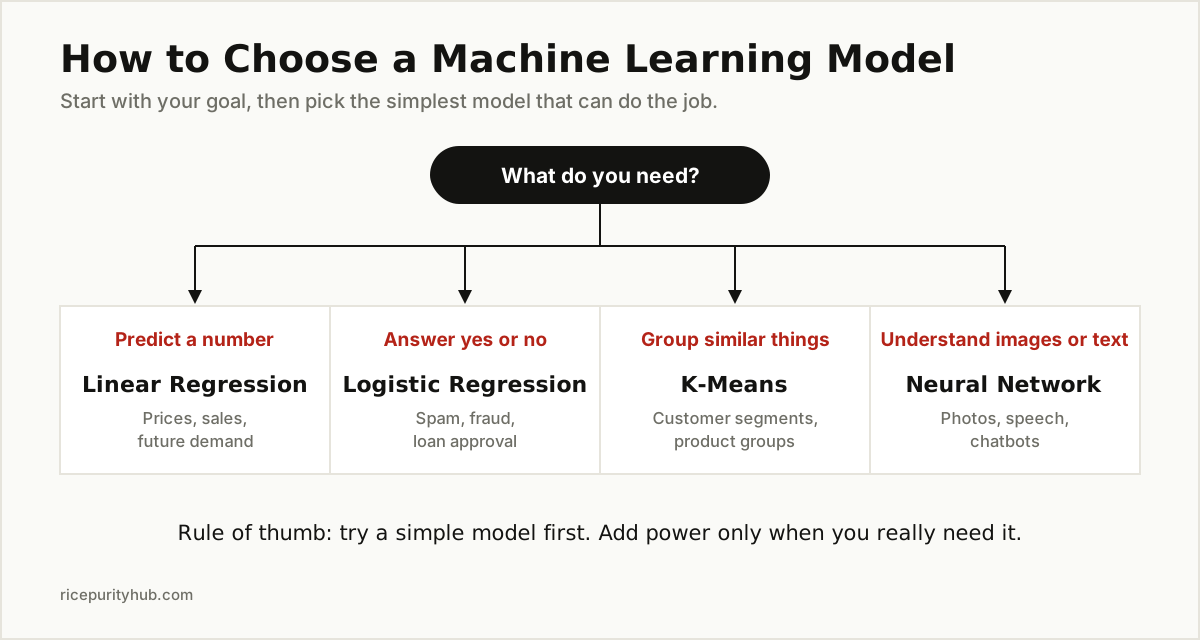
- What should the answer look like? A number points to regression models. A yes or no answer points to classification models, which is the formal name for sorting into groups. Finding groups points to clustering models. That one answer removes most of the list.
- Do you have labeled examples? If your data comes with right answers, supervised models are open to you, and they are the safest starting point. If not, begin with unsupervised models to explore and organize the data.
- How much data do you have? Small data sets reward simple models like linear regression and decision trees. Deep learning only earns its cost when you have very large amounts of data and the computing power to match.
- Do you need to explain the decision? A bank that must explain why a loan was refused needs a model it can show its work for, like a decision tree. A photo app does not, so it can use a neural network nobody can fully peek inside.
When in doubt, start simple, measure honestly on test data, and only move to a bigger model when the simple one is truly not good enough.
Common Mistakes Beginners Make With Models
A few traps catch almost every beginner. Knowing them in advance will save you real time.
- Training on too little data. A model that studied 50 examples has barely started learning. It will sound confident and be wrong often.
- Skipping the cleaning step. Wrong labels and messy rows teach the model the wrong lessons. Clean data beats a fancy algorithm almost every time.
- Memorizing instead of learning. If a model scores perfectly on training data but badly on test data, it memorized the practice exam instead of learning the subject. This problem is called overfitting, and the cure is more data, a simpler model, or both.
- Never checking the model again. Customer habits, prices, and language all drift over time. A model that was great last year can quietly go stale, which is why good teams keep testing and retraining.
The Bottom Line
Machine learning models are not magic, and they are not as mysterious as their names suggest. A model is simply a program that studied examples, found the patterns, and now makes predictions on new data. Pick the learning family that matches your problem, train honestly, test on data the model has never seen, and you understand the core of how modern AI products are built.
For the full technical picture, the machine learning article on Wikipedia is a solid next read. And if you are building your knowledge step by step, keep exploring our AI, ML and Data Science guides, where every topic gets the same plain English treatment as this one.