You use machine learning algorithms every single day, probably without noticing. They decide which emails land in your spam folder, which shows Netflix suggests tonight, and whether your bank calls you about a strange charge on your card.
But when most people search for machine learning algorithms, they run into pages full of math and hard words. This guide is different. Below, you will find every major algorithm explained in plain English: what it does, how it learns, and where you have already seen it in real life. No math degree needed.
What Is a Machine Learning Algorithm?
A machine learning algorithm is a set of steps a computer follows to learn patterns from data, instead of being told exact rules by a programmer.
Think of it like a recipe. A normal computer program is a recipe the cook must follow word for word. A machine learning algorithm is more like a young cook who tastes hundreds of dishes, studies what makes each one good, and slowly learns to cook well on his own.
Here is the simple difference:
- Normal software: a human writes fixed rules. “If the email contains the word ‘jackpot’, mark it as spam.”
- Machine learning: the computer studies thousands of old emails and figures out the rules by itself.
Companies like IBM describe machine learning as a branch of artificial intelligence that uses data and algorithms to copy the way humans learn, getting more accurate over time. That is exactly it: the more examples the algorithm sees, the better it gets.
The result of training an algorithm on your data is called a model. The algorithm is the learning method; the model is the trained result that makes real predictions. Keep that difference in mind, because people mix the two words up all the time.
The 3 Types of Machine Learning
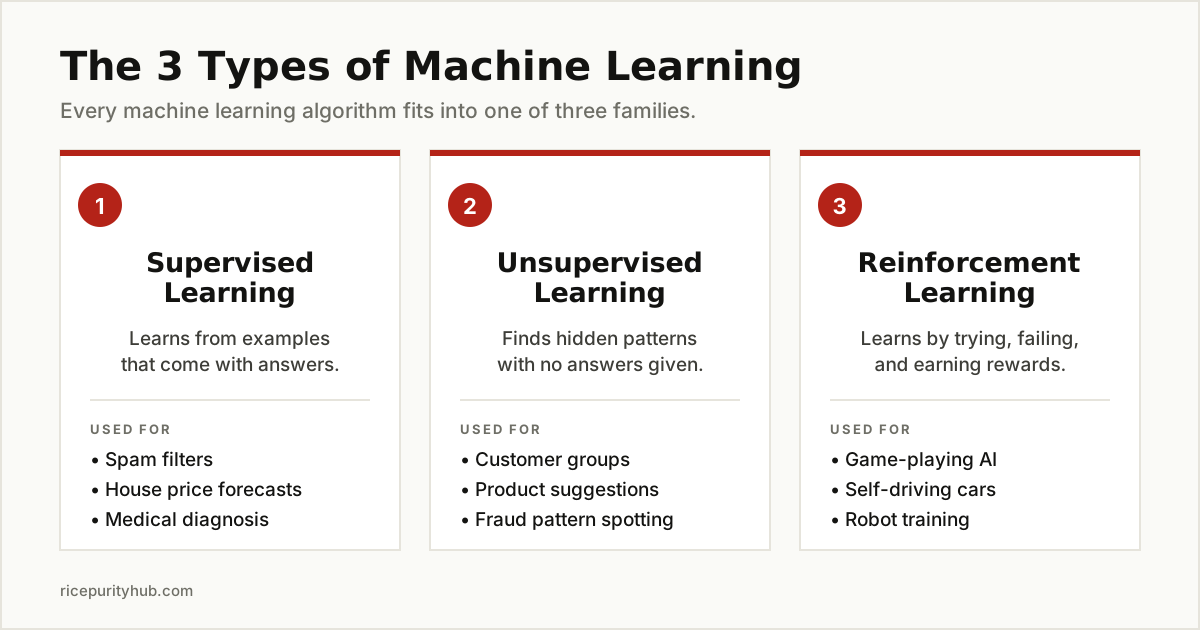
Almost every algorithm you will ever meet belongs to one of three families. The families differ in one simple way: how the computer learns.
Supervised Learning: Learning With an Answer Key
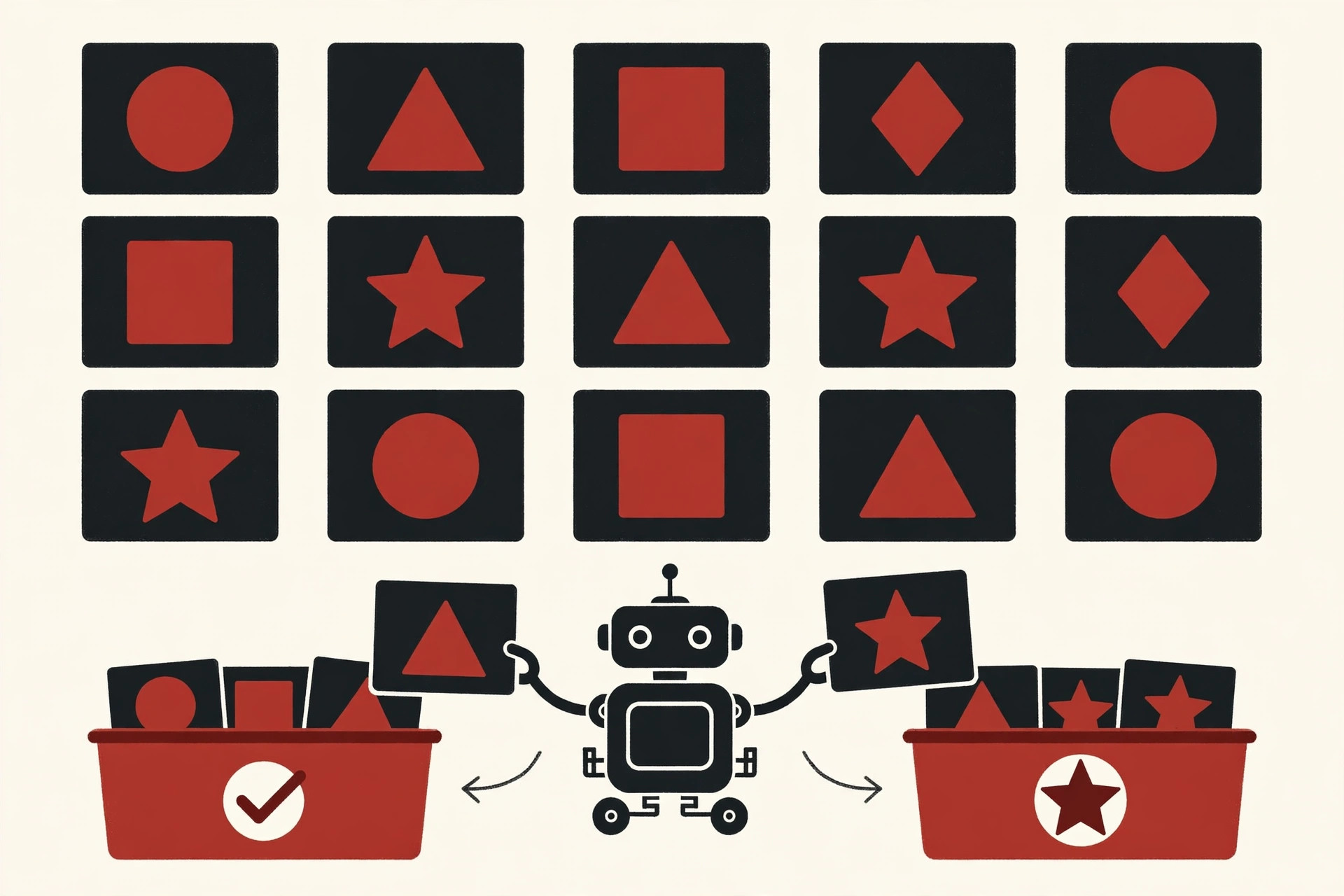
In supervised learning, the computer trains on examples that already have the right answers attached. It is like a student practicing with an answer key. After enough practice, the student can answer new questions alone.
Most of the famous machine learning algorithms are supervised, and they do two main jobs: predicting a number (like a house price) or sorting things into groups (like spam or not spam).
Unsupervised Learning: Finding Patterns Alone
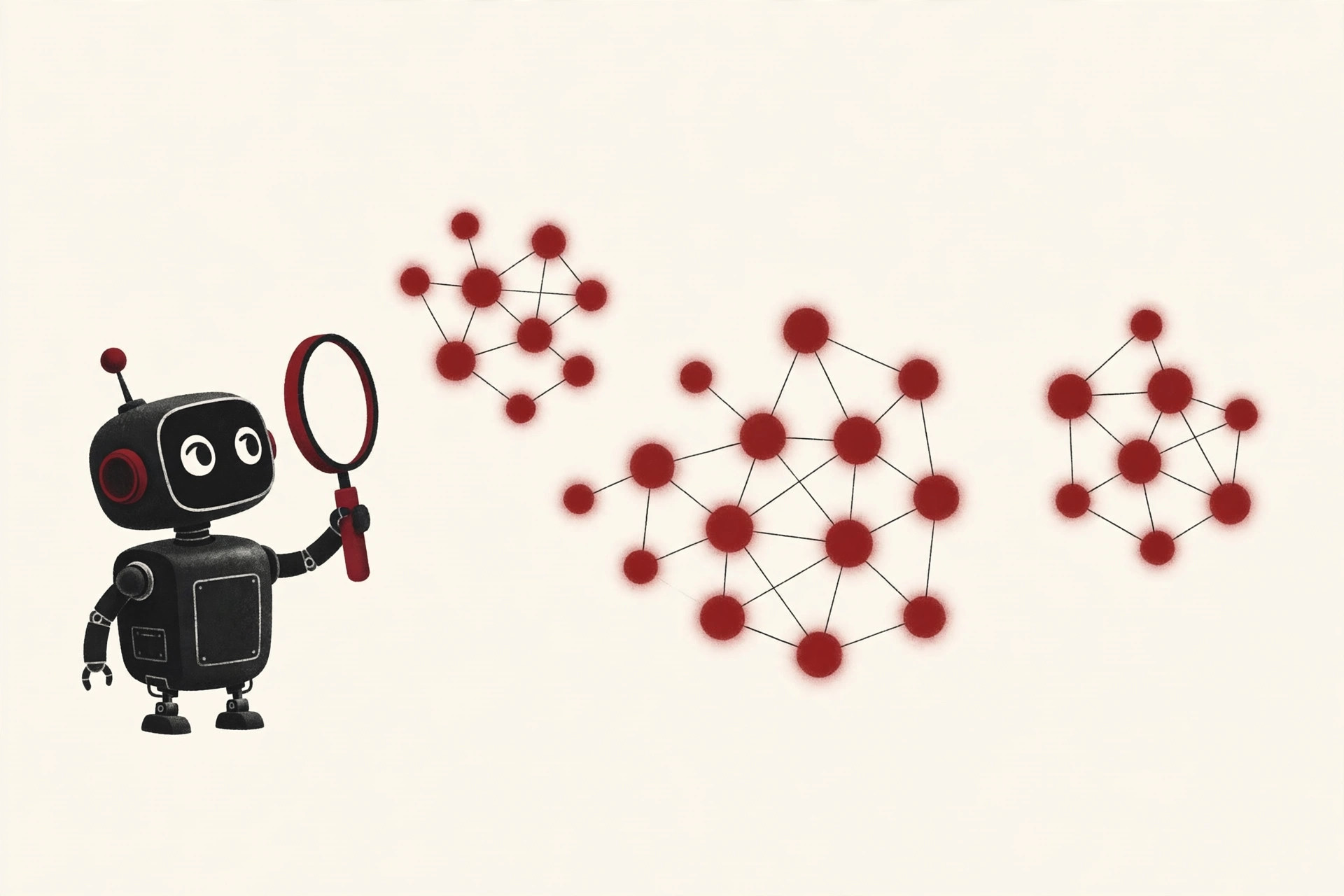
In unsupervised learning, nobody gives the computer any answers. It gets a pile of raw data and has to find structure in it by itself: grouping similar things together, or spotting what does not belong.
It is like handing someone a box of mixed photos and asking them to sort the photos into piles that make sense, without telling them what the piles should be.
Reinforcement Learning: Learning From Rewards
In reinforcement learning, the computer learns by trial and error. It tries an action, gets a reward when it does well and a penalty when it does badly, and slowly figures out the best strategy.
This is how computers learned to beat world champions at complex games, and how robots learn to walk. It needs far more practice than the other two types, but it can master problems that are too hard to teach with examples.
Now let us walk through the algorithms themselves, family by family.
Supervised Learning Algorithms (With Examples)
Supervised algorithms are the workhorses of machine learning. If a business says “we use AI” for an everyday prediction task, there is a good chance one of these eight is doing the work.
1. Linear Regression - Predicting Numbers
Linear regression is the simplest and oldest algorithm on this list, and the one most people learn first. It finds the pattern between things and uses it to predict a number.
Example: feed it the size, location, and age of hundreds of sold houses, along with their prices. It learns how much each factor adds to the price, then predicts the price of a new house it has never seen.
Use it for: house prices, sales forecasts, temperature guesses, and any “how much?” question.
2. Logistic Regression - Yes or No Answers
Do not let the name fool you. Logistic regression does not predict numbers. It predicts one of two answers: yes or no, spam or not spam, pass or fail.
It works by giving a score between 0 and 1 for how likely something is. If an email scores 0.93, it is 93% likely to be spam, so in it goes to the spam folder.
Use it for: spam filters, loan approvals, and “will this customer leave?” predictions.
3. Decision Trees - A Flowchart of Questions
A decision tree makes predictions the way you play twenty questions. It asks a series of simple yes-or-no questions such as “Is the amount over $500?” or “Was the purchase made at 3 a.m.?” Each answer leads to the next question, until it reaches a final decision.
Its biggest strength is honesty: you can draw the whole tree on paper and see exactly why it made any decision. Banks and hospitals love that.
Use it for: clear, explainable decisions in lending, hiring screens, and medical checklists.
4. Random Forest - A Vote of Many Trees
One decision tree can make mistakes. So a random forest builds hundreds of trees, each trained on a slightly different slice of the data, and lets them vote. The answer most trees agree on wins.
That voting makes random forests accurate and hard to fool, which is why they are a favorite for fraud detection and risk scoring. The trade-off: with hundreds of trees, it is much harder to explain one single decision.
Use it for: fraud checks, credit risk, and strong everyday predictions.
5. Support Vector Machines - Drawing the Best Line
A support vector machine (SVM) sorts things into groups by drawing the best possible line between them, the line that leaves the widest gap on both sides. A wider gap means new items are easier to sort correctly.
SVMs are older than the deep learning boom, but they are still excellent at sorting text and images, especially when your data set is not huge.
Use it for: sorting documents, handwriting recognition, and image sorting with limited data.
6. K-Nearest Neighbors - You Are Like Your Neighbors
K-nearest neighbors (KNN) has the most human logic on this list: to judge something new, look at the most similar things you already know, and go with what they say.
If five shoppers most similar to you all bought a jacket, KNN suggests the jacket to you. It is that simple. No training phase at all, just good memory and a smart way to measure “similar.”
Use it for: product and movie recommendations, and simple sorting tasks.
7. Naive Bayes - The Fast Text Sorter
Naive Bayes counts words and does the math on how often they appear in each group. The word “free” shows up far more in spam than in real email, so an email full of “free” is probably spam.
It is called “naive” because it treats every word as if it acts alone, which is not fully true. Yet it works surprisingly well, and it is extremely fast. Early spam filters were built on it, and it still handles huge amounts of text today.
Use it for: spam filtering, sorting news articles, and quick first drafts of any text-sorting system.
8. Gradient Boosting - The Team That Fixes Mistakes
Gradient boosting builds many small, weak decision trees one after another. Each new tree focuses on the mistakes the earlier trees made, like a team where every new member is hired to fix the previous members’ weak spots.
Popular versions named XGBoost and LightGBM have won more data competitions than almost anything else, and banks use them for serious prediction work. They need careful setup, but the accuracy is hard to beat.
Use it for: high-accuracy predictions in finance, insurance, and competitions.
Unsupervised Learning Algorithms
Unsupervised algorithms do not predict answers. They explore data and show you what is hiding in it, which is often the first step before any prediction makes sense.
9. K-Means Clustering - Finding Natural Groups
K-means clustering sorts data into groups (called clusters) based on how similar the items are. You tell it how many groups you want, and it keeps adjusting until each group is as tight and tidy as possible.
A clothing store might feed in customer data and get back clear groups nobody defined in advance, like “budget shoppers,” “brand lovers,” and “rare big spenders.” Marketing teams then talk to each group differently.
Use it for: customer segments, product grouping, and spotting unusual patterns.
10. PCA - Making Big Data Smaller
PCA (principal component analysis) has the scariest name on this list and one of the simplest ideas. When your data has hundreds of measurements per item, PCA squeezes it down to the few patterns that carry most of the meaning, and drops the rest.
It is like summarizing a 300-page book into 20 pages. You lose small details, but everything becomes faster and easier to see. Teams often use it to draw 2D pictures of data that really lives in 100 dimensions.
Use it for: speeding up slow models, cleaning noisy data, and visualizing complex data.
11. Association Rules - “People Also Bought”
Association rule learning looks for items that appear together. The classic result is the supermarket finding that people who buy bread often buy butter, so the store places them near each other.
Online, this is the engine behind “customers also bought” boxes. It does not predict the future so much as reveal habits that were already there, waiting to be noticed.
Use it for: shopping recommendations, bundle deals, and menu or playlist design.
Reinforcement Learning: Learning by Trial and Error
Reinforcement learning deserves its own moment, because it works nothing like the algorithms above. There is no data set of correct answers at all. Instead, an agent (the learner) takes actions in an environment, and the environment answers with rewards or penalties.
Over millions of tries, the agent builds a strategy. This is how DeepMind’s AlphaGo learned to beat the world champion at Go, a game with more possible positions than atoms in the observable universe, by playing itself millions of times. The same approach teaches robots to grip objects, manages cooling in data centers, and fine-tunes the AI assistants you chat with today.
The catch: it is slow and needs a safe place to fail millions of times, which is why it lives mostly in games, simulators, and very controlled systems, for now.
Deep Learning and Neural Networks
You will hear one more term everywhere: deep learning. Deep learning algorithms are built on neural networks, layers of simple math units loosely inspired by the human brain. Stack many layers (“deep”), feed in enormous amounts of data, and these networks become astonishingly good at images, speech, and language.
Face unlock on your phone, voice assistants, and the chatbots behind modern AI agents that can complete tasks on their own all run on neural networks. So does the search inside tools built on vector databases, which store meaning as numbers so computers can find “similar” ideas fast.
Deep learning is not always the right choice, though. It needs lots of data and computing power, and its decisions are hard to explain. For many everyday business problems, a random forest or gradient boosting model is cheaper, faster, and just as accurate. If you want a structured start, Google’s free Machine Learning Crash Course teaches the basics with hands-on exercises.
Machine Learning Algorithms Cheat Sheet
Here is the whole guide on one page. Save it, share it, or pin it above your desk.
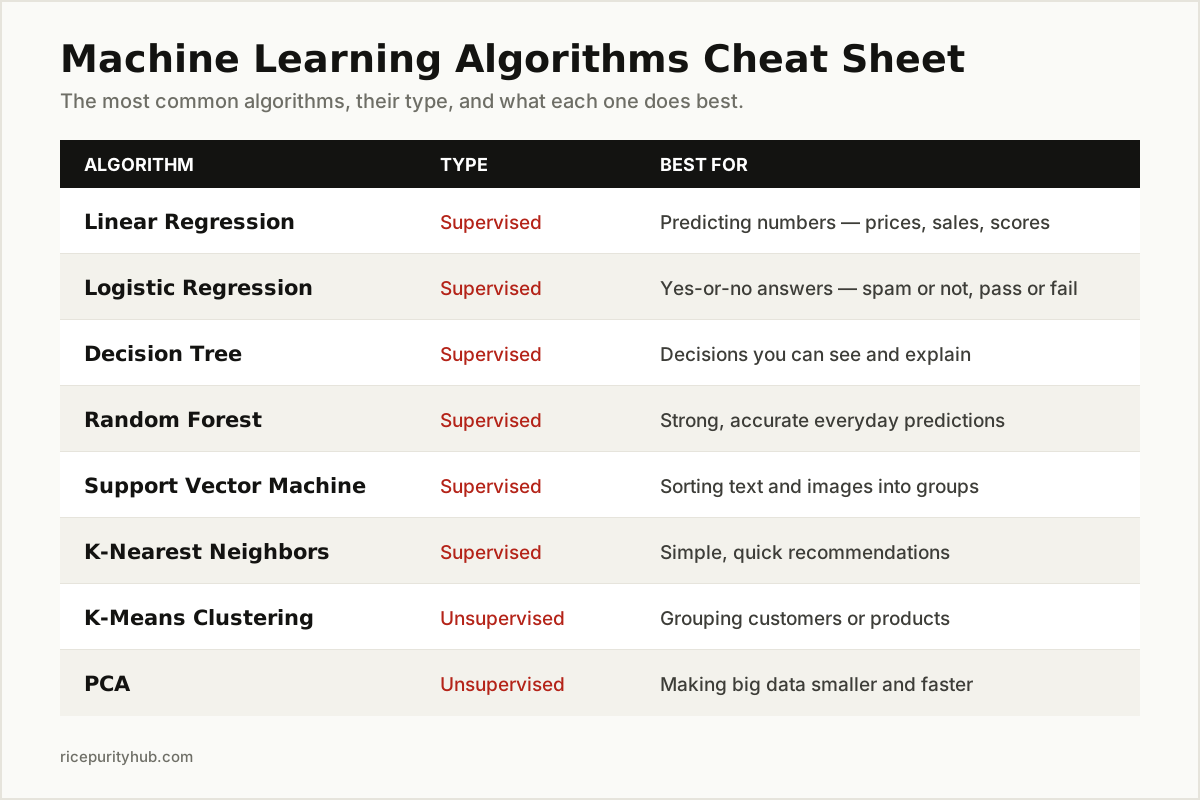
| Algorithm | Type | Best For |
|---|---|---|
| Linear Regression | Supervised | Predicting numbers like prices and sales |
| Logistic Regression | Supervised | Yes-or-no answers |
| Decision Tree | Supervised | Decisions you can explain |
| Random Forest | Supervised | Accurate everyday predictions |
| Support Vector Machine | Supervised | Sorting text and images |
| K-Nearest Neighbors | Supervised | Simple recommendations |
| Naive Bayes | Supervised | Fast text sorting and spam filters |
| Gradient Boosting | Supervised | Top accuracy in finance and contests |
| K-Means Clustering | Unsupervised | Grouping customers or products |
| PCA | Unsupervised | Shrinking big data |
| Association Rules | Unsupervised | “People also bought” patterns |
| Reinforcement Learning | Reinforcement | Games, robots, strategy |
How to Choose the Right Algorithm
Beginners often ask for “the best algorithm.” There isn’t one. There is only the best fit for your problem, your data, and your need to explain the result. Work through these four questions:
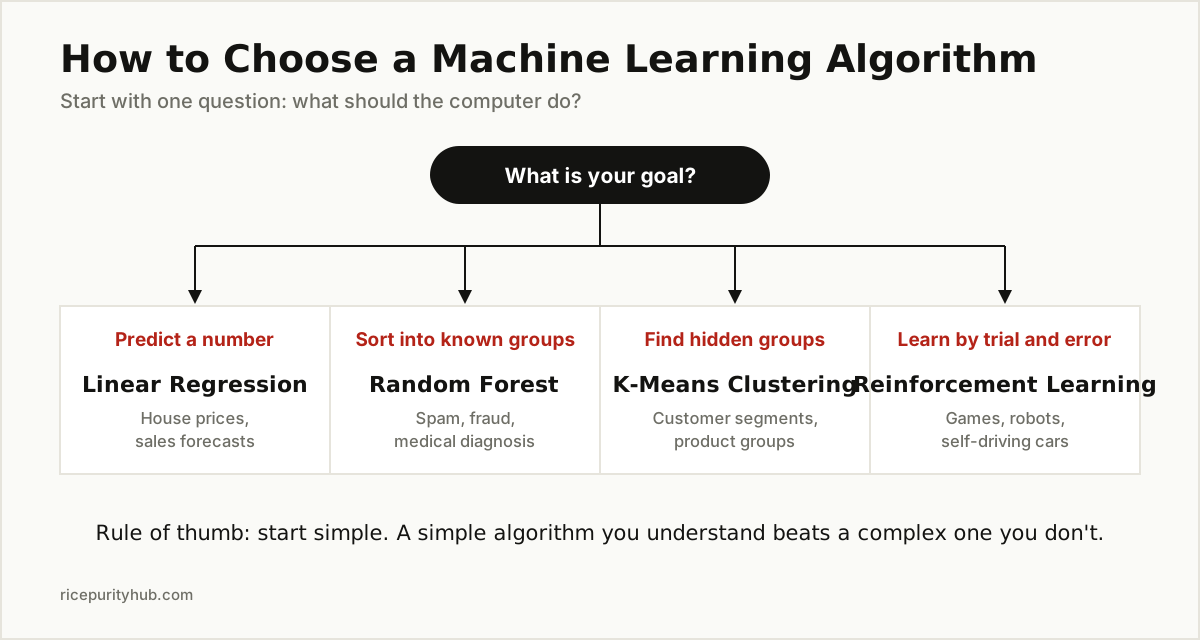
- What should the computer do? Predict a number, answer yes or no, sort into groups, find hidden groups, or learn a strategy? The answer cuts the list down fast.
- Do your examples have answers attached? If yes, you are in supervised land. If no, start with unsupervised methods to understand your data first.
- How much data do you have? Small data favors simple algorithms like logistic regression, KNN, or SVM. Deep learning only shines with very large data sets.
- Must you explain each decision? In health care and lending, the answer is often yes by law, which points you to decision trees and other clear models, a topic we also follow in our AI news and regulation coverage.
The makers of scikit-learn, the most popular machine learning library in Python, publish their own algorithm selection map that walks you through the same questions. And if you want to see what happens after a model is trained and put to work, our guide to agentic AI use cases in business shows these algorithms earning their keep in support, sales, and finance teams.
Real-World Examples You Use Every Day
Still sounds abstract? Here is the same technology, hiding in plain sight in your daily routine:

- Your inbox: Naive Bayes and logistic regression grew up fighting spam, and their modern versions still guard your email.
- Your Friday night: Netflix and Spotify blend clustering and nearest-neighbor logic to guess what you will enjoy next.
- Your bank card: Random forests and gradient boosting score every transaction in milliseconds, and flag the ones that do not look like you.
- Your photo library: Deep learning networks tag faces, pets, and places in Google Photos and Apple Photos automatically.
- Your shopping: Association rules build the “frequently bought together” box that adds one more item to your cart.
None of these systems were programmed rule by rule. Every one of them learned from examples, which is the entire point of machine learning.
The Bottom Line
Machine learning algorithms are not magic, and they are not as complicated as their names suggest. Each one is just a different strategy for learning from examples: regression draws trends, trees ask questions, forests vote, clustering finds groups, and reinforcement learning practices until it wins.
If you remember the three families, supervised, unsupervised, and reinforcement, and can name what each famous algorithm does in one plain sentence, you already understand this field better than most people who throw the terms around.
Keep going with our other AI, ML & Data Science guides, where we break down neural networks, natural language processing, and data science careers the same plain-English way.