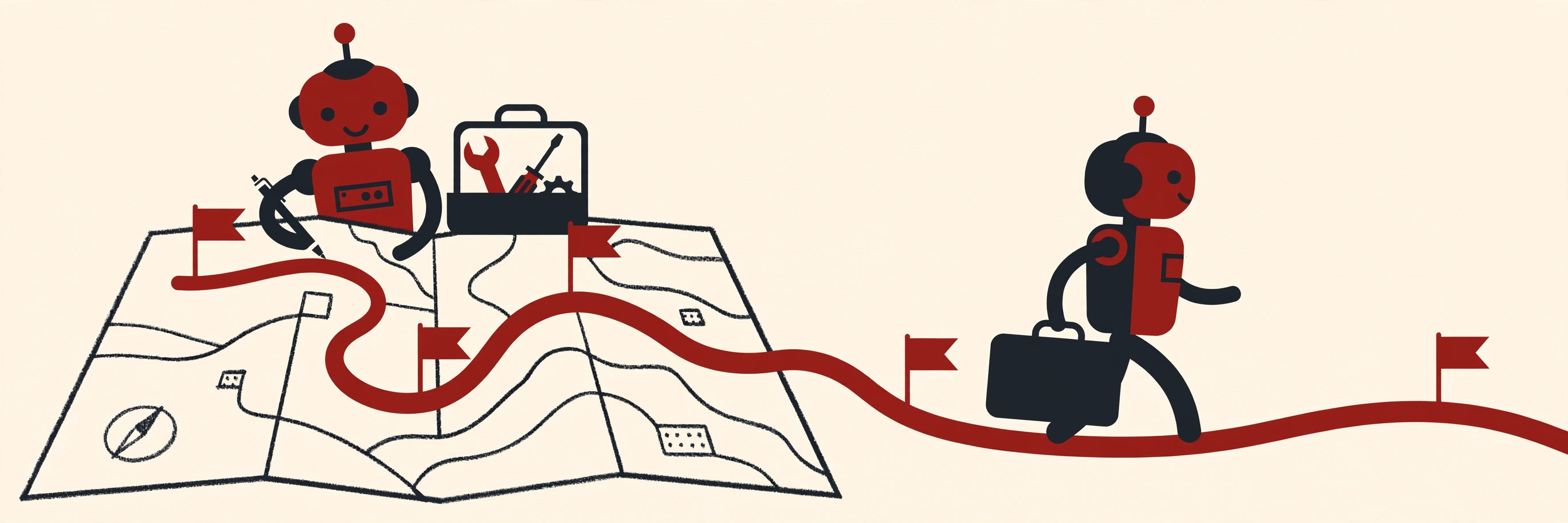
You have probably used a chatbot. You type a question, it types an answer, and then it sits there waiting for you. Agentic AI is the next step up from that. Instead of only answering, it goes off and does the job.
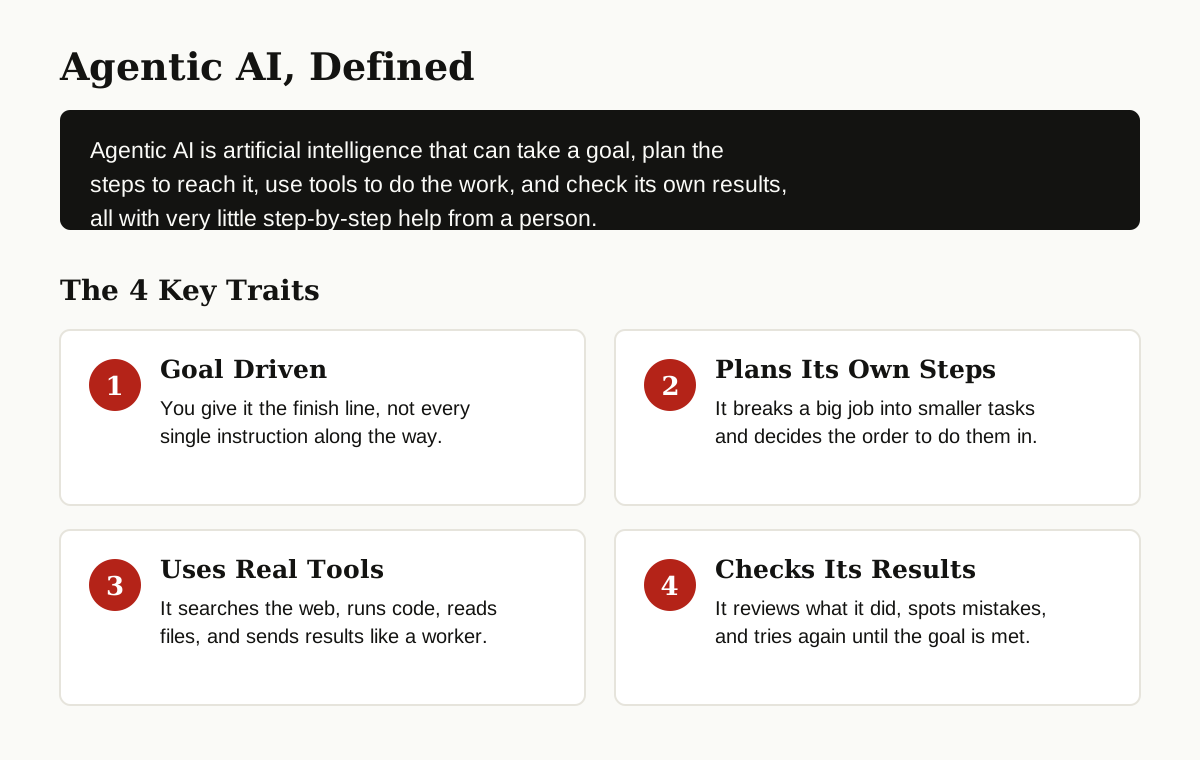
So, what is agentic AI? Here is the short version: agentic AI is artificial intelligence that can take a goal, plan the steps to reach it, use tools to do the work, and check its own results, all with very little step by step help from a person.
The agentic AI meaning clicks when you compare it to a good human assistant. You do not tell a good assistant which buttons to click. You say, “Sort out my trip to Chicago next month,” and they come back with flights, a hotel, and a plan that fits your calendar. Agentic AI is software that tries to work in exactly that way.

What Is an AI Agent?
An AI agent is the worker itself: the system that receives a goal and carries out the plan. When people ask what is an ai agent, the simplest answer is that it is AI with a job to finish, plus the tools to finish it.
Under the hood, most agents are built on a large language model, the same kind of AI that powers the chatbots you already know. The difference is everything wrapped around that model: a clear goal, a planner that breaks work into steps, a memory of what has already been tried, and access to tools such as web search, email, a calendar, or a code editor.
That is why the agentic ai definition matters more than the hype around it. Calling something “agentic” should mean it can act, not just chat. IBM’s guide to agentic AI makes the same point: these systems are built to act on their own in pursuit of a goal, making decisions along the way instead of waiting for instructions at every step.
A Simple Example: Booking a Trip, Start to Finish
Words like “goal” and “plan” can sound abstract, so let us watch an agent do one ordinary job. You give it one instruction:
“Get me to Denver for the conference on the 14th. Keep the whole trip under $600, and do not book a flight that leaves before 8 in the morning.”
Here is what happens next, without you lifting a finger:
- The agent reads your calendar and confirms which days you are actually free.
- It searches flights, compares prices and times, and throws out anything that breaks your rules.
- It finds hotels near the conference venue and checks which ones keep the trip under budget.
- It notices the cheapest flight lands too late for the first session, so it picks the next best option instead.
- It books the flight and hotel, adds both to your calendar, and sends you one neat summary.

Notice what you did not do. You did not open six browser tabs, compare prices yourself, or copy dates into a calendar by hand. You gave one goal, and the agent handled the chain of small jobs in between. That chain, handled on its own, is the entire point of agentic AI.
How Does Agentic AI Work?
Every agent, simple or advanced, runs on the same basic loop. Once you see the loop, the whole topic becomes much easier to understand. If someone asks you what is agentic AI and how it actually works, this loop is the honest answer.
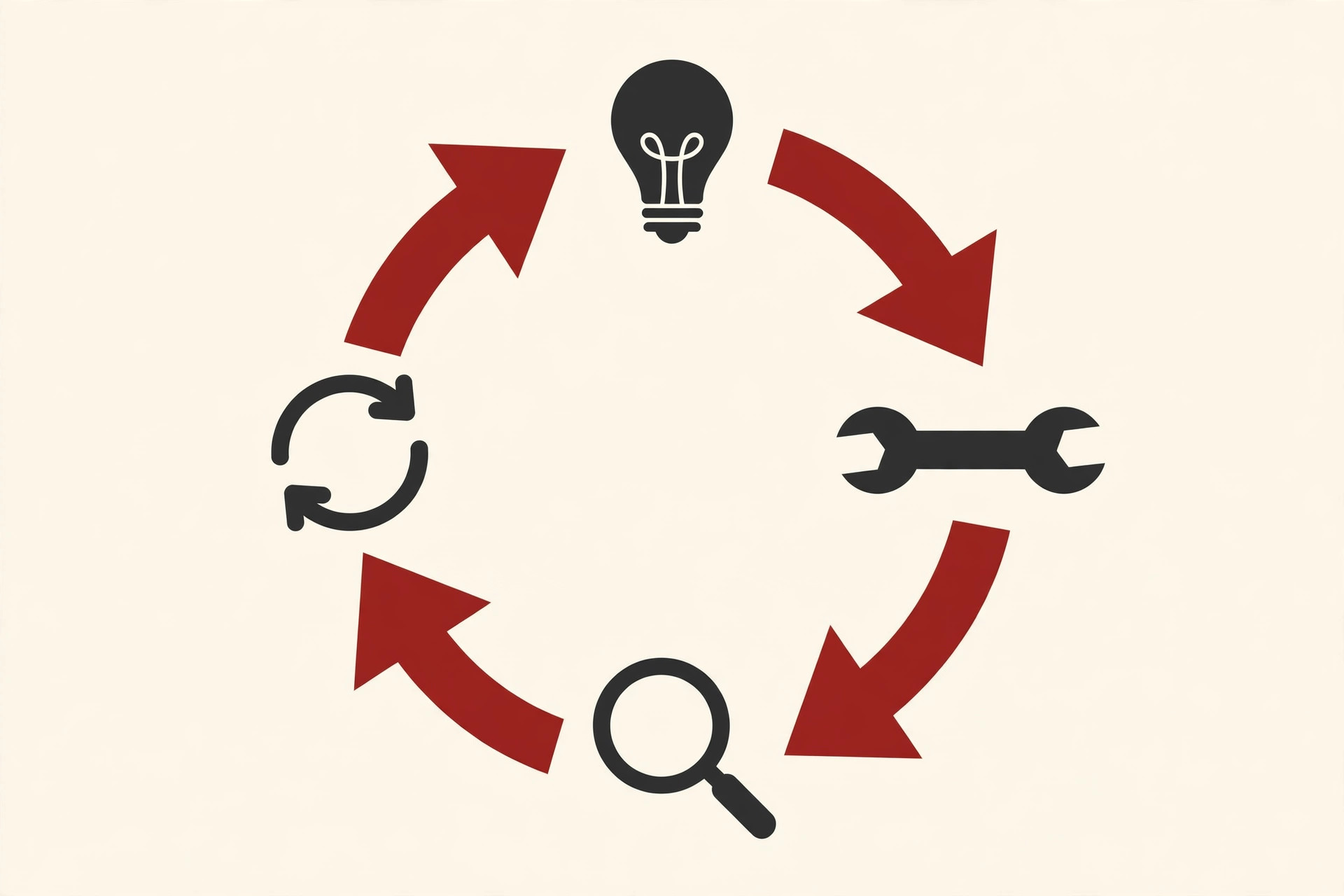
- Goal. You describe the outcome you want, in normal words. A clear goal matters, because the agent will make dozens of small decisions based on it.
- Plan. The agent breaks the goal into smaller steps and puts them in a sensible order, much like a person writing a to do list before starting a project.
- Tools. For each step, the agent picks a tool. Tools can be a search engine, a calculator, a database, or another app it is allowed to use. When software talks to other software like this, it usually does so through an API, which is simply a doorway built for that purpose.
- Act. The agent carries out the step: it runs the search, writes the code, sends the draft, or books the ticket.
- Check. The agent looks at what came back. Did it work? Does the result match the goal and the rules you set? This checking step is what separates an agent from a simple script.
- Loop. If something failed or looks wrong, the agent adjusts the plan and tries another way. If everything checks out, it moves to the next step, and the loop repeats until the goal is reached.
Google Cloud explains the same idea in its overview of what AI agents are: agents combine reasoning, planning, and tools so they can work toward a goal across many steps, rather than producing a single reply and stopping.
The Traits That Make AI Agentic
Plenty of products now wear the “agentic” label, so it helps to know what to look for. A system deserves the name when it has most of these four traits:
- It is goal driven. You hand over an outcome, not a script. The agent owns the details.
- It plans its own steps. It can break a big job into parts, order them, and change the plan when the situation changes.
- It uses real tools. It does not only produce text. It searches, calculates, reads files, calls apps, and creates finished work.
- It checks its results. It compares what happened against the goal, spots obvious mistakes, and retries instead of blindly moving on.
Memory supports all four traits. A good agent remembers what it already tried, what you approved before, and where it is in a long job, so it does not repeat itself or ask you the same question twice.
Agentic AI vs Chatbots vs Automation
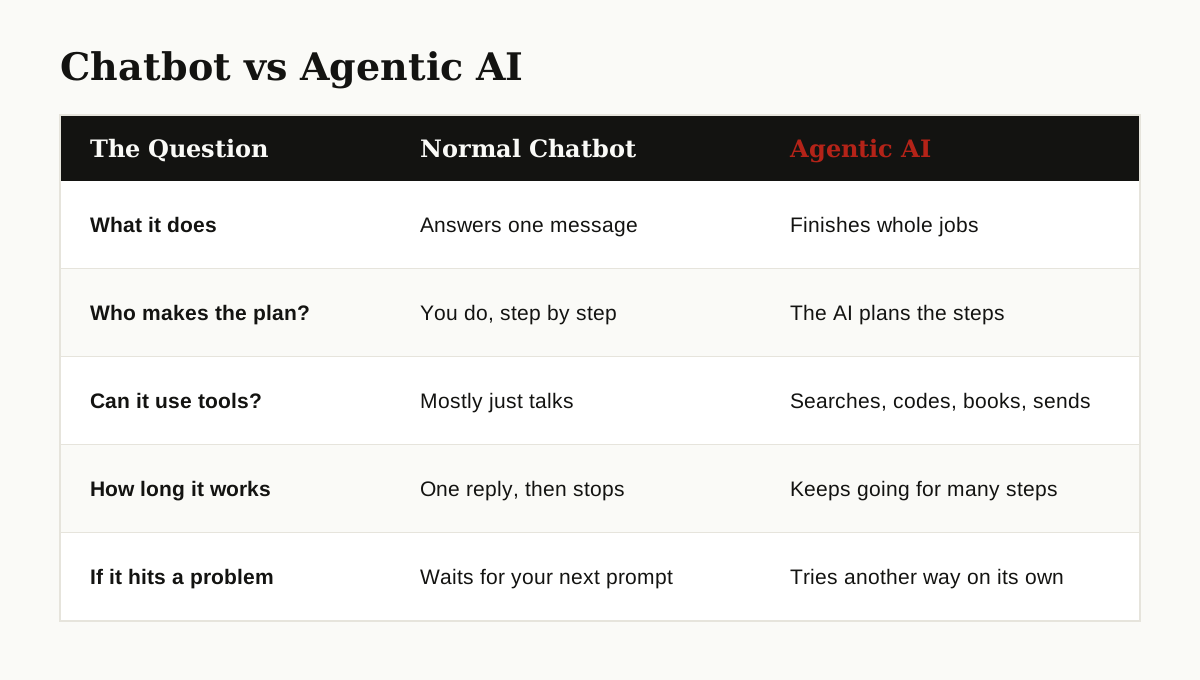
Three terms get mixed up constantly, so let us separate them once and for all. A chatbot talks. Automation follows fixed rules a person set up in advance. Agentic AI sits above both: it decides the steps itself, toward a goal you gave it.
| Normal Chatbot | Automation | Agentic AI | |
|---|---|---|---|
| What it does | Answers questions | Follows fixed rules | Plans and finishes tasks |
| Who decides the steps | You, one prompt at a time | A person, once, during setup | The AI, toward your goal |
| Can it use tools | Rarely, mostly just talks | Yes, but only as scripted | Yes, and it picks which ones |
| When something fails | Stops and waits for you | Breaks or quietly skips it | Tries another way |
| Simple example | “What is the capital of France?” | Auto-sort email into folders | “Research our rivals and draft the report” |
The idea itself is older than the current wave of products. Computer scientists have studied the intelligent agent for decades: a system that senses its surroundings and acts on them to reach a goal. Modern language models finally made that old idea practical for everyday tasks. For a closer look at how this differs from the AI that simply creates text and images, read our guide to agentic AI vs generative AI.
Real Agentic AI Examples You Can See Today
This is not science fiction. Agents are already working in ordinary jobs, usually inside tools you may have heard of. Here are the four places they show up most.

Coding Agents
A coding agent can take a bug report, search a large codebase to find the faulty part, write a fix, run the tests, and open the change for a human to review. If a test fails, it reads the error and tries again. Tools such as Devin built their whole product around this idea, and agent modes now live inside many popular editors. Our roundup of the best AI coding assistants shows how far these tools have come.
Research Agents
A research agent takes a question, searches many sources, reads the useful ones, and writes a summary with the key points organized. The better ones double-check facts across sources instead of trusting the first page they find. Many research agents are built on a pattern called agentic RAG, where the agent decides for itself what to look up next as it learns.
Customer Support Agents
Support agents read a customer message, look up the order, check the company policy, and either solve the problem or prepare everything a human needs to solve it fast. Companies set limits, for example allowing refunds only up to a set amount, so the agent can act freely on small things and escalate the big ones.
Personal Assistant Agents
These are the trip bookers and inbox sorters. They schedule meetings around two busy calendars, draft replies in your style for you to approve, and pull together a plan from scattered details. They are the closest thing most of us will have to the Denver example above, and they are arriving inside the email and calendar apps people already use.
Agentic AI Tools and Platforms People Actually Use
If you want to try or build an agent, the tools split into two groups. Developer frameworks give programmers full control, and ready-made platforms let business teams launch agents without writing much code.
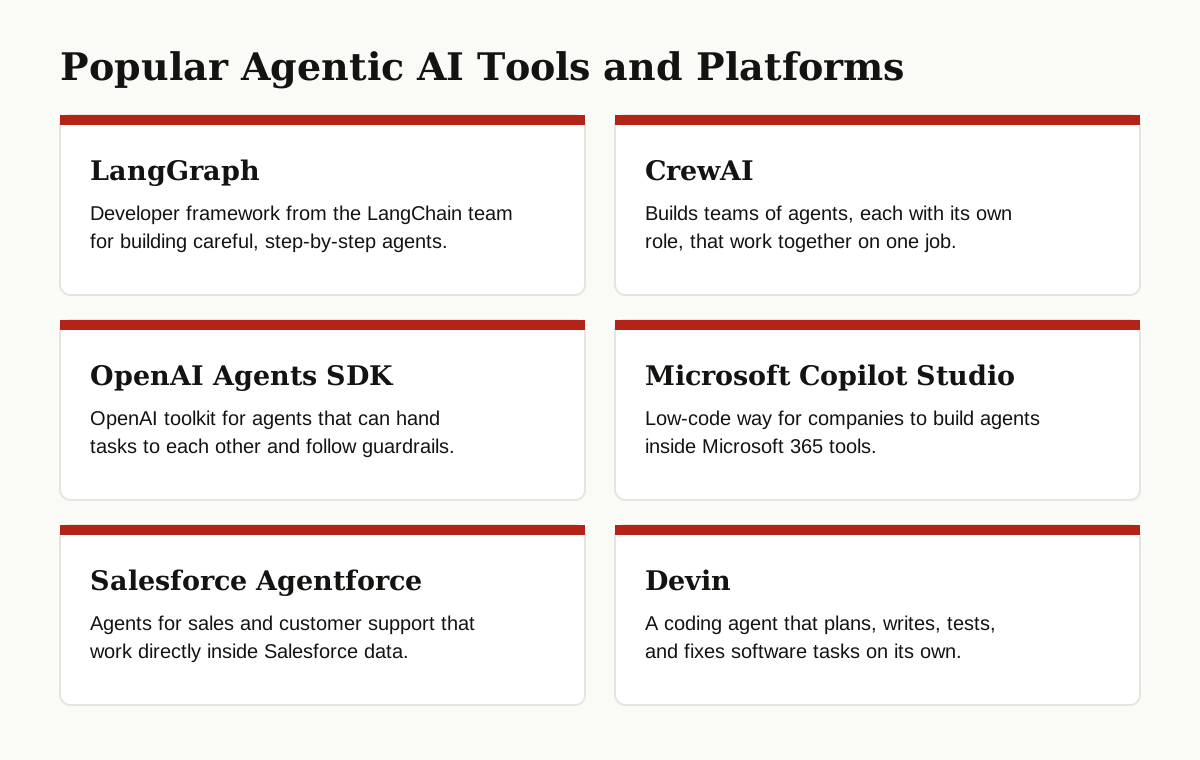
- LangGraph is a developer framework from the LangChain team, popular for agents that need careful, controlled steps.
- CrewAI lets developers build a small crew of agents, each with its own role, that divide a job between them.
- OpenAI Agents SDK is OpenAI’s toolkit for building agents that can hand tasks to each other and follow safety guardrails.
- Microsoft Copilot Studio is a low-code platform for building agents inside Microsoft 365, aimed at companies rather than coders.
- Salesforce Agentforce builds agents for sales and support that work directly with a company’s Salesforce data.
- Devin is a ready-made coding agent: you assign it a software task and it plans, codes, and tests on its own.
Whichever route you take, the quality of the instructions matters enormously. Because an agent follows a written goal through many steps, a vague goal produces vague work. That is why the skills covered in our guide to what is prompt engineering matter even more with agents than with chatbots.
The Benefits, in Plain Words
The appeal is easy to understand. Busywork is made of chains of small steps, and chains of small steps are exactly what agents are built to finish.
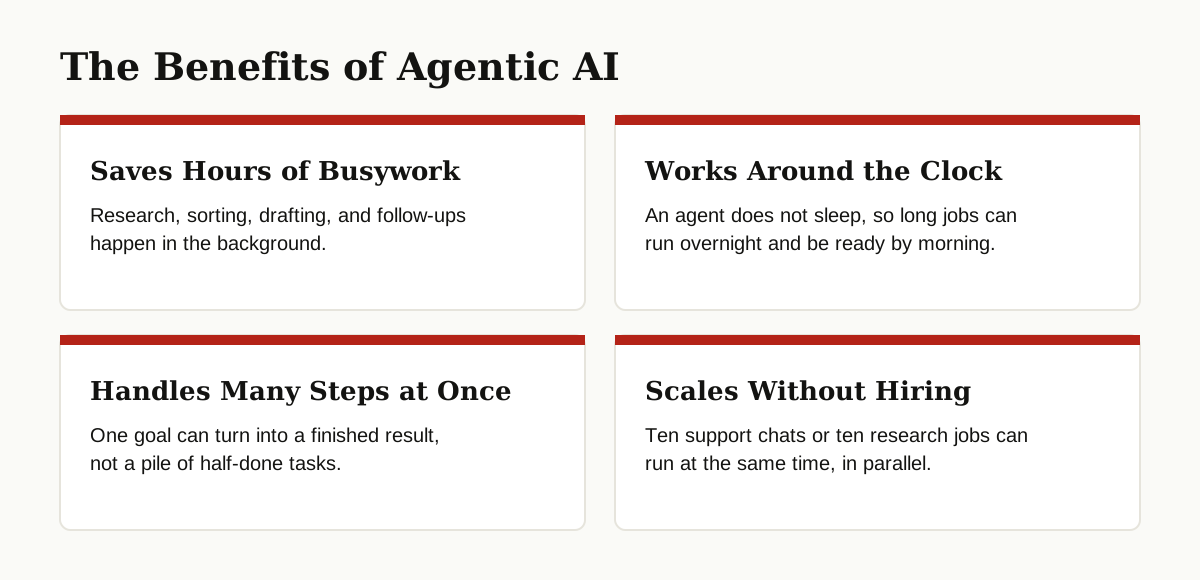
An agent can take research, sorting, drafting, and follow-up work off your plate and run it in the background. It does not sleep, so a long job started in the evening can be waiting, finished, when you sit down in the morning. And because one agent can run many copies of itself at once, a support team or a research desk can handle far more volume without the quality dropping at busy times.
The Honest Risks and Limits
Now the part the sales pages skip. Agentic AI is powerful precisely because it acts, and acting creates risks that a chatbot never had.
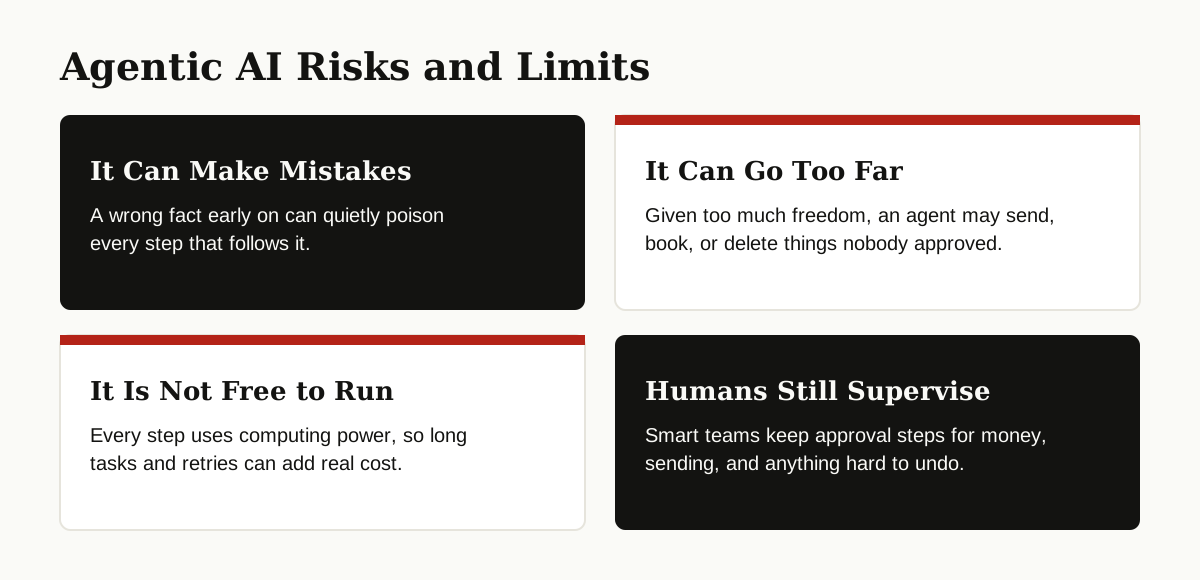
- Mistakes can compound. If an agent believes a wrong fact in step two, every step after that can be built on the error. A chatbot’s mistake ends with one bad answer; an agent’s mistake can end with a wrong booking or a bad report.
- Agents can go too far. Given wide freedom, an agent might send an email you would never have sent, book the non-refundable option, or delete files it judged unimportant. Freedom has to be earned with limits.
- Running agents costs money. Every step uses computing power, and a stuck agent retrying a failing step can quietly burn through a budget. Long jobs need spending caps.
- Instructions can hide in the data. An agent that reads web pages or emails can be tricked by harmful instructions planted inside them. Careful builders separate what the agent may read from what it may obey.
- Supervision is still the norm. Sensible teams keep a human approval step for anything involving money, sending, deleting, or publishing. The agent does the work; a person signs off on the parts that are hard to undo.
None of this means agents are a bad idea. It means the best setups treat them like keen new employees: real responsibility, clear limits, and a manager who checks the important work.
What Is Coming Next
The direction is clear, even if the timeline is fuzzy. Agents are getting better at checking their own work, which is the weakest link today. Teams of specialized agents that divide a project between them are moving from demos into real products. And agents are quietly appearing inside tools people already use, in email, spreadsheets, and support desks, rather than only in shiny new apps.
Expect the human role to shift, not vanish. People will spend less time doing each step and more time setting goals, setting limits, and judging the finished work. Knowing what is agentic AI, and where its limits sit, is quickly becoming a basic work skill.
The Bottom Line
What is agentic AI, in the end? It is AI that works toward a goal on its own: it plans the steps, uses tools, checks its results, and loops until the job is done. That is the whole agentic ai definition, and it is a genuine shift from chatbots that only talk.
The technology is real, useful, and already at work in coding, research, support, and scheduling. It is also young, and it earns trust slowly, one well-checked job at a time. Start with low-risk tasks, keep approval steps where they matter, and you will get the benefits without the nasty surprises.
Keep exploring with our other Generative AI and Agentic AI guides, where we explain the rest of this fast-moving field in the same plain English.