
Regular AI chatbots have one big weakness: they answer from memory, and memory can be wrong. RAG was invented to fix that, by letting the AI look things up in your documents before it answers.
Agentic RAG is the next step. It takes that same look-it-up idea and adds a brain on top: a system that plans, searches more than once, and checks its own work before it replies to you.
This guide explains both ideas in plain words: a quick recap of regular RAG first, then what the agentic version adds, how it works step by step, and when the extra effort is worth it.
Regular RAG in Plain Words (A Quick Recap)
RAG stands for retrieval augmented generation. It sounds technical, but the idea is simple enough to explain in one sentence: before the AI writes an answer, it first looks up useful text in your documents, then writes the answer using what it found.
Think of it as an open book exam. A normal chatbot takes the exam from memory. A RAG system takes the exam with the textbook open on the desk.
Here is how a regular RAG system handles a question:
- You ask a question. For example: “What is our refund window for damaged items?”
- The system searches your documents. Your files are stored in a special database that finds text by meaning, not just by matching words. (We explain that database below.)
- The best matching pieces go to the AI. Usually the top few paragraphs.
- The AI writes an answer using those pieces, often with a link to the source.
The search trick behind step 2 is worth a quick note. Your documents are cut into small pieces called chunks, and each chunk is turned into a list of numbers called an embedding. The numbers capture the meaning of the text, so a search for “money back” can find a paragraph that only says “refund policy.” The chunks and their numbers live in a vector database (a database built for meaning based search). This whole area sits inside natural language processing, the field that teaches computers to work with human language.
First described by researchers in 2020 and now covered in depth on the Wikipedia page for retrieval augmented generation, RAG made AI answers far more trustworthy. But regular RAG has a real limit: it searches once. If the first search grabs the wrong paragraphs, or the question needs facts from three different documents, the answer comes out thin, mixed up, or quietly wrong.
That limit is exactly what agentic RAG was built to remove.

What Agentic RAG Adds
The word “agentic” means the system is run by an agent. An agent is an AI program that does not just reply once. It decides what to do next, step by step, until a job is done. If you want the bigger picture first, our guide on what agentic AI is explains agents from the ground up.
So, what is agentic RAG, exactly? It is RAG with an agent in charge of the searching. Instead of one fixed search, the agent treats your question like a small research project. IBM describes agentic RAG as RAG combined with AI agents that can plan, pick tools, and keep working until the answer is solid. Four abilities make the difference.
Planning
The agent reads your question and breaks it into smaller tasks before searching anything. “Why did sales drop in March, and which product hurt most?” becomes two or three sub questions, each with its own search. Regular RAG never does this; it takes the question as one blob.
Routing
Routing means sending each part of the question to the right place. One part might belong in the product manual, another in the sales spreadsheet, another on the live web. The agent picks the right source and the right tool for each part, instead of throwing every question at the same document pile.
Multi Step Search
The agent can search, read the results, and search again with better words. If the first round finds the refund policy but not the exceptions list, it goes back for the exceptions. Each round is informed by what the last round found, just like a person digging through a filing cabinet.
Self Checking
Before answering, the agent grades its own findings. Does this paragraph actually support the claim? Is anything missing or out of date? Do two documents disagree? If the check fails, it searches again or says honestly that the documents do not cover the question, instead of inventing an answer. Making things up has a name, hallucination, and self checking is one of the best defenses against it.
Some systems even use a small team of rag agents: one searches, one checks facts, one writes the final answer.

How Agentic RAG Works, Step by Step
Here is the full journey of one question through an agentic RAG system.
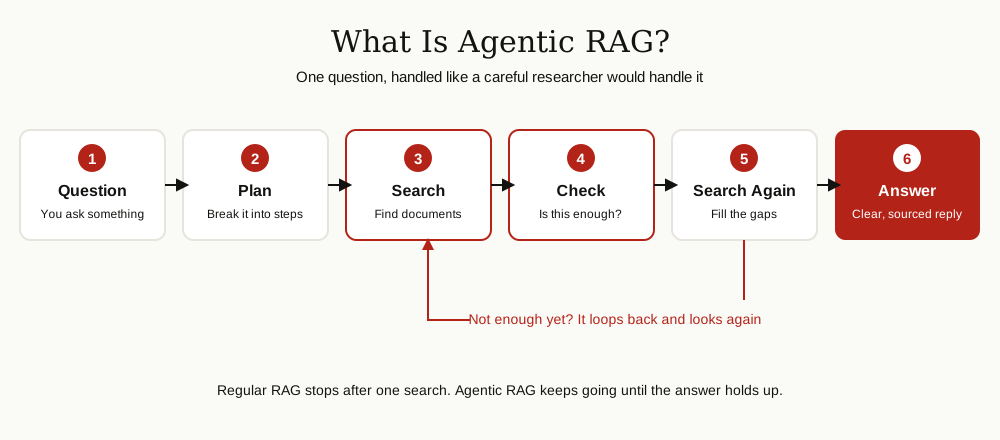
- The question arrives. You type a question in normal words.
- The agent makes a plan. It splits the question into parts and decides what evidence a good answer needs.
- The first search runs. The agent searches the vector database, and sometimes other tools too, like a web search or a company app.
- The agent checks the results. It reads the pieces and asks: is this enough? Is it current? Does it actually answer the question?
- It searches again if needed. Missing facts trigger new searches with sharper wording. Wrong turns get dropped.
- It may repeat the loop. Complex questions can take several rounds. Simple ones finish in one.
- The answer is written. The AI writes the reply from the checked evidence, usually with sources named so you can verify it yourself.
The loop in steps 4 to 6 is the heart of agentic rag architecture. Everything else is plumbing around it.
The Architecture in Plain Words
Architecture is just the map of parts and how they connect. An agentic RAG setup has six parts you should know.
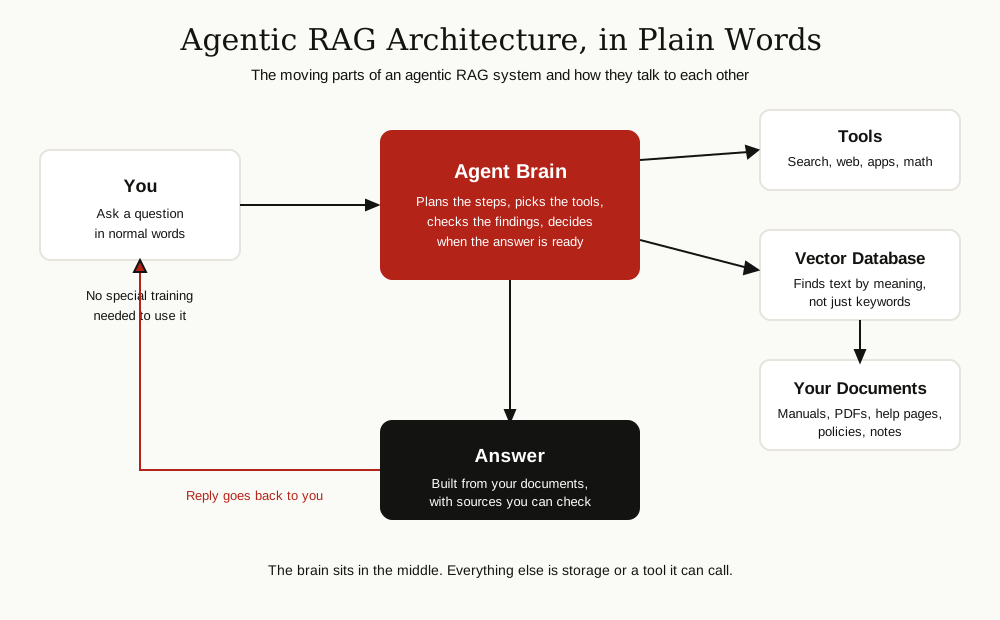
- You. You ask the question and read the final answer. No special skills needed.
- The agent brain. A large language model (an LLM, the same kind of AI behind chatbots) that plans, decides and writes. It is the manager of the system.
- Tools. Extra abilities the brain can call: document search, web search, a calculator, or your company software.
- The vector database. The meaning based index of your documents. It is what the search tool actually searches.
- Your documents. The raw material: manuals, help pages, policies, tickets, PDFs, notes.
- The answer. The final reply, built from checked evidence and naming its sources.
Notice the shape: the brain sits in the middle, and everything else is either storage or a tool it can call. When people talk about agentic rag architecture 2026 style, they mostly mean this same shape, with better models and checking tools than a year ago.
Agentic RAG vs Regular RAG
Time to put the two side by side. This rag vs agentic ai comparison is the fastest way to feel the difference.
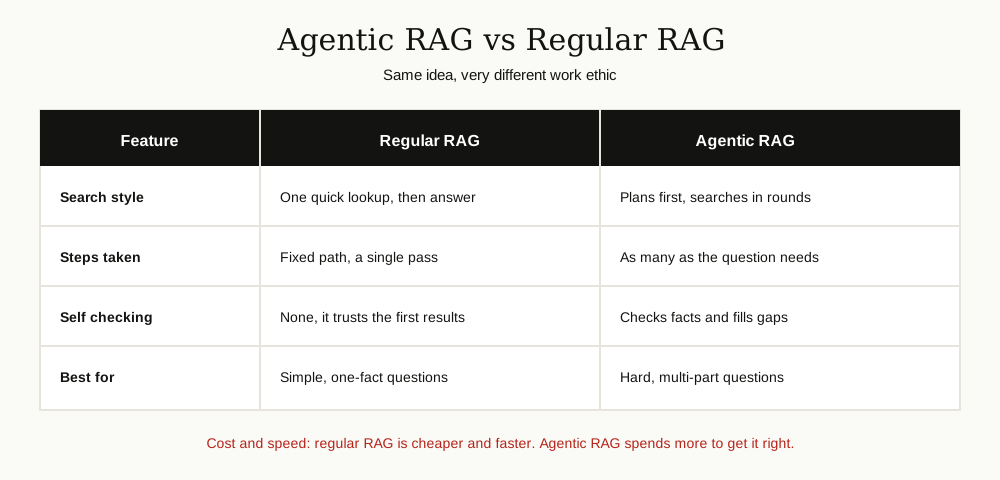
| Feature | Regular RAG | Agentic RAG |
|---|---|---|
| Search style | One lookup, then answer | Plans first, searches in rounds |
| Steps taken | Fixed path, a single pass | As many as the question needs |
| Self checking | None, trusts the first results | Checks facts and fills gaps |
| Tools used | Document search only | Search, web, apps, calculators |
| Best for | Simple, one fact questions | Hard, multi part questions |
| Cost and speed | Cheaper and faster | Slower, costs more per answer |
Neither one wins everywhere. Regular RAG is a good librarian who grabs the first book that matches. Agentic RAG is a researcher who keeps digging until the answer holds up. The researcher is better, but slower and pricier.
A Worked Example: One Question, Three Documents
Let us watch both systems handle a real support question: “My router keeps dropping Wi-Fi since the last update. Can I fix it myself, and if not, can I still return it?”

Regular RAG searches once. The closest match is the troubleshooting guide, so the answer covers restarting the router and changing the Wi-Fi channel. Useful, but it never mentions the update, and it ignores the return question completely.
Agentic RAG plans first. It spots three parts: the dropping problem, the update connection, and the return rights. Then it works the plan:
- Search one finds the troubleshooting guide: restart steps and channel settings.
- Search two finds the release notes for the latest firmware (the software inside the router), which admit a known Wi-Fi bug and name the fix version.
- Search three finds the return policy: 60 days for faulty items, receipt needed.
- The self check confirms all three parts are covered and the dates agree.
The final answer walks the customer through the fix, explains the update caused the issue, and states the return window with the policy linked. One question, three documents, zero guessing. That is the real world payoff of agentic RAG.
When to Use It, and When Regular RAG Is Enough
Honesty matters here, because agentic systems are fashionable and vendors oversell them.
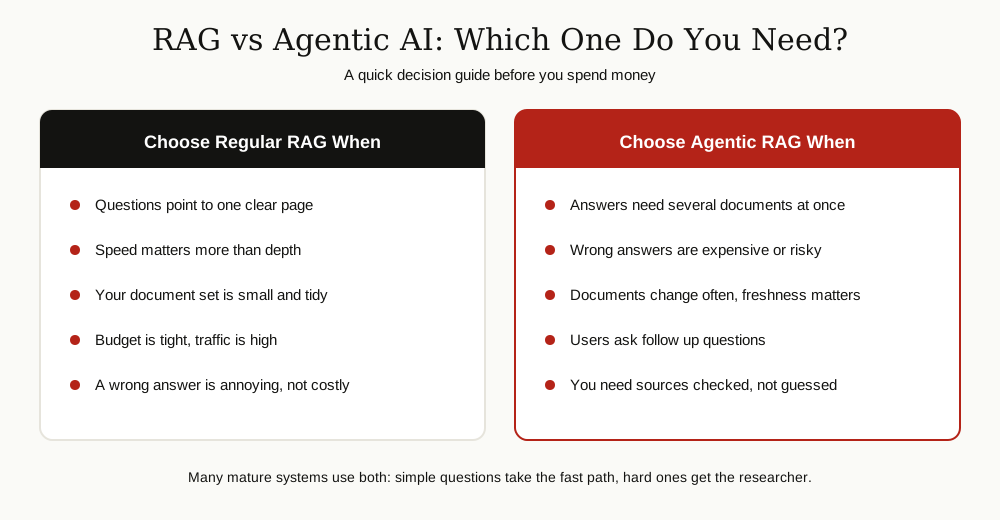
Agentic RAG earns its cost when:
- Questions regularly need facts from several documents at once.
- Wrong answers are expensive, like legal, medical, finance or safety topics.
- Your documents change often, so checking freshness matters.
- Users ask follow up questions that build on earlier answers.
Regular RAG is enough when:
- Most questions are simple and point to one clear page, like opening hours or a price.
- Speed matters more than depth, for example a busy help widget.
- Your document set is small and tidy.
Two honest warnings. First, cost: every extra search round uses more model calls, so an agentic answer can cost several times more than a regular one, and it takes longer to arrive. Second, control: an agent that can loop can also loop badly, repeating searches or drifting off topic. Good systems set a step limit. Knowing where the line sits between a helpful agent and a fancy chatbot is a theme we return to in agentic AI vs generative AI.
Tools and Frameworks People Use
You do not build this from zero. Most teams use a framework (a ready made toolkit) plus a vector database.
- LangChain. The most popular framework for chaining model calls and building agents. Its official RAG tutorial walks through a working question answering system, and its agent tools add the planning and checking loop on top.
- LlamaIndex. A framework focused on the data side: loading documents, chunking them well, and connecting them to models.
- Vector databases. Names you will see include Pinecone, Weaviate, Chroma and pgvector. They all do the same core job: store embeddings and find the closest matches fast.
- Managed platforms. The big cloud providers and many support tools now ship agent features built in, so smaller teams can start without hiring specialists.
Whichever stack you pick, the design stays the same: documents in a vector database, an agent brain on top, tools at its side, and a checking habit in the middle.
Best Practices for Building RAG Agents with LLMs
If you are building rag agents with llms yourself, these habits separate the systems that work from the ones that demo well and fail in real life.
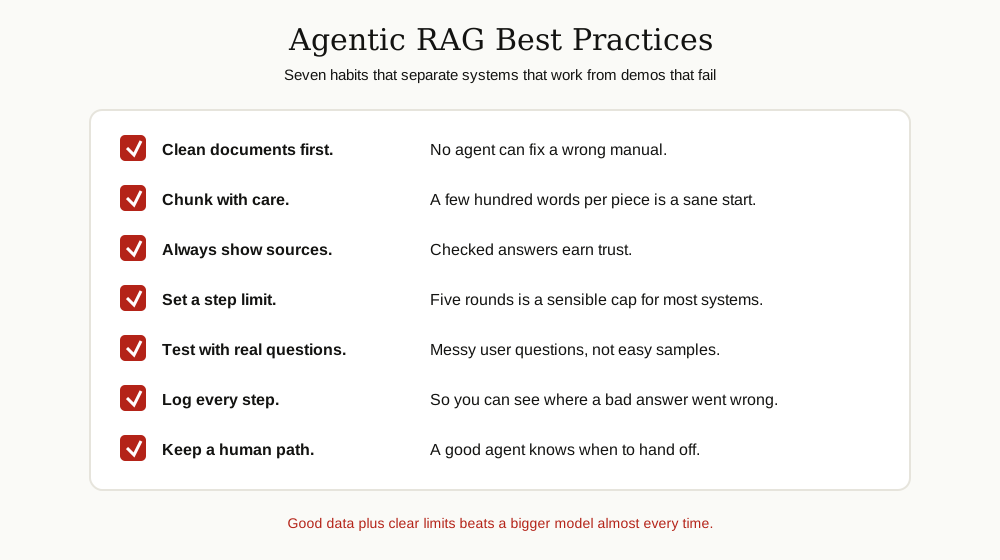
- Clean your documents first. An agent cannot fix a wrong manual. Remove duplicates, mark dates clearly, and delete outdated pages. This is the same lesson behind good AI data integration: smart tools still need trustworthy data.
- Chunk with care. Pieces that are too big bury the facts. Pieces that are too small lose the context. A few hundred words per chunk is a common, sensible starting point.
- Always show sources. Answers that name their documents get checked, trusted and improved. Answers without sources get believed blindly, which is dangerous.
- Set a step limit. Cap the search rounds, for example at five, so a confused agent stops and asks for help instead of burning budget.
- Test with real questions. Collect the actual questions your users ask, including the messy ones, and grade the system on those, not on easy samples.
- Log every step. When an answer is wrong, the step log shows whether the search missed, the check failed, or the writing went off the rails.
- Keep a human path. For sensitive topics, let the agent hand off to a person rather than guess. A good agent knows when to stop.
The Bottom Line
Regular RAG taught AI to look before it speaks. Agentic RAG teaches it to think about how to look: plan the search, route each part to the right source, search again when the evidence is thin, and check the answer before sending it.
That makes agentic RAG the better choice for hard, multi part questions where accuracy matters, and regular RAG the smarter choice for simple lookups where speed and cost rule. Most mature systems will end up using both: quick questions take the fast path, hard questions get the researcher.
Want to keep exploring? Browse our Generative AI and Agentic AI guides for plain English breakdowns of agents, prompts, and the tools behind them.