You have probably lived this moment. You ask an AI chatbot a question, it hands back a bland answer that misses the point, and you start to wonder if the tool is overrated. Then a friend types a longer, more careful message into the very same tool and gets a sharp, useful answer. The tool did not change. The words did.
This guide answers one question from the ground up: what is prompt engineering, and how do you get good at it? You will learn why your wording changes the answer, the five parts of a strong prompt, the core techniques the pros use, and how prompt engineering works in real tasks like emails, summaries, and code help. No coding needed, and no hard words.
What Is Prompt Engineering, in Plain Words?
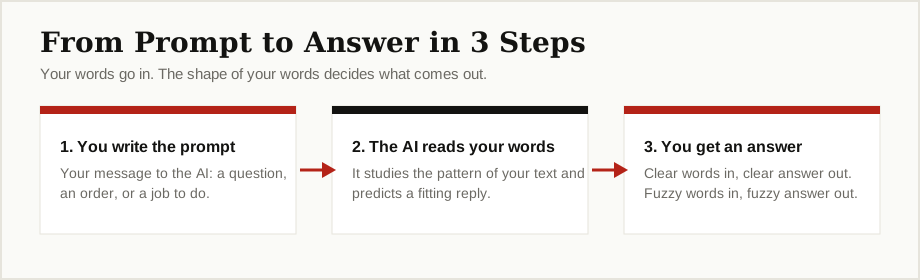
A prompt is the message you type into an AI tool: a question, an order, or a job you want done. Prompt engineering is the skill of writing that message well, so the AI gives you the answer you actually need.
So, what is prompt engineering at its core? It is clear writing, aimed at a machine. You say what you want, you add the background the AI needs, and you ask for the answer in a shape you can use. That is the whole craft. The fancy name hides a simple idea.
It helps to know what sits on the other side of the chat box. The AI answering you is a machine learning model trained on huge amounts of text. Tools like ChatGPT and Claude are built on natural language processing, which means they read your words and predict a fitting reply, one piece at a time. They do not look answers up in a book. They build each reply from the pattern of your words. Fuzzy words in, fuzzy answer out. Clear words in, clear answer out.
The Wikipedia page on prompt engineering describes it as the practice of shaping inputs so a generative AI produces the output you want. That is a formal way of saying what this guide teaches in plain words: the quality of the answer starts with the quality of the ask.
Why Your Wording Changes the Answer
An AI tool cannot read your mind. When your prompt leaves gaps, the tool fills those gaps with its best guess, and its best guess is usually the most average answer possible. That is why vague prompts produce text that sounds fine but says little.
Look at the same job, asked two ways:
| Weak prompt | Strong prompt |
|---|---|
| Write a caption for my coffee shop. | Write a friendly Instagram caption, under 40 words, for a small coffee shop launching a pumpkin spice latte. Use a warm tone, and end with a question that invites comments. |
The weak version could return anything: one dry line, or a long sales pitch. The strong version names the place it will appear, the length, the product, the tone, and the ending. The AI has far less to guess, so the first draft lands much closer to what you wanted.
This is the first lesson of how to write good prompts: every detail you add removes a guess. You do not need longer prompts for the sake of length. You need the right details: who the answer is for, what it must cover, and what shape it should take. The next section gives you a simple frame for adding them every time.
The 5 Parts of a Good Prompt
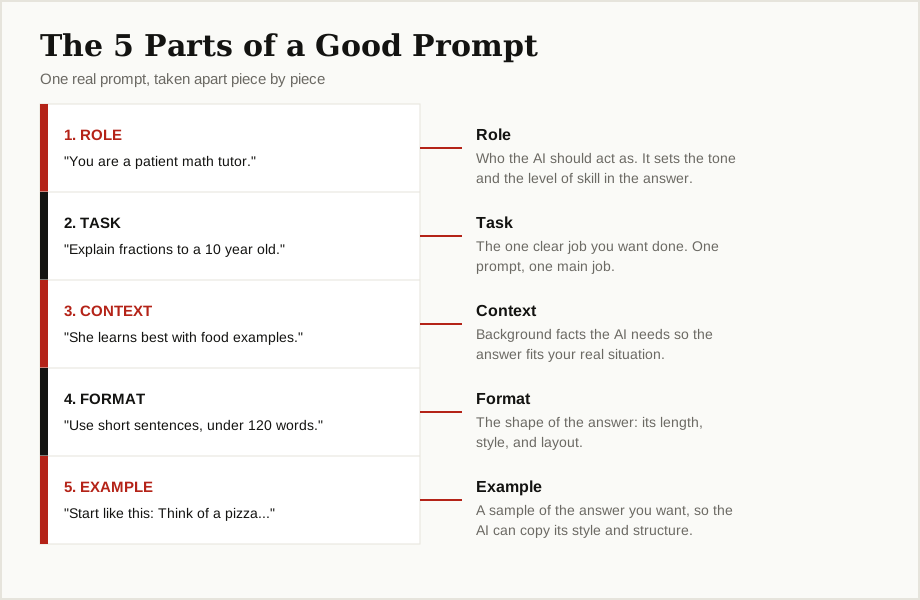
Most strong prompts are built from the same five parts. You will not need all five every time, but knowing them turns writing a prompt from guesswork into a quick checklist.
1. Role
Tell the AI who to act as. A role sets the tone and the skill level of the answer. “You are a patient teacher” and “you are a strict editor” produce very different replies to the same text.
2. Task
State the one clear job you want done. One prompt, one main job. “Explain this report” is a task. “Explain this report, rewrite it, and make slides” is three jobs fighting for space.
3. Context
Add the background facts the AI cannot know on its own: who the reader is, what happened before, and what limits matter. Context is the part beginners skip most, and it is the part that helps most.
4. Format
Ask for the shape of the answer: a list, a table, a word limit, a tone. Format requests stop the common problem of getting a long essay when you needed five short lines.
5. Example
Show one sample of the answer you want, and the AI will copy its style and structure. An example is the fastest way to explain a style that is hard to describe in words.
Here are all five parts working together in one prompt:
You are a patient math tutor. Explain fractions to a 10 year old
who learns best with food examples. Use short sentences, stay
under 120 words, and start like this: Think of a pizza cut into
four equal parts.
Short, plain, and complete. That single message will beat a page of vague instructions almost every time.
Core Prompt Engineering Techniques
Once the five parts feel natural, you can add technique. These six prompt engineering techniques cover nearly everything the pros do, and each one is simple once you see it in action.
Zero-Shot Prompting
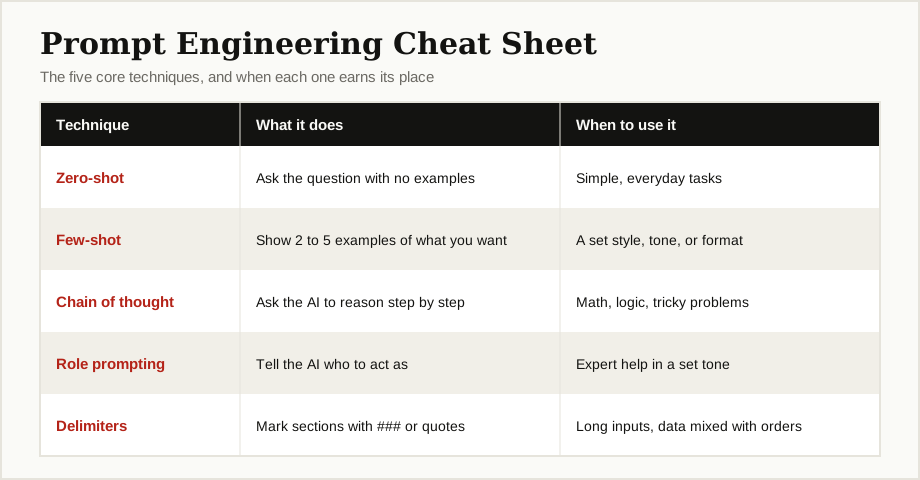
Zero-shot means asking with no examples at all. “Translate this sentence into French” is zero-shot. It works well for simple, everyday jobs, and it is where everyone starts.
Few-Shot Prompting
Few-shot means showing the AI two to five examples before you ask. If you want product names in a certain style, show three names you like first. The AI studies the pattern and follows it far more closely than it follows a written description of the style.
Chain of Thought
For math, logic, and tricky problems, ask the AI to work step by step instead of jumping to an answer. Adding “Explain your steps, then give the final answer” slows the tool down in a good way, and the final answer gets more accurate.
Role Prompting
This is the role part, used as a full technique. Starting with “You are an experienced travel agent” or “You are a careful proofreader” shifts the vocabulary, the tone, and even which facts the AI brings up first.
Delimiters
Delimiters are markers that separate your instructions from your data. When you paste a long article, a list, or a block of code into a prompt, wrap it in triple quotes or ### marks. The AI then knows where your orders end and your material begins, and it stops mixing the two up.
Output Format Control
You can ask for the answer as a table, a JSON block, a numbered list, or a set word count. Format control matters most when the answer feeds into something else, like a spreadsheet, a post, or a slide.
OpenAI publishes the same core moves in its official prompt engineering guide, which is worth reading once you have the basics from this page. And these skills matter even more as tools move from chatting to acting on their own, the shift explained in our guide to agentic AI.
Prompt Engineering Examples: Before and After
Techniques stick better when you see them at work. Here are three everyday jobs, each shown weak first, then strong.
Example 1: Writing an Email
Weak prompt:
Write an email to my boss about leave.Strong prompt:
Write a polite email to my manager asking for three days of leave
next month for a family trip. Keep it under 100 words, sound
professional, and end by offering to hand over my current tasks
before I go.
What changed: the reason, the length, the tone, and the ending are all named. The strong version can be sent after a quick read. The weak one needs a full rewrite.
Example 2: Summarizing a Long Article
Weak prompt:
Summarize this article.Strong prompt:
Summarize the article below for a busy shop owner with no tech
background. Give me 5 bullet points, each under 20 words, and end
with one line on why it matters for small shops.

[Paste the article text here]
What changed: the reader is named, the format is fixed, and the ending has a job to do. Note the plain note at the end telling you where the text goes. That small habit prevents a lot of confusion.
Example 3: Getting Help With Code
Weak prompt:
My code does not work. Fix it.Strong prompt:
I am learning Python. The code below should print the total
price, but it gives an error instead. Explain the mistake in
simple words first, then show the fixed code.

[Paste your code and the error message here]
What changed: the AI now knows your level, sees the actual code and the actual error, and knows you want to learn, not just copy. The explanation first, code second order makes a real difference for beginners.
Common Mistakes That Ruin Good Prompts
Most bad answers trace back to a short list of habits. Watch for these in your own prompts.
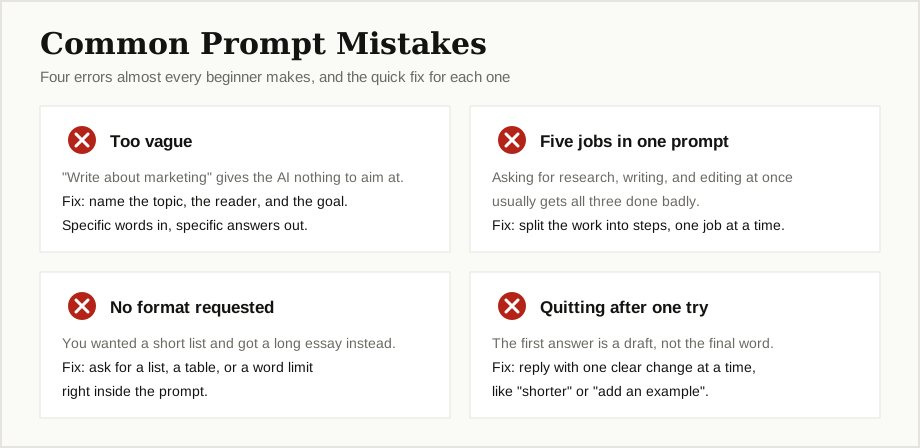
Asking for “the best” with no yardstick. Best for whom, and by what measure? Add your criteria, like cheapest, fastest, or easiest for a beginner, and the answer stops being generic.
Pasting data with no instructions. A wall of text and no task leaves the AI guessing what you want from it. Always pair pasted material with one clear sentence about the job.
Forgetting the reader. An answer for a child, a boss, and an expert on the same topic should read three different ways. Name the reader and the tone follows.
Changing five things at once. When an answer is close but not right, reply with one fix at a time, like “shorter” or “add an example”. Five changes at once makes the next draft worse as often as it makes it better.
Is Prompt Engineering a Real Job and Skill?
Yes to both, with one honest catch. Real job posts do exist. AI companies and large firms hire people with titles like prompt engineer to design, test, and improve the prompts inside products. Search data tells the same story: what is prompt engineering is now one of the most common questions new AI users ask, and the skill behind it is genuinely in demand.
The catch is that for most people, prompt engineering will be a skill inside a job, not the whole job. It sits next to clear writing, spreadsheets, and email as a basic work skill: marketers, teachers, support agents, and managers all get more from AI tools when they can ask well. It is also worth knowing that AI models keep getting better at guessing what you mean, so memorized tricks lose value over time. What keeps its value is the thinking underneath: knowing your subject, breaking a job into steps, and checking the answer with care. Learn those, and every future tool gets easier to use.
If you want to study further, the Claude prompt engineering overview from Anthropic is a clear, free next step that builds on everything in this guide.
Your Quick Start Checklist
Keep this prompt engineering guide next to your keyboard for your first week of practice. Before you press enter, run through these five checks.
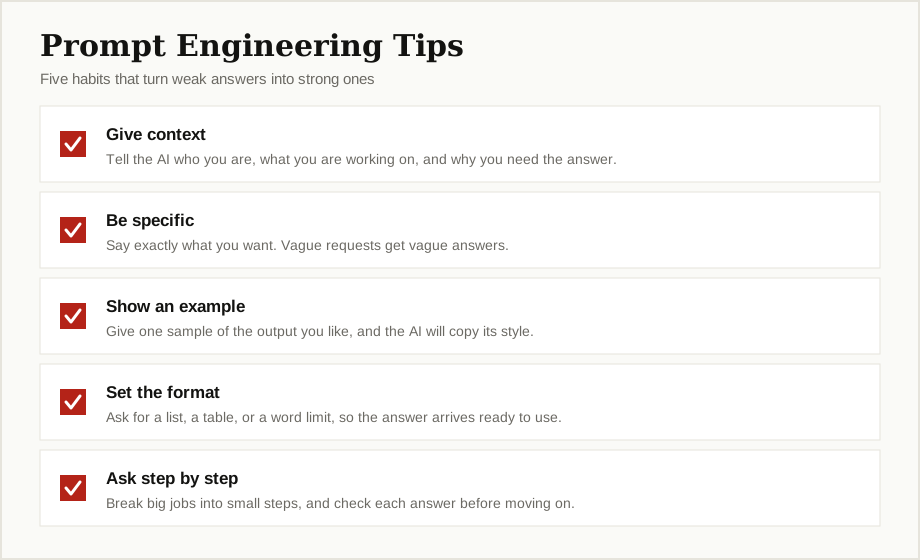
- Context added. Did you say who you are, what this is for, and who will read it?
- One clear task. Is there a single main job, stated in plain words?
- Specific details. Did you name the topic, the limits, and anything the answer must include or avoid?
- Format set. Did you ask for a list, a table, or a word limit, so the answer arrives ready to use?
- Example or steps. For a set style, did you show a sample? For a hard problem, did you ask for step by step work?
If the first answer misses, do not start over. Reply with the one change that matters most, and build on what you have. Prompting is a short conversation, not a single throw.
The Bottom Line
So, what is prompt engineering when you strip away the buzzword? It is the simple, learnable skill of asking AI tools clear questions. Give context, name one task, be specific, set the format, and show an example when style matters. Those five habits, plus a little patience when you refine, will carry you through almost every job you hand to an AI.
Start small today: take one prompt you used this week and rebuild it with the five parts. The difference will teach you more than any list of tricks. Then keep going with our other Generative AI and Agentic AI guides, where we break down AI agents, chatbots, and the tools behind them in the same plain English.