
Most talk about AI agents sounds like it belongs in a boardroom: departments, budgets and big company systems. But some of the most useful AI agent use cases right now are much closer to home. They live in your inbox, your study notes, your shopping list and your weekend plans.
An AI agent is simply software that takes a goal, breaks it into steps, uses your apps to do the work, and reports back. Google Cloud describes AI agents as systems that pursue a goal by observing, planning and acting with the tools they can reach. If that still sounds abstract, our guide on what is agentic AI explains the idea in plain words.
A quick test helps you judge any list of ai agent use cases, including this one. If a tool only answers when you type to it, it is a chatbot. If it can take a goal, plan the steps, use other apps on its own, and check back with a finished result, it is an agent. The second kind is the one worth your time, because it removes whole chores instead of just helping you type faster.
This article is the practical companion. Our separate guide to agentic AI use cases looks at the business and industry side. Here we stay personal: everyday examples for individuals, creators, students and small teams, plus project ideas you can build or try yourself.
Everyday AI Agent Use Cases
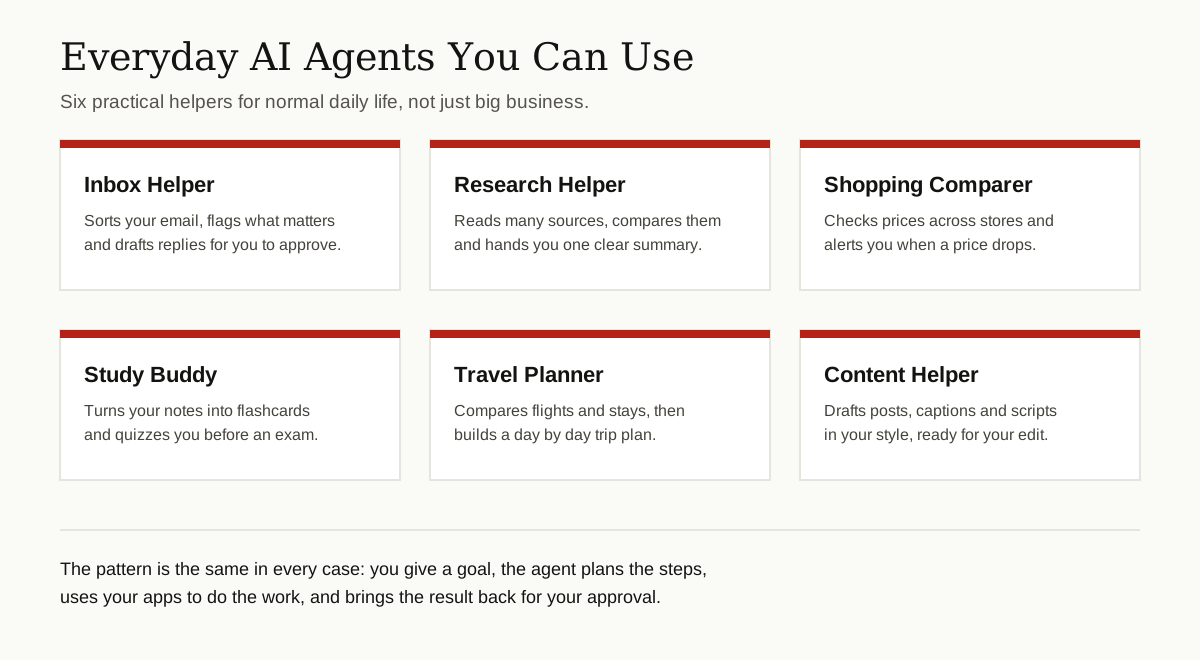
The eight jobs below are the ones ordinary people actually stick with after the first week of excitement. Each one is small, easy to check, and saves time you can feel. Start with whichever matches your own week, because the best first agent is the one pointed at a chore you already dislike.
Inbox and Scheduling Help

A personal inbox agent sorts new mail into piles, flags the three messages that actually need you today, and drafts replies in your tone for you to approve. It can also watch your calendar, suggest meeting times and send the invites once you say yes. This is one of the most popular ai agent use cases because the time savings show up in the first week. Our step by step guide on how to use an AI agent to sort emails walks through a safe setup.
Research and Summaries
Give a research agent a question and it will search several sources, compare what they say, and hand you a short brief with the key points and links. Students use this to map a topic before writing. Creators use it to check facts and gather background before filming. Small teams use it to watch competitors or track prices in their market. The agent does the legwork of opening twenty tabs, so you start from a summary instead of a pile of pages.
Shopping and Price Checks
A shopping agent compares the same product across stores, checks reviews for common complaints, and alerts you when the price drops below a level you set. Bigger jobs work too: give it a list for a home project and it builds a basket within your budget, ready for your approval. It never needs to buy on its own. In most ai agent use cases like this, the smart setup is simple: the agent prepares the cart, you press the buy button.
Study and Learning
A study agent turns your lecture notes into flashcards, builds a revision plan that fits the days you actually have, and quizzes you in short sessions. It can explain a hard paragraph in simpler words, then test whether the idea stuck. Language learners use agents for daily practice chats with corrections. The honest limit: an agent can still state a wrong fact with full confidence, so check anything that will end up in an exam answer or a graded paper.
Travel Planning
Tell a travel agent your dates, budget and travel style, and it comes back with flight options, areas to stay in, and a day by day plan that respects check in times and distances. It can hold the plan in one place and adjust it when you swap an activity. For group trips, it can collect everyone’s preferences and find the overlap. You still book the tickets yourself, which is the right call, but the hours of comparing tabs are gone.
Content Creation Help
Creators use agents as a small production team. One agent gathers ideas and trending questions in your niche. Another drafts an outline or a first script from your notes. A third turns one finished video into a blog draft, captions and a week of short posts. You stay the editor and the voice. Among ai agent examples for solo creators, this one pays off fast, because the slow parts of content work are mostly sorting, drafting and reformatting.
Coding Help
A coding agent can read an error message, search your project for the cause, suggest a fix and even write a first version of a small feature. Students learning to program use agents as patient tutors that explain each step instead of just giving the answer. Hobby builders use them to finish weekend projects that used to stall. Our comparison of the best AI coding assistants shows which tools handle this kind of agent work well.
Home and Money Admin
At home, an agent can turn a chat about meals into a grocery list, remind you before bills are due, and keep a simple note of where the money went this month. It can collect your subscriptions in one list so you can spot the ones you no longer use. None of this is exciting, and that is the point. Good ai agent applications often look boring from the outside. They just quietly remove small chores that used to eat your evenings.
AI Agent Project Ideas You Can Actually Build
Reading about agents is fine, but you learn how they behave by running one. The ai agent projects below are grouped by level, and every one of them teaches something real about giving instructions, setting limits and checking results.

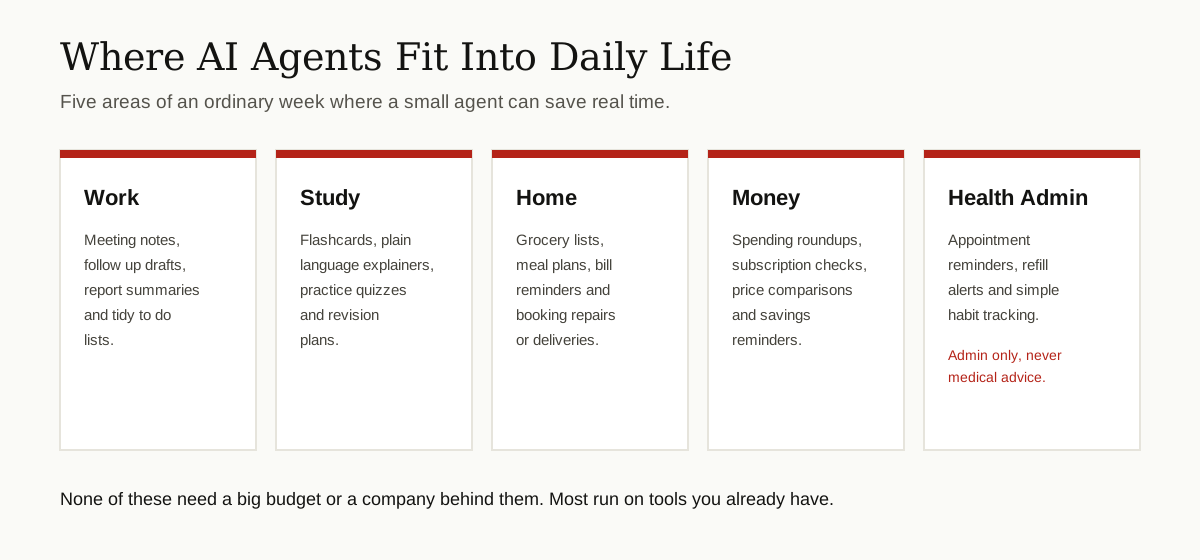
Beginner projects need no code. A morning briefing agent that collects the weather, your calendar and three headlines into one message is a classic first build. An email sorter and a flashcard maker are close behind. These take an evening at most and run on free tiers of common tools.
Intermediate projects add a little wiring. A price watch agent that checks a product page daily and messages you on a drop. A personal research agent that reads the pages you send it and keeps a growing summary file. A trip planner that combines maps, prices and your saved preferences.
Advanced projects usually involve some code and more trust. A supervised shopping assistant that prepares full baskets. A code review helper that reads each new commit and writes a plain language summary. An agent that manages a small content calendar end to end, with your approval at each step.
| Project | Level | What it does | Tools to try |
|---|---|---|---|
| Morning briefing agent | Beginner | Sends one daily message with weather, calendar and headlines | ChatGPT, Zapier |
| Email sorter and summarizer | Beginner | Labels mail and drafts a daily inbox summary | Make, Gmail |
| Study flashcard agent | Beginner | Turns notes into flashcards and quizzes | Notion, ChatGPT |
| Price watch agent | Intermediate | Checks prices daily and alerts you on drops | Python, price APIs |
| Personal research agent | Intermediate | Reads sources and keeps a running brief | LangChain, search API |
| Code review helper | Advanced | Summarizes new commits in plain words | LangGraph, GitHub API |
If you want a bigger menu, the open source community keeps a well known list of 500 AI agent projects on GitHub, sorted from simple builds to full systems. It is a good place to steal ideas and see how other people structure their agents.
A Simple Weekend Plan for Your First Build
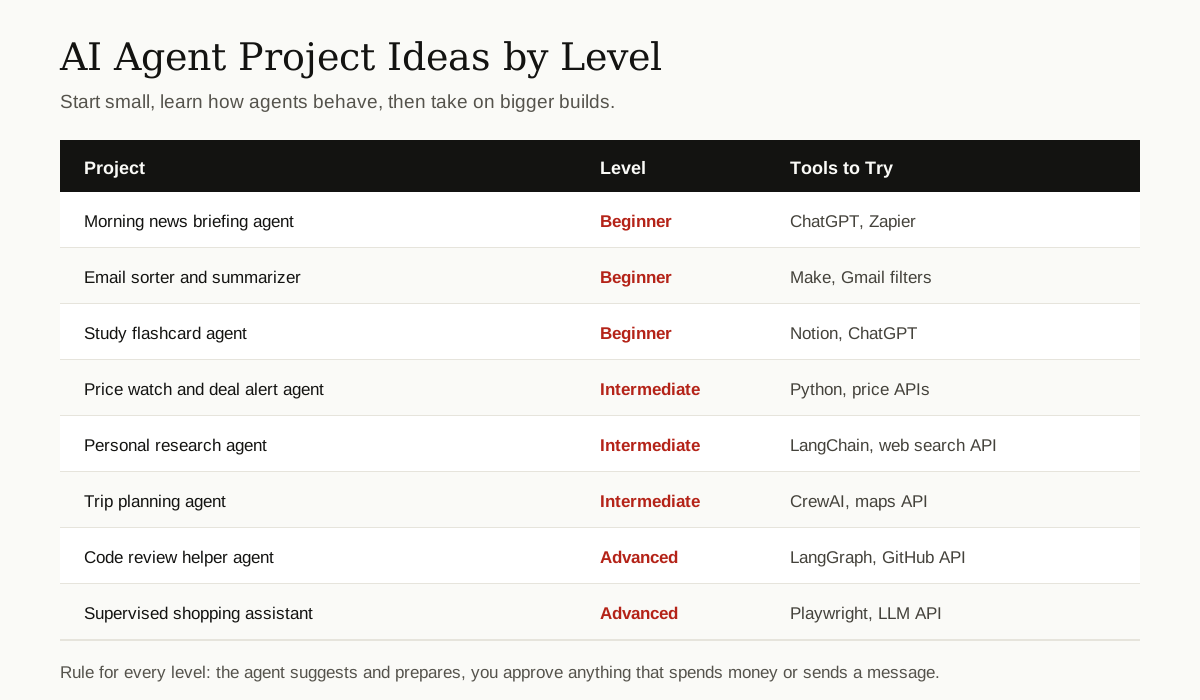
If you want a concrete starting point, steal this plan. On Saturday morning, pick one chore from the everyday list above and write down, in plain words, what done looks like. After lunch, build the smallest version with a no-code tool and read-only access. On Sunday, run it on real data, read every output, and fix the two or three rules that misfire. Leave approvals switched on for a full week of normal use. That slow start is not wasted time. It is how ai agent use cases turn into habits you trust instead of demos you abandon.
How to Try Your First Agent Safely
The difference between a helpful agent and a stressful one is rarely the tool. It is how much freedom you hand over on day one. IBM’s overview of agentic AI makes the same point in business terms: agents act with a degree of independence, so the goals and guardrails you set matter as much as the model behind them.
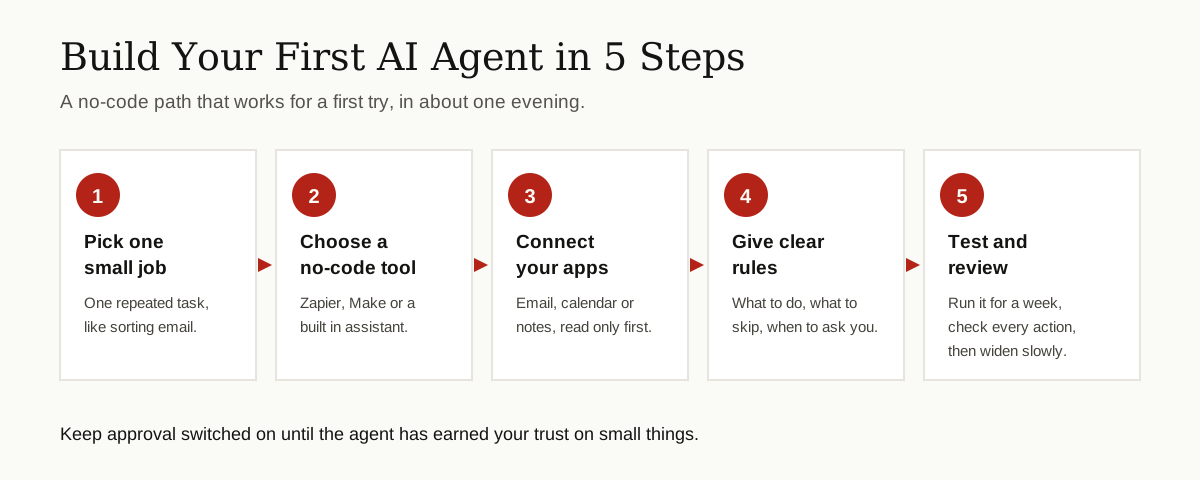
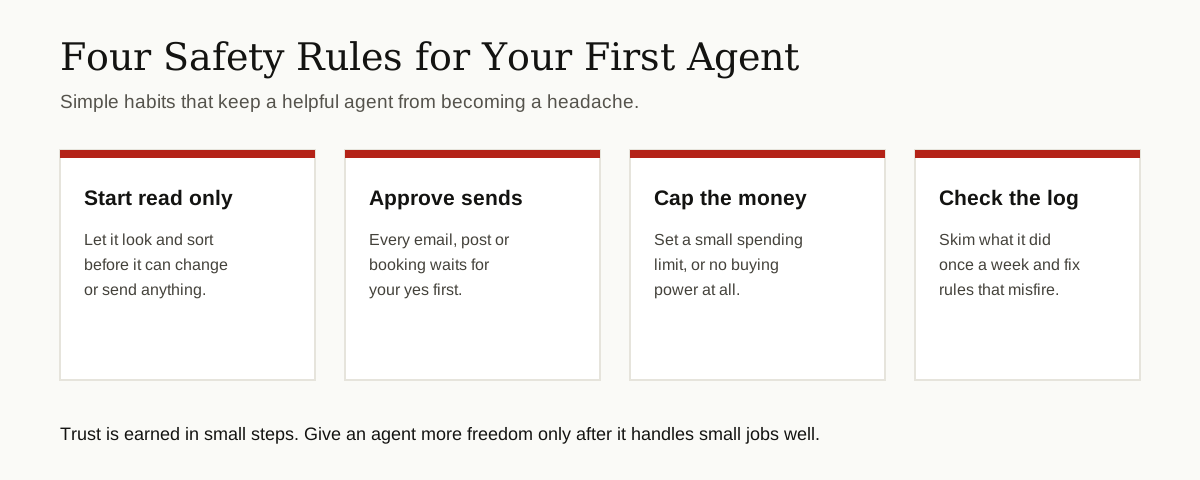
Start with read-only access. Let the agent look, sort and summarize before it can change or send anything. Then switch on approval for every action that leaves your accounts: emails, posts, bookings and purchases. Keep spending limits tiny, or give the agent no buying power at all while you learn. Among examples of ai agents going wrong, almost every story starts with too much freedom given too early.
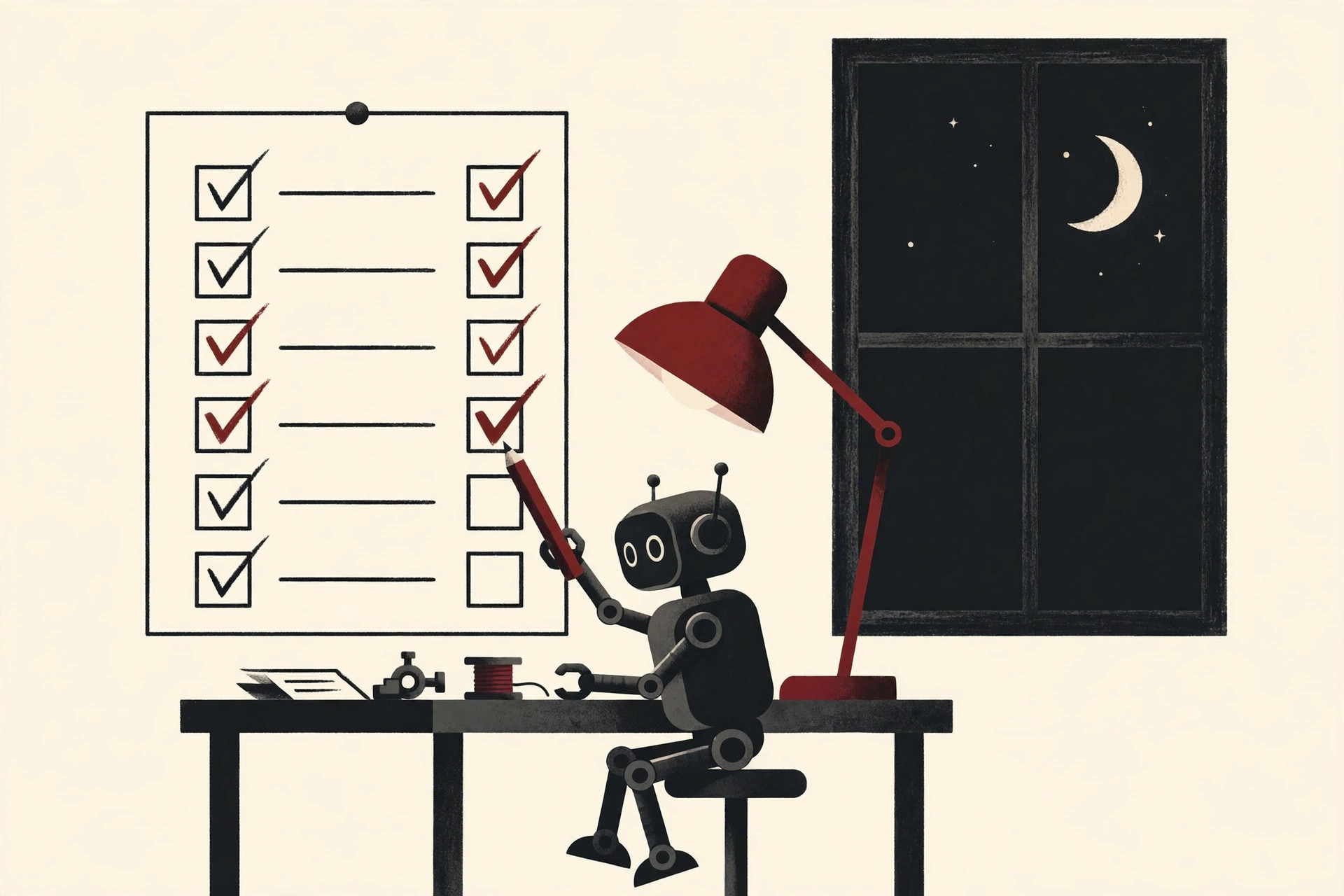
Fully autonomous ai agents examples do exist, like agents that run a checklist overnight and report in the morning. That level of trust should be earned in small steps, over weeks, on jobs where a mistake costs little. Check the activity log once a week, fix the rules that misfire, and widen the freedom slowly.
Honest Limits to Keep in Mind
Agents are useful, but they are not careful adults. They can book the wrong date with total confidence, misunderstand a short instruction, or follow a rule long after your situation changed. They also cost money to run: subscriptions, per task fees and your own review time all add up, so a free sounding agent is rarely fully free.
Privacy deserves one clear sentence. An agent that reads your email and calendar sees a lot of your life, so pick tools with clear data policies, and keep agents away from accounts you cannot afford to expose. Finally, keep your own skills alive. Use agents to remove chores, not to skip the learning itself. A study agent that writes every assignment for you leaves you weaker, not stronger.
One more limit is easy to miss: agents need upkeep. Apps change their buttons and layouts, rules go stale, and a workflow that ran perfectly in January can quietly break in March. Budget a few minutes a week to skim the logs and refresh the instructions. Treat your agent like a new helper who is fast and willing, but who still needs a manager. That mindset keeps expectations honest and results steady.
Conclusion
The best ai agent use cases are not the flashy demos. They are small, personal and a little boring: a sorted inbox, a fair price, a study plan that fits your week, a trip that plans itself down to the last train. Start with one small job, run it with approvals on, and let the agent earn more trust over time. For more guides like this one, browse our generative AI and agentic AI category, pick the use case that matches your week, and build from there.