
Type a question into Google today and the first thing you often see is not a list of links. It is a written answer, built by AI, with a few sources named beside it. Ask the same question in ChatGPT or Perplexity and you get the same thing: one answer, written for you, with your website either inside it or nowhere at all.
So, what is generative engine optimization? It is the practice of shaping your content so AI engines find it, trust it, and cite it inside those answers. This guide answers the question what is generative engine optimization in full: how it differs from classic SEO, why it matters now, and the exact steps you can take to earn a place inside AI answers.
Where AI Answers Show Up
AI answers are no longer an experiment. They sit on top of the tools hundreds of millions of people already use every day:
- Google AI Overviews: AI written summaries at the top of Google results, with source links on the side. They now appear for a large share of everyday questions, from recipes to product research. If you want to see how present they are, notice how many users even search for ways to turn off Google AI features.
- ChatGPT search: ChatGPT answers questions in plain conversation and cites the web pages it used.
- Perplexity: An answer engine built around citations. Nearly every claim in its answers carries a numbered source.
- Gemini: Google’s AI assistant, which also feeds AI features across Google products.

In all four places, the pattern is the same. The user asks once and reads one answer. There is no page two. Your content either feeds that answer, or a competitor’s content does.
GEO vs SEO: What Actually Changes
The term generative engine optimization comes from a 2023 research paper by researchers at Princeton and partner universities, who tested how content changes affect visibility inside AI answers. The idea has since spread across the industry, and Wikipedia’s overview of generative engine optimization tracks how the practice is developing.
SEO and GEO share the same foundation: a crawlable site, helpful content, real authority. What changes is the finish line.
| SEO | GEO | |
|---|---|---|
| Goal | Rank high in the results list | Be cited inside the AI answer |
| What the user sees | Links to choose from | One written answer with sources |
| What wins | Keywords, backlinks, technical health | Clear answers, facts, trust, mentions |
| How you measure | Rankings and organic clicks | Citations, brand mentions, AI referrals |
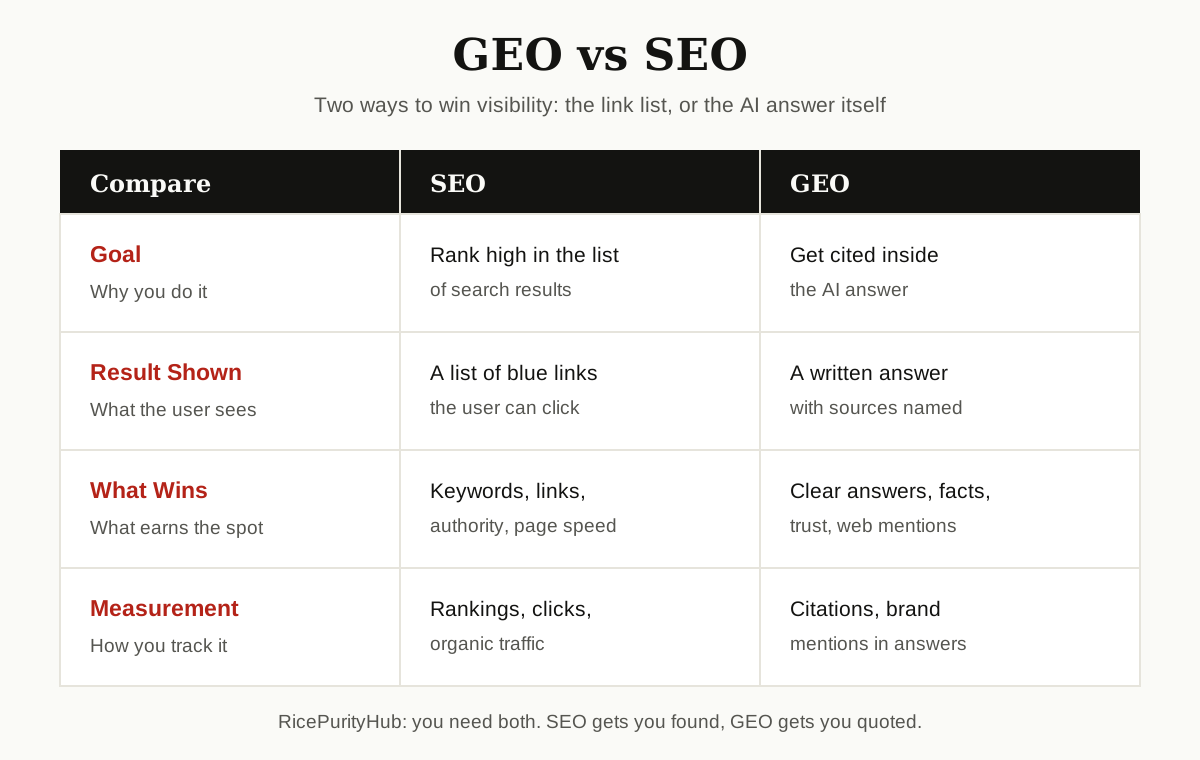
The honest way to see it: SEO is not dead, and GEO is not magic. AI engines still need search indexes to find pages in the first place. Good SEO puts you in the candidate pool. GEO habits decide whether the AI actually quotes you once you are in that pool.
Why GEO Matters Now
Two shifts make this urgent for site owners.
First, clicks are getting harder to win. When the answer sits at the top of the page, many users never scroll to the links below it. A page can hold a strong ranking and still receive fewer visits than it did two years ago, simply because the AI answered the question first.
Second, visibility inside the answer has real value even without a click. When ChatGPT or Google names your brand as the source, thousands of readers see your name attached to the answer they trust. That is the new version of a top ranking: not just being found, but being quoted.
There is a mindset shift hidden in all this. For twenty years, the goal was to win a click and let your homepage do the persuading. Now the answer itself does the persuading, often before any click happens. When owners ask what is generative engine optimization really about, this is the honest backdrop: your content now has to convince an AI first, and the AI then convinces the reader.

This is why generative engine optimization matters for small sites as much as big ones. AI answers pull from many sources, and a clear, well structured page from a small site can be cited next to famous brands when it answers the question better.
How AI Engines Pick Sources
To optimize for AI search, it helps to know what happens after a user asks a question. In plain words, four things happen in seconds:
- Fetch. The engine searches the web and pulls a shortlist of pages that might answer the question. This step works much like normal search, which is why classic SEO still matters.
- Check trust. The engine weighs authority signals: Is the source known? Is the information accurate and current? Is the brand mentioned on other trusted sites?
- Extract. The AI reads the shortlisted pages and lifts the clearest passages, facts and lists. This is where structure decides everything. A clean paragraph that directly answers the question is easy to lift. A long, wandering page is not. Under the hood, this reading step relies on natural language processing, the same technology that lets AI understand human text.
- Cite. The engine writes one answer and names or links the sources it used.
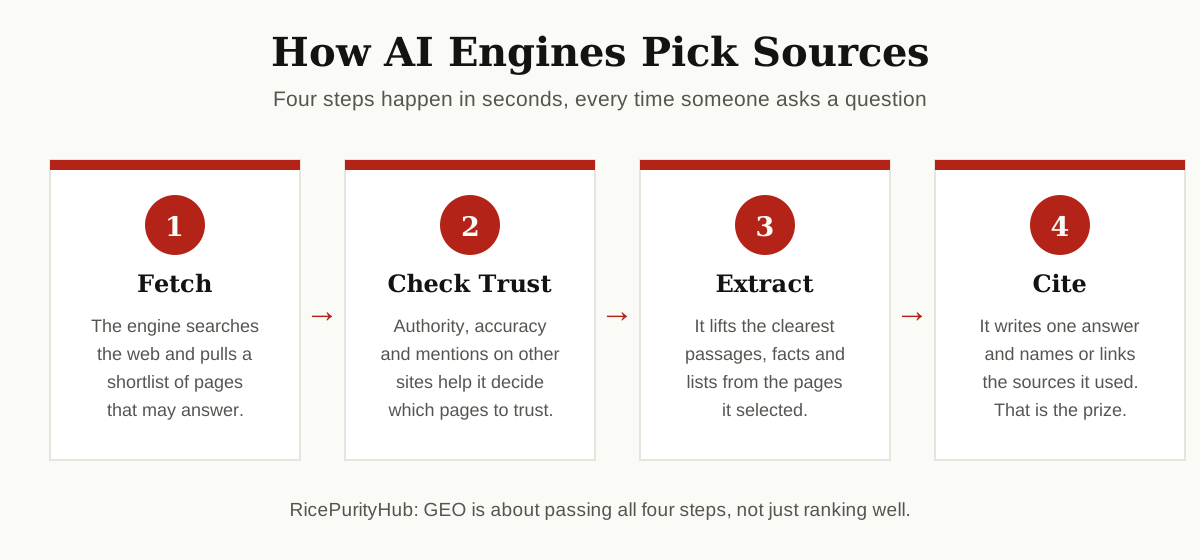

Notice what is missing from that list: keyword tricks. The models that do this work are built on machine learning algorithms trained to judge meaning, not word counts. They reward content that reads like a clear answer from a source that other people also trust.
One more detail matters: consistency. If your page gives one price, your listings give another, and a review site gives a third, the engine has no safe fact to quote and usually picks a different source. Keeping the same facts, names and numbers everywhere your brand appears is quiet GEO work that pays off every day.
How to Optimize for AI Search: A Step by Step Guide
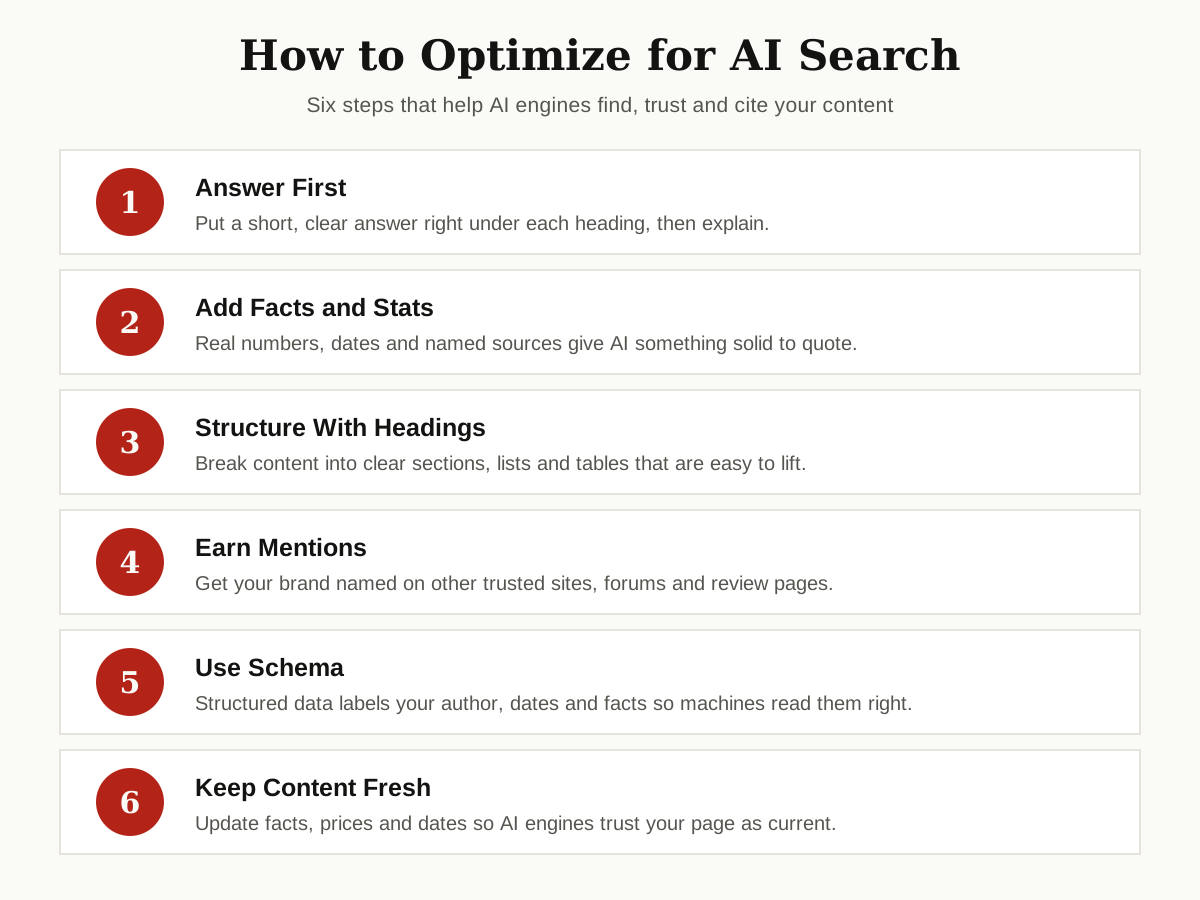
Here is how to optimize for ai search in practice, in the order that gives the fastest results.
Step 1: Answer first. Open every section with a short, direct answer to the heading’s question, then add detail. AI engines lift opening lines far more often than conclusions. A weak opening buries the answer under background and history. A strong one states it in the first two lines.
Step 2: Add facts, numbers and named sources. Specific claims are quotable. “Most users prefer weekly reports” is forgettable. A claim with a number, a date and a named study is something an AI can repeat with confidence. In the original GEO study, adding statistics and quotations improved source visibility in AI answers by up to 40 percent in the researchers’ own tests.
Step 3: Structure every page. Use question style headings, short paragraphs, numbered steps and comparison tables. Each block should make sense on its own, because the AI may lift it without the rest of the page.
Step 4: Earn mentions across the web. AI engines learn which brands matter from the whole web: reviews, forums, videos, news and directories. A brand mentioned in many trusted places looks like a real authority on the topic. You do not need a PR agency for this. Ten honest mentions in the right places beat a hundred spammy ones.
Step 5: Use schema and clean technical basics. Structured data labels your author, dates and article facts so machines read them correctly. Google’s own guidance on AI features in Search confirms there are no special technical tricks required: the same foundations as normal SEO apply, and your pages simply need to be indexed and eligible to appear.
Step 6: Keep content fresh. Update prices, dates and facts, and show the updated date. Stale pages quietly fall out of AI answers because engines prefer sources they can trust as current.
If your traffic depends on Google in particular, spend extra effort on one practical skill: learning how to optimize content for Google AI Overviews. The same answer first structure works there, because Overviews pull short passages from indexed pages and link to them as sources.
Generative Engine Optimization Best Practices
Beyond the steps above, these habits separate pages that get cited from pages that get skipped:
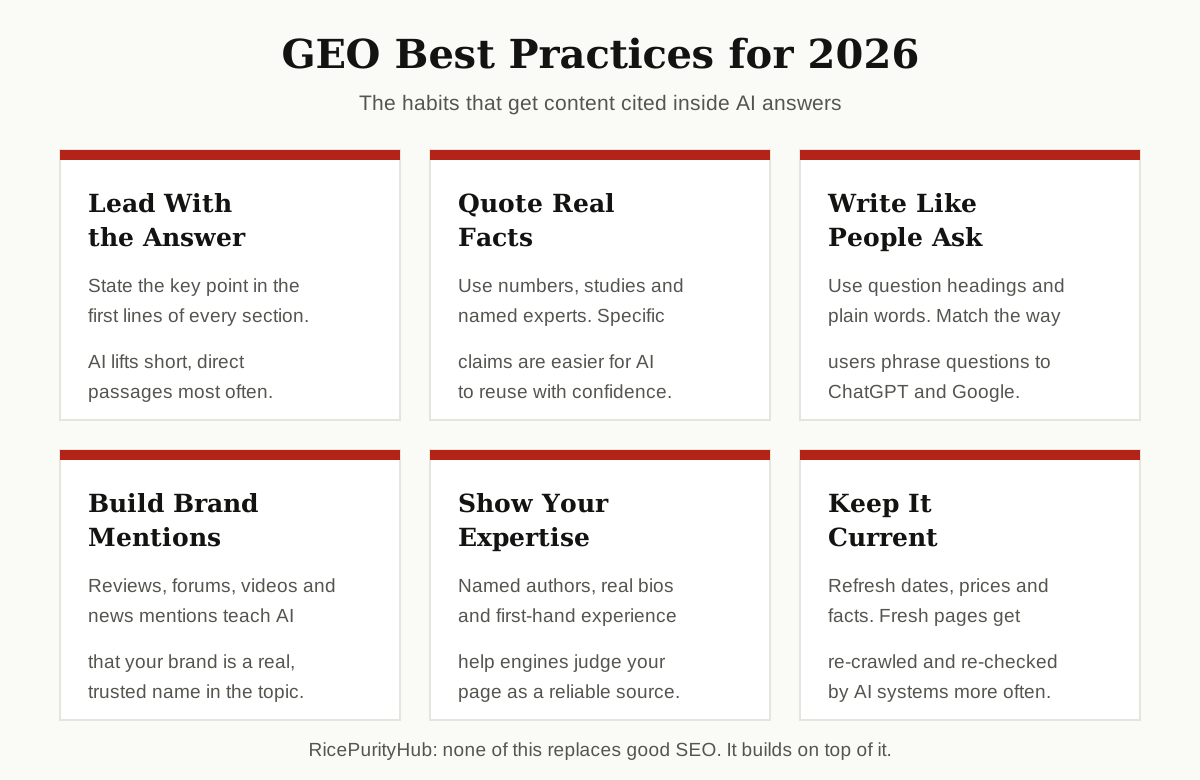
- Cover the full question. AI answers are built from several sources. Pages that answer the main question plus the obvious follow ups give the engine more usable material in one place.
- Write in plain words. If a smart friend would need a dictionary, the passage is harder for both readers and models to reuse. Plain language travels further.
- Show real experience. First hand testing, original photos, your own data and honest pros and cons are things AI cannot invent, and engines favor sources that add something new.
- Name a real author. A named writer with a bio and a track record is a trust signal for readers and machines alike.
- Agree with the consensus, then add value. If your page contradicts every trusted source without evidence, engines will treat it as unreliable. Match the known facts, then contribute your extra insight.
What to Measure
GEO measurement is younger than SEO measurement, so keep it simple and consistent:
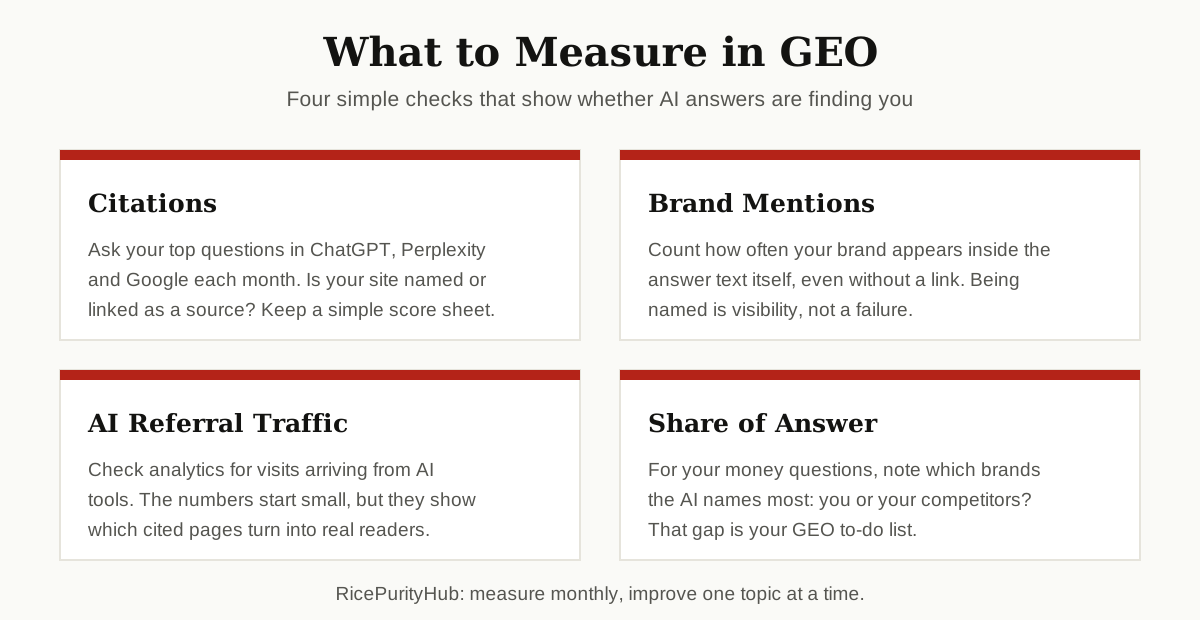
Pick your ten most valuable questions. Once a month, ask them in Google, ChatGPT and Perplexity, and record which sources get cited and whether your brand is named. In parallel, watch your analytics for referral visits from AI tools. The trend matters more than any single week: rising citations and mentions mean your ai search optimization work is landing.
Do not panic if AI referral traffic looks tiny at first. It starts small on almost every site, and the visitors it sends are often unusually ready to act, because the AI already explained the basics and named you as a source. Track the direction of travel, and let citations lead: traffic follows where citations grow.
Common Mistakes and Myths
A new field attracts bad advice fast. Watch for these:
- The llms.txt myth. Some guides promise that adding a special file for AI models guarantees citations. There is no solid evidence that major AI engines use such files to pick sources today. It takes minutes to add one, but it is not a strategy.
- Keyword stuffing for robots. Repeating a phrase twenty times does not impress a language model. It just makes the page worse for the humans who might link to it.
- Blocking all AI crawlers. Block the crawlers and you block your chance of being cited. Decide carefully which bots you allow, especially the ones tied to search features.
- Copying the AI’s own style. Pages written to sound like generic AI output blend into thousands of identical pages. Clear human writing with real facts stands out more, not less.
- Expecting instant results. Citations build as engines re-crawl and re-judge sources. Judge GEO work in months, not days.
GEO for Small Sites
Small sites actually hold one advantage: focus. A big site covers everything thinly. You can cover one topic deeply, answer its questions better than anyone, and become the obvious citation for that corner of the web.
Start with your five most important pages. Rewrite their openings to answer first. Add real facts with sources. Fix the headings. Then earn a handful of genuine mentions by helping people in the forums and communities where your topic lives. That is a complete first round of generative engine optimization, and it costs nothing but time. Repeat it page by page, and you have the real answer to what is generative engine optimization for a small team: better answers, structured clearly, from a brand the web trusts.
Conclusion
So, what is generative engine optimization, in one line? It is the work of getting your content cited and trusted inside AI answers, built on the same honest foundations as good SEO: clear answers, real facts, clean structure and a brand the web already mentions.
The readers are still out there. They are just reading answers now instead of link lists. Sites that adapt will be the ones quoted inside those answers, and that work is the heart of our Generative AI and Agentic AI coverage. Start with one page this week: answer first, add facts, and make it the easiest page on the internet for an AI to quote.