Most software projects do not fail because the team cannot code. They fail because the world changes halfway through. A competitor launches first. Users ask for something different. A new technology appears, or the budget shrinks. Traditional project methods treat these surprises as problems to be controlled. Adaptive software development treats them as the normal state of the work.
So, what is adaptive software development? It is a way of building software that expects change, works in short cycles, and learns as it goes. This guide explains where it came from, how its cycle runs, and when it is a smart choice, all in plain English.
What Is Adaptive Software Development?
Adaptive software development, often shortened to ASD, is an approach built around one simple idea: continuous adaptation is normal. The team does not try to predict the whole project at the start. Instead, it works in short, repeating cycles. Each cycle makes a best guess, builds something real, and learns from the result before going again.
Picture a gardener guiding a plant up a trellis. The gardener has a plan for the final shape, but the plant grows in its own way, so the gardener keeps adjusting the ties. ASD treats a software project the same way. The direction is clear, but the route is expected to change.
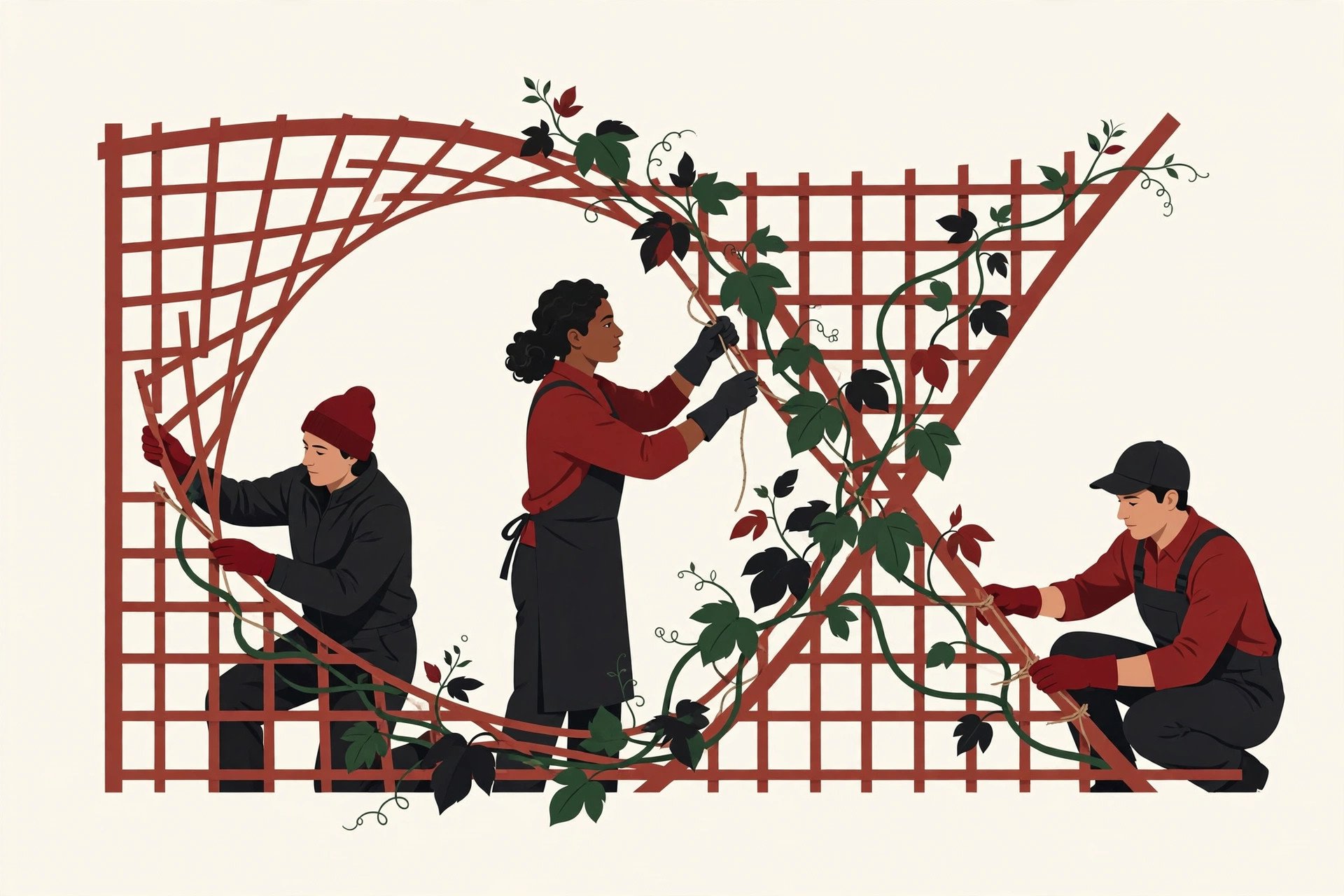
Two things adapt in ASD, and the second one is easy to miss. The product adapts, because each cycle can change what gets built next. The process also adapts, because the team reviews how it works and improves that too. In the words of its creators, ASD embodies the principle that continuous adaptation of the process to the work at hand is the normal state of affairs. Reference works such as the Wikipedia overview of adaptive software development describe ASD as an antecedent of modern agile development, which is a fair summary of its place in history.
Where ASD Came From
ASD grew out of rapid application development, known as RAD, a 1990s approach that favored speed and user involvement over long planning documents. Project managers Jim Highsmith and Sam Bayer developed the ideas further while working on fast-moving commercial projects. Highsmith then set out the full method in his 2000 book, Adaptive Software Development: A Collaborative Approach to Managing Complex Systems, published by Dorset House.
The thinking under the method came from an unusual place: complexity science. Scientists in that field study complex adaptive systems, things like flocks of birds, markets, and ecosystems. These systems have no central controller, yet they produce smart, coordinated behavior, because many independent parts keep reacting to feedback. Highsmith argued that a software organization works the same way. A team is not a machine that follows instructions perfectly. It is a group of people reacting to each other and to a changing environment, and good results emerge when the team gets fast feedback and the freedom to adjust.
A year after the book appeared, in 2001, Highsmith was one of the seventeen practitioners who wrote the Agile Manifesto, the short document that kicked off the agile movement. That is why ASD is best understood as one of the roots of agile, rather than a rival to it. Highsmith later expanded his lifecycle in the book Agile Project Management, where the phases became Envision, Speculate, Explore, Adapt, and Close. The three-phase cycle below is the original adaptive software development lifecycle, and the one students still study today.
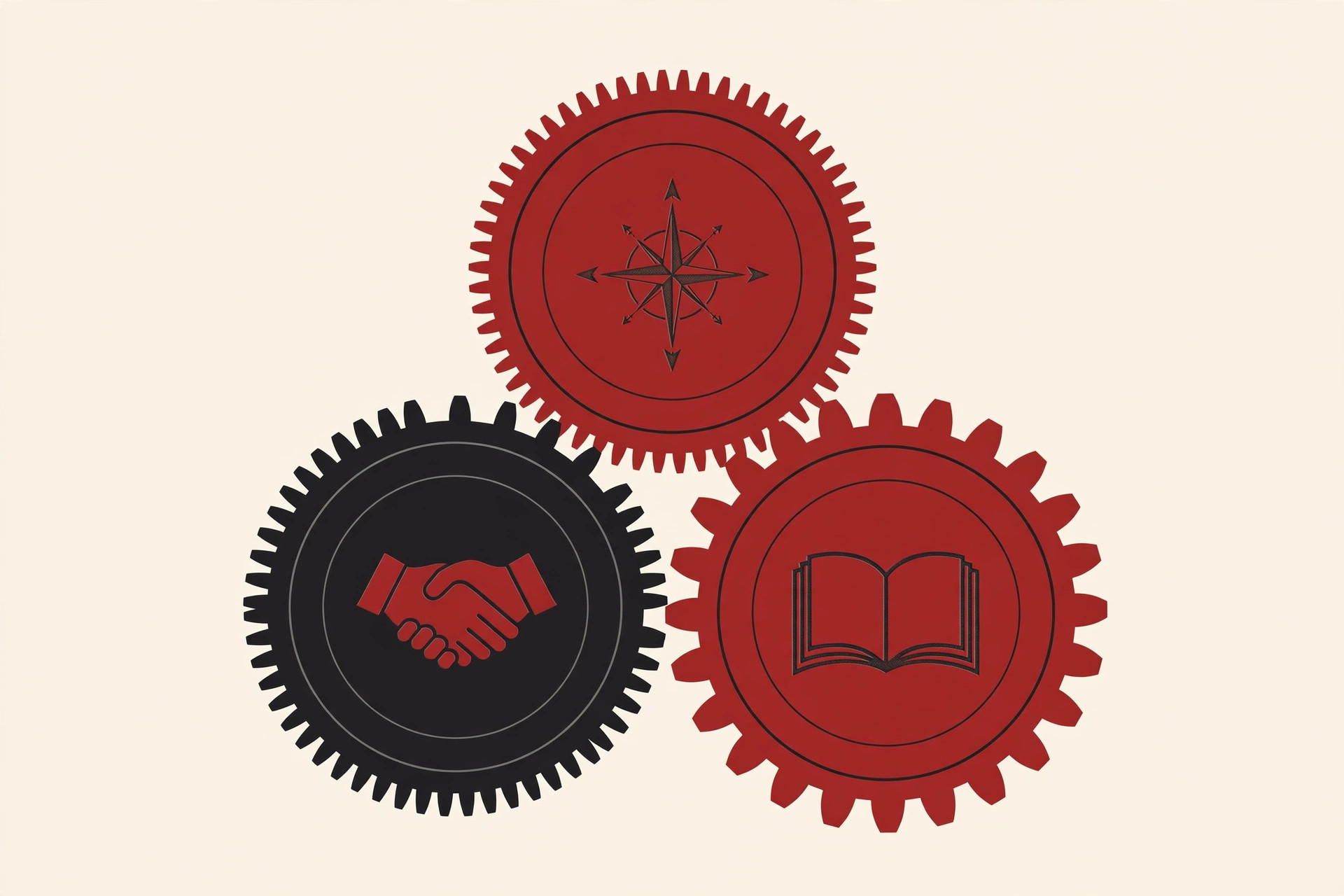
The Adaptive Software Development Lifecycle
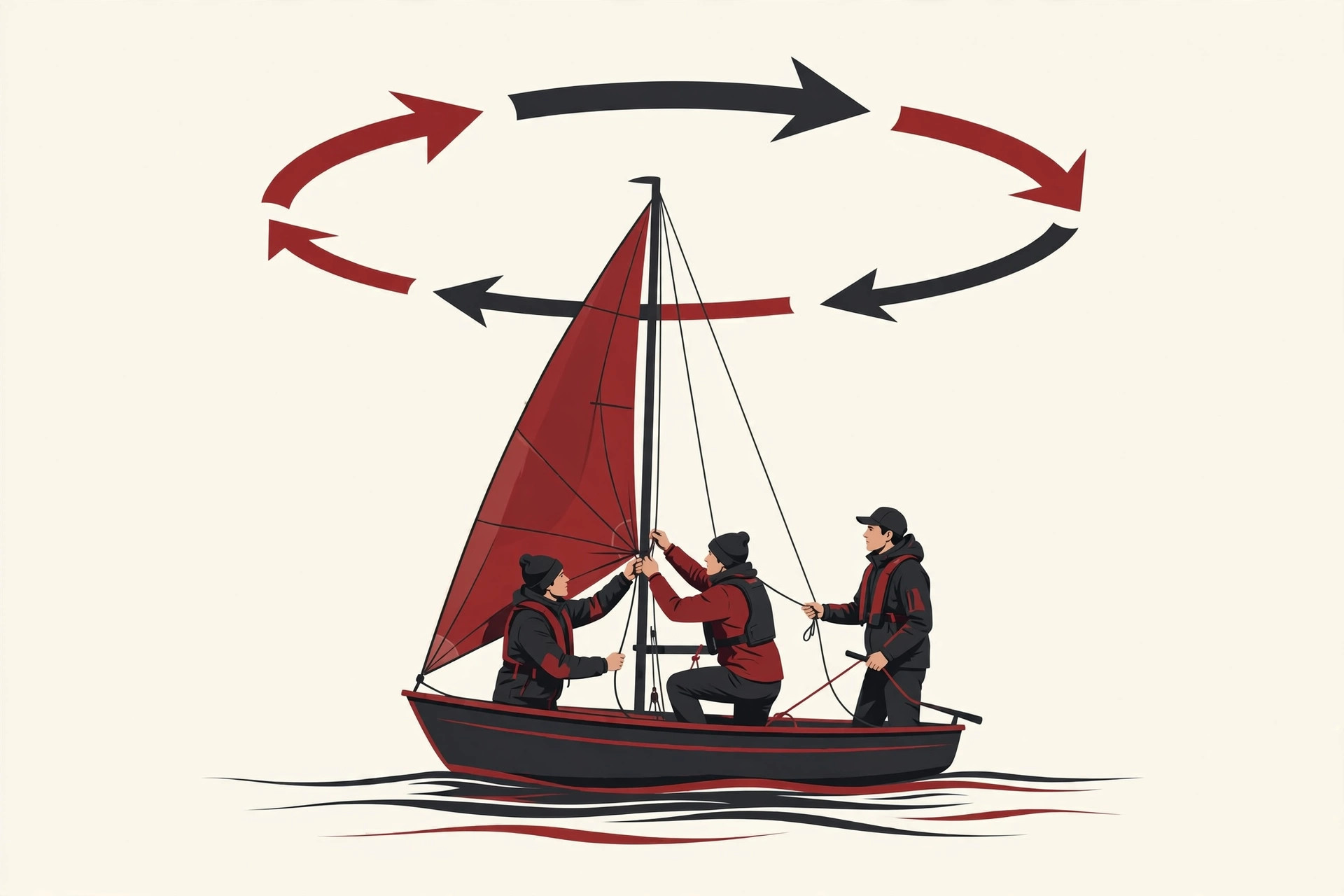
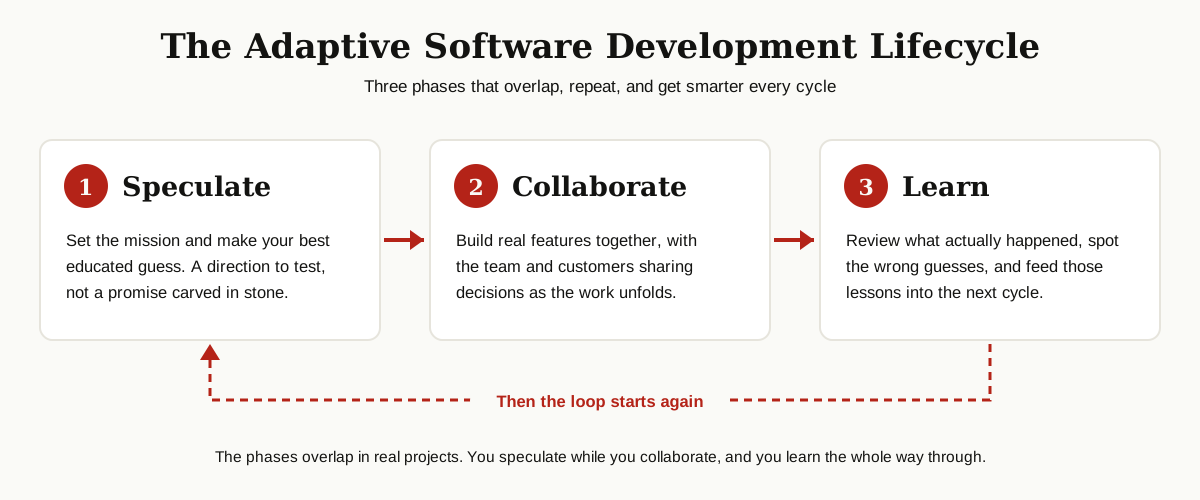
The ASD lifecycle replaces the old sequence of plan, design, build, and test with three phases that repeat: Speculate, Collaborate, and Learn. The phases are not a strict assembly line. They overlap, and a project cycles through them many times, with the product getting closer to what users actually need on every pass.
Speculate: An Honest Word for Planning
Every cycle begins with speculation. The team agrees on the mission for the cycle, looks at the basic requirements and the constraints, such as delivery dates, and picks the features it will try to build.
Why not just call this planning? Because Highsmith wanted to kill a dangerous illusion. A plan sounds certain, as if the future were already known. On a complex project, it never is. To speculate means to form a view based on incomplete information, which is an honest description of what project planning really is. As Highsmith explains, a traditional team treats any move away from the plan as a mistake to correct. An adaptive team treats that same move as information, and uses it to steer toward a better result.
Speculation is not wild guessing, and it is not skipping the thinking. The team still studies the problem, sets priorities, and commits to a direction. It just holds that direction with an open hand, fully expecting to revise it when the Learn phase brings back evidence.
Collaborate: Building Together
Next, the team builds. Collaboration in ASD means far more than people sitting in the same room. Developers, testers, managers, and customers work as one team, sharing decisions instead of passing documents down a chain. Customers stay involved throughout, so questions get answered in hours instead of weeks.
This phase balances two kinds of work. Some parts of a project are predictable, and those can be planned and guided in the usual way. Other parts are surrounded by change, shifting requirements, new technology, changing stakeholders, and those can only be handled by adapting as events unfold. Collaboration is where that balancing act happens, day by day. It runs on trust: people need enough freedom to make decisions, and enough contact with each other that those decisions stay joined up.
Learn: The Phase That Makes It Adaptive
Each cycle ends with learning, and this is the phase that separates ASD from simply working in small pieces. The team reviews what it built, checks quality, shows the working software to customers for feedback, and holds a short review of its own working habits.
Learning in ASD works through small mistakes. A cycle is short, so a wrong guess costs days, not months. The team made a guess, reality answered, and now everyone knows more than they did at the start. Those lessons feed straight into the next Speculate phase, which is why every round of the cycle is smarter than the one before.
Skipping the Learn phase is the most common way teams break the method. Without it, cycles are just short deadlines, and nothing actually adapts. Teams that take software testing basics seriously in every cycle also learn faster, because their feedback rests on evidence rather than opinion.
The Six Characteristics of ASD
Textbooks usually describe an ASD project with six characteristics. If a project shows all six, it is ASD in spirit, whatever the team calls it.
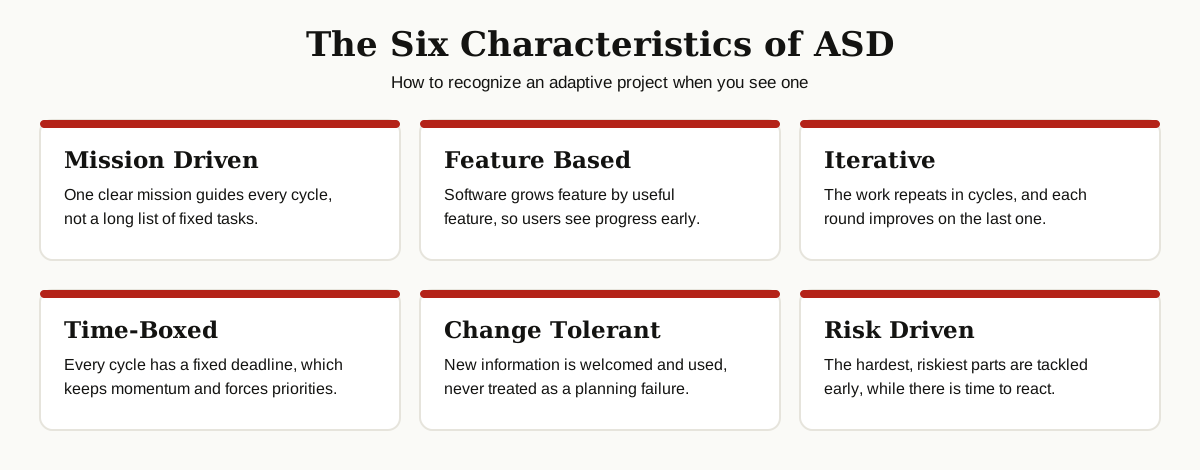
- Mission driven. A clear mission, the real outcome the project exists to achieve, guides every cycle. Tasks can change; the mission holds steady.
- Feature based. The product grows feature by feature. Each feature is something a user can see and use, so progress is real and testable, not just code written.
- Iterative. The cycle repeats. Nothing has to be perfect the first time, because there is always a planned next round to improve it.
- Time-boxed. Every cycle has a fixed end date. When time runs out, the team reviews what it has instead of quietly extending the deadline, which forces honest choices about what matters most.
- Change tolerant. Change is expected at any point, including late in the project. New information is treated as a gift, not as a failure of the original plan.
- Risk driven. Planning follows risk. The hardest and least certain work, such as a new software architecture decision, is scheduled early, while there is still time to recover if it fails.
How a Cycle Looks in Real Life
Imagine a small startup building a food delivery app. Nobody knows yet which features customers will love, and a big competitor is always one launch away. This is ASD home ground.
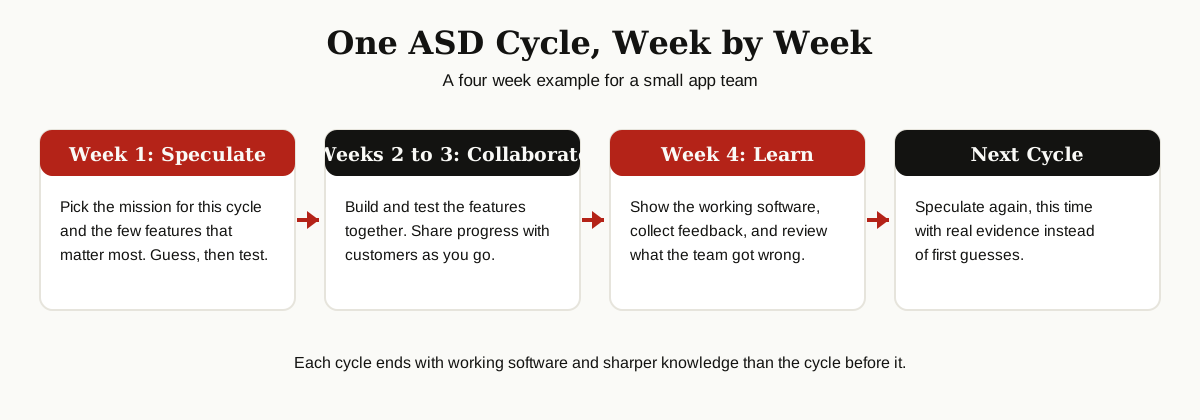
In cycle one, the team speculates. The mission is simple: let a hungry customer order in under three taps. The team guesses that a short menu, guest checkout, and live order tracking matter most. Then it collaborates, building those features over three weeks, with two restaurant owners checking in twice a week. Then it learns. Testers can order quickly, but most abandon the app at the payment screen. The guess about guest checkout was right, and the payment page itself is the problem.

Cycle two starts with evidence instead of hope. The team speculates again, and the mission narrows to fixing payment and adding the one feature every tester requested, one-tap reordering of a favorite meal. The team also changes how it works, adding the faster review step it wished it had last time. That second change matters. ASD adapts the product and the process, and a team that only adapts the product is doing half the method. Many teams warm up to this style through rapid prototyping, building quick versions of an idea before fully committing to it.
ASD vs Waterfall vs Scrum
ASD is often compared with the two approaches people know best. The honest summary is that waterfall makes the opposite bet, while Scrum is a younger, more structured member of the same agile family that ASD helped to start.
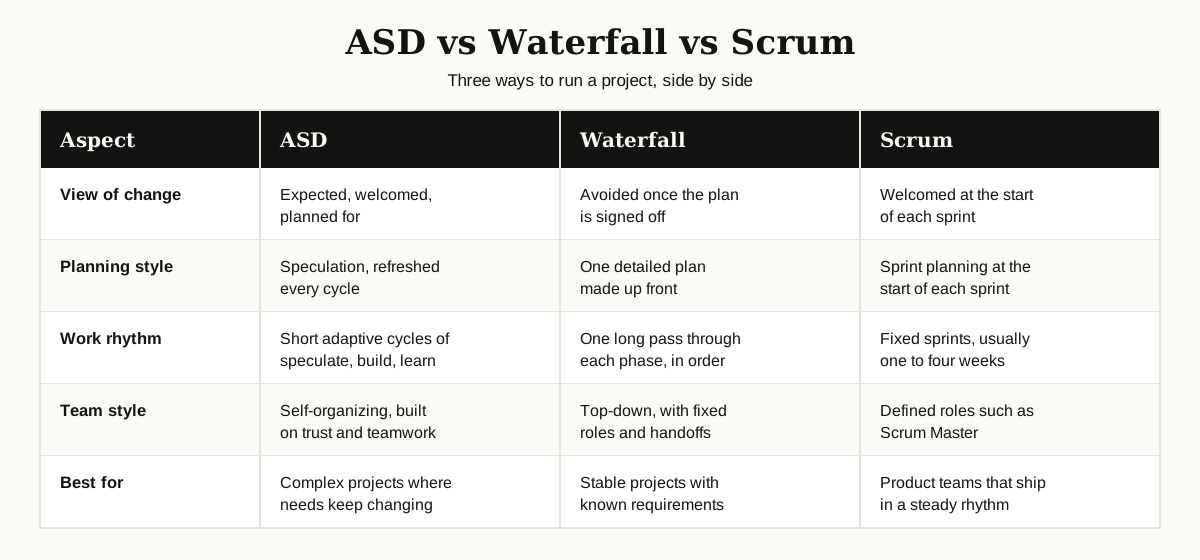
| Aspect | ASD | Waterfall | Scrum |
|---|---|---|---|
| First question | What will we learn this cycle? | What is the full plan? | What will we finish this sprint? |
| View of change | Expected and welcomed | Costly and resisted | Accepted between sprints |
| Guidance given | Principles and a cycle | Fixed phases, in order | Roles, events, and rules |
| Team freedom | High, self-organizing | Low, follows the plan | High, inside the sprint rules |
One fair warning: ASD and Scrum are not enemies, and most teams never choose between them directly. Scrum gives a team a tighter rulebook, with named roles and set meetings. ASD gives a philosophy and a cycle, and trusts the team to fill in the details. Plenty of modern teams run Scrum day to day while quietly living by ASD ideas.
Strengths and Honest Limits
The strengths follow directly from the design. ASD is built for uncertainty, so it stays calm when requirements move. Feedback arrives while change is still cheap. Risks are faced early instead of discovered at the worst moment. And because teams are trusted to organize themselves, people usually do their best work under it.
The limits are just as real. ASD needs experienced, self-organizing teams, and a team that needs close supervision will drift without the structure it provides. The loose style can worry clients who want a fixed price and a guaranteed date before work begins, because on a complex project ASD honestly cannot promise either. ASD also offers fewer ready-made practices than Scrum, so a team must build its own habits for meetings, quality, and documentation. Finally, on a stable project with well understood requirements, all this adapting is overkill, and a simpler planned approach can honestly be cheaper.
Who Should Use ASD?
Reach for the ASD methodology when the target is moving: startups, brand new products, research-heavy work, and markets that change every month. It also suits teams modernizing a live system, where surprises are guaranteed.
Borrow only its ideas when requirements are fixed by law or contract, when the work is routine and well understood, or when a team is too new to steer itself. And if you are a student, know that ASD appears in most software engineering courses for a reason: it is the clearest early statement of the ideas that later became agile.
Key Points to Remember
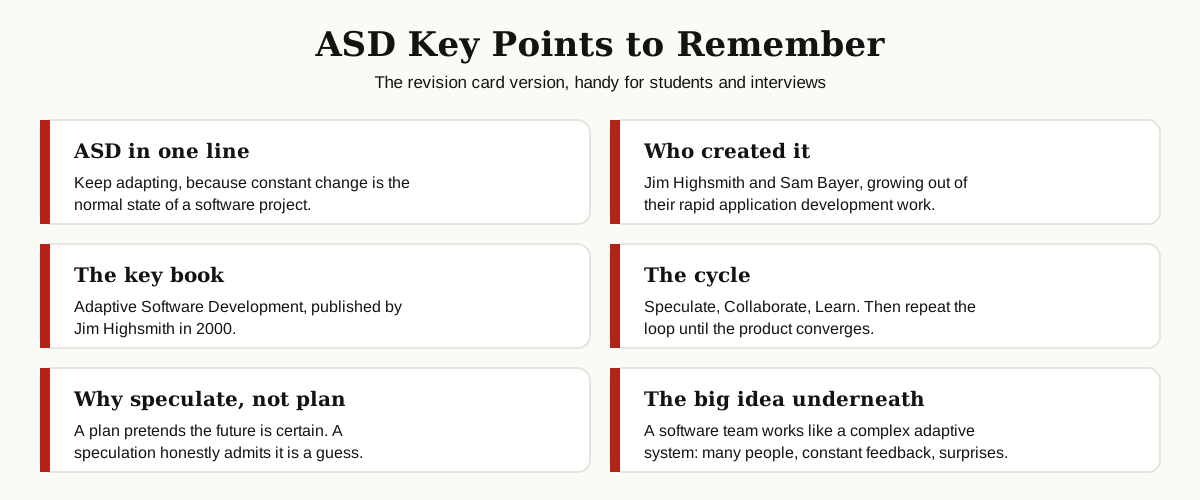
- ASD replaces one big plan with repeating Speculate, Collaborate, and Learn cycles.
- Speculate is honest planning: a best guess that expects to be revised.
- The six traits are mission driven, feature based, iterative, time-boxed, change tolerant, and risk driven.
- Learning is a scheduled phase, not an accident.
- ASD is a root of agile, created by Jim Highsmith and Sam Bayer, and published as a book in 2000.
Conclusion
Adaptive software development starts from a truth every experienced developer learns the hard way: on a complex project, change is not the exception. It is the job. ASD answers with a simple rhythm: guess honestly, build together, learn deliberately, and repeat until the product converges on what people actually need. To keep exploring ways of building software well, browse the rest of our software development guides.