Type “product lifecycle management” into a search engine and you will find two different ideas sharing one name. One is a business discipline backed by serious software, used by the companies that design and build physical products. The other is a marketing model about how sales rise and fall after a product launches.
This guide covers both, in plain English, and keeps them clearly separated. It starts with the main meaning: product lifecycle management, usually shortened to PLM, the system that keeps every fact about a product in one place from the first sketch to the day the product is retired.
What Is Product Lifecycle Management?
Product lifecycle management is the practice of managing everything about a product, its data, its documents and its changes, in one connected system across the product’s entire life.
Picture a company that makes industrial pumps. The design team draws the pump in CAD software. Purchasing needs the list of parts. The factory needs assembly instructions. The service team needs repair manuals and spare part numbers. The supplier across the world needs the exact specification of one component.
Without PLM, each of those teams keeps its own files: spreadsheets on shared drives, drawings in email threads, printed manuals that may be years old. The files drift apart. Somebody builds from an old drawing, and the mistake is only found after real money has been spent.
PLM fixes that by giving the product one shared home. As Siemens explains in its PLM guide, product lifecycle management brings people, processes and information together across the whole lifespan of a product, from the first concept to design, manufacturing, service and end of life, so everyone works from a single source of truth.
The Journey PLM Manages
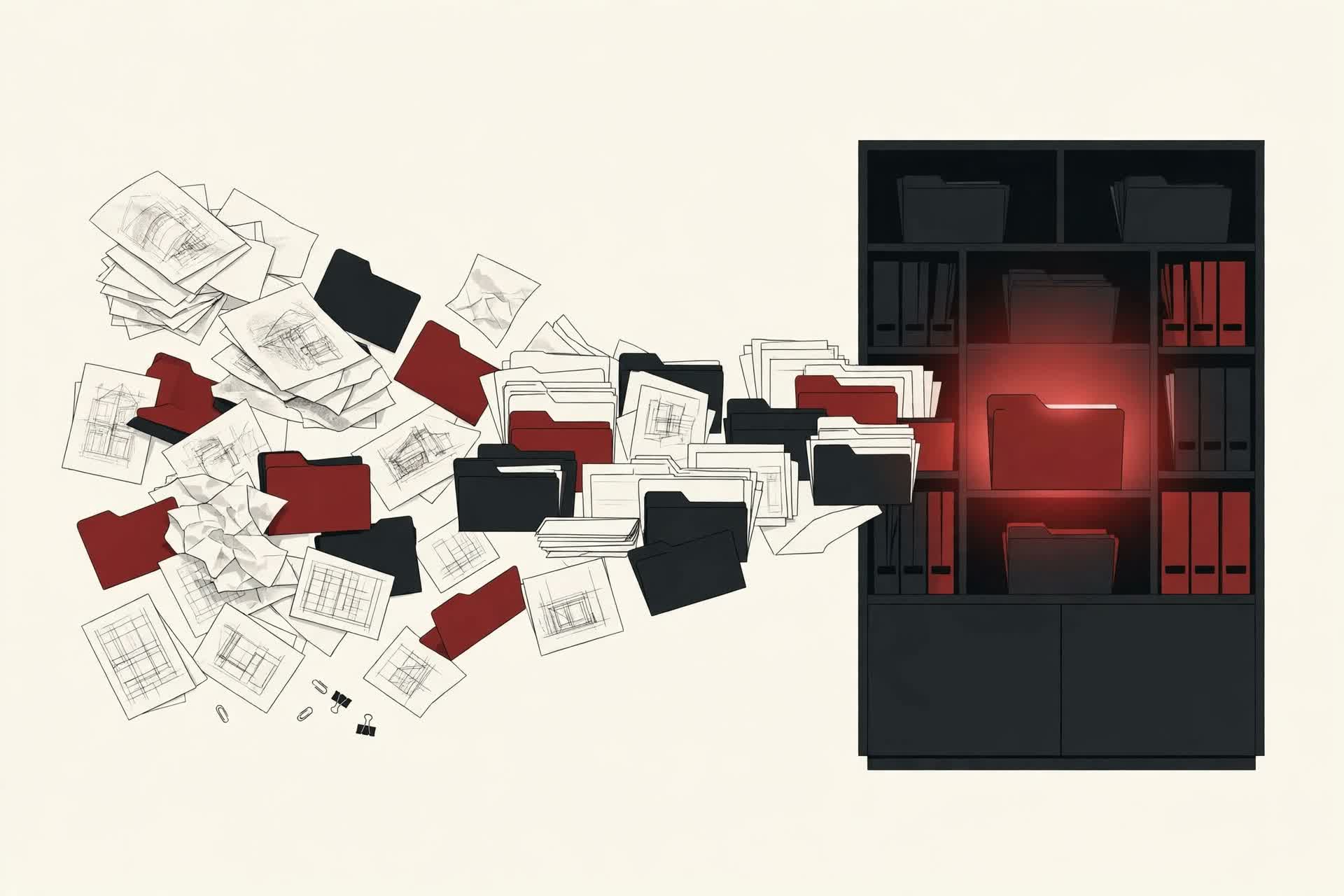
A product passes through five broad stages, and PLM keeps one correct record through all of them.
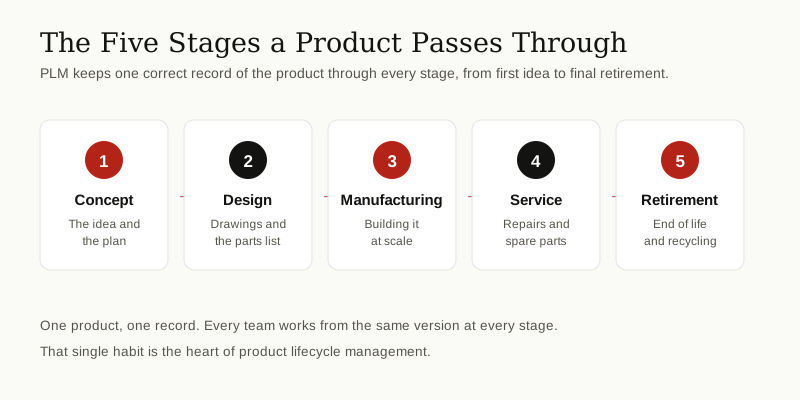
- Concept. The idea stage. What should we build, for whom, and roughly what should it cost? Early sketches, requirements and rough plans live here.
- Design. Engineers turn the idea into precise drawings and 3D models, and work out the full list of parts.
- Manufacturing. The factory builds the product. Work instructions, quality checks and the parts list used on the floor all come from the same record.
- Service. Customers use the product. Repairs, spare parts and fixes rely on knowing exactly which version of the product each customer owns.
- Retirement. The product is discontinued. Records are archived, remaining parts are handled, and lessons feed into the next product.
The important point is that these stages are connected. A design decision made in stage two affects repairs in stage four. PLM keeps that thread intact, so nothing important is lost between teams or across the years a product may live.
What Actually Lives Inside a PLM System
A PLM system stores more than files. It stores the relationships between them. The main contents are:
- Designs and CAD models. The drawings and 3D models of every part, with a full version history.
- Bills of materials. The parts list for the product, explained below.
- Change records. Every approved change, who requested it, who approved it, and what it affects.
- Documents and specifications. Requirements, test results, certificates and the raw material behind the site’s wider technical documentation.
- Requirements and quality records. What the product must do, and proof that it does it, which matters a lot in regulated industries like medical devices and aviation.
The Bill of Materials, in Plain Words
One term deserves a slow explanation, because it sits at the center of PLM: the bill of materials, or BOM.
A bill of materials is simply the complete recipe of parts needed to build one unit of a product. If the product is an office chair, the bill of materials lists the seat, the backrest, two armrests, the base with its wheels, and every screw. Nothing is too small to list, because the factory and the purchasing team both work from this recipe.
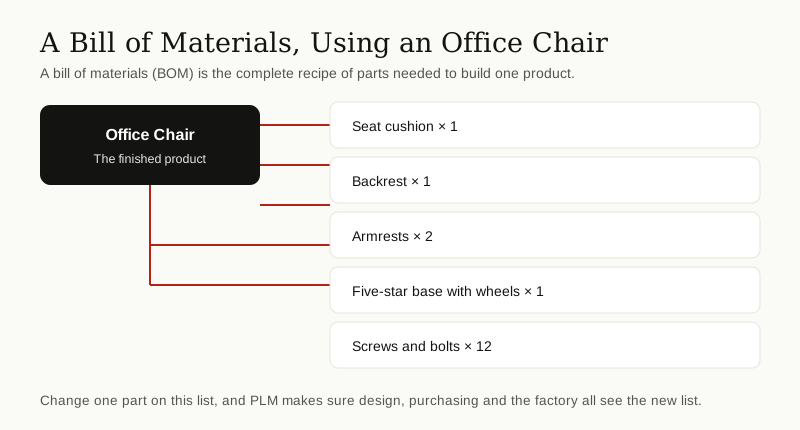
Change one part, say a stronger wheel, and the bill of materials changes. In a PLM system, that single update flows to the design, the cost estimate, the purchasing order and the service manual at the same time. In a world of scattered spreadsheets, someone has to remember to update each copy by hand, and sooner or later one copy is missed.
Why Companies Use PLM
Companies adopt PLM for practical reasons, not fashion. Four benefits come up again and again.
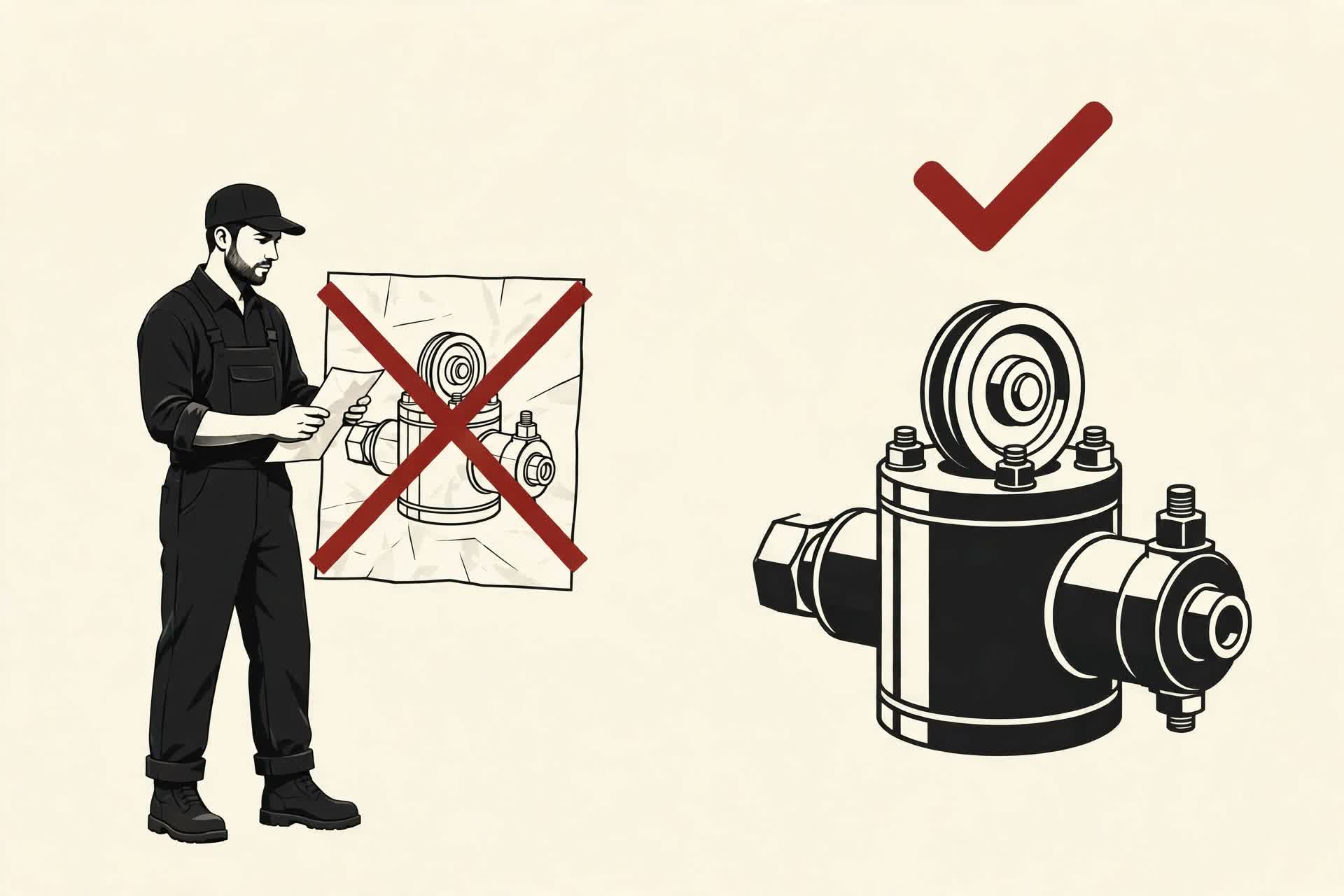
Fewer errors from outdated information. The most expensive mistakes in manufacturing often start with a correct team using a wrong, old version of a drawing. Version control inside PLM means the latest approved version is the one everyone sees, and old versions are archived rather than quietly passed around.
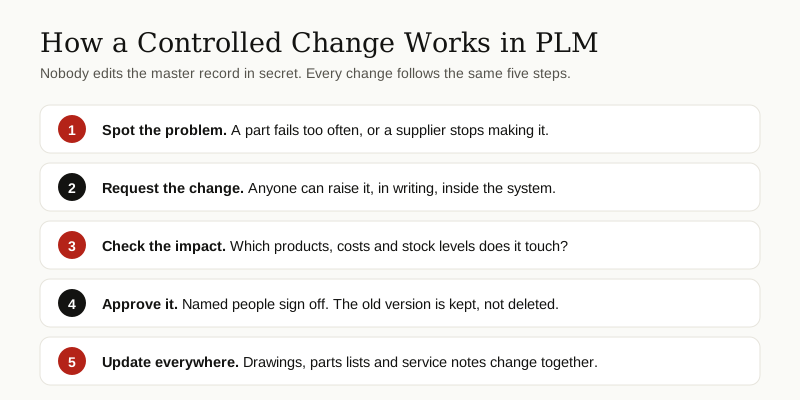
Controlled changes. Products change constantly: a part is improved, a supplier is replaced, a safety issue is fixed. In PLM, a change is never a quiet edit. It is a request that gets reviewed for its impact on cost, stock and other products, approved by named people, and then applied everywhere at once. The old version is kept in the history, so any decision can be traced later.
Faster product launches. When teams stop hunting for files and re-checking which version is right, development moves faster. Designers can also reuse proven parts from earlier products instead of designing everything from zero, because the PLM system makes those parts easy to find.
Better compliance and quality. Regulated industries must prove how a product was designed and changed. PLM keeps the audit trail automatically: every version, every approval, every test result. Teams often track the results of all this work with a small set of kpi examples for launch speed, error rates and change turnaround time.
PLM Software: The Names You Will Hear
Product lifecycle management is a discipline first and a software category second, but most larger companies run it on a dedicated platform. Three vendors dominate the enterprise end of the market, and it helps to know them neutrally.

Siemens Teamcenter. Teamcenter is Siemens’ PLM platform, and one of the most widely used PLM systems in the world. It manages CAD data, bills of materials, engineering changes and documents in one environment, and Siemens also offers Teamcenter X, a cloud version delivered as a service for companies that do not want to run the system themselves.
PTC Windchill. Windchill is PTC’s enterprise PLM software. It connects product data, processes and people across engineering, manufacturing and the supply chain, with strong tools for BOM management, engineering change and configuration management, and quality workflows.
Dassault Systèmes ENOVIA. ENOVIA is the PLM offering inside Dassault Systèmes’ 3DEXPERIENCE platform. As Dassault Systèmes describes ENOVIA, it connects people, ideas, data and processes in real time, linking the product, its bill of materials and configuration, the organization, and the network of suppliers and partners.
One trend is worth noting: all three vendors now sell their platforms as cloud services, not just as software a company installs and runs on its own servers. Siemens offers Teamcenter X as a service, PTC offers a cloud version called Windchill+, and ENOVIA runs on the cloud-based 3DEXPERIENCE platform. For buyers, that means PLM is slowly becoming something a mid-sized company can rent and grow into, rather than a system only the largest manufacturers can afford to run.
None of these is the right choice for every company. They are enterprise tools, priced and implemented for organizations with complex products, many variants, and teams spread across sites and countries. Smaller firms often start with the PDM features inside their CAD software, or with the habits described at the end of this article, and move to a full PLM platform when the complexity demands it.
Who Uses PLM Day to Day?
PLM starts with engineering, because that is where product data is born. Designers check drawings in and out, release new versions, and raise change requests.
From there, the circle widens:
- Manufacturing teams read the released designs and parts lists, and plan how the product will be built.
- Quality teams attach test results and inspection records to the exact product version they checked.
- Service teams look up which parts a specific customer’s product contains, so the right spare part is shipped the first time.
- Suppliers and partners get controlled access to just the specifications they need, instead of emailed files that can leak or go stale.
- Managers watch the status of designs, changes and launches without chasing people for updates, often alongside their wider project management tools.
The pattern to notice: PLM is not a tool one department owns. It is shared infrastructure for everyone whose work depends on product facts being correct.
The Other Meaning: The Marketing Product Life Cycle
Now for the second idea that shares the name. In marketing, the product life cycle is a model that describes how a product’s sales typically behave over time after it reaches the market. It has four stages.
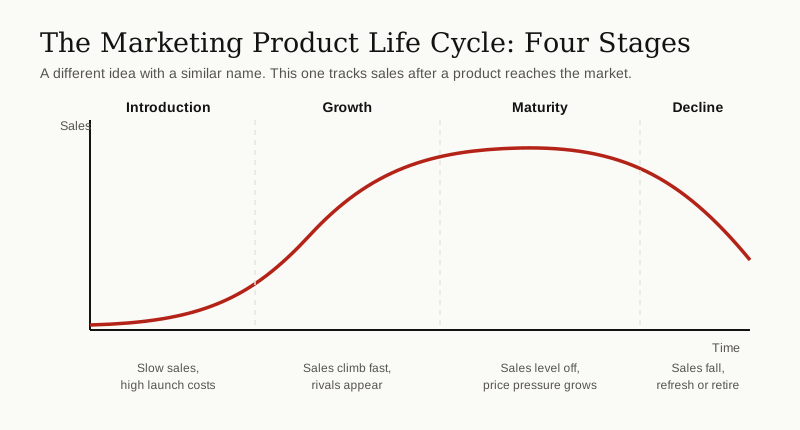
- Introduction. The product launches. Sales are slow, because few people know it yet, and launch costs are high.
- Growth. Word spreads, sales climb quickly, and competitors start to appear with their own versions.
- Maturity. Sales level off. Most people who want the product already have it, competition is at its strongest, and price pressure grows.
- Decline. Sales fall as tastes change or newer technology replaces the product. The company must refresh it, cut its price, or retire it.
Here is how the two ideas connect, and how they differ. The marketing model is about sales over time; it helps marketers and managers decide when to advertise, discount, expand or retire a product. Product lifecycle management is about information over time; it is the system that keeps the product’s data correct from idea to retirement.
They also cover different ground. The marketing life cycle starts at launch, while PLM starts much earlier, at the first concept, and continues after decline into service and archiving. A healthy company quietly uses both: the marketing model to plan the product’s commercial life, and the PLM system to run its engineering life.
PLM Thinking Without Enterprise Software
Enterprise PLM platforms are out of reach for many small companies, and honestly, most small teams do not need one yet. What they need is the thinking behind PLM, applied with simple tools.
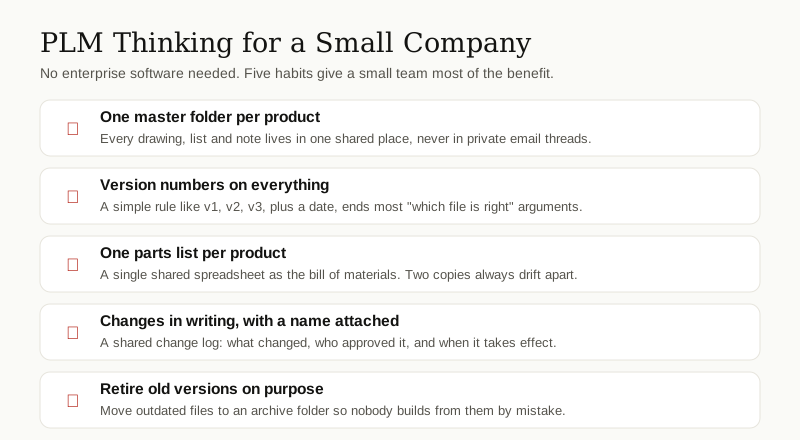
- One master folder per product. Every drawing, parts list and note lives in one shared place, with a clear name. The master copy is never the file on someone’s laptop.
- Version numbers on everything. A simple rule, like adding v1, v2 and a date to every file name, ends most arguments about which file is current.
- One parts list per product. Keep a single shared spreadsheet as the bill of materials. The moment two copies exist, they will drift apart.
- Changes in writing, with a name attached. A shared change log that records what changed, who approved it, and when it takes effect. It takes two minutes and prevents the most expensive class of mistakes.
- Retire old versions on purpose. Move outdated files into an archive folder. Old versions should be findable for history, but impossible to grab by accident.
When a company outgrows these habits, the warning signs are clear: the same part gets designed twice, the factory builds from an old drawing, or a customer asks a question about a product version that nobody can answer. That is the moment dedicated PLM software stops being a luxury.
The Bottom Line
Product lifecycle management, at its heart, is a simple promise: one product, one record, and every team working from the same correct version of the truth. The software from Siemens, PTC and Dassault Systèmes exists to keep that promise at industrial scale, across thousands of parts and years of changes. The marketing product life cycle is a separate, useful model about sales, and it deserves its own place in a manager’s toolkit, just not the same place.
Whether a company buys a platform or starts with five careful habits, the goal is identical: stop losing time, money and trust to outdated information.
For more guides like this one, browse the business productivity category.