Almost every company has a policy document, a training slide deck, or a framed code of conduct that says exactly how work should be done. The harder question is different: is any of it actually happening on a normal Tuesday, when nobody is watching?
Compliance monitoring is the work that answers that question. It is the steady, ongoing practice of checking whether your company really follows the laws, regulations, and internal rules it claims to follow, and then fixing what those checks uncover.
This guide explains compliance monitoring in plain English: what it is, why it exists, how it works step by step, who does the work, and how even a small company can start without expensive software.
What Is Compliance Monitoring?
Compliance monitoring is the regular testing of a company’s real behavior against the rules that apply to it.
Those rules come from two places. Some come from outside: laws and regulations set by governments and industry regulators. Others come from inside: your own policies, procedures, and codes of conduct. Monitoring compares what the documents promise with what people and systems actually do day to day, and it keeps evidence of what it finds.
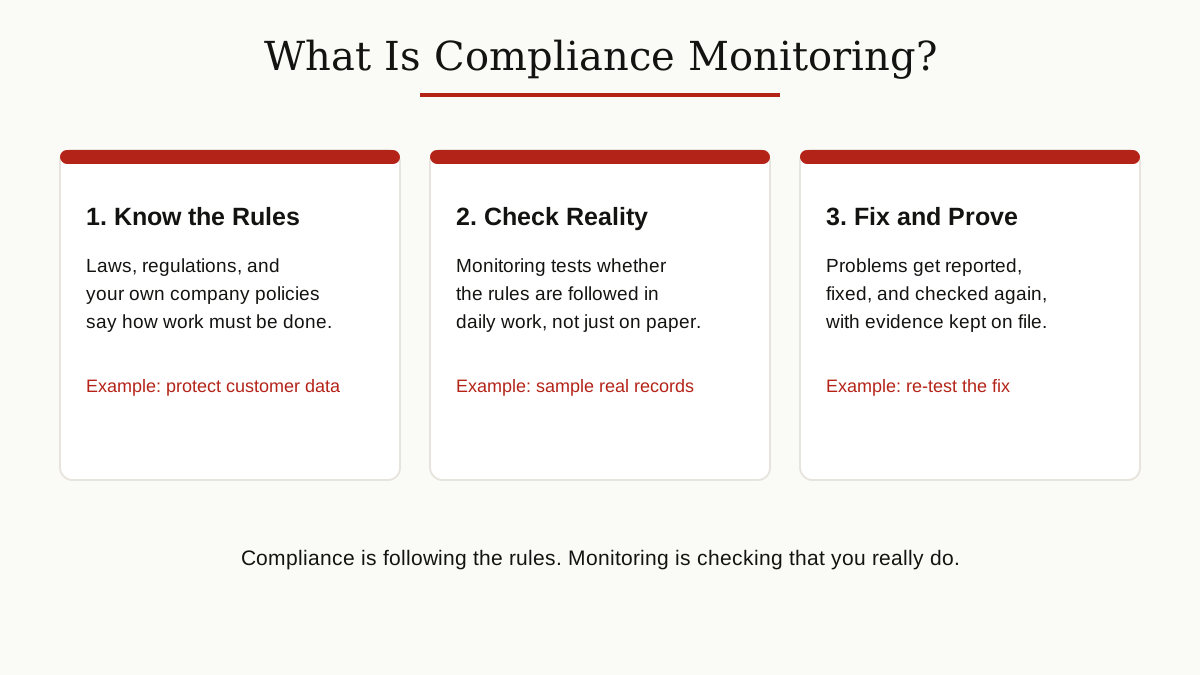
One distinction matters here. Compliance means following the rules. Compliance monitoring means checking, on purpose and on a schedule, that the following is really happening. A company can have excellent written policies and still fail in practice, because a form nobody uses, a training nobody finished, or an approval step everyone skips is invisible until someone goes looking.
Monitoring is also not the same as an audit. An audit is usually a deep, independent review of a whole area at one point in time. Monitoring is the routine checking that runs between audits, often done by people inside the company. The two support each other, a point we will return to below.
Why Compliance Monitoring Exists
Rules are not decoration. Every industry has rule areas that exist because something real is at stake:
- Money and banking rules govern how customer money is handled, how loans are sold, and how firms guard against dirty money being washed through the financial system.
- Health data rules protect patient information. In the United States, the law known as HIPAA sets rules for how health care organizations must guard that information.
- Personal data rules protect everyone’s information. In the European Union, the GDPR sets the rules for how companies collect, store, and use personal data.
- Workplace safety rules exist so that people come home from work unharmed.
- Your own customers and partners often demand proof too. Many companies adopt voluntary standards such as SOC 2 or ISO 27001 to show clients that their controls are real and tested.
In some industries, monitoring is not a choice at all. In the United Kingdom, the Financial Conduct Authority’s rulebook requires regulated firms to keep adequate policies and procedures, and it expects their compliance function to monitor, on an ongoing basis, whether those procedures are adequate and effective, working from a risk-based monitoring programme. In plain words, the regulator wants proof that you check yourself, not a promise that you meant well.
Companies that skip this work usually learn about their problems in the worst possible way: from a regulator, an angry customer, or a news story. A problem your own monitoring finds early is almost always calmer and cheaper to fix than the same problem found by someone outside.
How Compliance Monitoring Works, Step by Step
The details vary by industry, but the shape of the work is the same almost everywhere. It runs as a five step cycle.
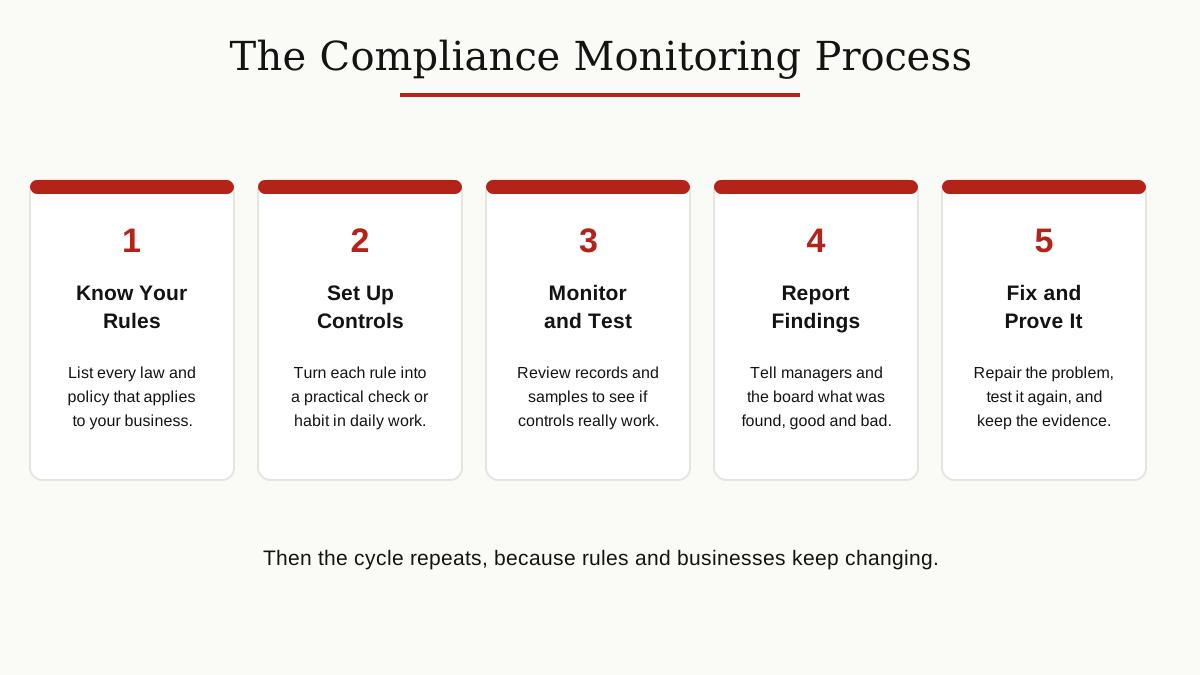
Step 1: Know Which Rules Apply to You
Everything starts with a list. Which laws, regulations, contract promises, and internal policies apply to each part of your business? Who owns each rule? The list also has to stay alive, because rules change and businesses change. If most of your rules are about data, our guide to data governance frameworks shows how companies organize that side of the work.
Step 2: Turn Rules Into Controls
A rule on its own is just a sentence. A control is the concrete habit or check that makes the rule real. For example, the rule “only staff who need customer records may see them” becomes the control “managers review the access list for their team every quarter and remove anyone who no longer needs access.” Controls are the things monitoring can actually test.
Step 3: Monitor and Test the Controls
Now the checking begins. Testers take samples of real work: a set of transactions, a batch of customer files, a list of system logins, and they ask a simple question: did the control work here? Testing is usually risk-based, which means the areas where a mistake would hurt most get checked most often and most deeply, and calmer areas get a lighter touch.
Step 4: Report What You Find
Findings go into a report for managers and, in bigger companies, the board. A good report is short and honest: what was tested, what passed, what failed, how serious each failure is, and what happens next. The simple numbers inside these reports, such as how many fixes are overdue or how often the same finding repeats, are classic KPI examples: small measurements tied to a real goal.
Step 5: Fix the Problem and Prove the Fix
A finding without a fix is just bad news filed away. Each problem gets an owner and a deadline. In larger companies, fixes are tracked like any other work, often in the same project management tools the teams already use. When the fix is done, someone tests it again. Only then is the finding closed, with the evidence kept on file. Then the cycle starts over, because next quarter brings new rules, new staff, and new ways for things to drift.
What Gets Monitored in Real Life
Compliance monitoring sounds abstract until you see what actually gets checked. Common targets include:
- Transactions and payments: were approvals given, limits respected, and records complete?
- System access: who can see sensitive data, and did anyone log in who should not have?
- Training completion: did every employee actually finish the required training, or just get enrolled in it?
- Customer complaints: are they logged, answered on time, and read for patterns?
- Policy updates: when a rule changes, did the procedure change too, and did staff hear about it?
- Records and approvals: are the documents that prove all of the above stored where they can be found?
Notice the pattern: monitoring rarely reads the policy itself. It reads the footprints the policy was supposed to leave behind.
Continuous Monitoring vs. the Once-a-Year Audit
For decades, the default rhythm was the periodic audit: once a year, reviewers arrive, evidence is gathered in a rush, and the company gets a snapshot of one moment. Snapshots are useful, but a lot can drift in the other eleven months.
That is why many companies now add continuous monitoring, where key checks run all the time, often with software watching logs, access changes, and approvals as work happens. IBM describes continuous compliance as the practice of monitoring systems for compliance continuously instead of relying on periodic audits, and the US National Institute of Standards and Technology defines continuous monitoring as maintaining ongoing awareness of security, vulnerabilities, and threats so leaders can make risk decisions with current information.
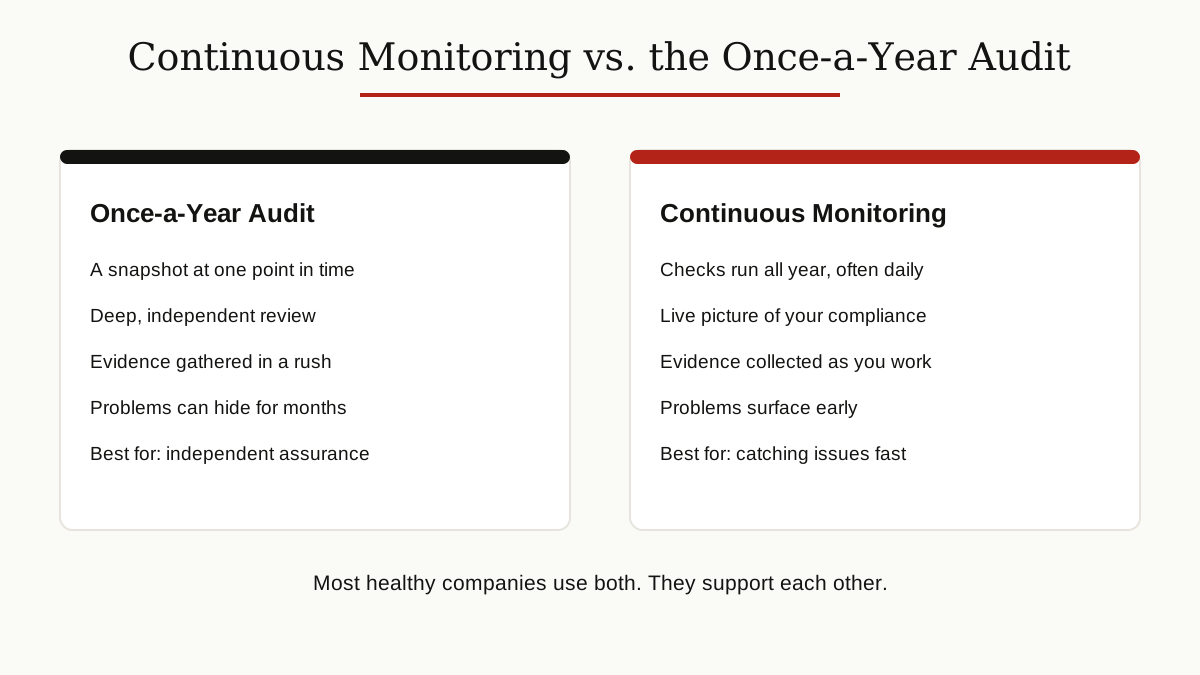
| Point | Once-a-Year Audit | Continuous Monitoring |
|---|---|---|
| When it happens | One point in time | All year, often daily |
| Depth | Deep and independent | Broad and frequent |
| Evidence | Gathered for the event | Collected as work happens |
| Problems surface | Sometimes months late | Usually early |
You do not have to choose one and abandon the other. Monitoring keeps the house tidy every week. The audit is the deep inspection that confirms the tidiness is real. Healthy companies use both.
Who Does the Work: Compliance Teams vs. Internal Audit
In larger companies, the work is split into layers. The Three Lines Model from the Institute of Internal Auditors describes the split in a way most organizations now follow:
- First line: the teams doing the work. They own the risks in their own area. They follow the rules, run the basic controls, and fix small problems themselves.
- Second line: compliance and risk specialists. They set the standards, explain the rules, advise the first line, and run the monitoring programme that checks whether the rules are holding.
- Third line: internal audit. Internal auditors stand apart from daily operations. They independently test whether the whole system, including the compliance team’s monitoring, actually works, and they report to the board.
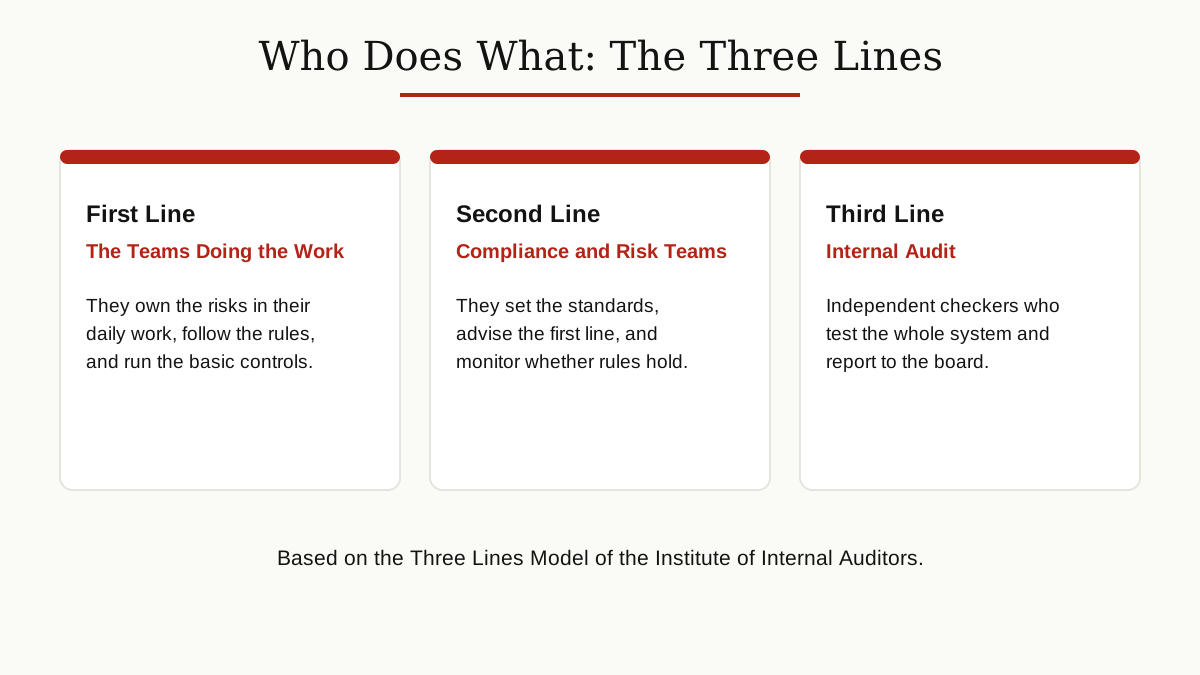
So how do a compliance team and internal audit differ? The compliance team is a player-coach: it helps design the controls, teaches people, and watches the game as it happens. Internal audit is the referee who arrives later with fresh eyes and no stake in the result. One more rule of thumb matters: people should never monitor their own work. UK financial rules even say this outright, requiring that staff in the compliance function not be involved in performing the very activities they monitor.
The Role of Compliance Monitoring Software
Software does the watching that humans cannot do at scale. In practice, compliance monitoring software collects data from your systems, runs checks against your controls, sends alerts when a check fails, shows the overall picture on dashboards, and stores an audit trail: a dated record of what was checked, what was found, and what was done about it.
Bigger companies often pull these pieces together in platforms known as GRC tools, short for governance, risk, and compliance. Whatever the label, the job is the same: turn scattered logs and records into one clear answer to the question “are we following our rules right now?”
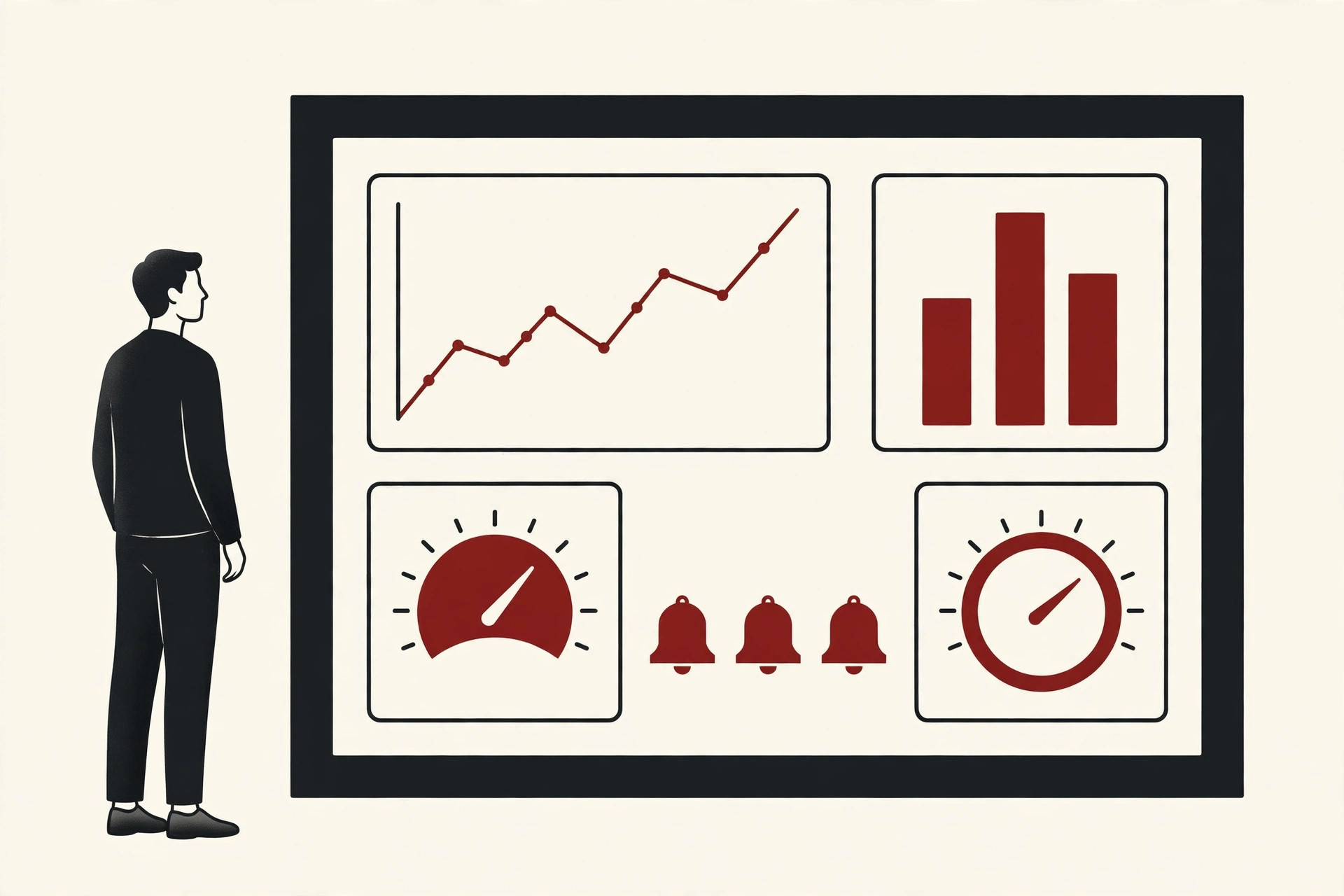
Software has honest limits, though. It is excellent at watching systems: access rights, missing approvals, expired training records. It is weaker at human things: whether a form was explained honestly to a customer, or whether a shortcut has quietly become the normal way of working. Dashboards support the checkers. They do not replace them.
Compliance Monitoring for a Small Company
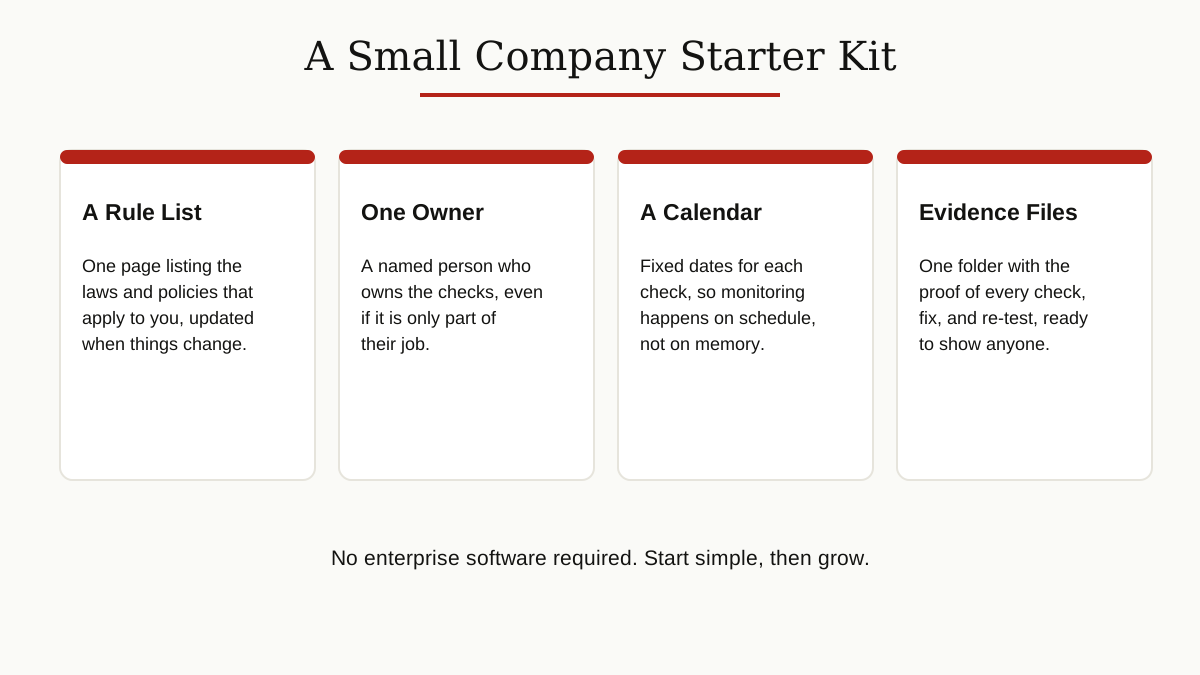
Reading all of this, a small business owner could reasonably ask: is this only for banks? It is not. The same cycle scales down to four humble ingredients:
- A rule list. One page naming the laws and policies that apply to you.
- One named owner. A real person who owns the checks, even if it is only a small part of their job.
- A simple calendar. Fixed dates for each check, so monitoring runs on schedule instead of on memory.
- An evidence folder. One place where the proof of every check, fix, and re-test is kept.
Start with your riskiest area, the one where a mistake would hurt a customer or your business most, and monitor that well. A short, honest routine you actually keep beats an impressive programme that exists only in a slide deck.
The Honest Limit: Monitoring Finds Problems, Culture Prevents Them
Here is the truth that software vendors rarely print: all compliance monitoring, however advanced the tools, is detective work. It finds problems, usually after they have already happened. It tells you a control failed. It cannot, by itself, stop the next failure.
Prevention lives somewhere else: in clear rules people understand, training that treats staff like adults, hiring and leadership that model the behavior, and a culture where raising a problem early is praised instead of punished. Think of monitoring as the smoke alarm. The alarm is essential, and you should test it. But the alarm does not stop fires from starting. What stops fires is how the kitchen is run every day.
One closing note: this article is general information to help you understand the topic. It is not legal advice, and any company in a regulated industry should confirm its exact duties with its own compliance or legal advisers.
The Bottom Line
Compliance monitoring is how a company proves, to itself before anyone else, that its promises are real. Know your rules, turn them into controls, test the controls, report honestly, and fix what you find, with evidence. Split the work so that nobody grades their own homework, use software to watch at scale, and remember that culture does the preventing while monitoring does the catching.
For more guides like this one, browse the business productivity category, where we cover planning, teamwork, and the everyday systems that keep good companies running well.