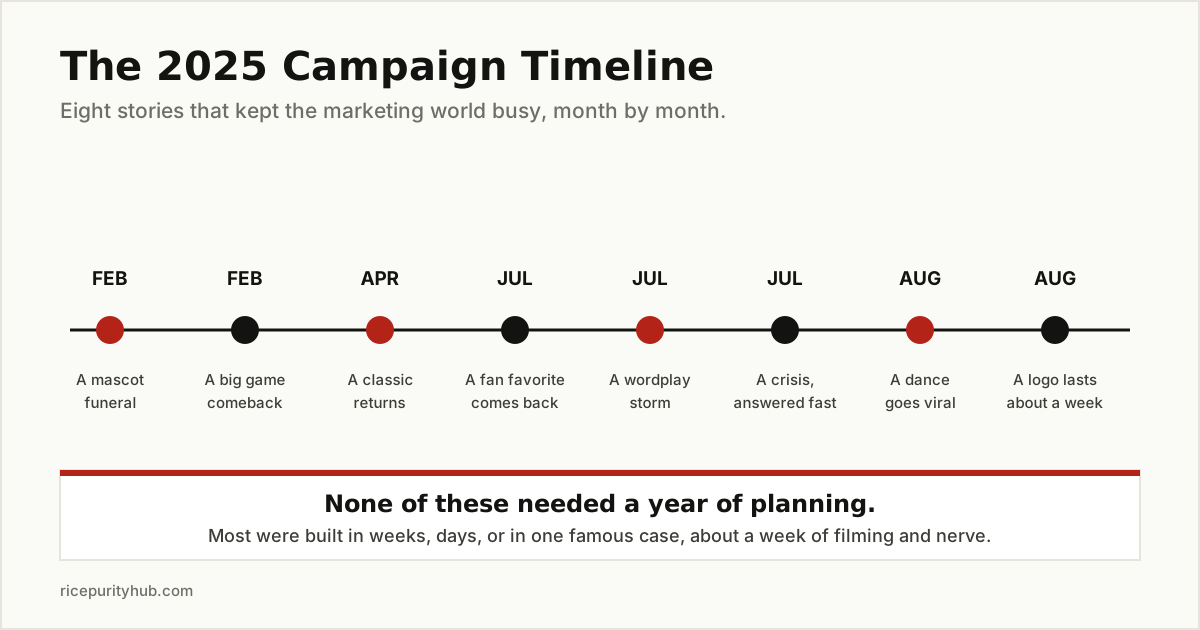
Every year, thousands of campaigns launch and vanish without a trace. A handful do the opposite: they take over group chats, news feeds and dinner table talk for days. Looking back at 2025, the year in marketing belonged to a language app that faked a mascot funeral, a soda brand that brought back an old favorite, and one restaurant chain that learned the hard way how much people love an old logo.
This is a look back at eight innovative marketing campaigns 2025 examples worth studying closely: real campaigns, widely reported at the time they ran. Most are wins worth copying. Two are cautionary tales, and they may teach even more. Under every stunt below sat one simple thing: a clear promise people could repeat to a friend. That is the whole job of a value proposition, and it is why these stories are worth studying even if your marketing budget is close to zero.
What “Innovative” Actually Meant in 2025
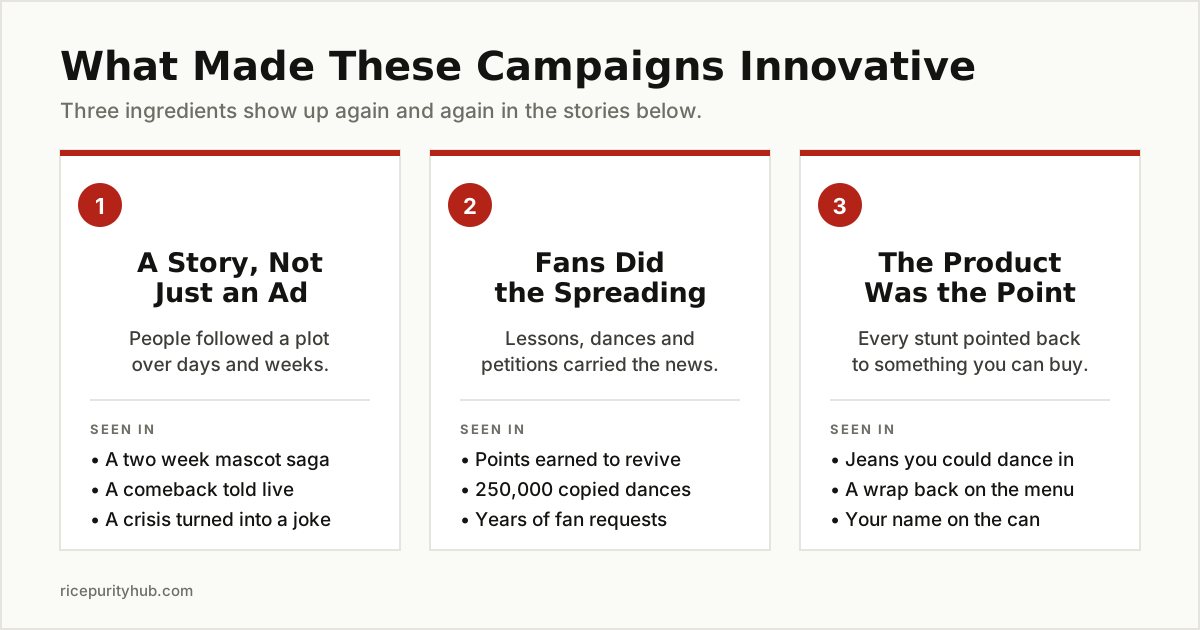
Here is the surprise: almost none of the year’s biggest campaigns used brand new technology. AI tools were everywhere in marketing departments in 2025, and we cover that shift in our guide to generative AI for marketing. But the campaigns people still talk about ran on older fuel: a story told in chapters, fans invited to take part, and teams ready to move within days when a moment opened up.
Three ingredients show up again and again. The campaign was a story, not a single ad. Fans did the spreading, through lessons, dances and petitions. And every stunt pointed back to a product you could actually buy. Keep those three in mind as you read.
1. Duolingo: The Mascot Funeral Nobody Asked For
On February 11, 2025, Duolingo announced on social media that Duo, its green owl mascot, was dead. A follow-up post the next day revealed the supposed cause: the owl had been hit by a Cybertruck. According to Fast Company’s inside account of the campaign, the plan started small. The team had built the stunt in about six days, as an app icon change plus three social posts.
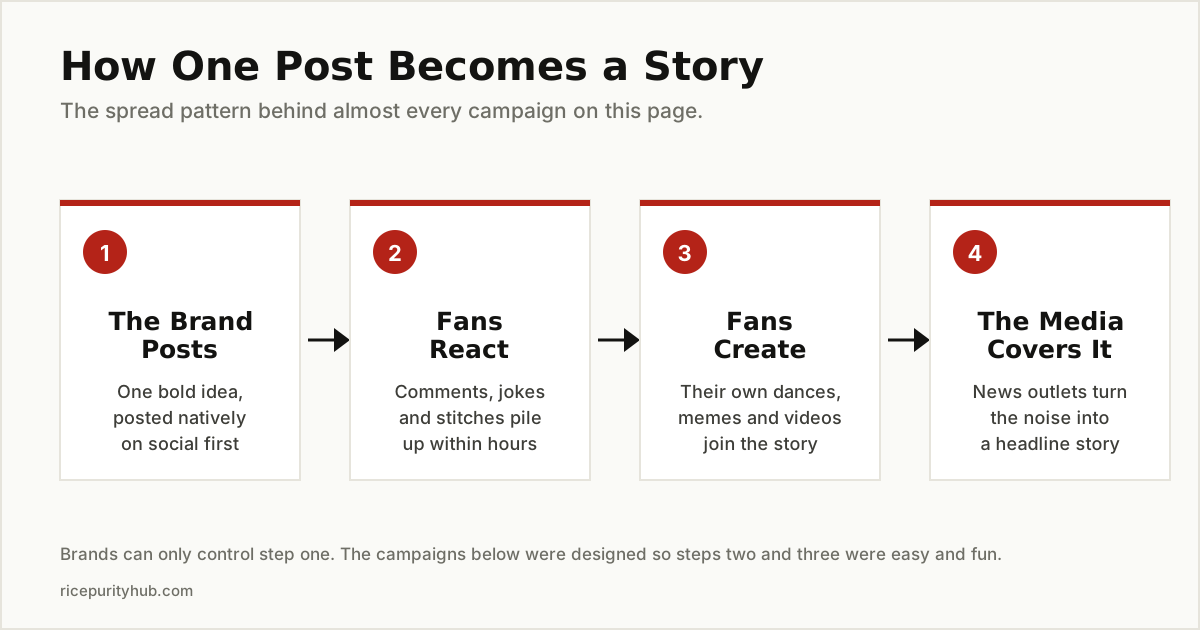
Then fans took over. Other brands, from Netflix to the World Health Organization, posted condolences. One funeral video passed 66 million views. Singer Dua Lipa, the long-running target of the owl’s pretend crush, replied, which fans treated as a historic event. So Duolingo stretched the story. Fans could bring Duo back by doing language lessons and earning experience points toward a shared goal of 50 billion points, tracked on a live site. About two weeks after the death announcement, the owl returned. Duolingo told Fast Company the campaign drew 1.7 billion impressions in its first two weeks.
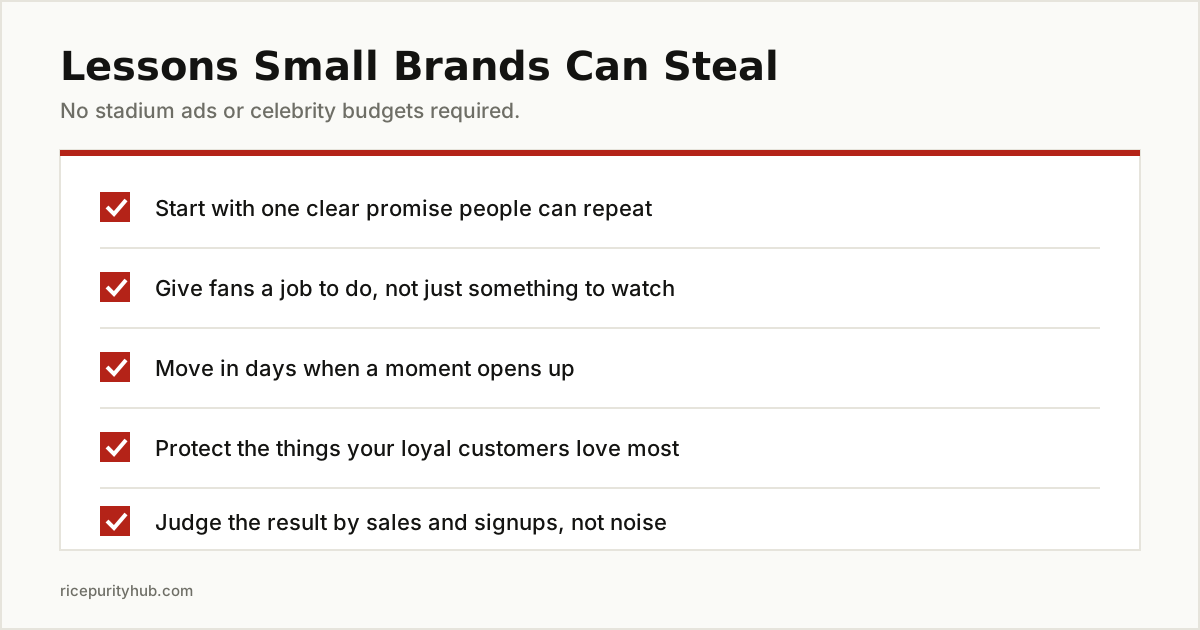
The lesson for small brands: give your audience a role in the story, not just a seat in front of it. And when a post outperforms everything you expected, have the freedom to build on it the same week, not next quarter.
2. Nike: A 27 Year Wait, Answered in 60 Seconds
Nike had not run an ad during the Super Bowl since 1998. For Super Bowl LIX in February 2025, it came back with So Win, a 60 second black and white film narrated by artist Doechii and built entirely around women athletes. Nine of the biggest names in women’s sports appeared, among them Caitlin Clark, Sha’Carri Richardson, A’ja Wilson and Jordan Chiles. The script listed the things women athletes are told they cannot do, then answered each one with footage of them winning anyway.
The ad won the Super Clio, the award for the most creative commercial of the game, and it arrived just as interest in women’s sports was hitting record levels. Nike backed the moment with a So Win collection on its website, so the film pointed straight at products fans could buy.
The lesson for small brands: a big moment works when the message fits in one line a viewer can repeat the next morning. Scarcity helped Nike too. Because the brand had stayed away for 27 years, its return was news by itself.
3. Coca-Cola: A Classic Returns, With a QR Code
Share a Coke began in Australia in 2011, swapping the logo on bottles and cans for popular first names. In March 2025, Coca-Cola announced the campaign was coming back, aimed this time at Gen Z. Name packs reached shelves starting in April, and the rollout was set to reach more than 120 countries, as the company explained in its official announcement of the campaign’s return.
The idea stayed the same. The mechanics got an update. QR codes on packs led to a digital hub where people could add a name they could not find in stores, and a Memory Maker tool let them turn their own photos into short personalized videos made for sharing.
The lesson for small brands: your archive is an asset. If customers loved an idea years ago, you may not need a new one. Bring back the favorite, then rebuild the details for how people share things today.
4. McDonald’s: The Wrap That Fans Refused to Forget
The Snack Wrap left US McDonald’s menus in 2016. Fans never accepted it. For years they signed petitions, posted about it, and, as the company’s own CEO noted when the return was announced, emailed him personally to ask for it back. On July 10, 2025, the wrap returned as a permanent menu item, rebuilt with the chain’s McCrispy Strips in Ranch and Spicy versions.
The marketing almost wrote itself. McDonald’s did not have to convince anyone to care. It teased the return date in spring posts before confirming it, and its chief executive even posted a short video of himself tasting the wrap. Mostly, the company just had to announce that the years of asking had worked, and let fans celebrate a win they felt they had earned.
The lesson for small brands: your comments, reviews and support inbox are free market research. When customers keep asking for the same thing for years, answering them is not just product news. It is a story about listening, and stories about listening spread.
5. American Eagle: The Pun That Ate the Campaign
In late July 2025, American Eagle launched its fall campaign around actor Sydney Sweeney, built on a play on the words jeans and genes. Before launch, the company’s chief marketing officer told trade press the campaign used clever, even provocative language, and was meant to push buttons. It did. Critics argued that the wordplay, paired with a blonde, blue eyed star, carried ugly echoes about heredity and who gets to be called beautiful. Defenders called it a harmless pun about denim. The argument grew large enough to pull in politicians and national talk shows.
On August 1, the company answered on Instagram, saying in effect that the campaign had always been about jeans and how everyone wears them. American Eagle stood by the work, and later said the denim line Sweeney promoted had sold out. Whether the storm helped or hurt depends on which numbers you trust, and honest analysts still argue about it.
The lesson for small brands: attention and approval are different currencies. If a joke needs a company statement to explain it, the joke has become the story. Decide in advance which conversation you are actually buying.
6. Gap: A Dance You Could Join
Four weeks later, Gap took the opposite road into the same denim season. Its fall campaign, Better in Denim, was a short dance film starring global girl group KATSEYE, dancing to Milkshake, the 2003 hit by Kelis, in a routine by choreographer Robbie Blue. It looked like the famous Gap dance ads older shoppers remembered, rebuilt for TikTok, and it put the return of low rise jeans at the center, alongside a relaunched version of the brand’s well known Long and Lean fit.
Gap executives later told investors the campaign passed 8 billion impressions and 500 million views, helped drive double digit growth in denim sales, and inspired fans to post more than 250,000 of their own versions of the dance.
The lesson for small brands: borrow a fandom instead of renting an audience. Give people a performance they can copy, and make the product what everyone is wearing while they copy it.
7. Astronomer: A Crisis Answered With a Wink
Astronomer, a data software company most people had never heard of, became famous in the worst way on July 16, 2025. At a Coldplay concert, a kiss cam caught its chief executive embracing the company’s head of human resources, and the clip raced around the world. Both executives soon resigned.
Nine days later, the company posted its response: a short video starring actor Gwyneth Paltrow, who happens to be the Coldplay singer’s former wife, a detail the internet noticed instantly. Playing a temporary spokesperson, she calmly took the questions everyone was asking and answered them with straight faced explanations of what the company actually sells, as if nothing unusual had happened. Ad Age reported the video was made by Maximum Effort, the agency owned by Ryan Reynolds, which confirmed its role two days after the video appeared.
The lesson for small brands: in a crisis, speed beats polish. A stiff statement would have bought Astronomer nothing. Owning the joke, once, and then pivoting to the product gave people a new story to share.
8. Cracker Barrel: The Logo That Lasted a Week
In August 2025, restaurant chain Cracker Barrel replaced its logo as part of a wider refresh. The old design, built around the Old Timer, a man leaning on a barrel who had been part of the brand since 1977, gave way to a plain text only wordmark. Loyal customers revolted online, saying the chain had deleted the part of the brand that felt like home. The share price fell fast, with several reports putting the lost market value at roughly 100 million dollars within days. Even the President of the United States publicly urged the company to go back.
On August 26, about a week after the new logo appeared, Cracker Barrel announced it was scrapped. The Old Timer would stay.
The lesson for small brands: for loyal customers, your oldest symbols are not decoration. They are part of the product. Evolve them gently if you must, test changes with the people who love you most, and never surprise them with a deletion.
The Patterns Worth Copying
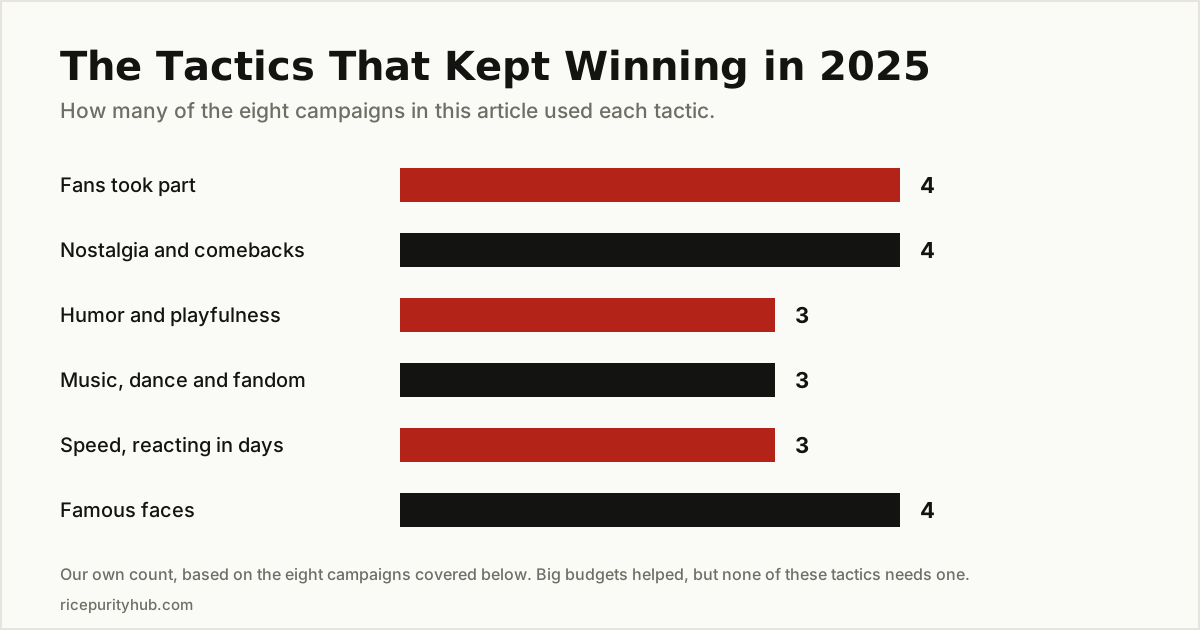
Step back, and the eight stories agree with each other. Fans took part in half of them. Nostalgia powered three comebacks and one rescue. The fastest teams worked in days, not months. And the two hardest stories of the year, a wordplay storm and a deleted logo, both came from forgetting that customers feel ownership over the brands they love.
One last habit separates the winners from the loud. Measure what the noise was worth. Followers and impressions are easy to count, but they are not results. Sales, signups, repeat visits and retention are. Our guide to KPI examples shows how to pick a small set of numbers that actually tell you whether a campaign worked.
The Bottom Line
If one thread runs through all of these innovative marketing campaigns 2025 examples, it is this: they were not won by the biggest budgets or the newest tools. They were won by clear stories, by fans who were handed something to do, and by teams brave enough to move fast and humble enough to listen. The year’s most expensive lesson cost a restaurant chain about a week of chaos, and it is free for the rest of us: people do not share ads. They share stories they get to be part of.
For more guides like this one, browse the business productivity category.