Every business makes a promise, whether it writes one down or not. Your customers hear it in your ads, read it on your homepage, and repeat it to friends when they recommend you. A value proposition is simply that promise, written clearly: what a customer gets, who it is for, and why it beats the other options.
Most businesses never write it down. The result is a homepage that says a little about everything and convinces nobody. This guide fixes that. You will learn what a value proposition is, what goes inside one, how it differs from a tagline or a mission statement, and how to write and test your own, step by step.
What Is a Value Proposition?
A value proposition is a short statement that explains why a customer should buy from you instead of someone else. Investopedia describes it as a statement that should explain how a product fills a need, communicate the specifics of its added benefit, and state the reason it is better than similar products on the market. Three jobs, handled in one short statement.
The idea is not new. The term itself dates back to a 1988 paper by two McKinsey consultants, Michael Lanning and Edward Michaels, who described a business as a system for delivering value to customers. The phrase has spread everywhere since then, but the core idea stayed simple: a clear promise of benefit that a specific group of customers can understand at a glance.
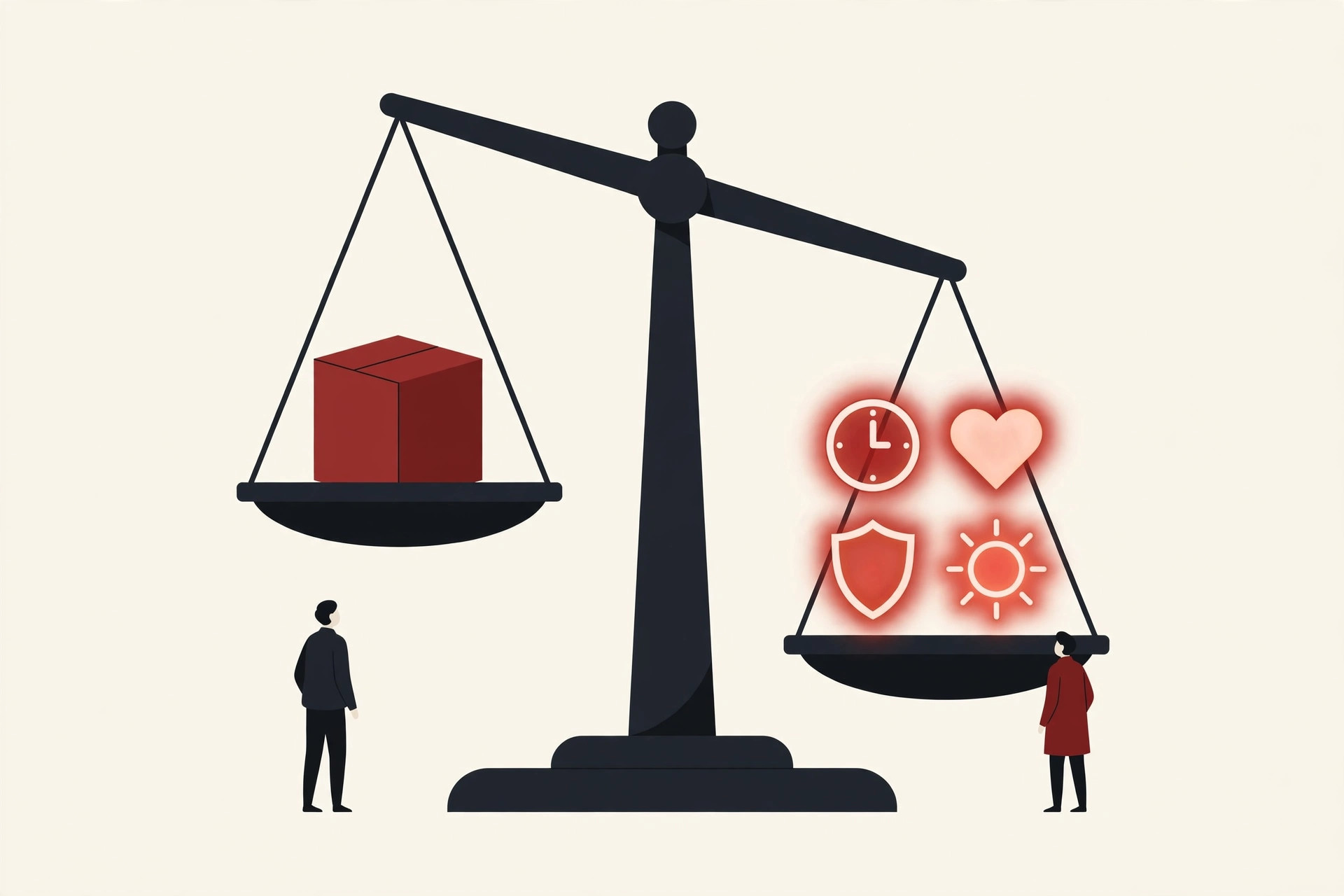
Notice two things in that definition. First, it is a promise, so it has to be one you can actually keep. Second, it is specific, aimed at one clear group of buyers, not at the whole world. A value proposition that tries to please everyone ends up meaning nothing to anyone.
The 5 Ingredients of a Strong Value Proposition
Every clear value proposition, whatever the industry, is built from the same five ingredients. Miss one, and readers are left guessing.
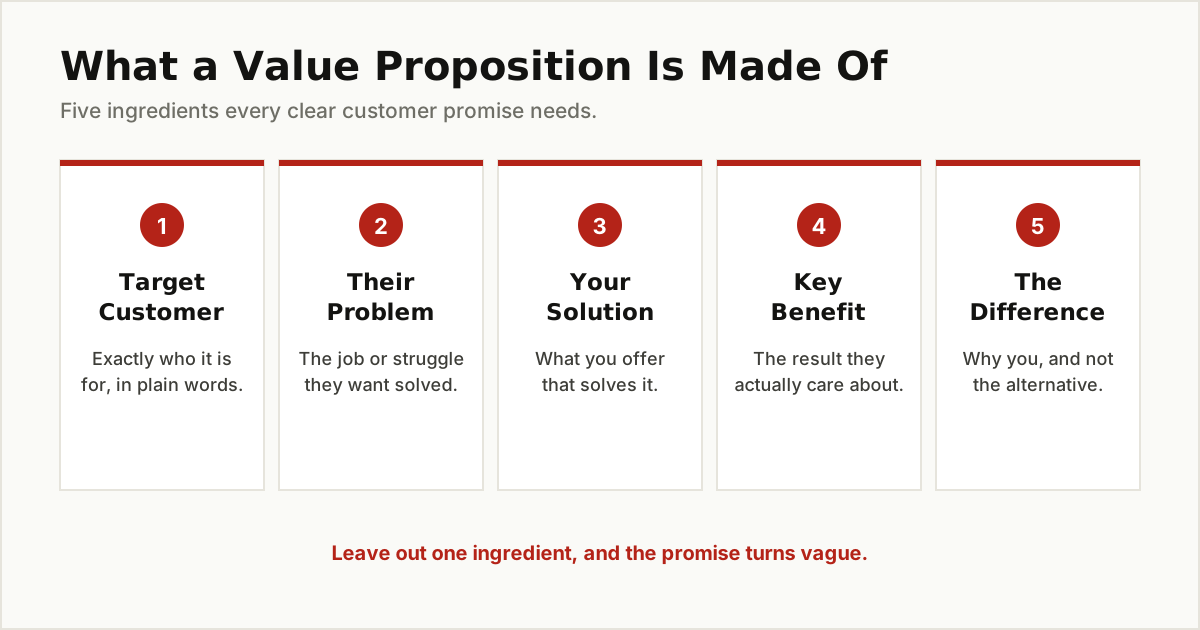
- The target customer. Name exactly who this is for. “Busy parents,” “small law firms,” and “first time dog owners” are customers. “Everyone” is not.
- Their problem or job. State the thing they are trying to get done, or the struggle they want to end. This is the reason they went looking for a product in the first place.
- Your solution. Say plainly what you offer that answers that problem. A category word helps here: a meal kit, an accounting service, a booking app.
- The key benefit. Describe the result the customer actually cares about, not the feature that produces it. People do not want a faster drill. They want the hole finished before lunch.
- The proof or difference. Give one reason to believe you over the alternative: a guarantee, a track record, a way of working that rivals do not offer. This is the part most first drafts leave out, and it is the part that closes the sale.
Value Proposition vs Tagline, Slogan and Mission Statement
These four statements get mixed up constantly, sometimes even inside the same company. They are not interchangeable, because each one has a different job and a different audience.
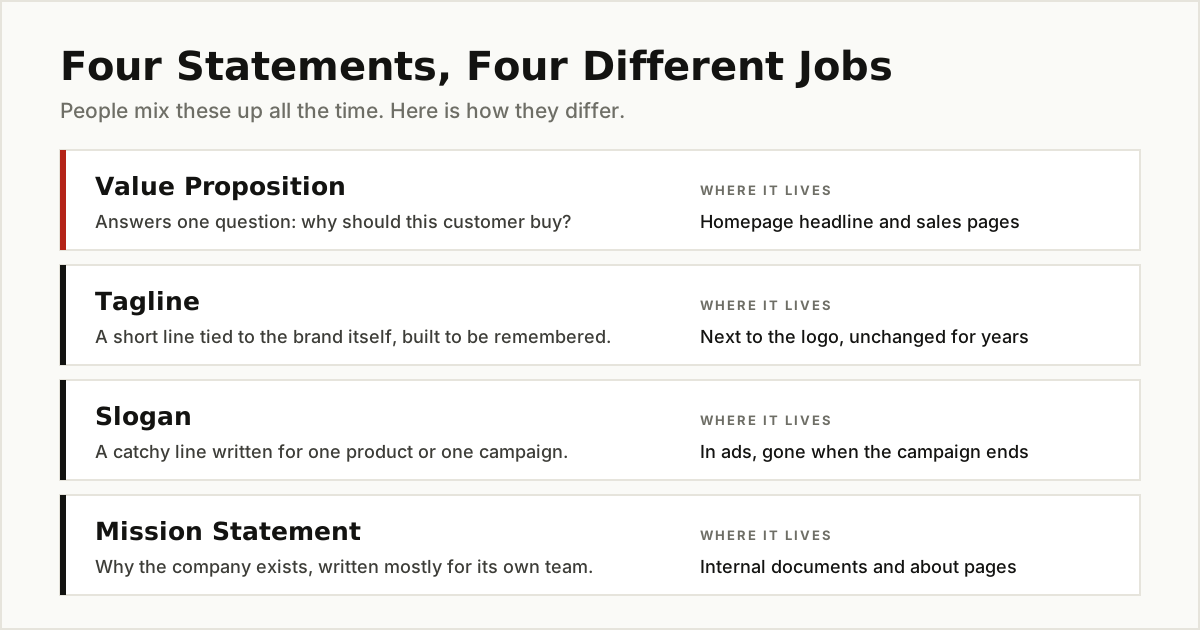
A tagline is a short phrase tied to the brand itself. It is built to be remembered and to carry a feeling, not to explain an offer. A good tagline can stay untouched for decades while products come and go underneath it.
A slogan is a tagline’s shorter lived cousin: a catchy line written for one product, one season, or one campaign. When the campaign ends, the slogan usually goes with it.
A mission statement explains why the company exists. It is written mostly for the people inside the company, to guide decisions and hiring. Customers rarely read it before buying, and it is not designed to persuade them.
A value proposition is the only one of the four that speaks to a buyer facing a choice right now. It does not need to be catchy or inspiring. It needs to be clear, specific, and true, because its job is to answer one question before the buyer clicks away: why you?
The Value Proposition Canvas, in Simple Words
If you want help building your value proposition instead of staring at a blank page, the best known tool is the Value Proposition Canvas, created by Alexander Osterwalder and his team at Strategyzer and set out in their book Value Proposition Design. Strategyzer offers the official canvas template as a free download, and the idea behind it is easy to grasp.
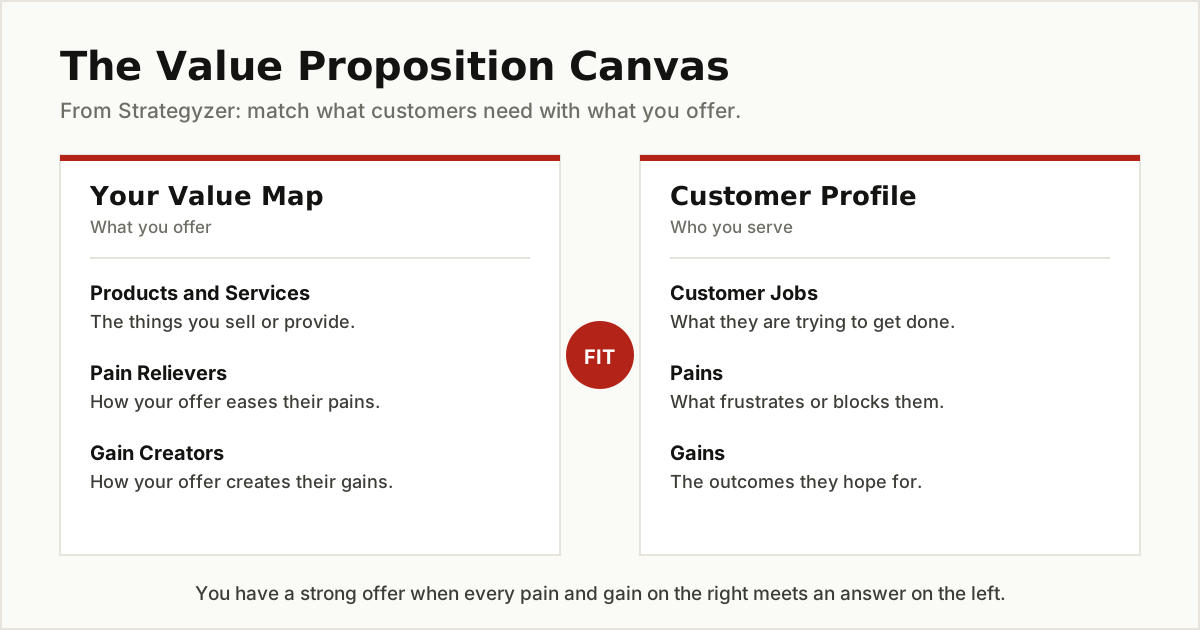
The canvas has two sides. On the right is the customer profile: the jobs that customer is trying to get done, the pains that frustrate or block them, and the gains they hope for. On the left is your value map: the products and services you offer, the pain relievers that ease those frustrations, and the gain creators that deliver those hoped for outcomes.
You fill in the customer side first, honestly, and only then look at your side. Where a pain on the right meets a pain reliever on the left, you have a match. Strategyzer calls that match “fit,” and it is the whole point of the exercise. If a pain has no answer on your side, your offer has a gap. If something on your side answers no pain and creates no gain, it is probably a feature you love more than your customers do.
A Value Proposition Template You Can Copy
Once you know your customer and their problem, drafting the statement itself is the easy part. This classic fill in the blanks shape covers all five ingredients:
For [your customer] who [has this problem or job], [your product] is a [what it is] that [main benefit], so they can [the result they want]. Unlike [the usual alternative], it [your key difference].
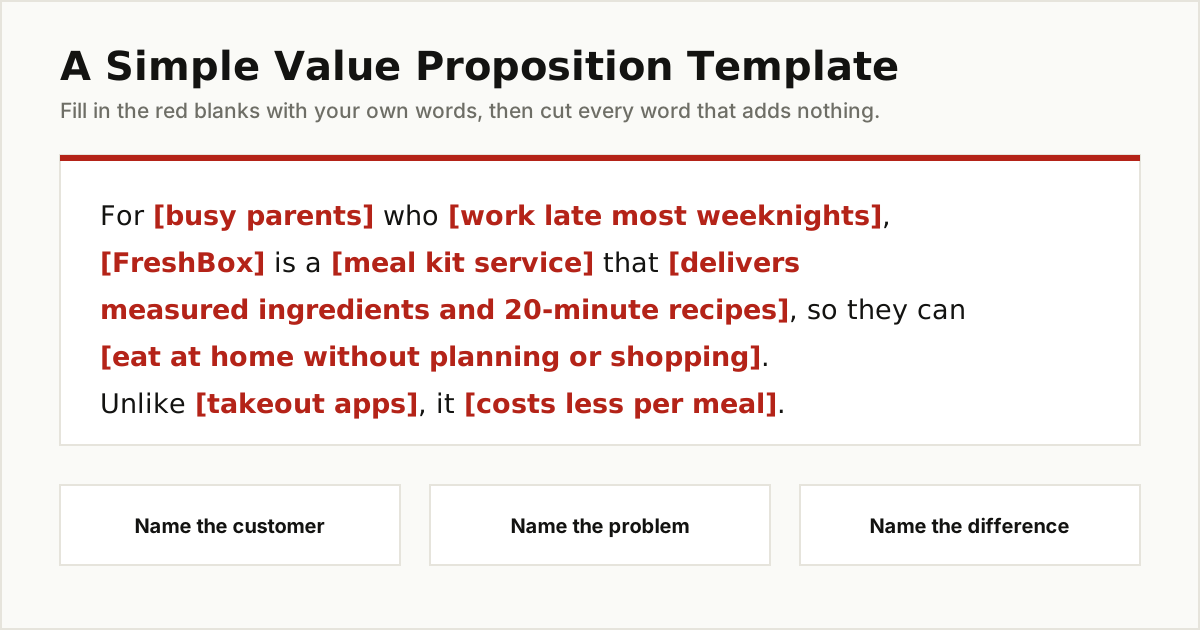
Here is the template filled in for an invented business, so you can see the shape at work. Imagine a dog walking service called HappyPaws:
For busy apartment owners who work long hours, HappyPaws is a dog walking service that sends a photo report after every walk, so they can relax at work knowing their dog got real exercise. Unlike asking a neighbor, every HappyPaws walker is background checked and insured.
Notice what that draft does. The customer is narrow, the worry is named, the benefit is a feeling backed by a habit (the photo report), and the last line gives a concrete reason to trust it. That is the standard your own draft should meet.
Real Value Proposition Examples, Explained
Famous companies rarely publish a neat statement labeled “our value proposition,” but you can see the promise clearly in how they present themselves. Here are three, described in plain words.
Uber built its name on a simple promise to riders: open the app, tap a button, and a car comes to you. No standing on a corner waving, no guessing the fare, no hunting for cash at the end of the trip. The value was never the car itself. It was the removal of every annoying step that used to sit between a person and a ride.
Slack aimed its promise at office teams drowning in email. Its pitch, in plain terms, was that team talk belongs in one searchable place, sorted by topic, instead of buried inside long email chains that half the team never sees. The pain it names is real and specific: hours lost hunting for a decision someone made months ago.
Airbnb made two promises at once, one to each side of its market. Travelers were offered stays that feel like real homes in real neighborhoods, often with a kitchen and more space than a standard hotel room. Hosts were offered a way to earn money from a spare room or an empty home. One company, two clear value propositions, each written for a different customer.
Large brands also swap the wrapping around the promise from season to season while the promise itself stays put. Our roundup of innovative marketing campaigns in 2025 shows how that refreshing works in practice.
How to Write a Value Proposition, Step by Step
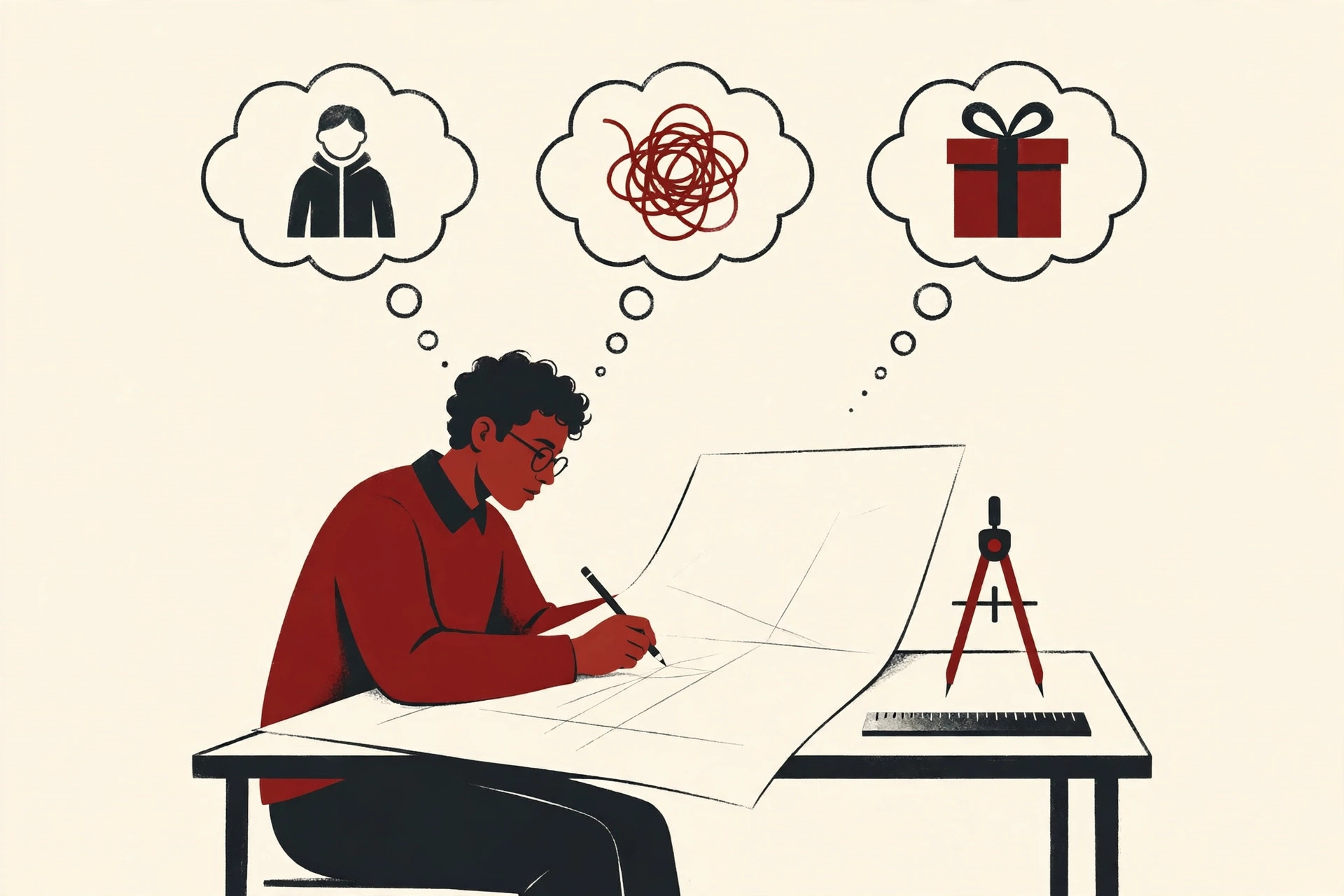
- Start with the customer, not the product. Talk to a handful of real buyers, read your support emails, and listen to what people say when they describe their problem in their own words.
- Write down their jobs, pains, and gains. The canvas from the section above gives you a tidy place to put them. Keep every draft in one shared note inside the productivity tools your team already uses, so versions do not scatter across chats and inboxes.
- Pick the one pain that matters most. A value proposition built on five problems persuades nobody. Choose the pain your best customers mention first and loudest.
- Match it to your strongest answer. Name the part of your offer that relieves that pain, and the proof that makes the claim believable.
- Draft three versions with the template. Short drafts are cheap. Write three, leave them overnight, and read them again with fresh eyes in the morning.
- Cut every word that adds nothing. Replace insider words with the words your customers used in step 1. If your own team needs a paragraph to explain the sentence, the sentence is not done.
How to Test Your Value Proposition
A value proposition is a claim until real people react to it. Luckily, testing one is cheap, and you can start today.
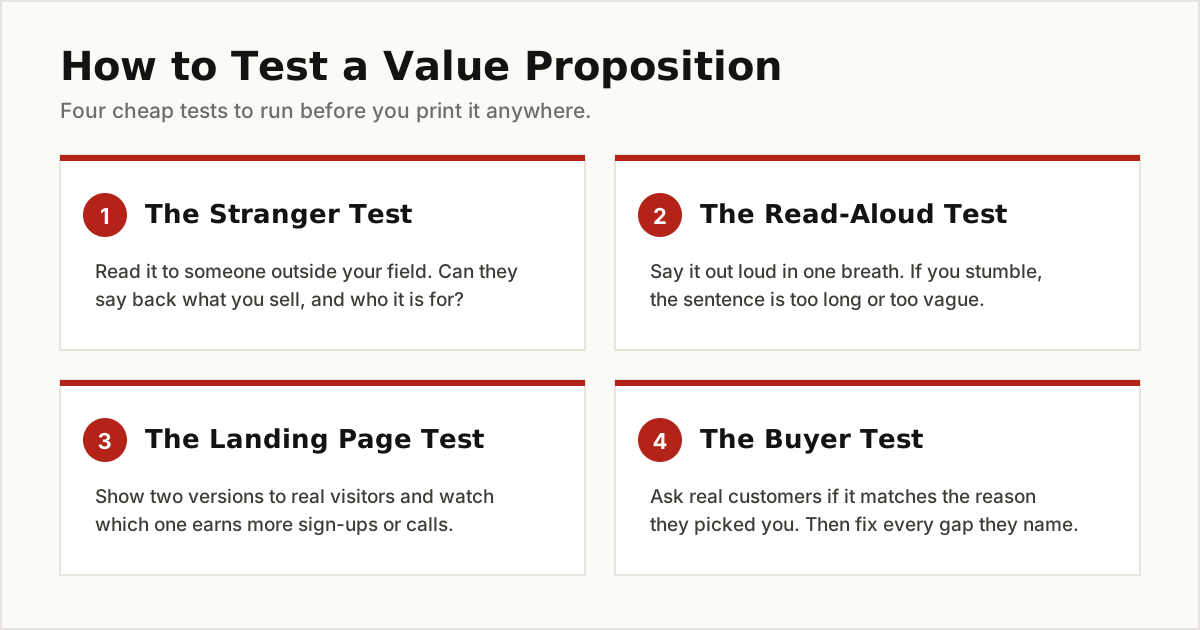
The stranger test. Read your statement to someone outside your industry, then ask them to say back what you sell and who it is for. If they cannot, the statement is unclear, no matter how good it sounds to you.
The read aloud test. Say it out loud, the way you would to a customer across a table. Sentences that look fine on a screen often fall apart when spoken. Awkward spots are where readers will quietly stop paying attention.
The landing page test. Put two versions of your headline on real pages and watch which one earns more sign ups, calls, or orders. Decide in advance which numbers will judge the winner, and keep them few. Our guide to KPI examples shows how to pick measures that actually match a goal like this one.
The buyer test. Show the statement to people who already bought from you and ask if it matches the reason they chose you. Customers will often name a benefit you never thought to mention, and that line belongs in your next draft.
Common Mistakes That Weaken a Value Proposition
- Buzzwords instead of meaning. “World class,” “cutting edge,” and “innovative solutions” say nothing a rival could not copy in one minute. Investopedia makes the same point: effective value propositions differentiate and avoid overused marketing buzzwords. Swap every buzzword for a fact.
- Features dressed up as benefits. A feature is what your product has. A benefit is what the customer gets. “Stores 10,000 photos” is a feature. “Never delete a photo again” is a benefit. Buyers pay for the second kind.
- Speaking to everyone. The wider you aim, the weaker the promise lands. A narrow value proposition that thrills one group beats a broad one that mildly interests the whole market.
- Promising what you cannot deliver. An exaggerated promise may win a first purchase and lose every one after it. Reviews travel fast, and a value proposition only works while customers believe it.
The Bottom Line
A value proposition is your promise, written down: who it is for, what problem it solves, what result it delivers, and why you are the right choice. Build it from your customer’s real jobs, pains, and gains, draft it with the template, and test it on strangers before you trust it. Keep it honest, keep it specific, and rewrite it whenever your customers or your offer change.
Get that one short statement right, and every ad, homepage, and sales call you write afterward gets easier. For more guides like this one, browse the business productivity category.