Every company runs on data. Sales figures, customer records, invoices and product lists drive decisions every single day. Yet in many companies, nobody can answer three simple questions. Who owns this data? Who is allowed to use it? And who fixes it when it is wrong?
When those questions have no answer, the same problems keep coming back. Two departments produce two different revenue numbers for the same month. A marketing list turns out to be full of duplicate customers. An old spreadsheet with home addresses sits on a shared drive that anyone in the company can open.
Data governance frameworks exist to stop this drift. A framework gives a company one shared blueprint for looking after its data: clear owners, simple rules, and checks that the rules are actually followed. This guide explains the best-known data governance frameworks in plain English, the parts they all share, and how a company can start small instead of trying to govern everything at once.
What Is Data Governance, in Plain Words?
Data governance is the set of rules, roles and habits a company uses to look after its data. It decides who owns each data set, who can use it, what good quality looks like, and how private data stays protected.
IBM describes data governance as the data management discipline that focuses on the quality, security and availability of an organization’s data. IBM compares the governance function to an air traffic control hub: its job is to make sure verified data flows safely to the people and systems that need it.
Two roles show up in almost every governance program:
- Data owners are the people accountable for one area of data, such as customer data or finance data. They approve access, agree on definitions, and answer for quality.
- Data stewards are the day to day caretakers. They keep definitions up to date, spot errors, and help other teams use the data correctly.
Above them, many companies add a small governance council of managers that settles disagreements and sets priorities. Governance is one part of the bigger job of data management, which also covers storing, moving and processing data. Governance is the part that sets the rules the rest must follow.
What Is a Data Governance Framework?
A data governance framework is the written blueprint behind those rules. Governance is the daily work; the framework is the structure that describes how the work is organized. It covers the goals of the program, the roles and who fills them, the standards data must meet, the processes for approving access or fixing errors, and how the company checks that all of this really happens.
Why not simply write new rules as problems appear? Because ad hoc rules do not scale. Each team invents its own definitions, so a simple phrase like “active customer” ends up meaning three different things. There is no proof to show an auditor or a regulator. And when the one person who understood the data leaves, their knowledge walks out with them.
A framework fixes this by giving decisions one home. Whether a company borrows a famous model or writes its own, good data governance frameworks share the same skeleton, which the next section walks through.
The Parts Every Framework Covers
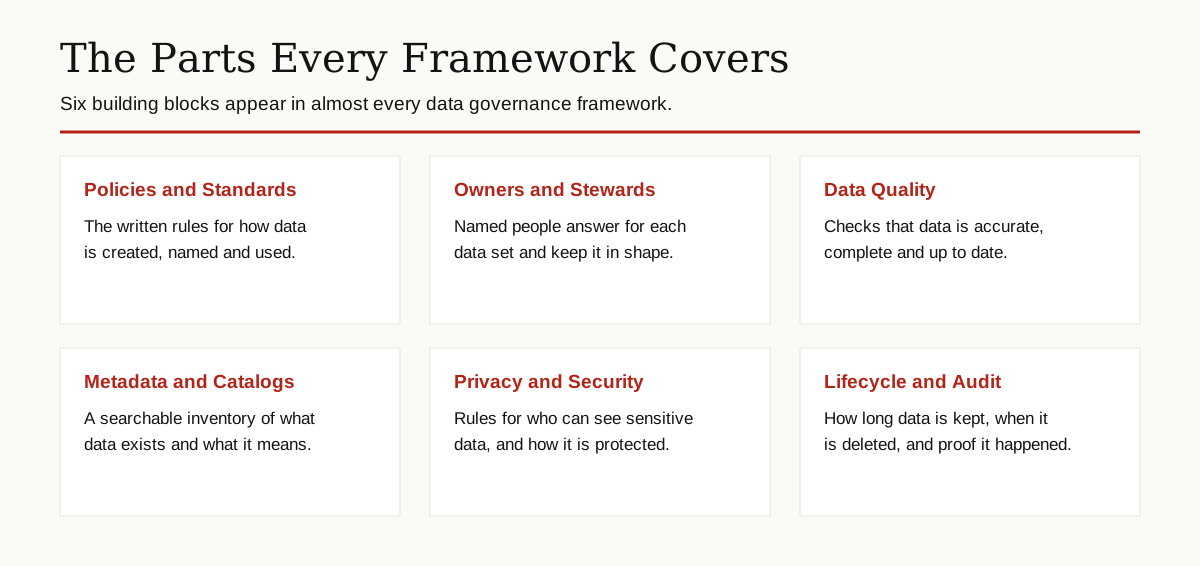
Policies and standards. The written rules: how data gets named, formatted, stored and shared. The best policies are short and practical, written so that busy people actually read them.
Data owners and stewards. Named humans, not departments. When a number in a report is wrong, everyone should know exactly whose desk the problem lands on.
Data quality. Simple checks and measures: is the data complete, free of duplicates, and up to date? Governance defines what “good” means for each data set. In practice, the checks themselves are often built by the teams behind a company’s data engineering services, who run the pipelines that carry data from system to system.
Metadata and catalogs. Metadata is data about data: what a field means, where it came from, and when it last changed. A data catalog gathers this into a searchable inventory, so people can find data, understand it, and decide whether to trust it.
Privacy and security. Which data is sensitive, who may see it, and how access is granted and later removed. This part connects governance to the security team and to privacy law.
Data lifecycle. Rules for the whole life of a data set: how it is created, stored, archived, and finally deleted. Data kept forever is both a cost and a risk. Well governed data is also easier to look after day to day, and clean, well documented databases are far simpler to tune, as our guide to database optimization explains.
The Best-Known Frameworks and Models
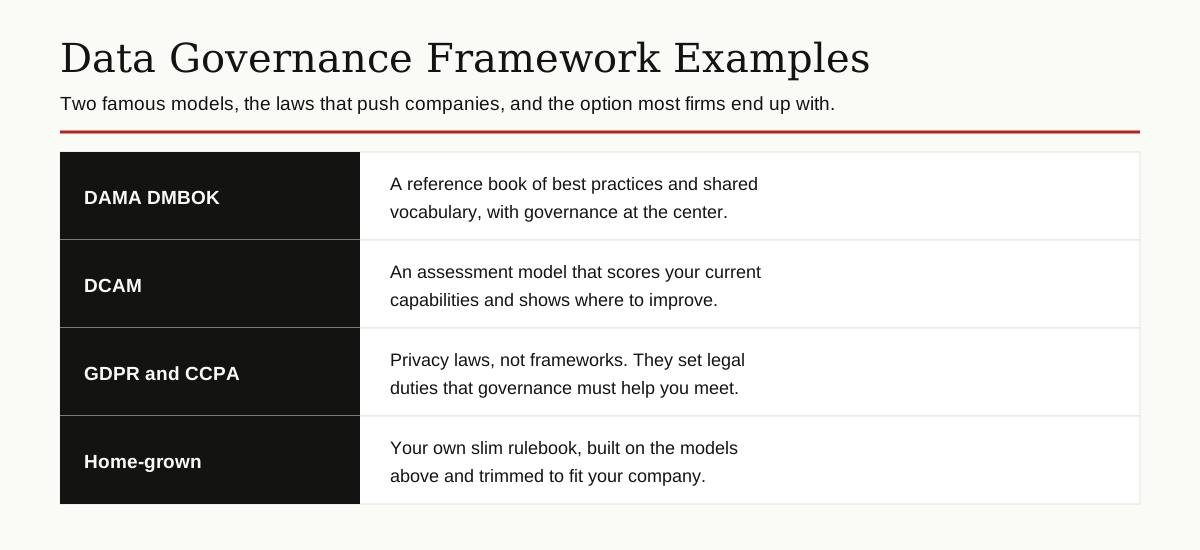
Most companies do not invent their approach from zero. They borrow from a small set of famous models. Two names come up again and again, and a third force, privacy law, pushes everyone in the same direction.
DAMA DMBOK: The Reference Book
The best-known name in the field is DAMA International, a nonprofit association of data professionals. Its guide, the DAMA Data Management Body of Knowledge, usually shortened to DMBOK, was first published in 2009, with a second edition in 2017.
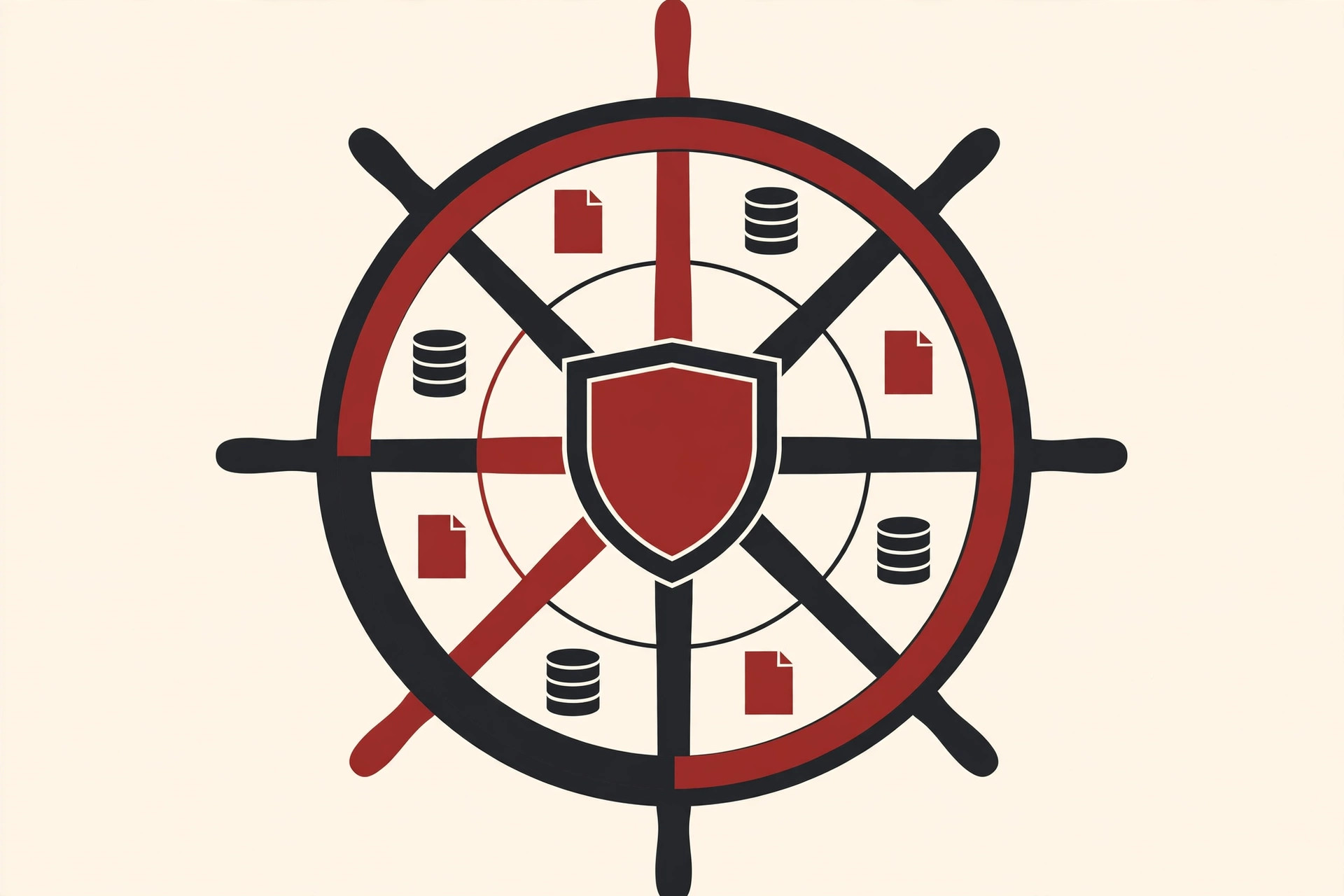
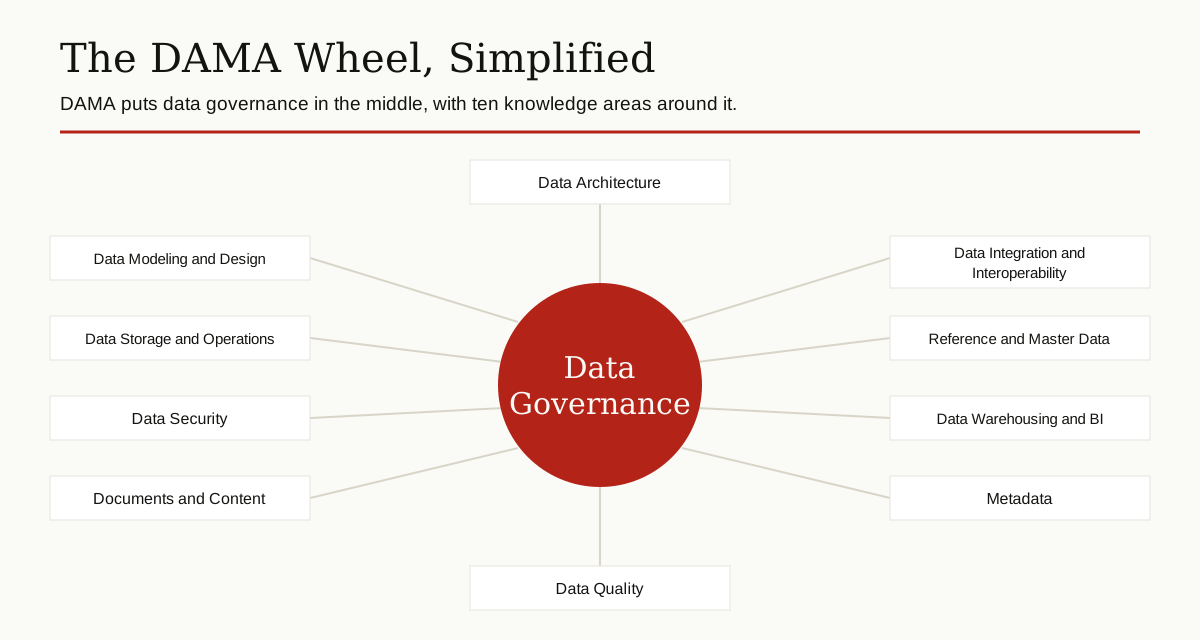
DMBOK describes data management as 11 knowledge areas: governance, architecture, modeling and design, storage and operations, security, integration, documents and content, reference and master data, warehousing and business intelligence, metadata, and data quality. DAMA draws these areas as a wheel, the DAMA Wheel, with data governance in the center, because governance is meant to guide all the others.
Be clear about what DMBOK is not. It is not software, and it is not a step by step recipe. On its own site, DAMA stresses that the guide is vendor neutral and not a prescriptive standard, and that it is not a law anyone must obey. It describes what good looks like, and each company adapts it to its own size, industry and habits. The book also serves as the knowledge base for DAMA’s CDMP certification, the best-known credential for data management professionals. A third edition is now in development, with a stronger focus on AI and cloud platforms.
DCAM: The Scorecard Model
The second famous name is DCAM, the Data Management Capability Assessment Model, published by the EDM Council, a nonprofit association that began in the financial industry, where regulators demand strong proof that banks control their data.
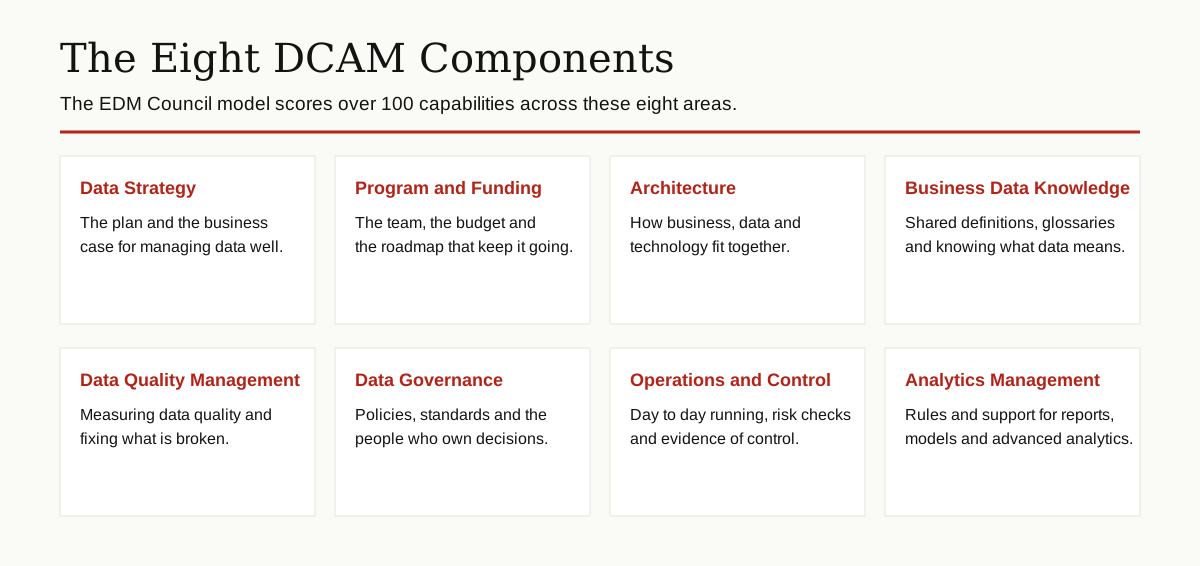
Where DMBOK describes the destination, DCAM measures where you stand. It breaks data management into eight components, from strategy and funding to data quality, governance and analytics, and scores more than 100 detailed capabilities inside them. A company runs an assessment, gets honest scores for each area, and uses the gaps to build a realistic improvement plan.
The two models fit together well. Many organizations use DMBOK as their map of what to build, and DCAM style assessments to check how far they have come. Neither one, on its own, writes your company’s rules for you.
Privacy Laws: The Push From Outside
Frameworks are voluntary. Laws are not. Two privacy laws explain why so many companies started serious governance programs in the last decade.
The GDPR, the European Union’s privacy law in force since 2018, gives people rights over their personal data and obliges companies to know what personal data they hold, why they hold it, and who can access it. California’s CCPA, in force since 2020, gives similar rights to California residents. Both laws carry fines large enough to make headlines.
A company cannot honor a request to delete everything it holds about a person if nobody knows where that person’s data lives. That is why privacy compliance so often becomes the first real budget for governance work. Modern governance also has to cover the data that feeds AI systems, including training data and the embeddings stored in tools like a vector database, which is why newer frameworks pay far more attention to AI data than the early ones did.
How a Company Starts, Step by Step
Reading about frameworks can make governance sound like a giant program. In real life, the companies that succeed start small, sometimes embarrassingly small.
- Start with one painful problem. A report nobody trusts, an audit finding, or a privacy request that took weeks to answer. Governance earns support by fixing visible pain.
- Name owners for the most important data. Pick the few data sets the business depends on most, usually customer, product and finance data, and give each one a named owner and a steward.
- Write a few simple rules. Keep them practical: how customer records are created, who approves access, and what happens when an error is found.
- Build a small catalog and glossary. List the key data sets, where they live, and what the main business terms mean, in words the whole company shares.
- Add quality checks where it hurts. A handful of automatic checks on the most important fields, with errors sent to someone who can actually fix them.
- Review, prove value, then grow. Show what improved, then extend the same pattern to the next area of data.

This start small pattern is deliberate. Every step produces something useful on its own, and the framework grows out of real work instead of arriving as a finished theory that nobody asked for.
Why Frameworks Fail
Adopting one of the famous data governance frameworks is the easy part. Making it stick is where companies struggle, and the failure patterns are honest and familiar.
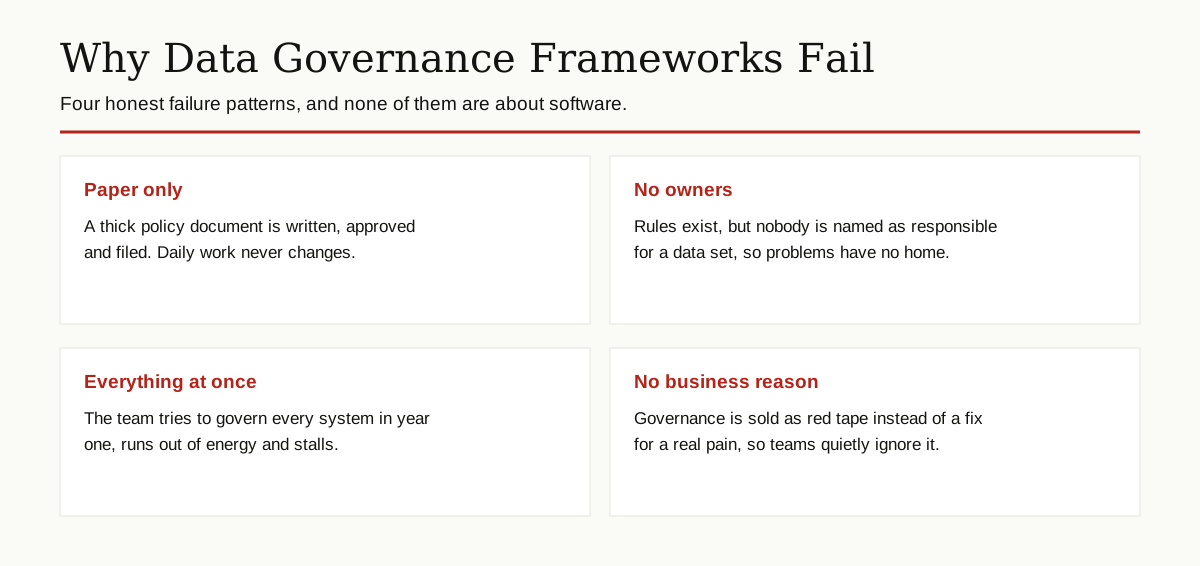
- Paper only. A long policy document gets written, approved and filed, and daily work never changes. A framework that lives in a drawer governs nothing.
- No owners. Rules exist, but when data is wrong, nobody is responsible for fixing it, so the same errors keep returning.
- Too much at once. The team tries to govern every system in the company in year one, runs out of energy and money, and the program quietly stalls.
- No business sponsor. If leaders treat governance as red tape instead of a fix for real problems, busy teams will route around it.
There is also a limit that no framework can remove. A framework is guidance, not software and not magic. It cannot repair data that nobody maintains, and it cannot force people to care. Governance works when it is treated as a long, light habit: clear owners, a few enforced rules, and steady small improvements. It fails when it is treated as a one time project with a launch date.
Which Framework Should You Choose?
If your biggest problem is confusion, with every team using different words and habits, start with DMBOK as your shared map and vocabulary. If your biggest problem is proof, for example a regulator or a board asking how mature your data management really is, a DCAM style assessment gives you scores and a roadmap.
Most companies end up in the middle. They take one of the known data governance frameworks as a guide, write their own slim version that fits their size and industry, and review it once a year. That review matters, because frameworks grow stale as data moves to the cloud and into AI systems.
The Bottom Line
Data governance frameworks turn a vague wish, that the company should look after its data better, into named owners, written rules and honest checks. DAMA DMBOK gives the field its shared map, DCAM gives a way to score progress, and privacy laws give everyone a deadline. You do not need all of it on day one. Start with the data that matters most, name its owner, write a few rules people can follow, and grow from there.
For more guides like this one, browse the data, cloud and databases category.