Every growing company hits the same wall. Sales data sits in one tool, billing data in another, website numbers in a third, and nobody fully trusts the report that tries to combine them. People export spreadsheets by hand, fix the same errors every week, and still argue about whose numbers are right.
Data engineering services exist to fix exactly this. A provider designs and builds the plumbing that moves your data from where it is created to where it can actually be used, and then keeps that plumbing healthy. This guide explains what these services include, who buys them, how the work usually runs, and how to choose a provider without wasting money. It also covers the question underneath all the others: should you hire this skill into your own team instead?
What Is Data Engineering, in Simple Words?
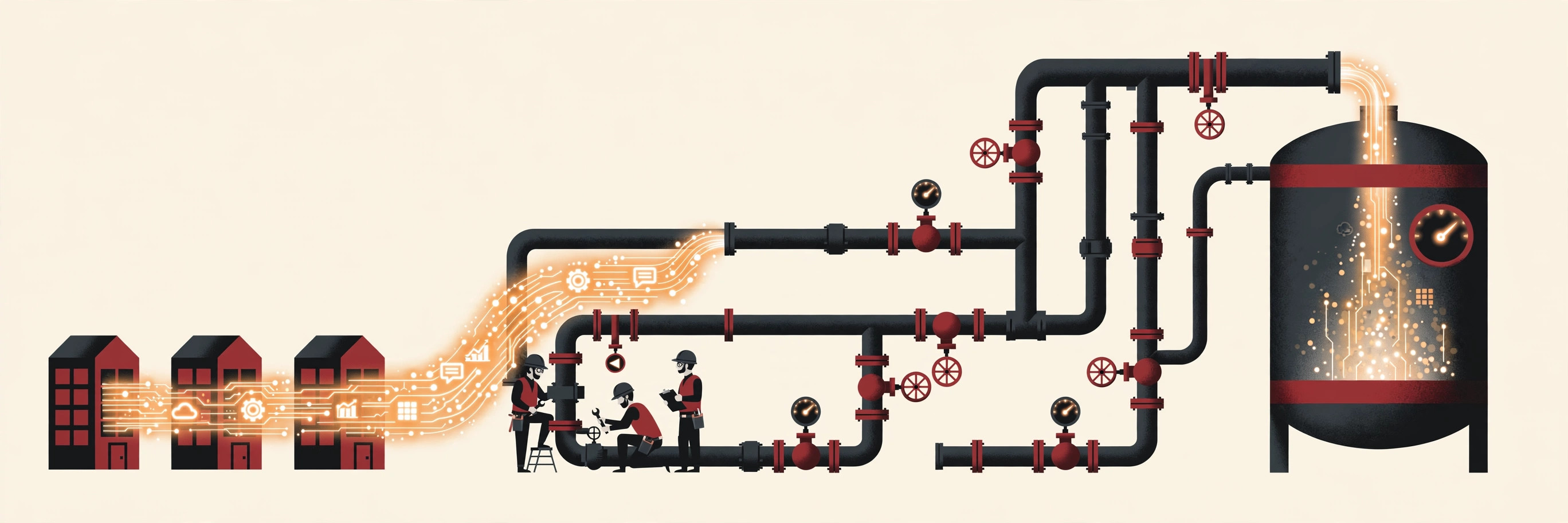
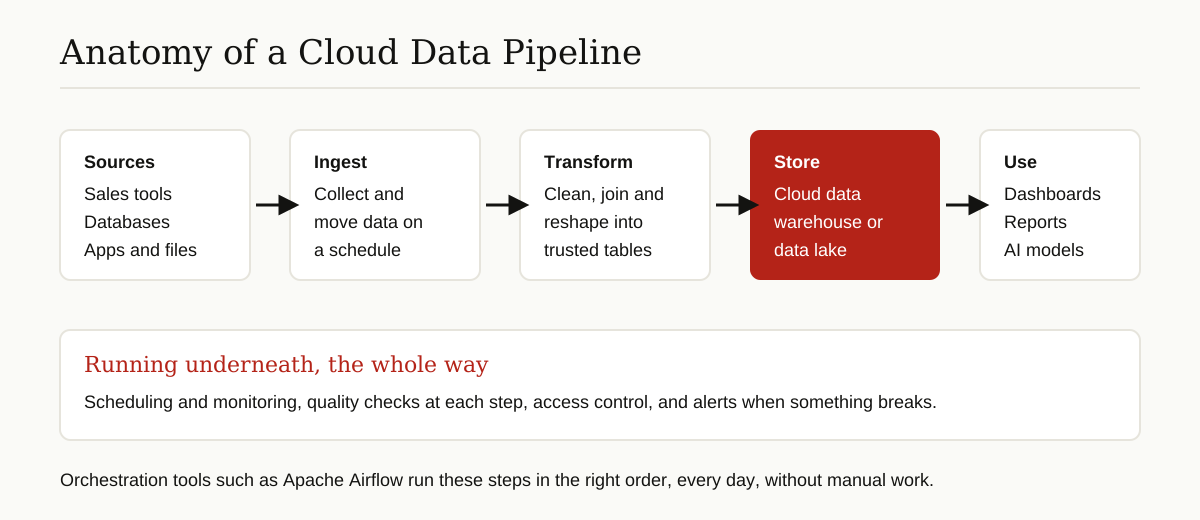
Data engineering is the work of building the pipes that carry data. Raw data is messy: it arrives from apps, websites, payment systems, spreadsheets and sensors, in different formats, with gaps and duplicates. Data engineers collect it, clean it, reshape it, and store it in one place where analysts, dashboards and AI models can use it safely.
IBM describes data engineering as designing and building systems for collecting, storing and analyzing data at scale, so that everyone in the company, from executives to data scientists, can reach the datasets they need. That is the heart of it. Analysts answer questions with data. Data engineers make sure the data is there, fresh and trustworthy enough to answer with.
When you buy data engineering services, you are not buying reports or dashboards. You are buying the foundation under them: the pipelines, storage and checks that make every report possible.
What Data Engineering Services Usually Include
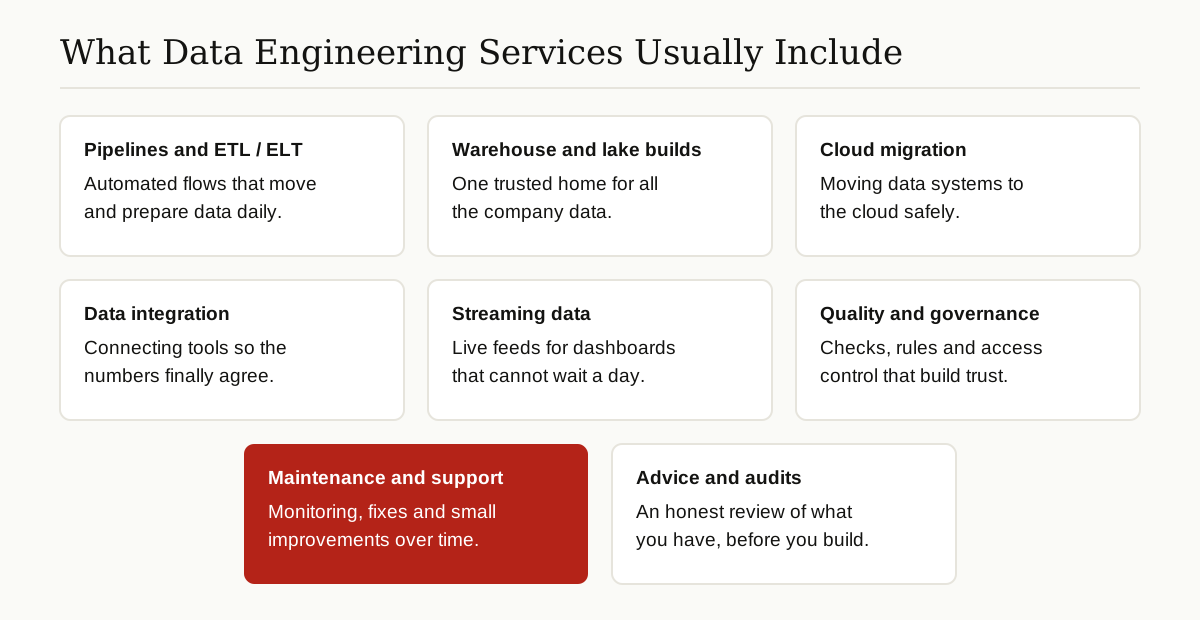
The exact menu differs from one provider to the next, but most engagements cover the same core areas.
Data pipelines and ETL or ELT
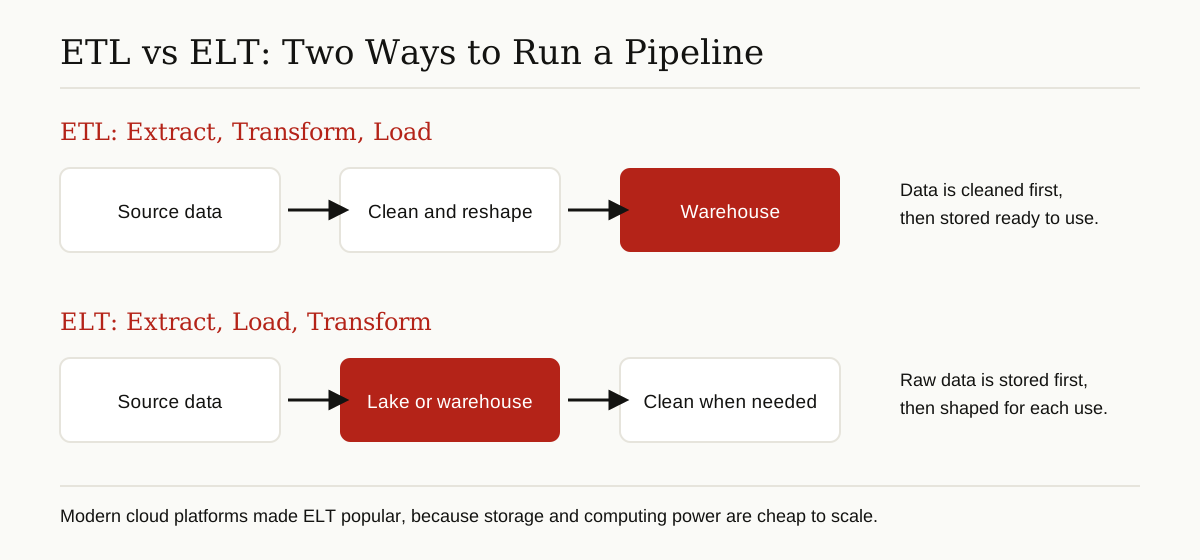
A pipeline is an automated flow that moves data from a source to a destination on a schedule. The classic pattern is ETL: extract data from the source, transform it (clean names, fix formats, remove duplicates, apply business rules), then load it into storage. The modern pattern is ELT: load the raw data first, then transform it inside a powerful cloud platform, which is flexible when you are not yet sure how the data will be used.
Data warehouse and data lake builds
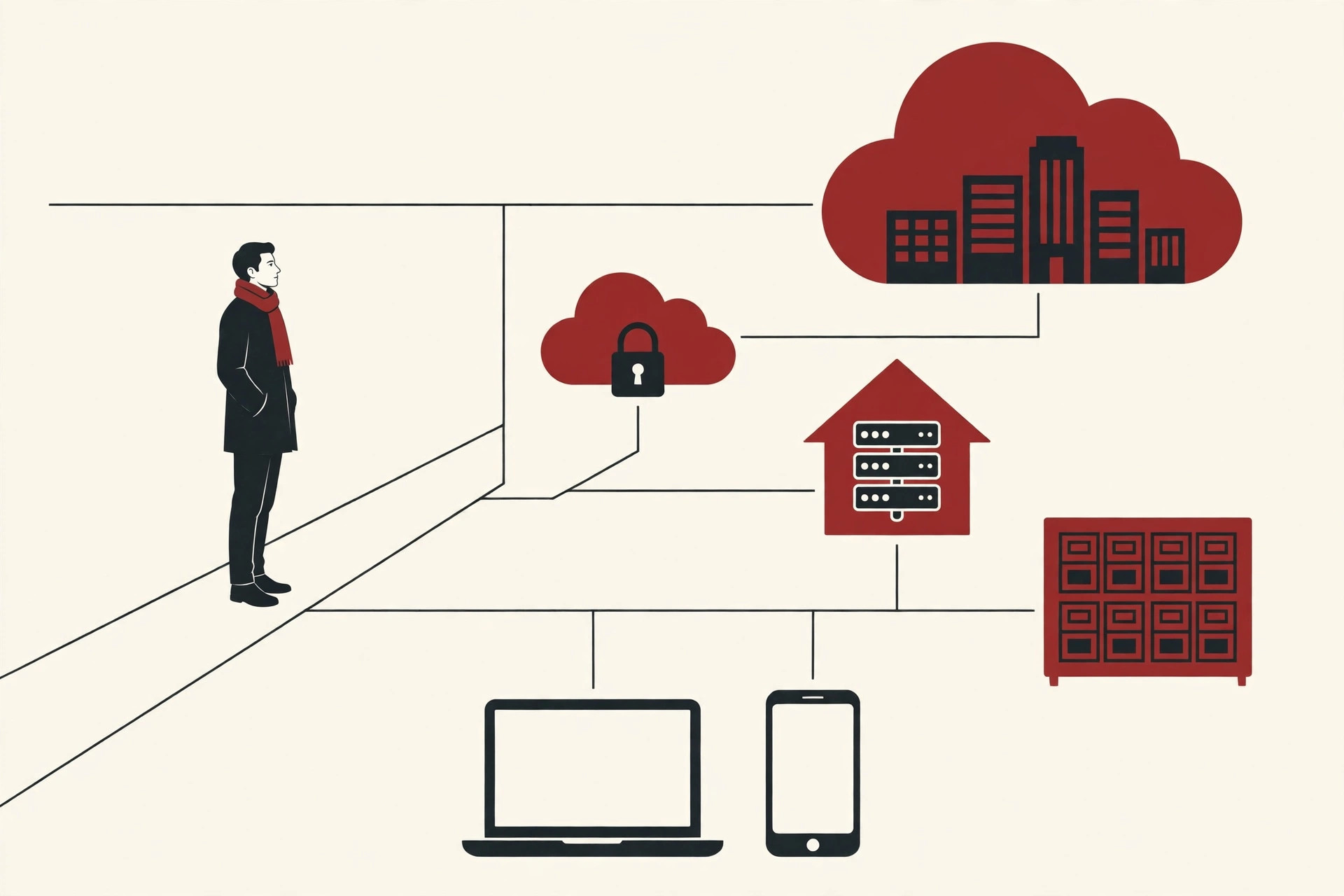
Most companies need one trusted home for their data. A data warehouse stores cleaned, structured data that is ready for reporting. A data lake stores raw data of every kind, cheaply and in large amounts. Many modern builds combine the two ideas. Providers design the storage, set up the tables, and connect the first sources. For software companies that serve many customers from one platform, this work can also involve patterns like multitenant database containers, where each customer’s data stays separate inside a shared system.
Cloud migrations and data integration
Moving from old servers or a patchwork of tools to the cloud is a common project. So is integration: connecting the CRM, the billing system, the support desk and the product database so the numbers finally agree. A good provider plans the move in stages, so reporting never fully stops during the change.
Closely related is data modeling: deciding how the cleaned data should be shaped so that common questions are fast and easy to answer. Good modeling is invisible when it works. Sales by month, by region and by product just come out of the warehouse in seconds, in the same form, every time. Bad modeling is equally invisible at first, and then every new report turns into a small research project. Providers earn much of their fee here, in patient design work that pays off for years.
Streaming, quality, governance and maintenance
Some data cannot wait for a nightly run. Streaming pipelines feed live dashboards with events as they happen, work that is sometimes sold as part of big data engineering services when the volumes are large.
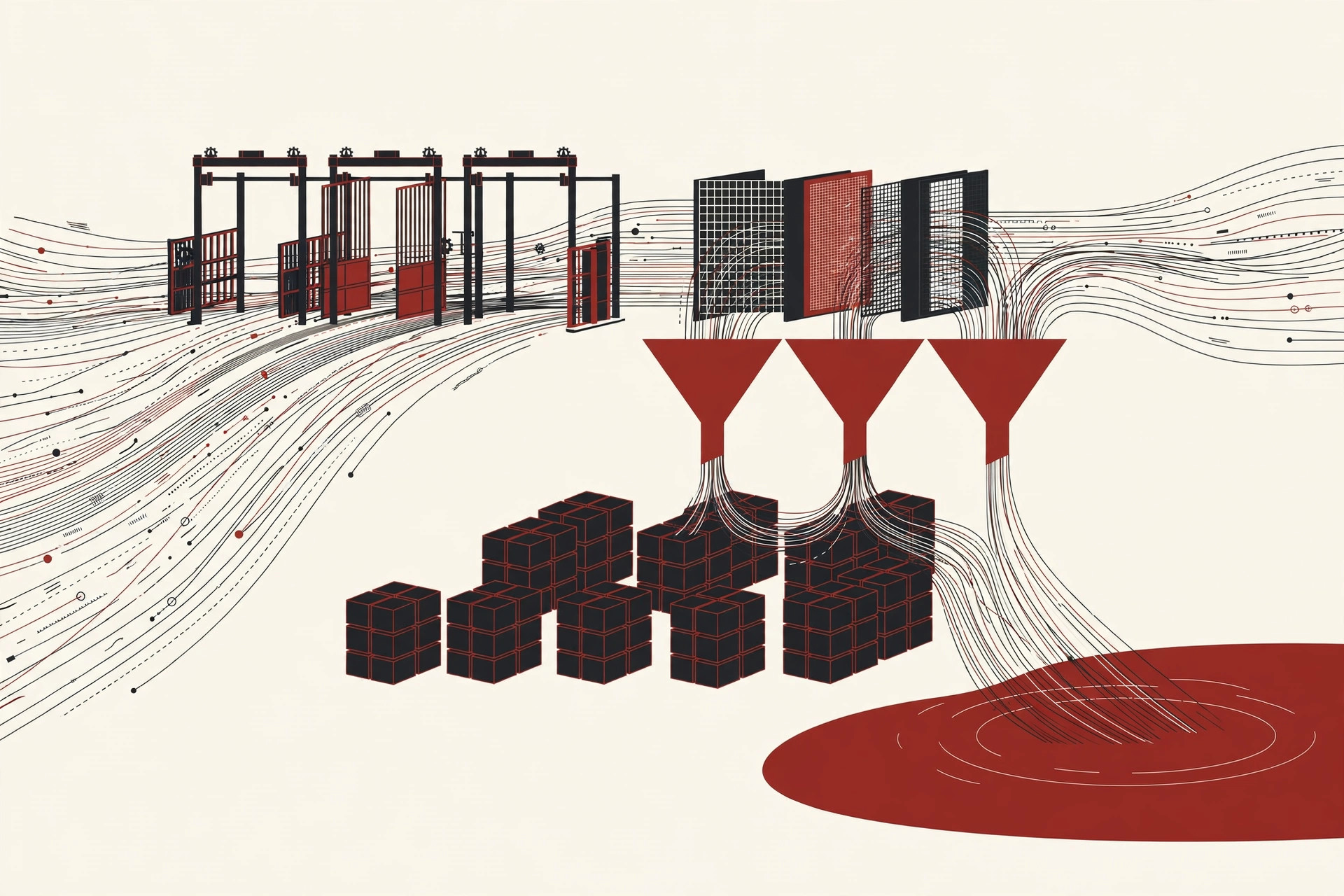
Just as important is the quiet work: quality checks that catch a broken feed before your team does, rules about who can see sensitive data, and ongoing maintenance. The wider discipline behind those rules is covered in our guide to data governance frameworks. Healthy systems also need performance care over time, the same habit we explain in database optimization.
The Tools Behind the Work
You do not need to be an expert, but it helps to recognize the common building blocks a provider will mention. Cloud warehouses such as Snowflake and platforms such as Databricks store and process the data. A tool called dbt is widely used to write and test the transformations that turn raw tables into trusted ones. And an open source tool called Apache Airflow schedules the whole show: Airflow exists to author, schedule and monitor workflows, so each step runs in the right order, every day.
Microsoft’s training material makes a point worth repeating for buyers: building reliable pipelines takes more than connecting a source to a destination. The design has to handle failures gracefully and stay maintainable as your needs change. When a provider talks about retries, alerts and testing, that is not padding. That is the difference between a demo and a system you can trust.
Who Buys These Services, and Why?
The typical buyer is not a giant corporation. It is a company in the messy middle: big enough to have data in ten different tools, too small to employ a full data team.

Common triggers include a reporting process that eats one person’s whole week, a migration to a new cloud platform, an AI project that stalled because the training data was a mess, or a leadership team tired of meetings where three departments bring three different revenue numbers. Companies also buy data engineering consulting services before a big build, paying for an honest assessment and a plan when they are not yet sure what they need.
Fast-growing startups hit a version of this wall too. The first dashboards were built by whoever had time, often the founder or a lone analyst, and they worked fine at small volumes. Then the data doubles, the exports start failing, and the person who built everything becomes the single point of failure for every number in the company. Bringing in outside help at that moment is not a luxury. It is how the company stops depending on one person’s memory.
How an Engagement Usually Runs
Most projects follow a similar rhythm, whether the provider calls it consulting, a build, or a managed service.
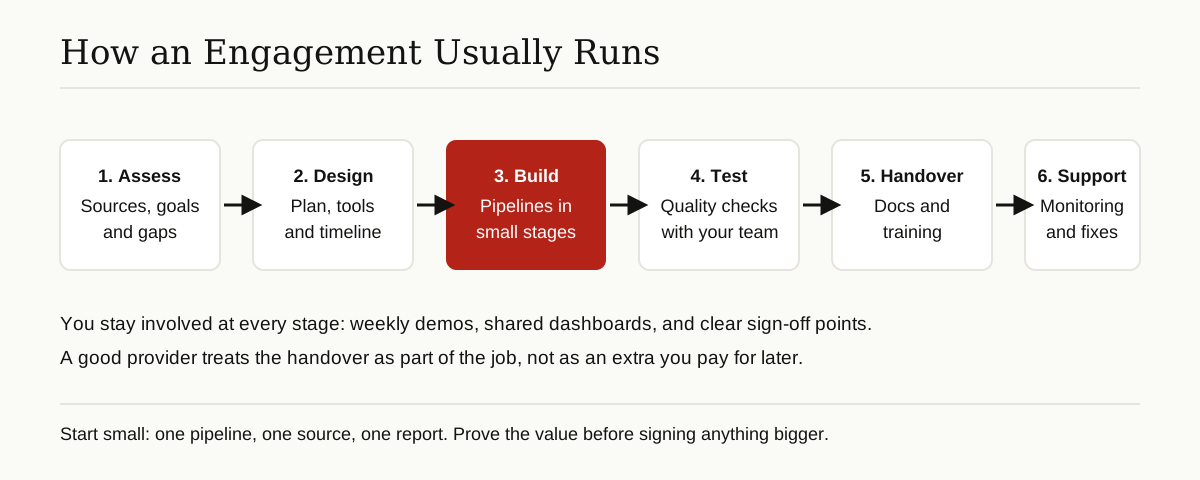
First comes an assessment: the provider maps your sources, your goals and your gaps, and tells you what is realistic. Then a design stage agrees the architecture, the tools and the timeline. The build itself should happen in small stages, so you see working pipelines and real data early, not after months of silence. Testing runs alongside the build, with quality checks and your team’s feedback. Finally there is a handover: documentation, training and a clear answer to the question “what do we do when this breaks at 2 a.m.?”
After the build, many companies keep the provider on a support arrangement for monitoring and small improvements. That is normal and often wise, as long as the knowledge is shared and you are not locked in.
Your side has homework too. The provider will need access to your systems, sample data to work with, and a named person who can answer questions and make decisions quickly. Projects rarely fail on technology. They stall when nobody on the client side has time to say what “correct” looks like, or when access requests sit in a queue for weeks. Assign one owner, protect a little of their time each week, and the whole engagement moves faster.
In-House Team or Outsource? An Honest Comparison
This is the decision most buyers struggle with, so here is the trade in plain terms.
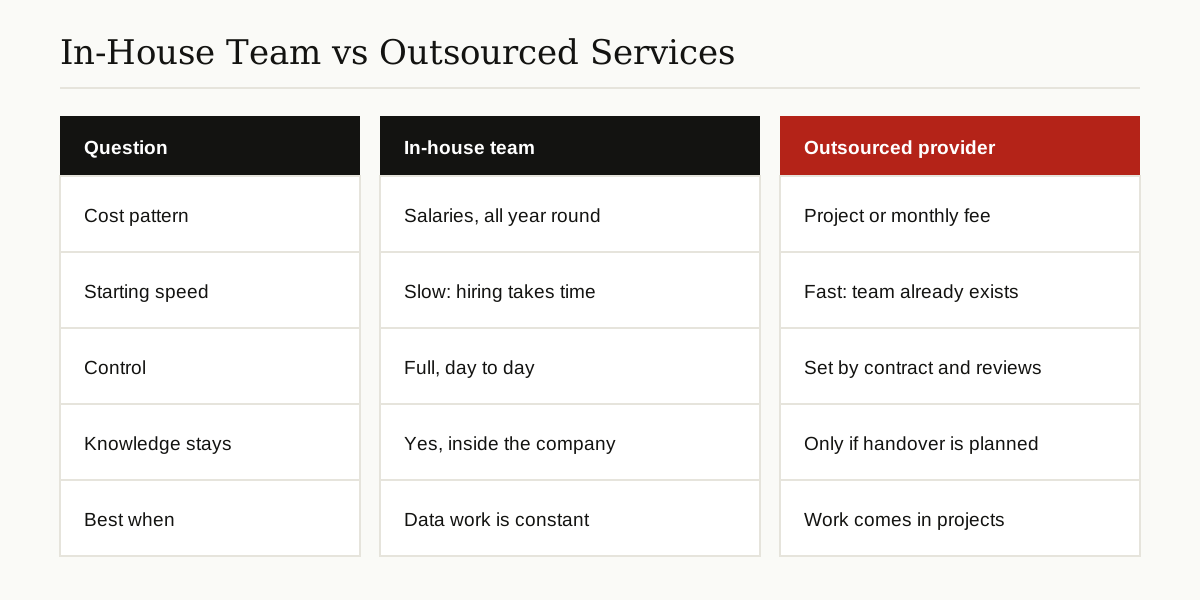
An in-house engineer costs a salary all year, plus hiring time, management and tools. In return you get full day-to-day control, and the knowledge of your systems stays inside the company and grows. If data work is constant and central to your product, that usually wins.
When you outsource data engineering services, you trade a salary for a project fee or a monthly retainer. You start fast, because the team already exists, and you can rent senior skills you could not justify hiring. The risks are real, though: less daily control, and knowledge walking out of the door at the end of the contract unless the handover is written into the deal. The honest middle path for many mid-size companies is a small internal owner who understands the systems, plus an outside team for heavy builds.
How to Evaluate a Provider
Portfolios and logos tell you little. These questions tell you much more.
Ask who will actually do the work, and whether you can meet them. Ask what happens when a pipeline breaks at night, and who gets alerted. Ask for one past project that went wrong and what they changed. Ask how documentation and training are handled, and what you own at the end: the code, the credentials, the designs. Good data engineering service providers answer these plainly. Vague answers about “AI-powered synergy” are a red flag, and so is a quote given before anyone has looked at your data.
Start with a pilot. One source, one pipeline, one report your team already trusts, rebuilt the new way. A small, verifiable success tells you more about a provider than any slide deck, and it limits your risk if the fit is wrong.
What Results to Expect: The Honest Part
Done well, these services give you reports you can defend, hours back every week, and a foundation that new tools and AI projects can build on. But be clear about the limits. No provider can fix bad source data by magic: if your sales team types free-text notes instead of using the fields, the pipeline will faithfully deliver messy notes, faster. Someone in your company still owns the rules for what the numbers mean. And a build is not a one-time cure. Sources change, tools update, volumes grow, so budget for care after launch, the same way you would for any machine the business depends on.
Expect the first visible win to be modest: one report that used to take two days now refreshes itself every morning. That is not a small thing. It is proof the pipes work, and it is the moment your team starts trusting the system. Bigger wins, like retiring the spreadsheet empire or feeding a serious AI project, come after the foundation has survived a few months of real life. A provider who promises a total transformation in the first month is selling you a story, not a system.
The Bottom Line
Data engineering services buy you the plumbing: pipelines, storage, checks and care, so the data your company already creates becomes data your company can actually use. Choose a provider the way you would choose a builder: references, a small first job, plain answers, and a proper handover. Get those right, and the dashboards, reports and AI projects everyone keeps promising suddenly have something solid to stand on.
For more guides like this one, browse the data, cloud and databases category.