Few word pairs in programming cause as much quiet confusion as parallel and concurrent. People use them as if they mean the same thing. Job ads mix them up. Even experienced developers swap them in conversation.
Here is the good news. The difference between them is simple, and once you see it through a coffee shop, you will not forget it.
This guide explains parallel concurrent processing in plain words: what each idea means, where you already see both every day, the classic problems they create, and how to know which one your program actually needs.
Concurrency in Plain Words
Picture a small coffee shop with exactly one barista.
Orders keep coming in. The barista starts the espresso for order one, and while it pours, she steams milk for order two. While the milk heats, she takes payment for order three and calls out a finished drink for order four.
She only ever does one thing at any single moment. But four orders are in progress at the same time, and all of them move forward. Nobody waits for the person ahead to finish completely before their order even starts.
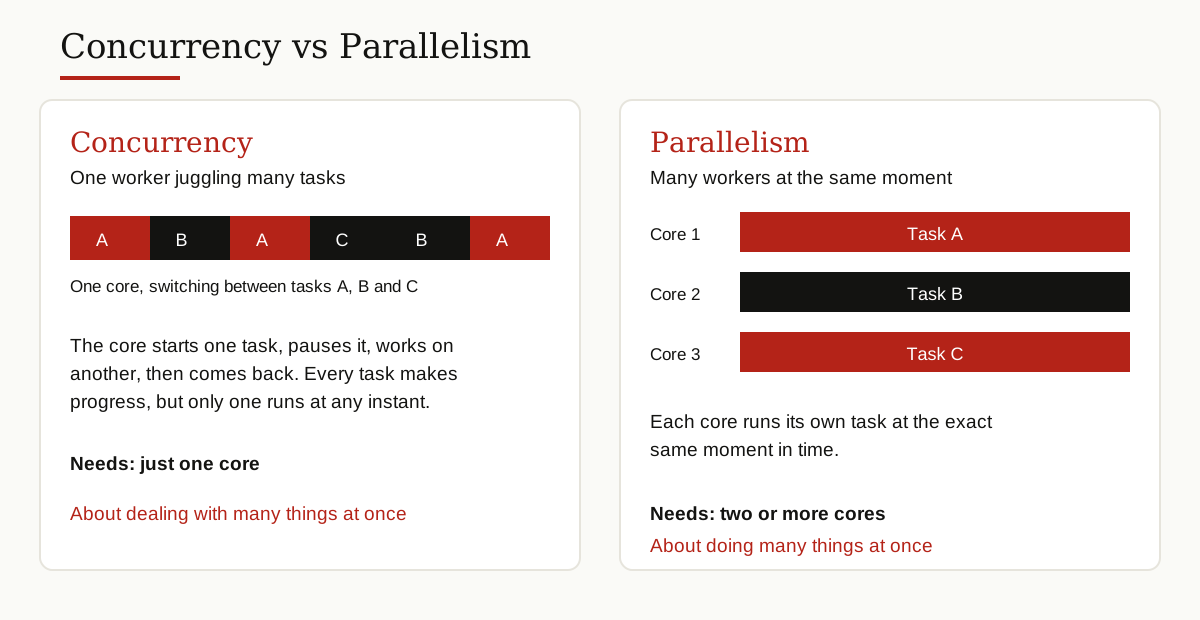
That juggling is concurrency. In computing, concurrent processing means a program is built to handle many tasks that are all in progress during the same period of time. The tasks take turns. On a single core computer, only one task truly runs at any instant, but the switching is so fast that everything progresses.
Rob Pike, one of the creators of the Go programming language, explained it in a famous 2012 talk called Concurrency Is Not Parallelism: “Concurrency is about dealing with lots of things at once.”

The key word is structure. Concurrency is a way of organizing a program so that it can deal with many things, whether or not the hardware can run them at the same moment.
Parallelism in Plain Words
Now picture the same coffee shop on a busy morning, but with four baristas behind the counter.
Each barista makes one drink from start to finish. Four drinks are genuinely being made at the exact same moment. No juggling is needed, because there are enough hands.
That is parallelism. Parallel processing means a program really does run several tasks at the same time, on different processor cores. No cores, no parallelism. A single core machine can juggle tasks all day, but it can never run two of them at the very same instant.
Pike’s talk gives the matching half of the quote: “Parallelism is about doing lots of things at once.”
So the two ideas are close cousins, not twins:
- Concurrency is about how a program is structured to deal with many tasks.
- Parallelism is about how a program is executed, truly at the same time.
A program is often designed to be concurrent, and then the computer runs it in parallel when enough cores are available. That combination is what people usually mean by parallel concurrent processing.
The Difference at a Glance
| Question | Concurrency | Parallelism |
|---|---|---|
| What is it about? | Dealing with many tasks at once | Doing many tasks at once |
| At one instant, how many tasks run? | One (they take turns) | Several, on different cores |
| Hardware needed | A single core is enough | Two or more cores |
| Coffee shop version | One barista juggling orders | A team of baristas |
| Main benefit | Nothing sits idle while waiting | Heavy work finishes faster |
One more point is worth fixing in your mind. Concurrency does not promise speed. Its promise is that waiting time gets used instead of wasted. Parallelism is the one that can make the total work finish sooner.
Processes and Threads, Simply Put
To talk about parallel concurrent processing properly, you need two building blocks: processes and threads.
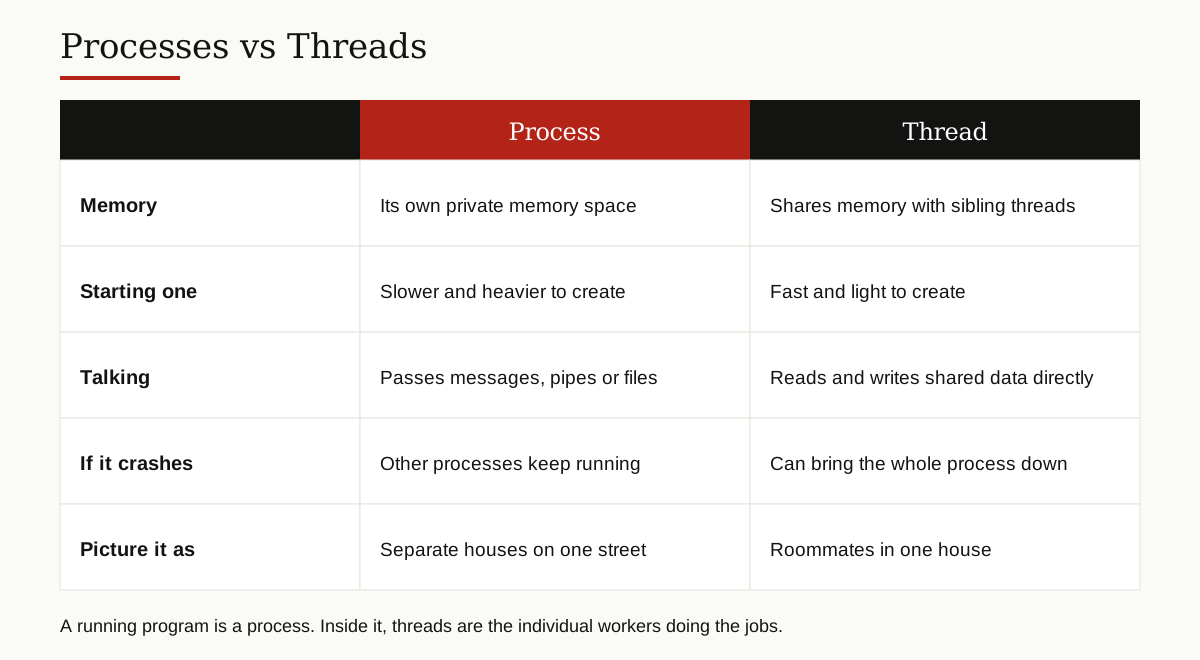
A process is a running program with its own private memory. When you open your browser and your music player, those are two processes. They cannot reach into each other’s memory, which is why one can crash without taking the other down.
A thread is one path of work inside a process. A single program can have many threads, and they all share the same memory. One thread of your browser might load a page while another plays a video and a third waits for your typing.
Oracle’s Java concurrency tutorial describes it the same way: a process has its own execution environment and memory space, while threads exist inside a process and share its resources.
Sharing memory makes threads light and fast to create, and it makes teamwork easy. It also creates danger, because two threads can change the same data at the same time. Most of the classic problems below come from exactly that.
The part of the operating system that decides which thread runs on which core, and when, is the kernel, working with the hardware. Programmers design the juggling. The system does the scheduling.
Where You See Each One Every Day
These ideas are not academic. You used both before breakfast.
Web servers live on concurrency. A popular website may have thousands of visitors at the same moment. The server cannot finish one visitor’s request before starting the next, because most of the work is waiting: waiting for the database, waiting for files, waiting for the network. Concurrent processing lets the server juggle all those requests, using every moment of waiting productively. When traffic grows past one machine, the same thinking stretches across many machines, which is the world of distributed systems.
Your phone mixes both. While music plays in the background, a map redraws, messages arrive, and you scroll through photos. The operating system juggles these tasks concurrently, and the phone’s several cores often run the busy ones in parallel.
Video rendering is parallelism at work. When you export a video, the editor splits the frames among all your cores. Each core renders different frames at the same moment, and the export finishes much sooner than one core could manage alone.
Data processing uses parallelism at scale. Sorting a huge file, resizing a million photos, or training on a big dataset all split naturally into independent chunks. Many cores, or many computers, each take a chunk and work at the same time. That is a process parallel style of working: the same step, applied to many items, all at once.

How Programmers Handle Concurrency
Writing juggling programs by hand is tricky, so languages and frameworks offer a few standard patterns. You only need the plain idea of each.
Threads and locks. The oldest approach: run several threads, and protect shared data with a lock. A lock works like the key to a single restroom. Only the thread holding the key may enter and change the shared data. Everyone else waits their turn. It is simple to picture, and easy to get wrong, as the next section shows.
Async and await. Instead of extra threads, one worker is taught never to stand idle. The code says “start this download, and while it loads, go do something else; come back when it is ready.” The words async and await in languages like JavaScript, Python, and C# mark exactly those pause and resume points. This style shines when work is mostly waiting.
Actors and message passing. Here, each worker is like an employee with a private desk and a mailbox. Workers never touch each other’s desks. They send notes instead: “here is a new order,” “this job is done.” The Go language uses channels for this style, passing messages between lightweight tasks called goroutines, and it grows out of the same thinking as Pike’s talk. Because nothing is shared, whole families of bugs never get the chance to appear.
Good software architecture is often about choosing which of these patterns fits the job, and keeping the shared parts small.
The Classic Problems
Concurrency has a famous set of traps. Every programmer meets them, and each one is easy to understand with a story.
Race condition
Two cashiers update the same bank account at the same moment. The balance is $100. Both screens read $100. A $50 deposit arrives at each screen. Each cashier adds $50 and writes back $150.
The correct answer is $200. The account shows $150. One deposit vanished, not through theft, but because the two updates raced and the second write quietly replaced the first.
That is a race condition: the result depends on the exact order and timing of tasks that share data. These bugs are nasty because the program may work a thousand times and fail on the thousand and first run, when the timing lines up badly.
Deadlock
Two narrow doors stand side by side, and passing through the second door needs a key. Worker one holds the key to door one and waits for the key to door two. Worker two holds the key to door two and waits for the key to door one.
Neither lets go. Neither can move. This polite standoff is a deadlock, and it can freeze a whole program while every part of it waits for another part.
Starvation
A support desk serves urgent tickets first. All day, urgent tickets keep arriving, and one quiet, low priority ticket keeps getting pushed to the back. Nothing is broken and nobody made a mistake, yet that ticket may never be served. That is starvation: a task that waits forever because others always go first.
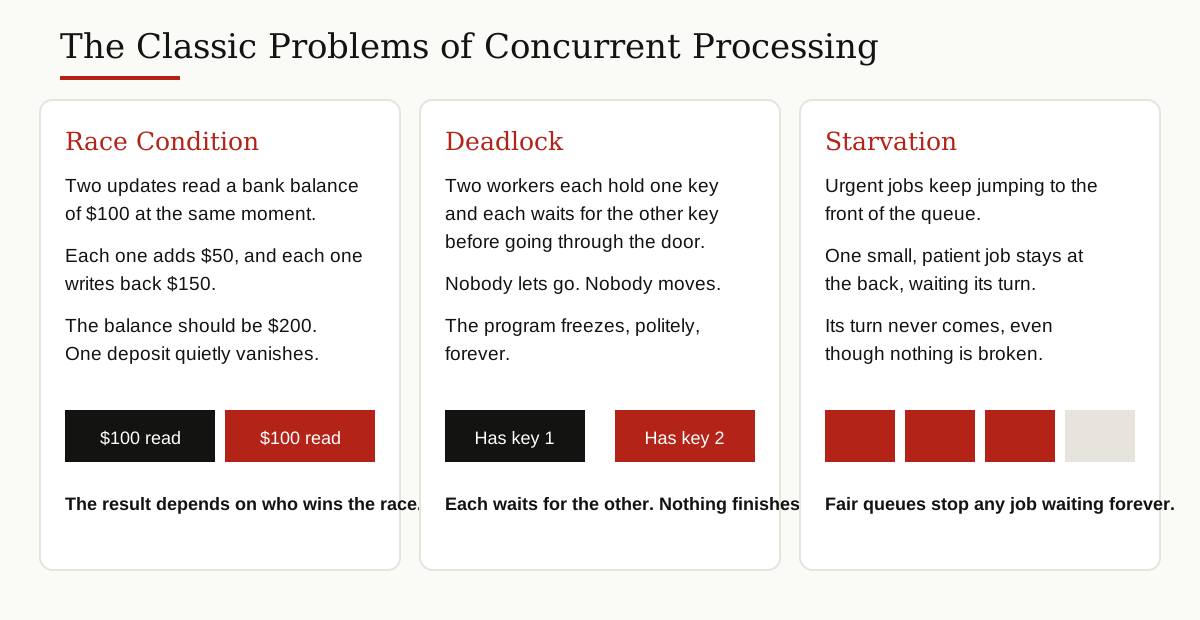
Locks, careful ordering of keys, and fair queues exist to prevent exactly these three traps.
Amdahl’s Law in Plain Words
If parallelism is so helpful, why not throw a hundred cores at every problem? A computer architect named Gene Amdahl gave the answer back in 1967, and it is now called Amdahl’s law.
Split any job into two parts:
- The part that can be divided among many workers.
- The part that must be done step by step, in order, by one worker.
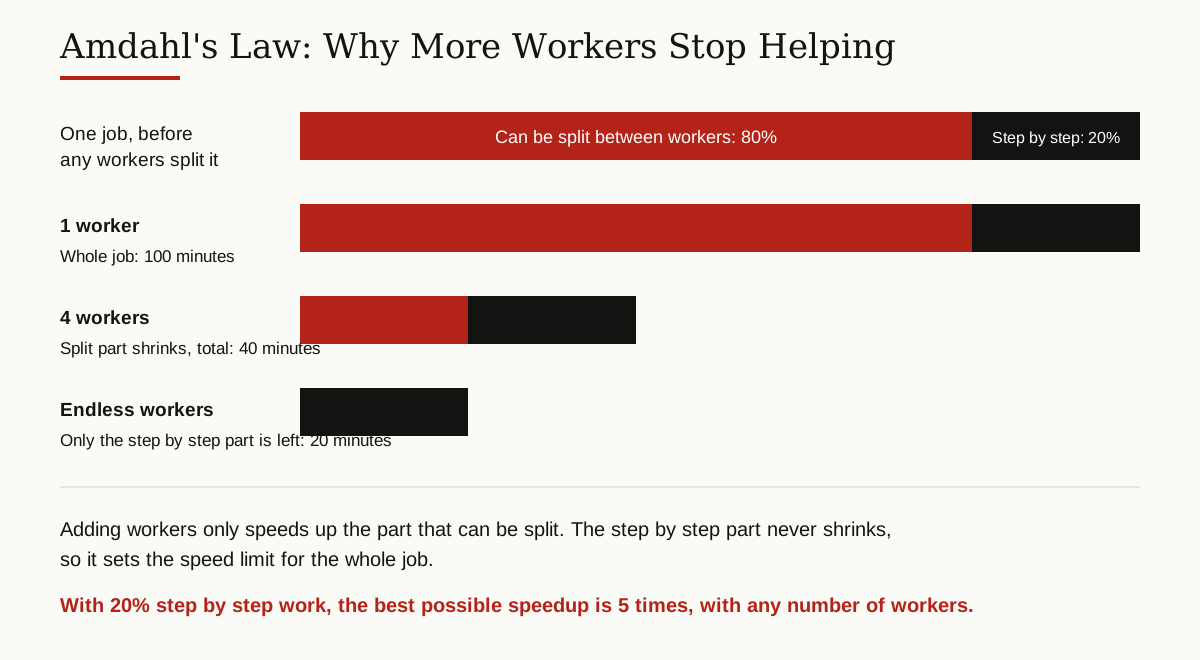
Adding workers only shrinks the first part. The second part never shrinks. So the step by step part quietly decides the fastest the whole job can ever go.
Suppose 20 percent of a job is step by step work. Even with endless workers, the divisible part shrinks to nothing and the total time stops at that stubborn 20 percent. The best possible speedup is 5 times, and no budget for extra cores can beat it.
This is why experienced engineers ask about the shape of the job before buying hardware, and why small step by step sections, like one shared lock everyone must wait for, can spoil an otherwise parallel design.
I/O Bound or CPU Bound: How to Choose
The most useful question in parallel concurrent processing is also the simplest: what is your program mostly doing?
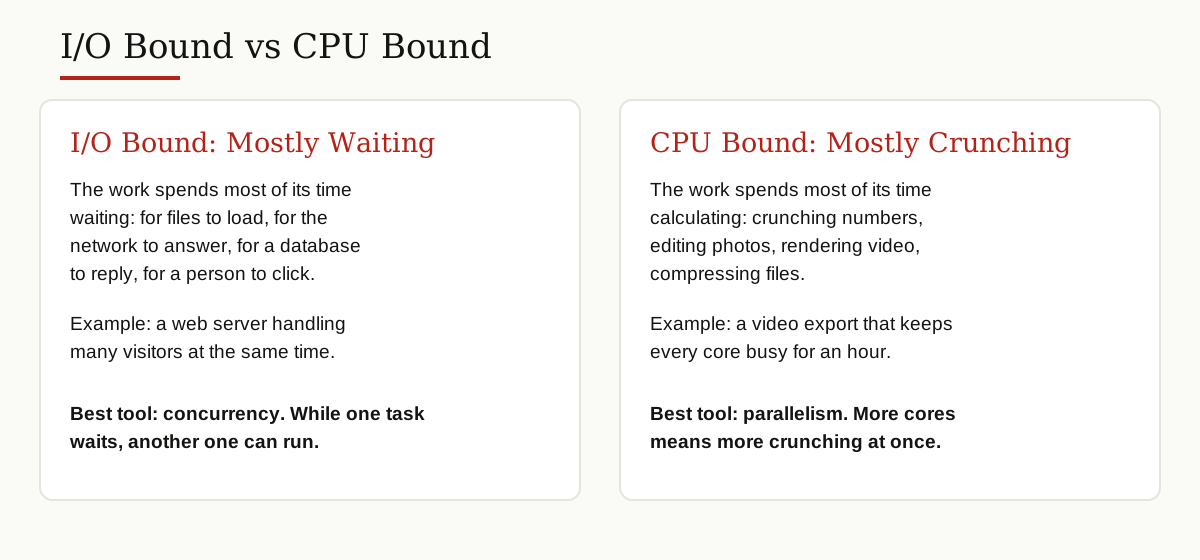
I/O bound work is mostly waiting. Input and output, shortened to I/O, means talking to the outside world: loading files, calling a database, fetching web pages, waiting for a click. The processor is idle most of the time. Concurrency is the hero here, because juggling fills the waiting gaps. Ten waiting tasks need attention, not ten cores.
CPU bound work is mostly crunching. The processor is busy the whole time: rendering video, resizing photos, running heavy math. Waiting is not the problem; raw calculation is. Parallelism is the hero here, because only more cores can do more crunching at the same moment.
Most real programs are a mix. A photo app waits for images to download (I/O bound) and then crunches filters onto them (CPU bound). The craft is spotting which part dominates, then applying concurrency to the waiting and parallelism to the crunching.
Common Misconceptions
More threads always means faster. Not true. Switching between threads costs time, threads wait on each other’s locks, and Amdahl’s law caps the gain. Past a point, adding threads makes a program slower.
Concurrency and parallelism are the same thing. They are partners, not twins. Concurrency is structure, parallelism is execution. You can have either one without the other.
Parallel code is always better code. For a small tool used by one person, plain step by step code is easier to write, easier to read, and fast enough. Parallel concurrent processing earns its complexity only when there is real waiting to hide or real crunching to split.
Threads are free. Each thread carries its own stack of memory, and thousands of threads can strain a system. That is why lightweight patterns like async code and goroutines exist.
Conclusion
Concurrency is dealing with many things at once, by juggling. Parallelism is doing many things at once, with many hands. One is about structure, the other about execution, and strong programs usually combine them into parallel concurrent processing.
If you remember the coffee shop, you remember the topic. One barista juggling orders is concurrent processing. A team of baristas working side by side is parallel processing. And a shop that trains its staff to juggle well, then staffs enough baristas for the morning rush, is doing what good software does.
Explore more guides like this in our software development section.