For years, the smart features on your phone were not really on your phone. You typed a question, the phone sent it to a giant data center, a server farm did the thinking, and the answer traveled back. That picture is now changing fast.
On-device AI means the artificial intelligence runs right on your phone, tablet or laptop, on a chip inside the device itself, with no trip to the cloud. It is the biggest shift in how AI reaches normal people, and it explains most of the on-device AI news of the past two years. Apple, Google, Samsung, Qualcomm and Microsoft have all reshaped their product plans around it.
This roundup explains why the industry is moving this way, and then walks through the biggest verified stories, company by company, with dates and sources so you can check every claim yourself.
If you follow on-device AI news today, one pattern stands out. Two years ago, a phone with a small local model was a curiosity. Now every major launch event, from Apple keynotes to chip summits, leads with what the device can do on its own. The race is no longer about who has the biggest server. It is about who makes the smartest use of the computer already in your hand.
Why the Industry Is Moving AI Onto Devices
Four plain reasons explain the shift, and none of them is hype.
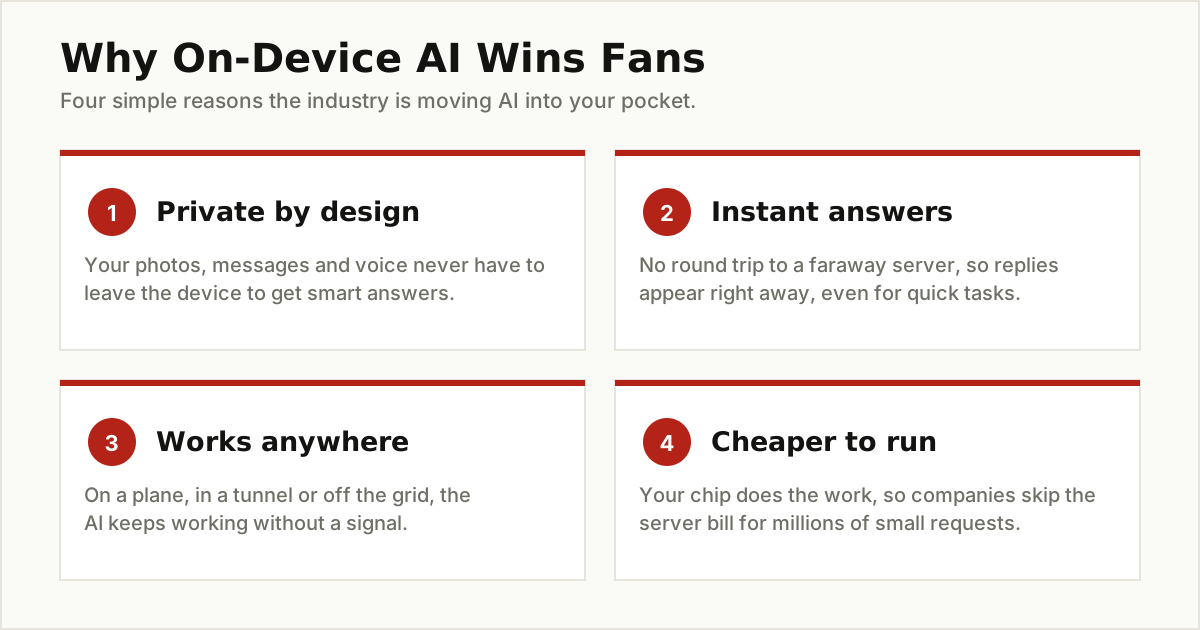
Privacy. When the AI lives on the device, your photos, voice notes and messages do not have to leave your pocket. That is a much easier promise for companies to make, and a much easier one for users to trust.
Speed. A local chip answers in a blink. There is no waiting for a request to cross the internet, queue on a server and come back. For small jobs like fixing a sentence or summarizing a note, local simply feels instant.
It works anywhere. On-device features keep running on a plane, in a subway tunnel or in a village with weak signal. Cloud AI stops the moment the connection drops.
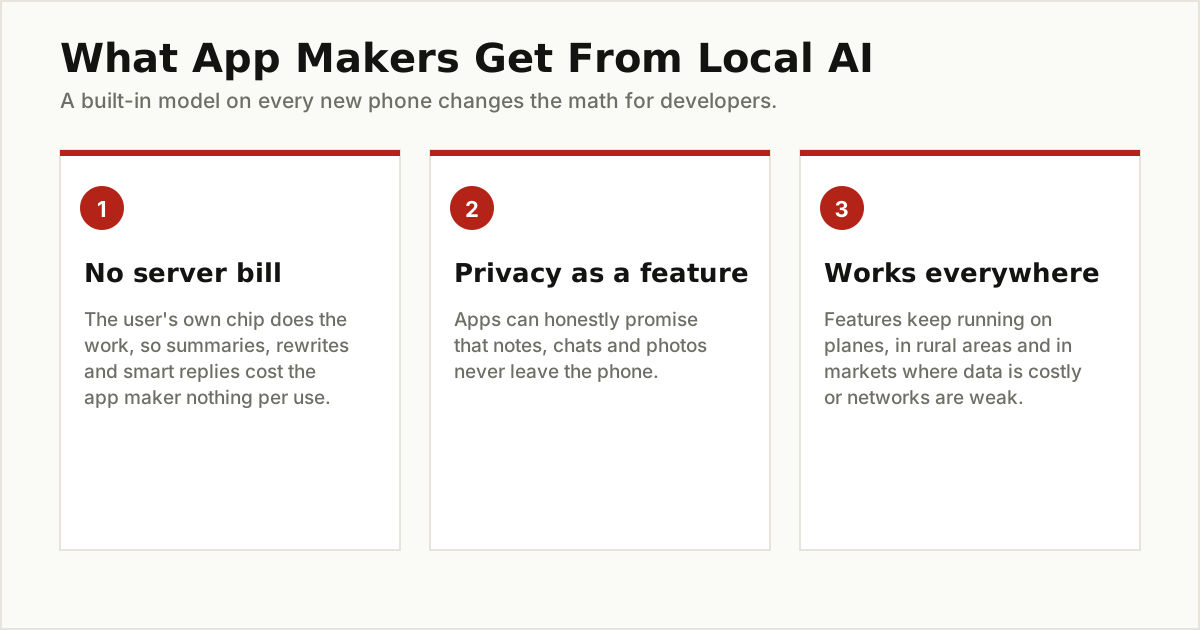
Cost. Every cloud question costs the company behind it real money in servers and electricity. When millions of small requests move onto chips that users already own, the bill drops sharply. Apple makes this point openly: developers who use its on-device model pay no per-request inference cost at all.
There is also a quiet fifth reason. Rules about personal data keep getting stricter around the world, and data that never leaves the device is data a company never has to defend.
You already use more of this than you think. Face grouping in your photo library, offline voice typing, live captions on videos, spam call screening and the keyboard predictions that finish your sentences all lean on models running locally. The recent on-device AI news is really about that quiet layer getting much stronger, and learning to write, summarize and create, not just sort and predict.
On-Device AI vs Cloud AI
Neither side wins at everything. The honest picture looks like this:
| Question | On-Device AI | Cloud AI |
|---|---|---|
| Where does it run? | On a chip inside your device | On servers in a data center |
| What happens to your data? | It stays on the device | It travels to the company |
| Does it need internet? | No, it works offline | Yes, always |
| How fast is it? | Instant for small tasks | Fast, but depends on connection |
| How smart is it? | Good, but limited by size | The smartest models available |
| Who pays for the computing? | Your device battery | The company, per request |
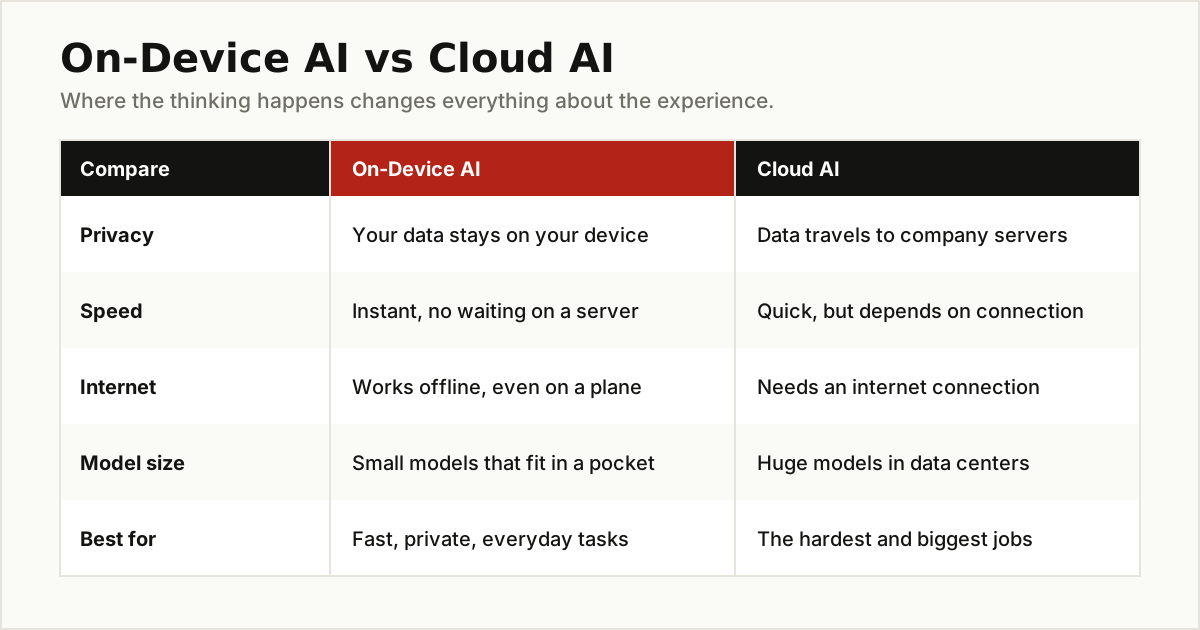
In practice, phones now blend both. Quick and private jobs stay local. Rare, heavy jobs quietly visit the cloud. The news below is about how fast the local side is growing.
The Big Stories in On-Device AI
Apple: Apple Intelligence and the Foundation Models Framework
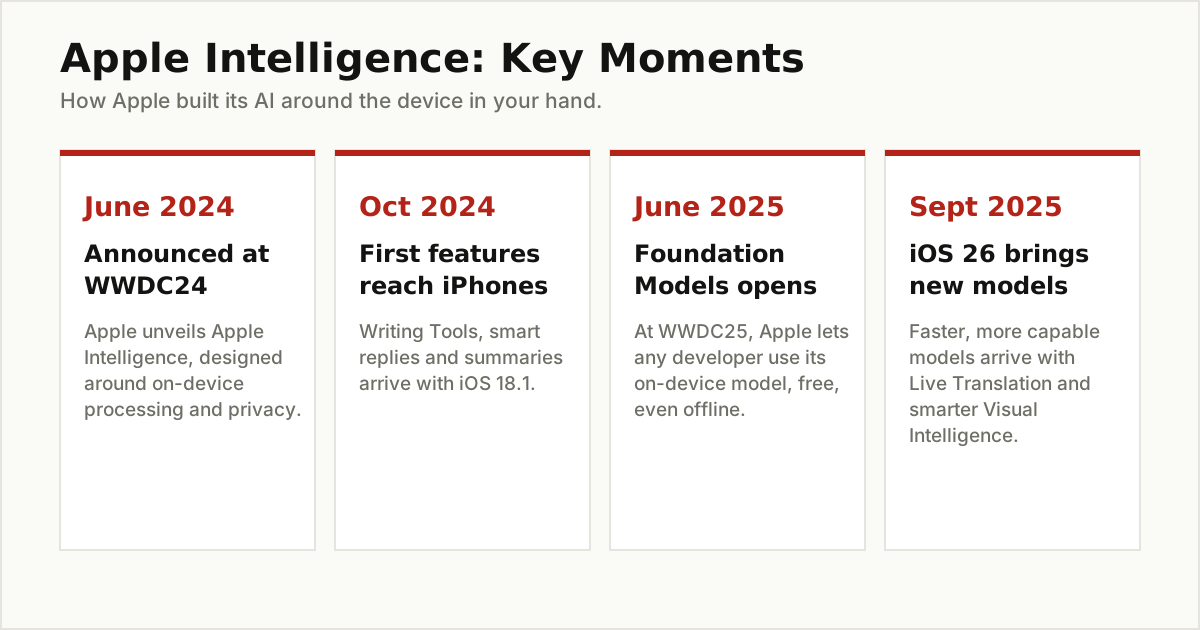
Apple is the company that turned on-device AI into a headline. It announced Apple Intelligence at its developer conference in June 2024, built around a simple idea: process as much as possible on the device, and use its Private Cloud Compute servers, which Apple says do not store your data, only when a request is too big for the phone.
The first features, including Writing Tools, notification summaries and smart replies, reached iPhones with iOS 18.1 in October 2024. Then came the move that matters most for this story. At WWDC in June 2025, Apple introduced the Foundation Models framework, giving every developer direct access to the same on-device language model that powers Apple Intelligence. According to Apple’s announcement, apps can add summarization, extraction and creative tools with a few lines of Swift code, with no cloud cost and full offline support.
Apple describes its on-device model as a compact model of roughly 3 billion parameters, small enough to live on a phone yet strong enough for everyday work. In September 2025, updated and faster models shipped with iOS 26, alongside features such as Live Translation in Messages, FaceTime and phone calls, and a smarter Visual Intelligence that can search and act on what is on your screen. Features like that lean on the same ideas explained in our guide to how AI visual search works.
One honest footnote: Apple’s more personal, deeply aware Siri has taken longer than promised. At WWDC 2025 the company said openly that the feature needed more time and would roll out in the coming year.

Google: Gemini Nano and AICore on Android
Google’s answer is Gemini Nano, the smallest model in its Gemini family, built from the start to run on phones. It runs through AICore, a system service inside Android that downloads, updates and guards the model centrally, so every app on the phone can share one copy instead of shipping its own.
In May 2025, during its I/O developer season, Google opened Gemini Nano to app developers through new ML Kit GenAI APIs. As the Android Developers Blog explains, the first set of tools covers summarization, proofreading, rewriting and image description, all processed locally on the device.
In August 2025, Google followed up with the newest multimodal version of Gemini Nano on the Pixel 10 series, a model that can work with text and images together. Google also uses Nano inside its own features, from summarizing recordings to describing images for blind users through TalkBack, a good example of computer vision applications doing quiet, useful work.
The push reaches beyond phones. Google has also brought Gemini Nano to Chrome on the desktop, opening developer previews that let websites run small AI tasks, such as writing help and translation, right in the browser. The same logic applies: quick jobs stay local, private and free of server costs, while heavy work still goes to the cloud.
Qualcomm: The Chips That Make It Possible
None of this happens without silicon, and Qualcomm is the loudest voice selling it. On September 24, 2025, at its Snapdragon Summit in Hawaii, the company announced the Snapdragon 8 Elite Gen 5, the flagship phone chip that will power many 2026 Android phones.
According to Qualcomm’s launch release, its Hexagon NPU, the part of the chip built to run neural networks, is 37 percent faster than the one before it, and the platform is designed for agentic AI assistants that learn on the device while personal data stays on the device. The same week, Qualcomm showed its Snapdragon X2 Elite chips for Windows laptops, led by an Extreme version whose 80 TOPS NPU it calls the fastest in a laptop chip.
The pattern to notice: every chip launch now leads with AI numbers, not raw speed. The processor race has become an AI race.
Microsoft: Copilot+ PCs and the Phi Models
The same shift is happening on your desk. Copilot+ PCs, a class of Windows laptops Microsoft introduced in 2024, must include a neural processing unit rated at 40 TOPS or more, a hardware bar set purely so AI can run locally.
Built into these machines is Phi Silica, a small language model from Microsoft’s Phi family that is tuned for the NPU. It powers features like Click to Do, which can summarize or rewrite text anywhere on your screen without sending it anywhere. At its Build conference in May 2025, Microsoft wrapped these local models into Windows AI Foundry, giving app developers a simple way to use the model already sitting on the PC.
The Phi family itself is worth knowing. Microsoft has released several Phi models as open models that researchers and companies can download and run themselves, proof that small models, trained carefully, can punch far above their size.
Samsung: Galaxy AI and the Personal Data Engine
Samsung wrapped its phone AI in the Galaxy AI name, and pushed it hardest with the Galaxy S25 series, launched at its Unpacked event on January 22, 2025.
The part that fits this story is the Personal Data Engine. Samsung says it studies your routines and preferences to power features like Now Brief, a personal morning and evening briefing, and that this personal data is processed on the device and protected by its Knox Vault security hardware. Galaxy AI settings also let owners choose on-device processing for supported features, a real choice more phones should copy.
Samsung leans on partners too: the S25 series uses a custom Snapdragon chip and Google’s Gemini for cross-app actions, some of which still use the cloud. It is a fair snapshot of the industry in 2025 and 2026: local where it counts, cloud where it must.
What This Means for App Makers
For developers, the ground has moved. A small team can now add smart summaries, writing help or photo descriptions to an app without renting servers, paying per request or asking users to trust a cloud with their data.
Apple and Google both hand developers the same on-device model the phone already carries, kept updated by the system itself. That lowers the cost of adding AI to nearly zero, and it means the next wave of AI features will come from small apps, not just giant platforms. Expect AI to become a normal ingredient in ordinary apps, the way GPS and cameras did before it. For more coverage like this, see our AI news and regulation section.
The Honest Limits
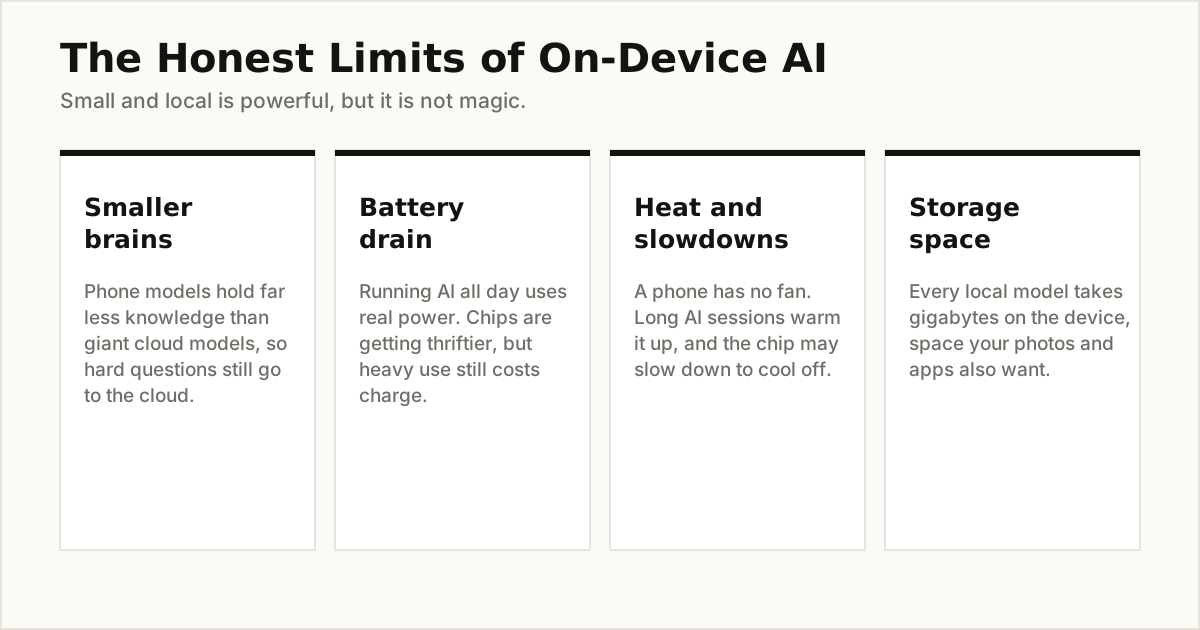
On-device AI is real progress, but it is not magic, and the limits are worth stating plainly.
The models are small. A model that fits on a phone knows less and reasons less deeply than the giant models in data centers, which is why phones still hand the hardest questions to the cloud. Local AI also drinks battery and warms the phone up during long sessions, and every stored model eats gigabytes that photos and apps would love to use. Finally, most of these features live on recent, expensive hardware. If your phone is a few years old, much of this news is still a reason to upgrade, not a feature you have today.
What to Watch Next
Three threads are worth following. First, Apple’s delayed, more personal Siri: when it lands, it will test whether deep on-device awareness can feel helpful rather than creepy. Second, agents: Qualcomm, Google and Microsoft all describe assistants that do not just answer but act across apps, and the safest place for an acting assistant is on the device, close to your data. Third, reach: as chips improve, today’s flagship-only features will slide down into mid-range phones, which is when on-device AI stops being news and becomes normal.
A fourth thread is the open model race. Google’s Gemma family and Microsoft’s Phi models can be downloaded and run by anyone, and each release gets smaller and smarter. The better these open models get, the faster local AI spreads into apps, cars, appliances and tools nobody has thought of yet.
Conclusion
The on-device AI news of the past two years tells one story from five directions. Apple opened its phone model to every developer. Google did the same on Android with Gemini Nano. Qualcomm rebuilt its chips around AI. Microsoft put a small model inside Windows PCs. Samsung turned local processing into a privacy selling point.
The center of gravity in AI is moving, from distant servers to the device in your hand. The cloud is not going away, but the smartest place for everyday AI is turning out to be the closest one.