
Every AI headline you read, from a new chatbot to a smarter phone, sits on top of a small piece of silicon. Models do not run on magic. They run on chips, and the race to build those chips has become the most expensive contest in technology.
That is why AI chip news now moves stock markets, shapes trade fights between countries, and decides which companies can even build the next generation of AI. One deal can be worth more than the yearly output of a small country.
This roundup walks through the biggest AI chip news of the past year, company by company, in plain English: Nvidia’s Blackwell ramp, AMD’s giant OpenAI deal, Google’s TPU push, Qualcomm’s jump into data centers, the custom chips Big Tech builds for itself, and the export rules that kept changing the game for China.
The Main Kinds of AI Chips, in 60 Seconds
Before the news, a quick map. Almost every AI chip story falls into one of these buckets.

- GPU (graphics processing unit): a chip that does huge amounts of simple math in parallel. First built for video games, it turned out to be perfect for AI. Nvidia is the king here.
- TPU (tensor processing unit): Google’s custom chip, designed only for AI math. You cannot buy one in a store; you rent time on it through Google Cloud.
- Custom silicon or ASIC: a chip a company designs for its own exact workload, often with a partner’s help. Cheaper to run at giant scale, useless for anything else.
- NPU (neural processing unit): a small AI chip inside phones and laptops. It runs features like photo cleanup and live translation without draining the battery.
Two more words show up in every story. Training is teaching an AI model, the heavy work that needs the biggest chips. Inference is running a trained model to answer you, lighter work done billions of times a day. A lot of AI chip news today is really about the shift from training to inference, because that is where the everyday money now flows.
| Chip type | Who makes it | Main job |
|---|---|---|
| GPU | Nvidia, AMD | Training and inference, sold to everyone |
| TPU | Google’s own AI, rented through its cloud | |
| Custom ASIC | Amazon, Microsoft, Meta, OpenAI | One company’s own workload at huge scale |
| NPU | Qualcomm, Apple | AI features inside phones and laptops |
Nvidia: Still the Sun Everything Orbits
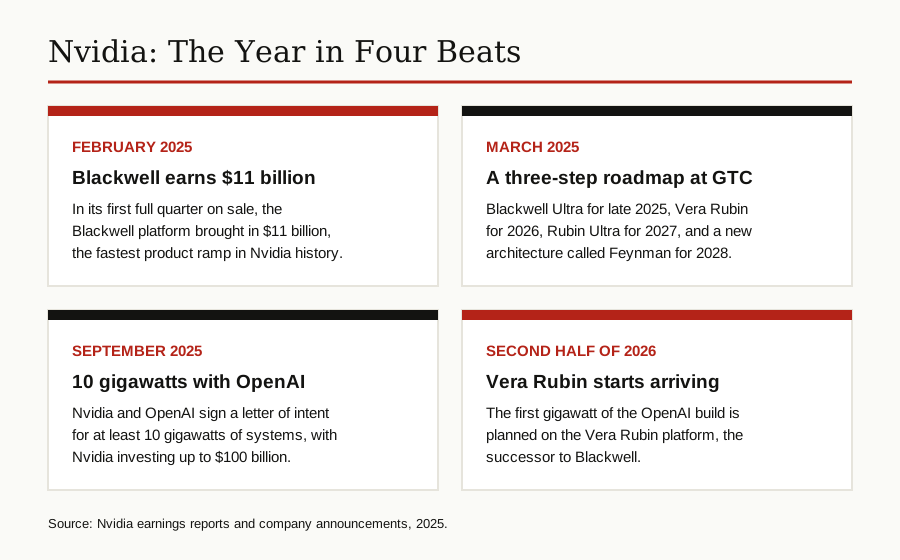
Nvidia’s year started with proof that its newest platform, Blackwell, was printing money. Reporting its results in February 2025, Nvidia said Blackwell brought in $11 billion in its first full quarter on sale. Finance chief Colette Kress called it the fastest product ramp in the company’s history, and data centers made up the bulk of the business.
A month later, at its GTC conference on March 18, 2025, CEO Jensen Huang laid out the road ahead, as Reuters reported at the time: Blackwell Ultra, a stronger version with more memory, in the second half of 2025; a new platform called Vera Rubin in the second half of 2026; Rubin Ultra in 2027; and a further design, Feynman, in 2028. The message was simple: a new flagship every year, so rivals never get time to catch their breath.
The biggest Nvidia headline came on September 22, 2025. Nvidia and OpenAI announced a letter of intent to deploy at least 10 gigawatts of Nvidia systems for OpenAI’s next generation of AI, with Nvidia intending to invest up to $100 billion in OpenAI as the capacity gets built. The first gigawatt is planned for the second half of 2026 on the Vera Rubin platform. Ten gigawatts is roughly the power draw of a large city, which tells you how this industry now measures deals: not in chips, but in power stations.
AMD: The OpenAI Deal That Changed the Story

AMD spent years as the respected runner up, strong on technology, short on headline wins against Nvidia. That changed in a single morning.
On October 6, 2025, AMD and OpenAI announced a deal to deploy 6 gigawatts of AMD GPUs across several generations of its Instinct line. The first gigawatt, built on the new Instinct MI450 series, is set to start in the second half of 2026. AMD leaders told Reuters they expect the agreement to bring in tens of billions of dollars a year as other buyers follow OpenAI’s lead.
The deal had an unusual twist. AMD gave OpenAI a warrant, the right to buy up to 160 million AMD shares at a token price, vesting as the gigawatts get deployed and as AMD’s share price hits set targets. If fully used, that is roughly a tenth of the company. Investors loved it anyway: AMD shares jumped more than 20 percent on the news, according to Reuters.
Why it matters: this was the first time a top AI lab bet its future build out on AMD at the same scale as its Nvidia plans. It also showed the pattern of the year in AI chip news, buyers paying not just with money, but with equity, partnerships and power contracts.
Google TPUs: The Quiet Second Superpower
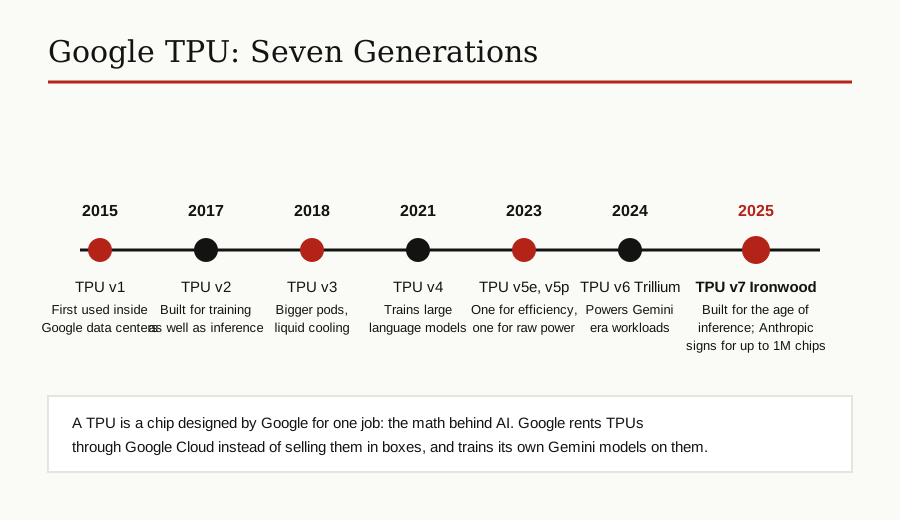
Google has designed its own AI chips longer than anyone, since 2015, but for years TPUs were mostly an internal tool. In April 2025, at its Cloud Next conference, Google unveiled Ironwood, its seventh generation TPU. Google built Ironwood for the inference era: chips link into pods of up to 9,216 units, and the company says one pod delivers computing power beyond the world’s largest supercomputers.
Then came the deal that turned heads. On October 23, 2025, Google Cloud and Anthropic announced that Anthropic would get access to up to one million TPUs, a commitment worth tens of billions of dollars, bringing more than a gigawatt of new capacity online during 2026 for training and running its Claude models.
Google AI chip news matters beyond Google. Anthropic also trains on Amazon’s chips and Nvidia’s GPUs, so its giant TPU order was a public vote that Google’s silicon can carry a frontier lab. Every TPU rented is also proof that Nvidia is not the only road to serious AI compute, a theme you can follow across our LLM news coverage.
Qualcomm and the Edge: Chips Where AI Actually Lives

Qualcomm owns the AI chips inside most premium Android phones, and in 2025 it pushed into the data center too. On October 27, 2025, Qualcomm announced the AI200 and AI250, accelerator cards and full racks for running AI models, built on the same Hexagon technology as its phone chips. Each AI200 card carries 768 GB of memory, far more than a typical GPU card, aimed at running large models cheaply. The AI200 is due in 2026 and the AI250 in 2027, and Saudi Arabia’s HUMAIN signed on to deploy 200 megawatts of the racks starting in 2026. Qualcomm’s stock jumped by double digits on the announcement, as SiliconANGLE reported.
The logic is the training versus inference split. Qualcomm is not trying to out train Nvidia. It is betting that running models, cheaply and at huge volume, becomes the bigger business. The same bet powers the AI features arriving in phones and laptops, which we track in our on-device AI news coverage.
The Custom Silicon Crowd: Big Tech Builds Its Own
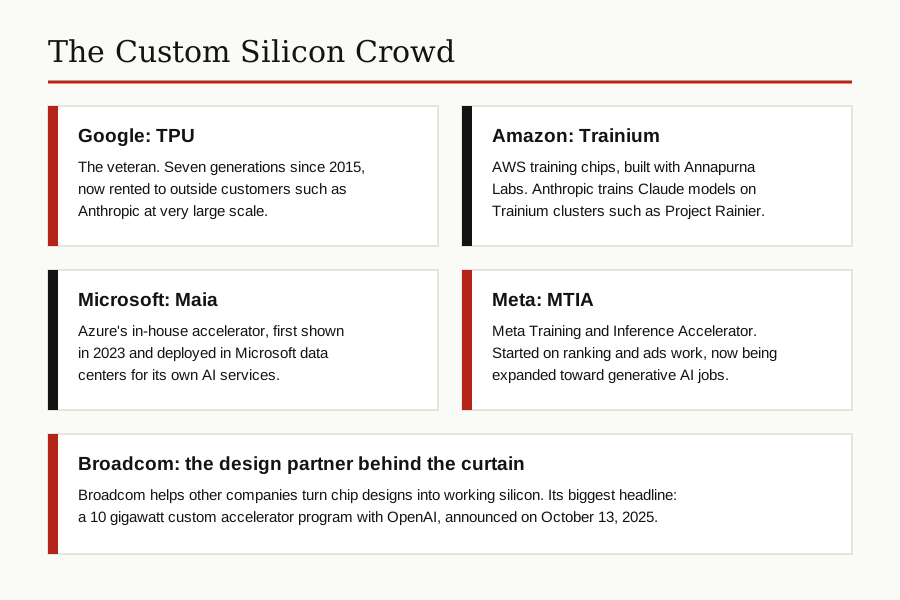
The strangest twist in recent AI chip news is that Nvidia’s biggest customers are becoming its competitors.
Amazon runs Anthropic’s training on its own Trainium chips, built by its Annapurna Labs team. Its Project Rainier cluster, assembled for Anthropic, strings together hundreds of thousands of Trainium2 chips into one of the largest AI computers ever built. Microsoft has its Maia accelerator running in Azure data centers for its own AI services. Meta’s MTIA chips handle the ranking and recommendation work behind its apps, and Meta keeps expanding the program.
The headline act, though, was OpenAI itself. On October 13, 2025, one week after the AMD deal, OpenAI and Broadcom announced they would co-develop and deploy 10 gigawatts of custom AI accelerators designed by OpenAI. Deployments start in the second half of 2026 and run to the end of 2029. Broadcom is the industry’s go to partner for turning a design into real silicon, so the deal instantly made it a central player in AI chips news today.
None of these companies plans to drop Nvidia soon. Custom chips take years and work best on fixed, predictable jobs. But every workload that moves to home grown silicon is a sale Nvidia does not make, and the direction of travel is clear.
Export Controls and China: The Rules Kept Moving
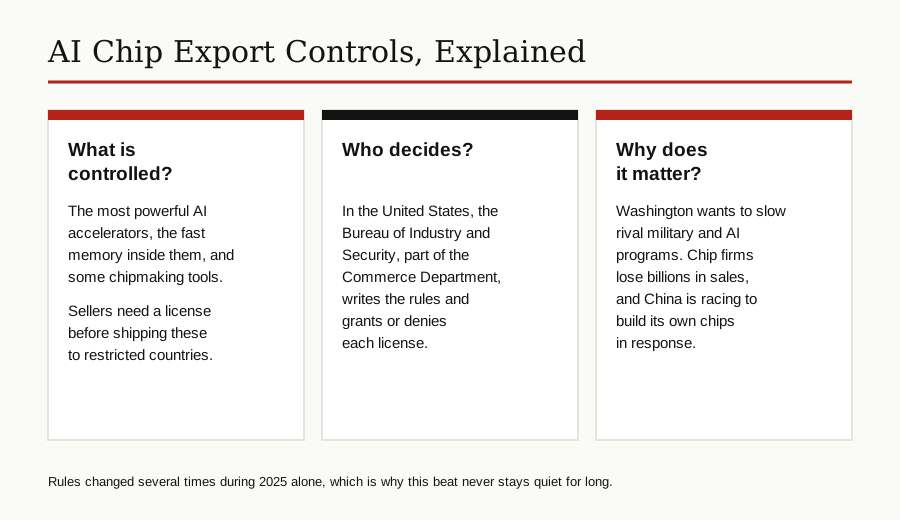
If one thread ran through AI chip news in 2025, it was Washington rewriting the rulebook, sometimes mid game. As a detailed legal summary of the changes from law firm Crowell and Moring lays out, the year went like this.
In January 2025, the outgoing Biden administration published the AI Diffusion Rule, which sorted countries into tiers and capped how many advanced chips most of the world could buy. In April, the Trump administration told Nvidia it would need a license to sell even the H20, a reduced chip Nvidia designed specifically to comply with earlier China rules. Nvidia took a $4.5 billion charge on unsold H20 inventory and commitments.
In May, the policy flipped again. On May 13, 2025, the Commerce Department rescinded the AI Diffusion Rule, calling it overly complex, and issued new guidance instead, including a warning that using Huawei’s Ascend chips anywhere in the world could violate US export rules.
Then came the most unusual chapter. In July 2025, Washington agreed to grant licenses for the H20 and AMD’s MI308 to ship to China again. Reporting by the Associated Press confirmed in August that, in return, Nvidia and AMD agreed to pay the US government 15 percent of the revenue from those China sales, an arrangement with no real precedent in export policy.
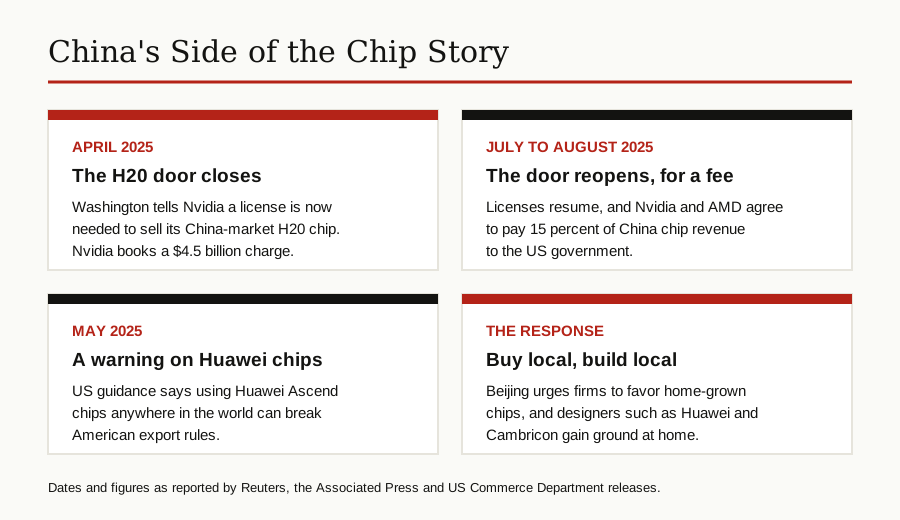
China, meanwhile, pushed its own firms to buy local. Officials urged Chinese companies to avoid the H20 for government linked work, according to Bloomberg reporting, and home grown designers such as Huawei and Cambricon gained ground at home. The result is two slowly separating tech worlds, each building its own AI chip supply chain. Intel’s struggles underline how hard this business is: despite its history, Intel’s Gaudi accelerators won few big AI buyers, and intel ai chip news today is mostly a story of a giant trying to rebuild.
What This Means for Buyers and Prices
For anyone renting AI computing power, the news is mixed but hopeful. More suppliers, AMD winning flagships deals, TPUs rented at scale, Qualcomm entering racks, means more bargaining power than buyers had in the Nvidia only years. Cloud prices for inference should keep falling as these chips compete.
For the companies themselves, the risk flipped. The danger is no longer failing to get chips. Deals are now measured in gigawatts and hundreds of billions of dollars, signed years before the hardware exists, which is why spending plans by the big labs, covered in our AI agents enterprise news reporting, are worth watching as closely as the chips themselves.
What to Watch Next
- Second half of 2026: the first gigawatts land, Vera Rubin systems for OpenAI, the first AMD MI450 racks, and the start of OpenAI’s Broadcom built accelerators. Delays here would shake the whole market.
- Qualcomm’s 2026 racks: whether the AI200 wins real data center customers beyond its Saudi anchor deal.
- The next export rule: Washington has promised a replacement for the rescinded diffusion rule, and the 15 percent China arrangement still needs a formal framework.
- Custom silicon share: how much of the big labs’ new capacity runs on chips they designed themselves.
The Bottom Line
The race for AI silicon is no longer a one company story. Nvidia still sets the pace, but AMD has a flagship customer, Google rents out a genuine alternative, Qualcomm is entering the data center, and the biggest buyers are designing chips of their own, all while governments treat these parts like strategic weapons.
Keep following this beat with our AI news and regulation coverage, where we track the deals, the rules and the technology in plain English.