If you follow LLM news today, you already know the problem: the story changes every week. A model that tops the charts in January can look old by spring, and a quiet open-source release on a Friday can matter more than a big launch event.
So this roundup plays by strict rules. Every item below comes from an official announcement or a trusted news outlet. Every item carries a date. And every item ends with a short “why it matters” note, so you can see the practical point, not just the headline. If you want the basics first, our guide to natural language processing explains how these models work in plain words.
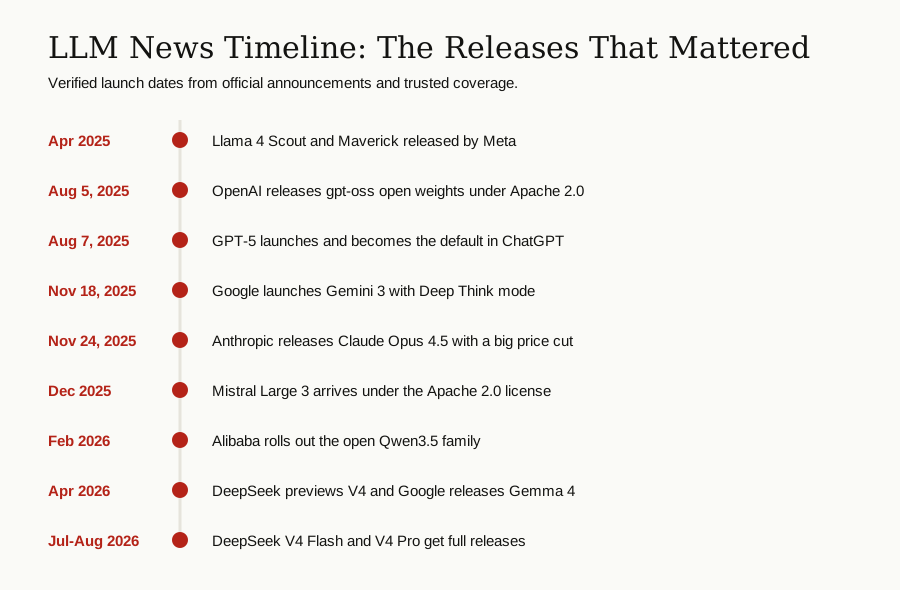
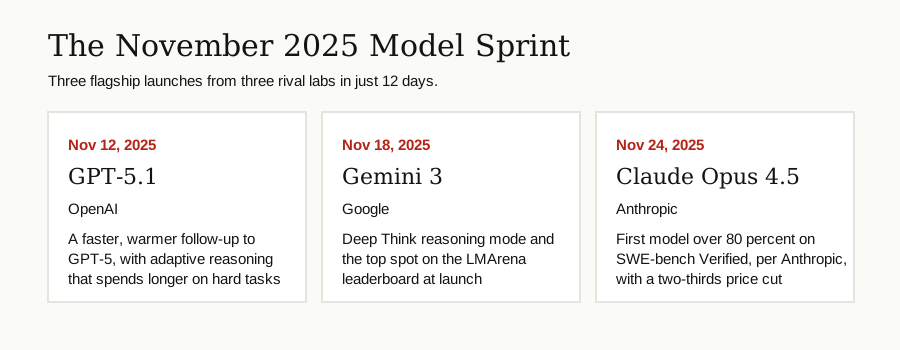
Here is the timeline first, then the details.
The Biggest Flagship Releases
The closed models from the big labs still set the pace. Four stories defined the last year of large language model news today.
GPT-5 became the default (August 7, 2025)
OpenAI launched GPT-5 on August 7, 2025, and made it the standard model in ChatGPT for everyone, including free accounts. Instead of asking users to pick between a fast model and a thinking model, GPT-5 works as one system with a router that decides how long to think about each request. OpenAI also stressed safer answers, with a feature it calls “safe completions” that gives a helpful high-level reply instead of a flat refusal where that is safe to do. Coverage of the launch, including MacRumors’ report on the GPT-5 rollout, noted that GPT-5 replaced GPT-4o and the older reasoning models in one move.
Why it matters: GPT-5 ended the confusing model picker era. For most users, “the model” is now just ChatGPT itself, and rivals had to answer with simpler lineups of their own.
Gemini 3 and Deep Think (November 18, 2025)
Google launched Gemini 3 on November 18, 2025, according to the company’s announcement on its official blog. The release put Gemini 3 into the Gemini app, Google Search and developer tools on day one. Google said the model topped the LMArena leaderboard with a score of 1501 Elo, and it introduced Deep Think, a slower reasoning mode for the hardest problems. Google also launched Antigravity, a coding tool built around agents, on the same day.
Why it matters: Gemini 3 showed Google’s real advantage: distribution. A model that ships inside Search reaches billions of people before a standalone app gets its first million downloads.
Claude Opus 4.5 and the price cut (November 24, 2025)
Anthropic released Claude Opus 4.5 on November 24, 2025, calling it the best model in the world for coding, agents and computer use. Anthropic reported a score of 80.9 percent on SWE-bench Verified, a well-known test of real coding tasks, which made it the first model to pass 80 percent on that test. Just as important, Anthropic cut the price by about two thirds, to 5 dollars per million input tokens. MacRumors covered the Opus 4.5 launch and the wider access that came with it.
Why it matters: the price cut matters as much as the score. When a top model gets three times cheaper, apps that were too costly to run suddenly make business sense.
Claude Sonnet 4.5 warmed up the race (September 2025)
Before the November sprint, Anthropic had already set the pace for coding models with Claude Sonnet 4.5, released at the end of September 2025. It quickly became the model many developers reached for first, and Anthropic reported it held the top spot on SWE-bench Verified at the time, with a score of 77.2 percent. A smaller sibling, Claude Haiku 4.5, followed in October 2025 for faster and cheaper work.
Why it matters: Sonnet 4.5 showed that the mid-size tier, not just the flagship, is where most daily work happens. Labs now compete on that tier as hard as they do at the top.
The November sprint, and what followed
These three launches did not arrive alone. OpenAI had shipped GPT-5.1 on November 12, 2025, which means three flagship releases landed within 12 days. xAI’s Grok 4.1 also arrived that month, according to launch coverage. Then OpenAI followed with GPT-5.2 in December 2025, after reports described an internal “code red” push to answer Gemini 3.
Why it matters: release cycles are now measured in weeks. If you build products on these models, plan for change: pin your model versions, and test again after every upgrade.
Open-Source LLM News
The open side of the market moved just as fast, and open-source llm news today is where the biggest surprises keep coming from.
DeepSeek V4 kept the pressure on (2026)
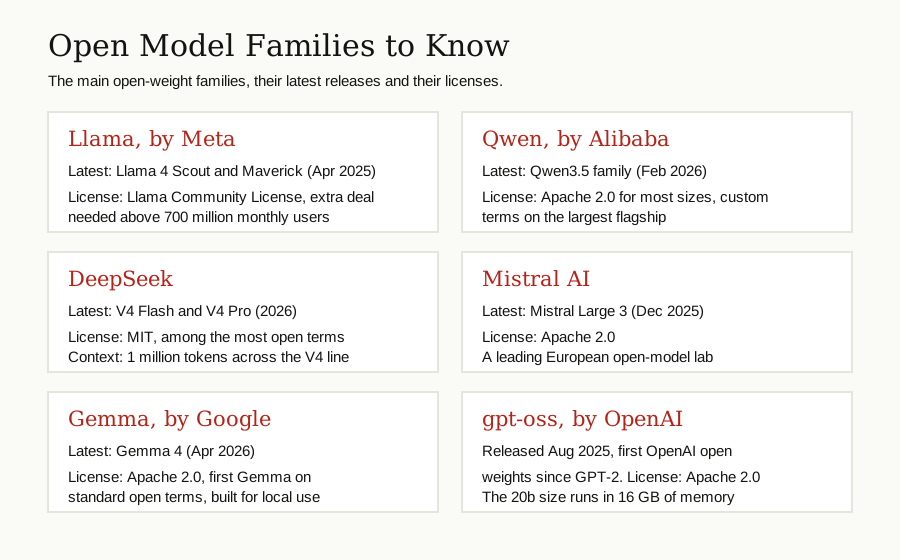
DeepSeek previewed its V4 family on April 24, 2026, then rolled it out over the summer: V4-Flash became official on July 31, 2026, V4-Pro followed on August 13, 2026, and a V4.1-Flash update landed on September 10, 2026. The flagship V4-Pro is a very large mixture-of-experts model, with 1.6 trillion total parameters but only about 49 billion active on each token, and the whole V4 line offers a context window of 1 million tokens. All of it ships under the MIT license, one of the most open licenses there is.
Why it matters: DeepSeek keeps proving that near-frontier quality does not have to come with frontier prices or closed doors.
Qwen3.5 and the license split (February 2026)
Alibaba rolled out the Qwen3.5 family through February 2026, starting with a 397 billion parameter flagship in mid-February. The Decoder reported that the mid-size models match or beat well-known closed rivals on several tests, and most sizes ship under the Apache 2.0 license, which allows free commercial use. But the story has a twist: when the Qwen3.8 flagship arrived in August 2026, its biggest model carried custom terms for very large hosting businesses. The Decoder’s Qwen 3.5 coverage has the launch details.
Why it matters: “Qwen is open” is no longer one simple fact. You now have to check the license of each size, a theme that runs through all open source llm news at the moment.
Llama 4 and gpt-oss (2025)
Meta released Llama 4 Scout and Llama 4 Maverick in April 2025. Scout made headlines with a claimed context window of 10 million tokens, while Maverick aimed at the best closed models. Both ship under the Llama Community License, which asks companies with more than 700 million monthly users to make a separate deal with Meta. Model roundups since then have noted that Meta’s open line has been quiet, with no new Llama release after April 2025.
In August 2025, OpenAI surprised everyone with gpt-oss, its first open-weight release since GPT-2 in 2019. The two models, gpt-oss-120b and gpt-oss-20b, ship under Apache 2.0, and the smaller one runs in just 16 GB of memory.
Why it matters: the two biggest American labs both treat open weights as strategy now, not charity. Open models grow their ecosystems, even when the flagship stays closed.
Mistral Large 3 and Gemma 4 (December 2025 and April 2026)
Mistral AI released Mistral Large 3 in December 2025, a mixture-of-experts model reported at 675 billion total parameters, under the Apache 2.0 license. Google followed with Gemma 4 in April 2026, and launch coverage noted it was the first Gemma family released under the standard Apache 2.0 license instead of a custom one.
Why it matters: Europe and Google both keep a credible open option on the table, which matters to any team that wants a non-Chinese, cleanly licensed model.
Local LLM News Today
Not every model story is about giant data centers. Local llm news today is mostly about how easy the tools have become.
Free programs like Ollama and LM Studio now let you download an open model and chat with it on your own machine in minutes. Ollama works from the command line with a single command, while LM Studio gives you a normal app window with a model browser. The trick that makes it possible is quantization, which compresses a model into a smaller file that fits in a normal computer’s memory, with only a small quality loss.
Practical picks from current guides: a laptop with 8 GB of memory can run small models such as the smallest Gemma 4 and Qwen3.5 sizes, while 16 GB opens up stronger options like gpt-oss-20b and mid-size Qwen models. Because the model lives on your machine, your chats stay private and keep working with the internet switched off.
The honest limits are worth knowing too. A laptop model is still well behind a flagship cloud model on hard reasoning, long documents and tricky code. Local tools also put the update work on you: when a better small model lands, you download it yourself. For most people, the sweet spot is a mix: local models for private, everyday tasks, and a cloud flagship for the hardest jobs.

Why it matters: local models turn AI into a utility you own. For private notes, client files or code you cannot send to a cloud service, a slightly weaker model that never phones home can be the right trade.
Research and Safety Items Worth Knowing
EU rules for the biggest models are now in force
Under the EU AI Act, duties for general-purpose AI models took effect on August 2, 2025. Providers must keep technical documentation, publish a summary of their training data and follow EU copyright rules, with extra safety duties for the most powerful models. The European Commission published a voluntary Code of Practice in July 2025, and enforcement with fines began for new models on August 2, 2026, according to EU guidance. Models already on the market before August 2025 have until August 2027 to comply.
Why it matters: this is the first big rulebook that treats the largest LLMs as a category of their own, and labs now design their release paperwork around it.
Vendor benchmark scores can melt on retest
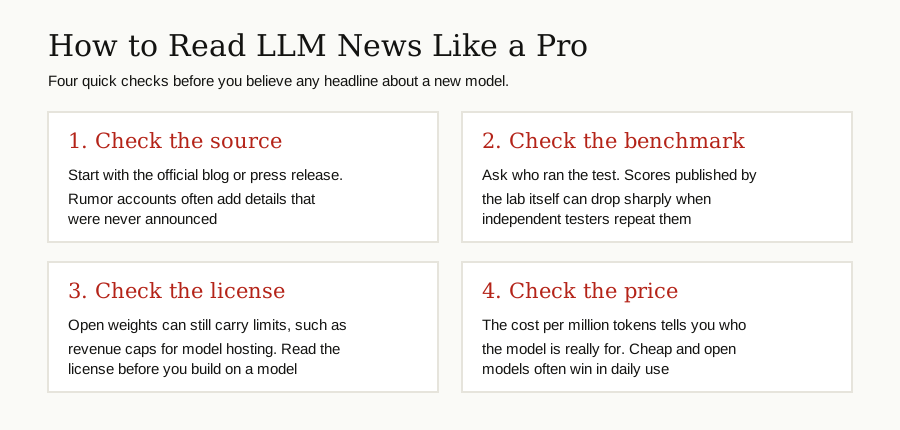
Treat launch-day charts with care. When independent testers re-ran one well-known terminal task test on DeepSeek’s V4-Pro, the score came out near 54.7 percent, far below the 87.9 percent on the model’s own card, according to retest results reported by CoderSera. The model is still strong; the point is that the test setup changes the result.
Why it matters: if you choose models by headline scores alone, you will sometimes buy the chart instead of the model. Test on your own tasks.
The word “open” now comes with fine print
An October 2026 analysis by Forkast described a new pattern: open-weight models with deployment gates. Some licenses from labs such as Moonshot AI and Mistral add revenue thresholds for companies that sell model access, and Alibaba’s largest Qwen carries its own big-provider terms. DeepSeek’s plain MIT license and Google’s Apache 2.0 Gemma sit at the other end of the scale.
Why it matters: for builders, license checks are now part of model selection, next to speed, quality and price.
How to Follow LLM News Without Drowning
You do not need to read everything. You need a small, reliable routine:
- Read official lab blogs for releases, and treat social media claims as rumors until a model card appears.
- Check the trending page on Hugging Face weekly to see which open models people actually download.
- Keep one weekly roundup, and skim the rest. Our own coverage of agentic AI news follows the agent side of the story.
- Whenever a score looks amazing, ask who ran the test.
What to Watch Next
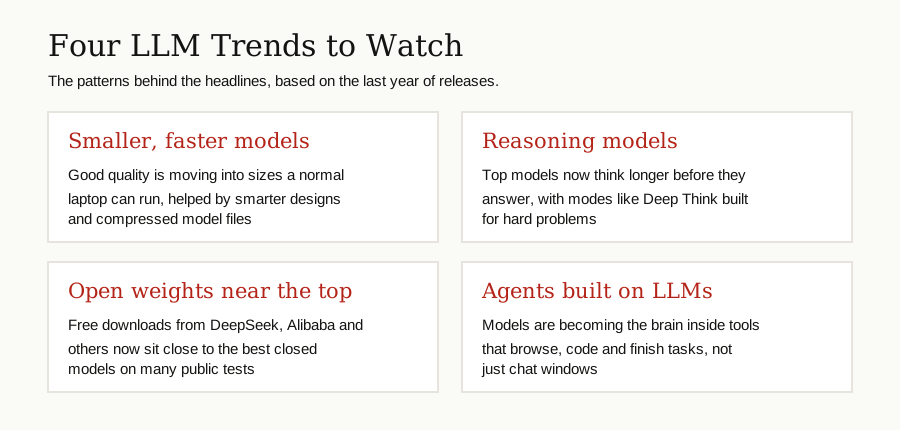
Four trends will shape the next year of llm news. Models will keep getting smaller and faster without giving up much quality. Reasoning modes, where a model spends more time thinking before it answers, are now standard at the top and are spreading to open models. Open weights will stay close to the frontier, while license fights decide how open they really are. And more products will use LLMs as the brain inside agentic AI tools that browse, code and finish tasks on their own.
Conclusion
LLM news today moves fast, but the pattern is clear once you line the stories up. The big labs launch in tight sprints and cut prices as they go. Open models from DeepSeek, Alibaba, Mistral and others now sit close behind, sometimes under licenses you must read twice. Regulators, especially in Europe, have started writing rules with real deadlines.
For the full picture across the industry, browse our AI news and regulation coverage, and check back: this roundup is built to be updated as the next wave of releases lands.