This article looks back at April 2025, a month that packed a full season of AI drama into four weeks. Anyone following the latest artificial intelligence news April 2025 produced will remember it for three things: a heavyweight open model launch, a public fight over benchmark honesty, and a flood of reasoning models from every major lab.
April 2025 was also the month the AI race quietly changed shape. Raw power still mattered, but cost, speed and trust started to matter just as much. Below is the month in review: what launched, what checked out, and what it all set in motion.
The Month at a Glance
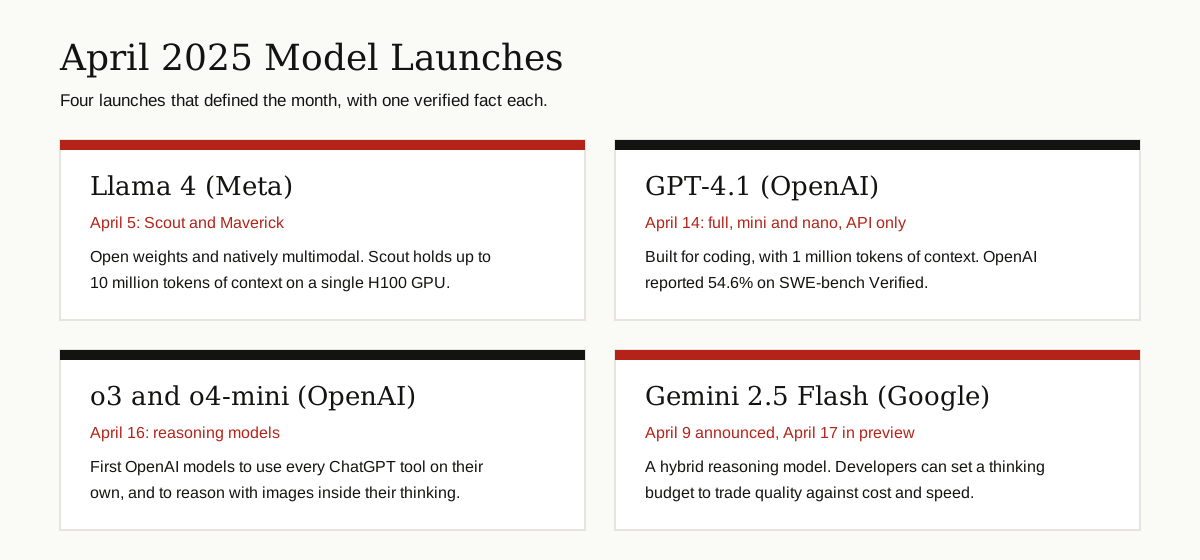
Here are the biggest ai stories april 2025 gave us, with the dates that matter.
| Date | Story | Why it mattered |
|---|---|---|
| April 3 | Midjourney V7 enters alpha testing | First new Midjourney image model in nearly a year |
| April 5 | Meta launches Llama 4 Scout and Maverick | Open weights go multimodal with huge context windows |
| April 7 | LMArena responds to Meta | Leaderboard rules tighten after the benchmark dispute |
| April 9 | Google Cloud Next and Anthropic’s Claude Max | Ironwood chip, Gemini 2.5 Flash and a $200 plan land the same day |
| April 14 | OpenAI releases GPT-4.1, mini and nano | A developer model built for coding and long context |
| April 16 | OpenAI releases o3 and o4-mini | Reasoning models that can use every ChatGPT tool |
| April 17 | Gemini 2.5 Flash preview opens | Developers get thinking budgets to control cost |
Llama 4: A Big Launch With a Bumpy Landing
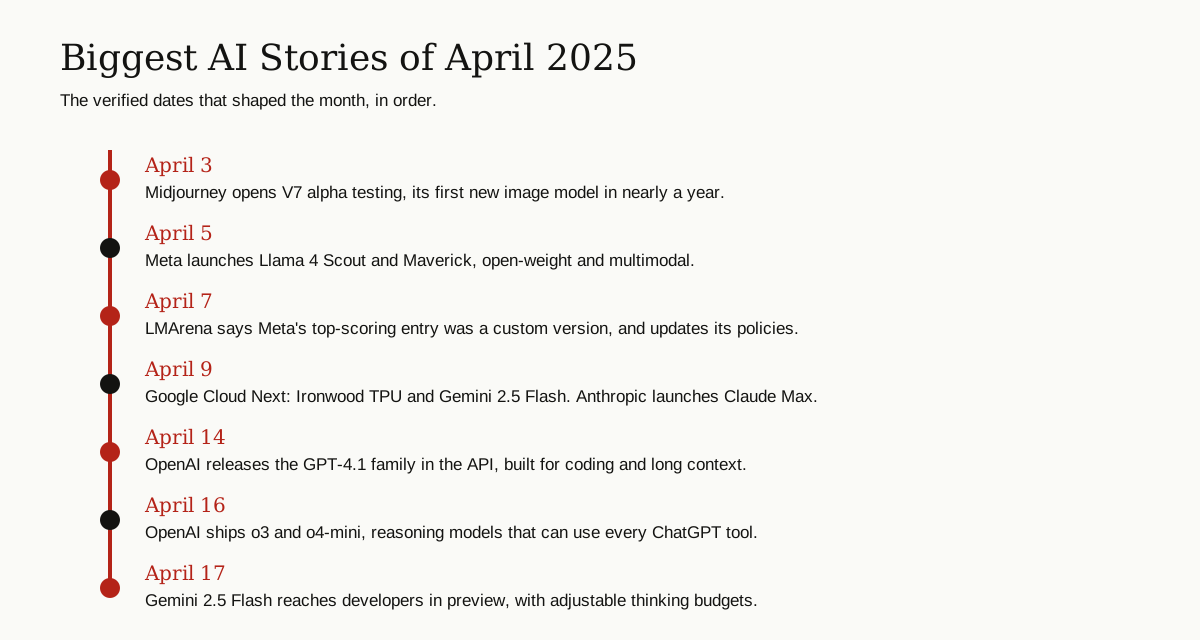
On April 5, Meta released Llama 4 Scout and Maverick, the first models in its new Llama 4 family. Both are open weight, which means anyone can download and run them, and both understand images as well as text from the start.
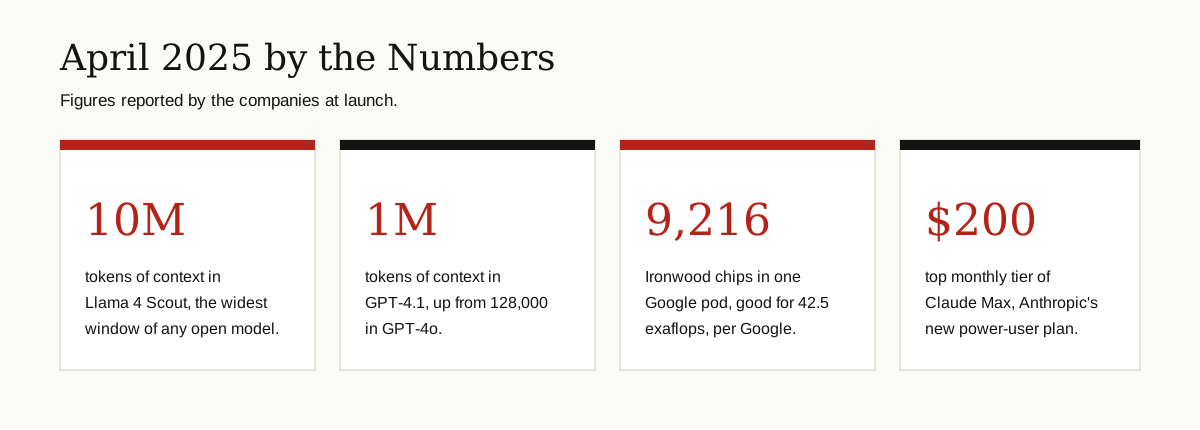
The design uses a trick called mixture of experts. Instead of waking up the whole brain for every word, the model switches on only a small team of specialist parts. Scout has about 109 billion parameters in total but uses only 17 billion at a time, and it fits on a single Nvidia H100 GPU. Its headline feature is a context window of 10 million tokens, the largest of any open model at the time. Maverick is bigger, with about 400 billion total parameters and a 1 million token window, and Meta said it was distilled from a giant teacher model called Behemoth, which was still training and only previewed.
On paper, it was a strong hand. In practice, the launch ran into trouble within 48 hours, and the trouble was not about the models themselves. It was about a number.
The Benchmark Controversy
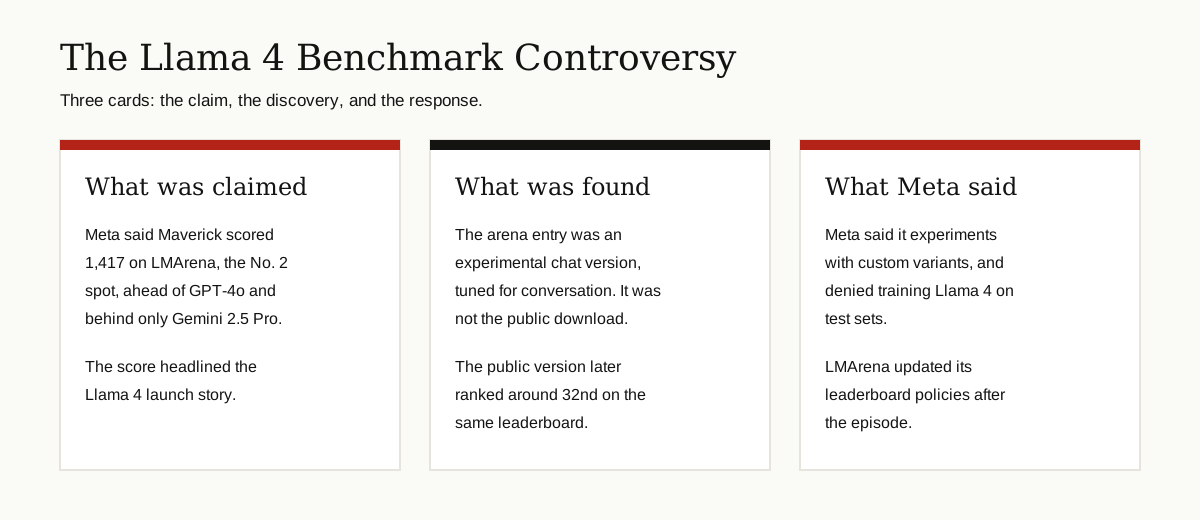
Meta promoted Maverick with an LMArena score of 1,417. LMArena is a popular leaderboard where real people compare two anonymous chatbots and vote for the better answer. A score of 1,417 put Maverick in second place, ahead of GPT-4o and behind only Google’s Gemini 2.5 Pro.
Then researchers read the fine print. Meta’s own materials noted that the score came from an “experimental chat version” of Maverick that was, in Meta’s words, “optimized for conversationality.” In plain terms, the model on the leaderboard was a special build tuned to sound good in chat contests. It was not the model the public could download.
On April 7, LMArena answered in public. “Meta’s interpretation of our policy did not match what we expect from model providers,” the organization posted, adding that Meta should have made it clearer that the entry was a customized model built to win human preference votes. LMArena released more than 2,000 head-to-head battle records for public review and said it would update its leaderboard policies. When the standard public version of Maverick was added to the same arena, it ranked around 32nd, far below the experimental build.
Meta pushed back on the wider criticism. A company spokesperson said Meta experiments with many custom variants and was eager to see what developers would do with the open release. Ahmad Al-Dahle, Meta’s vice president of generative AI, also denied online claims that Llama 4 had been trained on test sets, calling that accusation false.
Both things can be true at once: the released models were useful, and the launch marketing leaned on a score the public model had not earned. That is why this episode still anchors artificial intelligence news april 2025 retrospectives. It changed how carefully the whole industry reads a leaderboard.
OpenAI’s April: Two Launches in Three Days
OpenAI treated April like a product sprint. On April 14, it released the GPT-4.1 family in its API: GPT-4.1, GPT-4.1 mini and GPT-4.1 nano. The family skipped ChatGPT at first and aimed straight at developers.
The pitch was practical. All three models accept up to 1 million tokens of context, a big jump from GPT-4o’s 128,000, and OpenAI built them to follow instructions closely and write better code. In OpenAI’s GPT-4.1 announcement, the company reported a score of 54.6% on SWE-bench Verified, a test of real software fixing tasks, up 21.4 points over GPT-4o. The nano version was OpenAI’s fastest and cheapest model yet. In the same breath, OpenAI told developers that the expensive GPT-4.5 preview would leave the API in July, because GPT-4.1 did much of the same work for less money.
Two days later, on April 16, came the bigger swing: o3 and o4-mini. OpenAI called them its smartest models to date. They belong to the reasoning family, models that think step by step before answering. Two upgrades stood out. First, o3 and o4-mini could use and combine every ChatGPT tool on their own: web search, Python code, file analysis and image generation. Second, they could “think with images,” pulling a picture into their reasoning, zooming in, cropping it or turning it around to study it.
That tool use is a milestone for the agent era covered in our agentic AI news roundup. OpenAI also launched Codex CLI the same day, an open source terminal tool that lets programmers run these reasoning models next to their own code.

Google’s April: Chips and Controllable Thinking
Google held its Cloud Next conference in Las Vegas on April 9, and it used the stage to talk about the machinery under AI as much as the models themselves.
The hardware headline was Ironwood, Google’s seventh generation TPU chip and the first one designed only for inference, the work of running models after they are trained. In Google’s Ironwood announcement, the company said a single Ironwood pod links 9,216 liquid cooled chips for 42.5 exaflops of compute, and called this the start of an “age of inference,” when AI systems do more of the work on their own.
The model headline was Gemini 2.5 Flash. Announced at Cloud Next and opened to developers in preview on April 17 through Google AI Studio and Vertex AI, it was Google’s first fully hybrid reasoning model. Developers could turn its thinking on or off, or set a “thinking budget,” a cap on how much effort the model may spend before answering. Hard question, bigger budget. Simple question, fast and cheap reply. Google Cloud also told the crowd that more than four million developers were now building with Gemini models.
Google played host to its rivals, too. During the same Cloud Next week, Meta’s brand new Llama 4 models became generally available on Vertex AI, Google’s cloud platform for builders. Only days after the benchmark headlines, the models at the center of them were already on sale inside a competitor’s store. April kept showing that distribution matters as much as invention: a model earns its keep where developers can actually reach it.
Other Verified Stories From April 2025
The month had more than model launches. On April 3, Midjourney began alpha testing of V7, its first new image model in nearly a year. As TechCrunch reported on the Midjourney V7 release, the model arrived with a Draft Mode that renders images about ten times faster at half the cost, plus personalization switched on by default. CEO David Holz described V7 as a “totally different architecture” that handles text prompts and details like hands far better than before.
On April 9, Anthropic launched Claude Max, a power user subscription with two tiers: $100 a month for five times the usage of its Pro plan, and $200 a month for twenty times the usage, plus priority access to new features. It was a clear signal that heavy users had become a business of their own.
The month closed with a quiet goodbye. On April 30, OpenAI retired the original GPT-4 from ChatGPT, ending the run of the model that had defined the chatbot era for two years.

The Themes of the Month
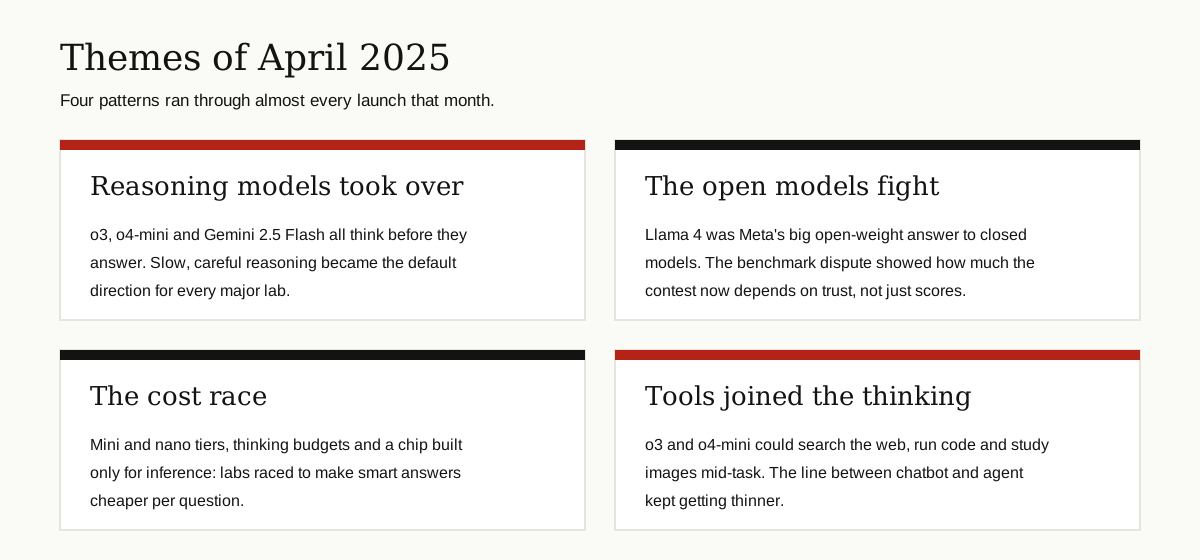
Four patterns ran through the artificial intelligence news april 2025 cycle, and each one kept running for the rest of the year.
Reasoning became the default. o3, o4-mini and Gemini 2.5 Flash all think before they speak. April was the month slow, careful reasoning stopped being a special feature and became the standard design.
The open models fight got personal. Llama 4 was Meta’s claim that open weights could match closed flagships. The score dispute showed the fight would be judged on trust as much as talent.
Everyone raced on cost. Mini and nano tiers, thinking budgets and a chip built only for inference all point the same way: the contest shifted from who is smartest to who is smartest per dollar. Our LLM news roundup tracks how that race played out in later launches.
Tools joined the thinking. When a model can search, code and inspect images while it reasons, the line between a chatbot and an agent gets thin. April made that line thinner than ever.
What April Set Up for the Rest of 2025
Look at the months after April and the fingerprints are everywhere. The pressure on Meta after the Llama 4 stumble built through the summer, and by June the company had bought a reported 49% stake in data firm Scale AI for about $14.3 billion and put its founder, Alexandr Wang, in charge of a new superintelligence push. GPT-4.1’s developer lessons fed the road to GPT-5 in August. The reasoning plus tools recipe from o3 became the template for the agent products that filled the latest AI news of October 2025.
April also set a new habit for readers. After the LMArena episode, launch-day scores got read the way food labels get read: carefully, and with the ingredients checked. Labs felt the change as well. Through the rest of 2025, model releases came with longer technical reports, clearer notes on which build was tested, and more detail about safety checks, because April had shown how fast a victory lap can turn into a trust problem. That skepticism may be the month’s most useful legacy.
Conclusion
April 2025 delivered a rare mix: genuinely important models and a genuinely important lesson. Llama 4 pushed open AI forward, o3 and o4-mini showed what reasoning with tools looks like, and Google bet on cheaper, controllable thinking backed by its own silicon. At the same time, one leaderboard score taught everyone to ask a simple question of every launch: is the model being scored the model I can actually use?
For more month-by-month coverage like this, browse the AI News and Regulation category. The story of 2025 makes much more sense when you start it in April.