If September 2025 was the month AI got faster, October 2025 was the month it grew up. The latest AI news October 2025 brought two clear storylines. On one side, the big labs raced to turn chatbots into agents that click, type and finish real work. On the other side, governments and the platforms themselves started drawing hard lines, especially around safety and teenagers.
This roundup covers the whole month at a high level: the eight stories that mattered most, the regulation moves you may have missed, and the money deals underneath it all. Every story below is dated and tied to the outlet or company that reported it, so you can check the details yourself. For day-by-day agent coverage, see our ongoing agentic AI news reporting.
The Month at a Glance
October opened with a developer conference and a chip deal on the same morning, and it closed with a corporate rebuild and a teen safety crackdown in the same week. In between came new models, a new European law and the first American law written just for companion chatbots.
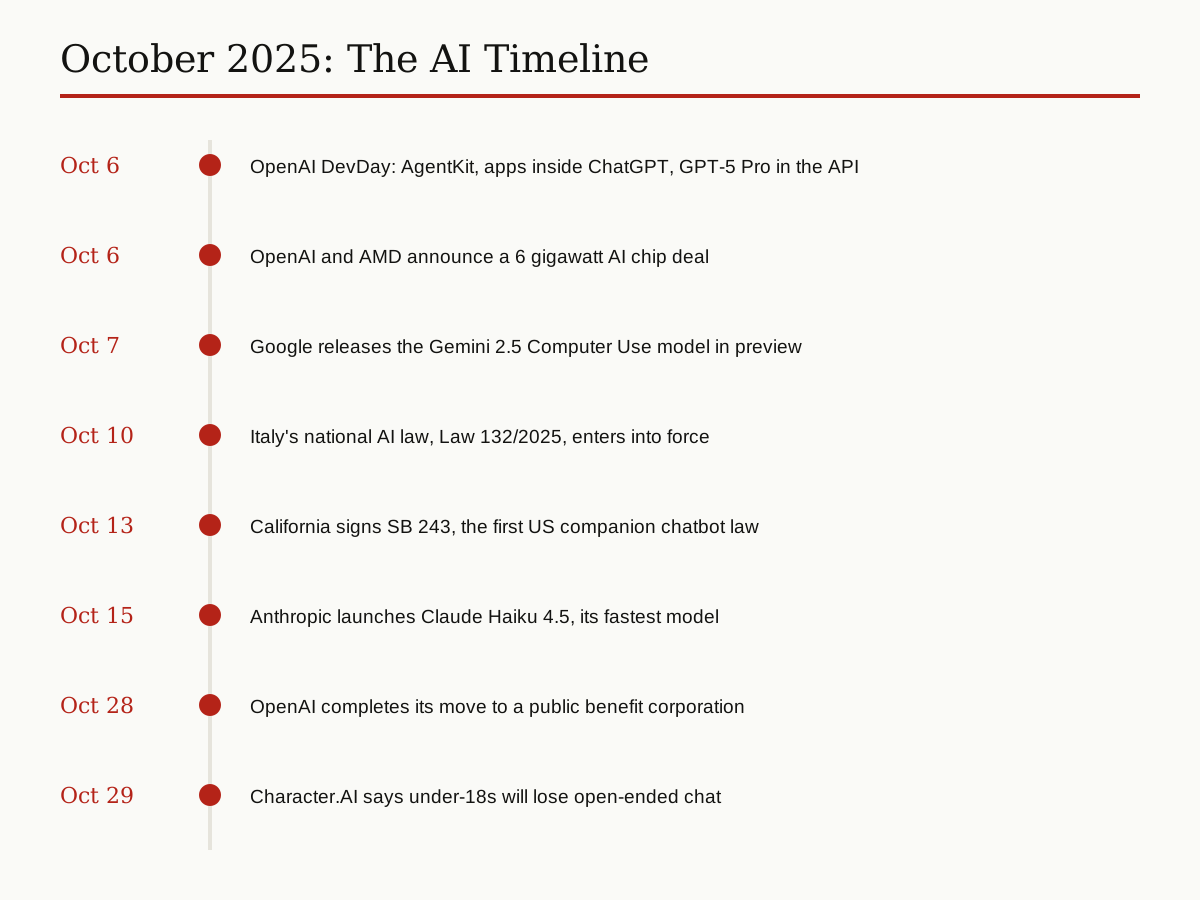
| Date | Story | Why it mattered |
|---|---|---|
| Oct 6 | OpenAI DevDay: AgentKit and apps in ChatGPT | ChatGPT became a platform, not just a chatbot |
| Oct 6 | OpenAI and AMD chip deal | 6 gigawatts of non-Nvidia computing power promised |
| Oct 7 | Google Gemini 2.5 Computer Use | Google’s agent learned to click and type in browsers |
| Oct 10 | Italy’s national AI law took effect | First EU country with its own full AI law |
| Oct 13 | California SB 243 signed | First US law written for AI companion chatbots |
| Oct 15 | Anthropic Claude Haiku 4.5 | Frontier-level coding at a budget price |
| Oct 28 | OpenAI restructuring completed | A clearer path toward a possible public listing |
| Oct 29 | Character.AI teen chat removal | Platforms started limiting minors on their own |
The Top Stories of October 2025

October 6: OpenAI DevDay Turns ChatGPT Into a Platform
OpenAI held its third DevDay in San Francisco on October 6, and the theme was building. The headline launch was AgentKit, a set of tools for creating AI agents, including a visual Agent Builder that OpenAI’s Sam Altman described as a way to take agents from prototype to production. Alongside it came apps inside ChatGPT: services like Canva, Spotify, Zillow, Coursera and Figma could now run inside a chat through a new Apps SDK.
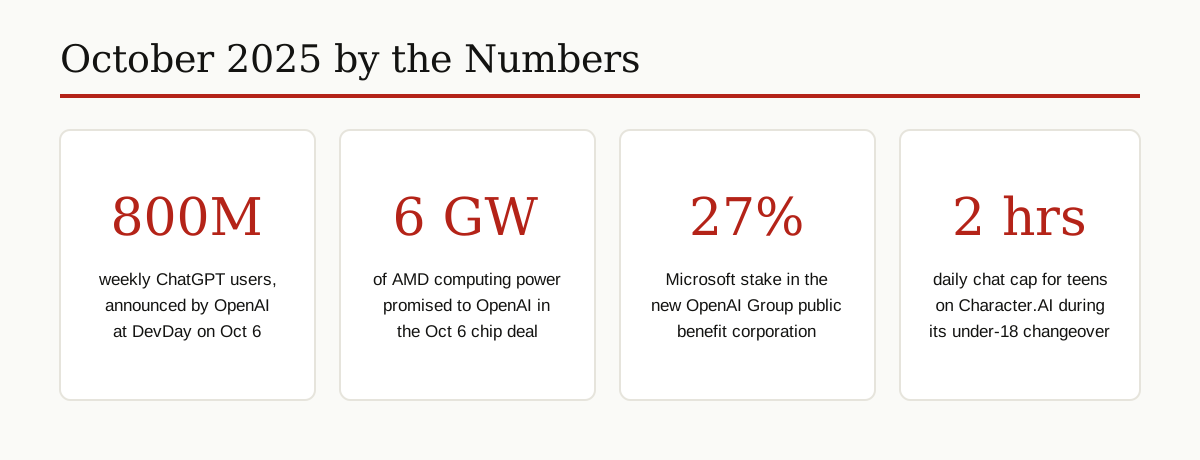
The company also put GPT-5 Pro into its API, moved its Codex coding tool to general availability with a Slack integration and new admin controls, and previewed the Sora 2 video model for developers. AgentKit itself bundled three pieces: the visual builder, a ChatKit tool for embedding chat interfaces, and stronger evaluation tools so teams can grade each step an agent takes. Altman told the crowd that ChatGPT had passed 800 million weekly users and that more than 4 million developers were building on OpenAI’s tools. Why it matters: the chatbot era quietly ended here. October’s OpenAI story was about becoming the place where other companies’ software lives.
October 6: OpenAI Signs a Giant Chip Deal With AMD
The same day, the Associated Press reported that AMD would supply OpenAI with chips for 6 gigawatts of computing power, starting with a first gigawatt of its Instinct MI450 chips in the second half of 2026. AMD also gave OpenAI a warrant to buy up to 160 million AMD shares, roughly 10 percent of the chipmaker, tied to deployment and share price milestones. AMD’s stock jumped close to 24 percent on the news.
Why it matters: OpenAI had been seen as an Nvidia customer first. This deal spread its bets, gave AMD a flagship customer, and showed how the AI race is now measured in gigawatts, a unit more familiar to power companies than to software firms.
Early October: The Sora 2 Wave Rolls On
OpenAI’s Sora 2 video model and its companion app had launched on September 30, and October was the month the experiment met reality. The invite-only app, limited to the United States and Canada, let people drop themselves into AI videos through a feature called cameos. Within days, OpenAI tightened the rules: Sora lead Bill Peebles posted in early October that users gained stricter controls over where their cameo could appear, and that the watermark on generated videos would become clearer and more visible.
Why it matters: Sora showed both halves of the AI video story at once. The technology was suddenly social and fun, and the guardrails had to be rebuilt in public, in real time, because real people’s faces were involved.
October 7: Google Gives Gemini Hands
One day after DevDay, Google DeepMind released the Gemini 2.5 Computer Use model in public preview through the Gemini API, AI Studio and Vertex AI. Instead of only answering questions, this model looks at screenshots and takes actions: clicking buttons, scrolling pages, typing into forms and filling in fields, with per-step safety checks and the option to ask a human before sensitive steps.
Google followed it with Gemini Enterprise, a workplace platform pitched as a front door for company AI, where businesses build agents grounded in their own documents and apps. Google said firms including Figma, Klarna and Virgin Voyages were already using it, with pricing starting at 21 dollars per seat per month for smaller companies. Why it matters: Google’s answer to AgentKit arrived within 24 hours. For readers following Google AI news today October 2025, the pattern was unmistakable: every major lab spent the month shipping agents, not chatbots.
October 15: Anthropic Ships Claude Haiku 4.5
Anthropic spent the month completing its 4.5 model family. Claude Sonnet 4.5, released on September 29, kept collecting praise as a top coding model through October. Then, on October 15, Anthropic launched Claude Haiku 4.5, its smallest and fastest model, at 1 dollar per million input tokens and 5 dollars per million output tokens.
The numbers explained the excitement: Haiku 4.5 scored 73.3 percent on SWE-bench Verified, a respected coding test, matching the older Sonnet 4 while running more than twice as fast, according to Anthropic. It also beat Sonnet 4 on computer use tasks, the clicking and typing skills behind browser agents, and Anthropic pitched it as a building block for teams of small agents working under a bigger model. Why it matters: cheap, fast models are what make fleets of AI agents affordable. Catch up on model releases any time in our LLM news today coverage.
October 28: OpenAI Finishes Its Big Restructuring
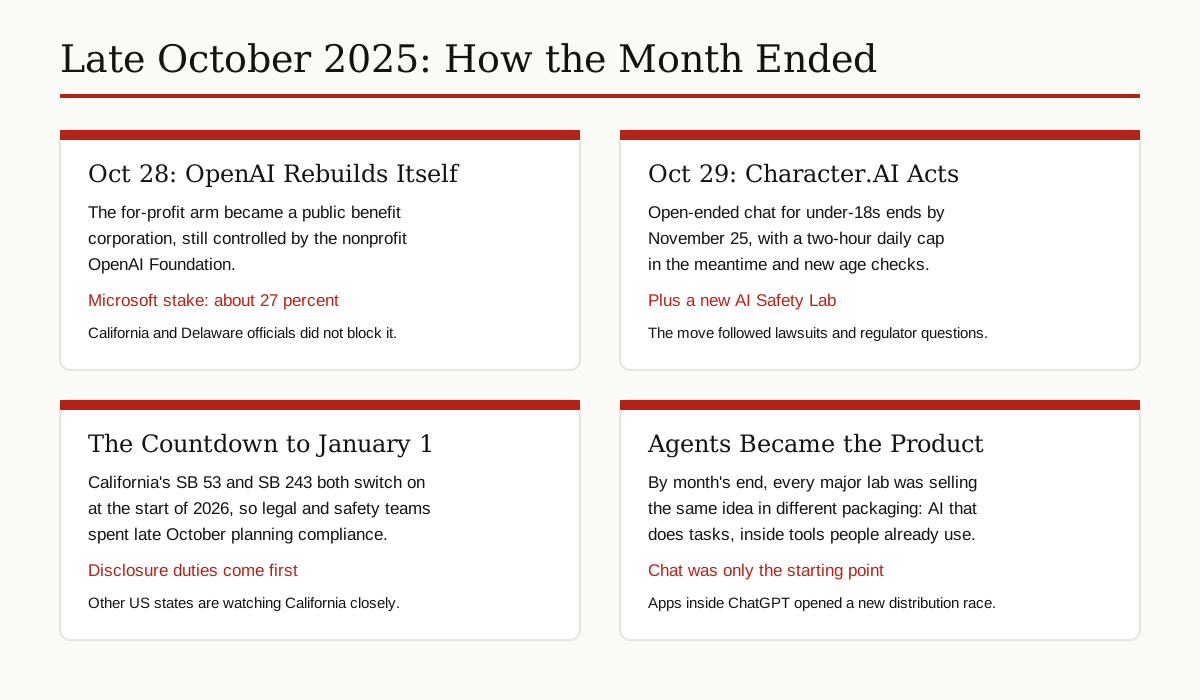
Late in the month came the business story of the year. On October 28, OpenAI announced it had completed its long-debated restructuring: its for-profit arm became OpenAI Group PBC, a public benefit corporation still controlled by the nonprofit, now renamed the OpenAI Foundation. As PYMNTS reported on the new Microsoft deal, Microsoft received about a 27 percent stake, valued around 135 billion dollars, and kept rights to OpenAI technology through 2032.
The attorneys general of California and Delaware, who had reviewed the plan for over a year, did not stand in the way. Why it matters: the unusual structure clears a path for OpenAI to raise money like a normal company, and possibly to list on the stock market one day, while the foundation keeps formal control.
October 29: Character.AI Pulls Open-Ended Chat From Minors
The month ended on a serious note. On October 29, Character.AI announced that users under 18 would lose the ability to hold open-ended chats with its AI characters by November 25, with a two-hour daily cap during the transition and new age-assurance tools. The Associated Press report, carried by SRN News, noted the company also plans an AI Safety Lab and more creative tools for teens, such as making videos and stories with characters.
The decision followed lawsuits from families, including the case of a 14-year-old who died by suicide after months of intense chats, and growing questions from regulators. Why it matters: it was the clearest sign yet that the companion chatbot industry expects stricter rules, and some companies would rather move first than be forced.
Regulation Corner: The Rules Caught Up
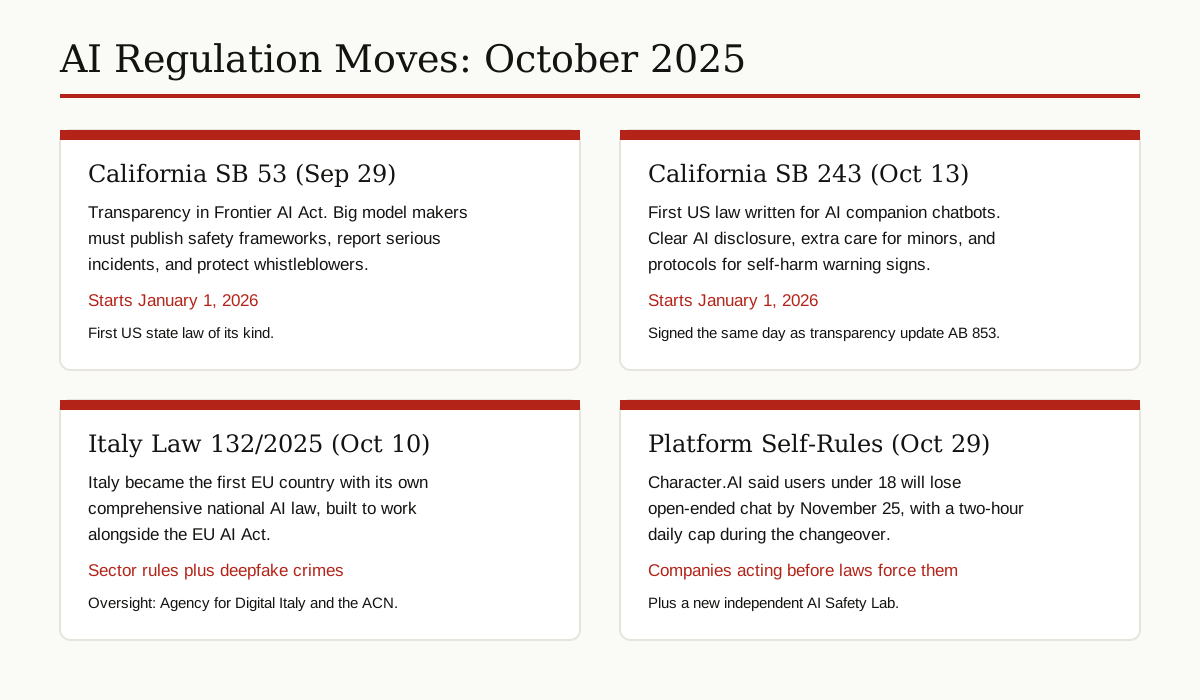
If you only followed product launches, you missed half of the global AI regulation news October 2025 produced. Three moves stood out.
California SB 53. Signed on September 29 by Governor Gavin Newsom and debated all through October, the Transparency in Frontier Artificial Intelligence Act is the first US state law setting binding safety and transparency duties for frontier model developers. As law firm White and Case summarized the law, companies training the largest models must publish a safety framework, post transparency reports before releasing new models, report critical safety incidents to the state, and protect whistleblowers. The bill, carried by Senator Scott Wiener, applies its heaviest duties to developers with more than 500 million dollars in yearly revenue. Penalties can reach 1 million dollars per violation, and the law starts on January 1, 2026. It also creates CalCompute, a planned public cloud program meant to give researchers and startups computing resources.
California SB 243 and AB 853. On October 13, Newsom signed SB 243, the first US law aimed at AI companion chatbots. It requires clear disclosure that users are talking to AI, extra protections for minors including break reminders every three hours during long sessions and blocks on sexual content, and protocols for responding to signs of self-harm, according to legal analysis by Mayer Brown. It also gives people a right to sue over violations. The same day, AB 853 updated the California AI Transparency Act for AI-generated content, pushing some disclosure deadlines to August 2026 and adding duties for large platforms. Newsom also vetoed a stricter bill, AB 1064, saying it could amount to a near-total ban on conversational AI for teenagers.
Italy moves first in Europe. On October 10, Italy’s Law 132/2025 entered into force, making Italy the first EU member state with a comprehensive national AI law, according to White and Case’s global regulatory tracker. The law is built to sit alongside the EU AI Act rather than compete with it, adding national oversight bodies, sector rules for areas like health and work, and new criminal offenses for harmful deepfakes. Our EU AI Act news page tracks how the European framework keeps evolving.
Business and Funding Moves
Underneath the product news, October was a month of very large numbers. The AMD deal gave OpenAI a warrant for up to 160 million shares, aligning the two companies for years of data center building. AMD executives suggested the partnership could eventually be worth tens of billions of dollars in yearly revenue if all 6 gigawatts ship.
The Microsoft side of the ledger was just as big. Alongside its roughly 27 percent stake, Microsoft’s new agreement included an OpenAI commitment to buy another 250 billion dollars of Azure cloud services, while Microsoft gave up its right of first refusal to be OpenAI’s only cloud provider. In plain terms: the two companies stayed close partners, but OpenAI bought itself freedom to shop around, which is exactly what the AMD deal showed it doing.
What It All Meant
Read together, the latest AI news October 2025 tells one story from three angles. The technology angle: agents that act inside software became the standard product pitch from OpenAI, Google and Anthropic in the same month. The money angle: computing power and corporate structure, not model quality alone, decided the headlines. And the human angle: teen safety moved from debate to law and to platform policy within weeks.
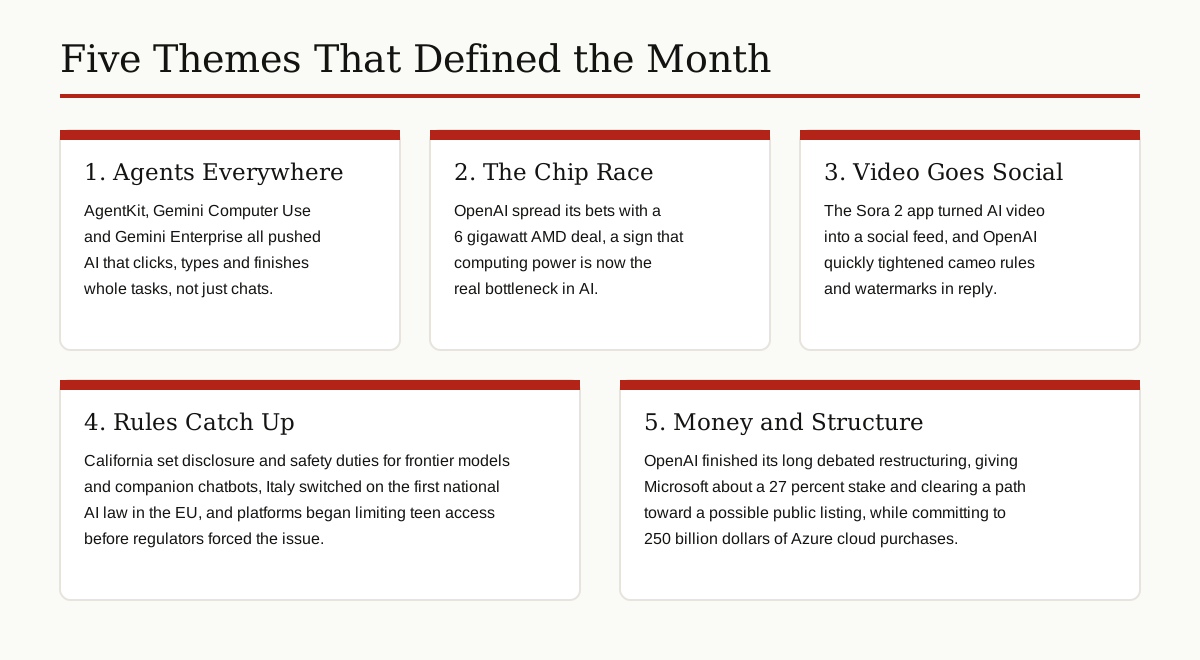
The late-month stories underlined the shift. A restructured OpenAI, a chastened Character.AI and a California rulebook taking effect on January 1, 2026 all pointed the same way: the industry is being treated less like an experiment and more like infrastructure, with the duties that come with that. Europe told the same story in a quieter tone. Italy did not wait for Brussels to finish every detail of the EU AI Act rollout; it built its own national layer on top, a template other member states were openly studying as October closed.
Conclusion
October 2025 will be remembered as the month AI agents went mainstream and the rulebook started to harden. DevDay, AgentKit and Gemini Computer Use pushed the technology forward, while SB 53, SB 243, Italy’s national law and Character.AI’s teen decision pulled the safety net tighter.
November would bring earnings, enforcement deadlines and the first compliance work. To keep following the story, browse the full AI news and regulation category, where we track the launches, the laws and the fights in between.