If 2024 was the year of the chatbot, 2025 was the year the software giants tried to sell big companies something bolder: AI workers. Not assistants that answer questions, but agents that take a task, break it into steps, use company data and finish the job.
This roundup of ai agents enterprise news follows the biggest verified stories from the vendors fighting for that market: Snowflake, Salesforce, Microsoft, ServiceNow, SAP and Google. Every claim below is dated and attributed, and when a number comes from the vendor itself, we say so. If you are new to the idea, start with our plain English guide to what agentic AI is, and for the wider stream of launches, see our agentic AI news coverage.

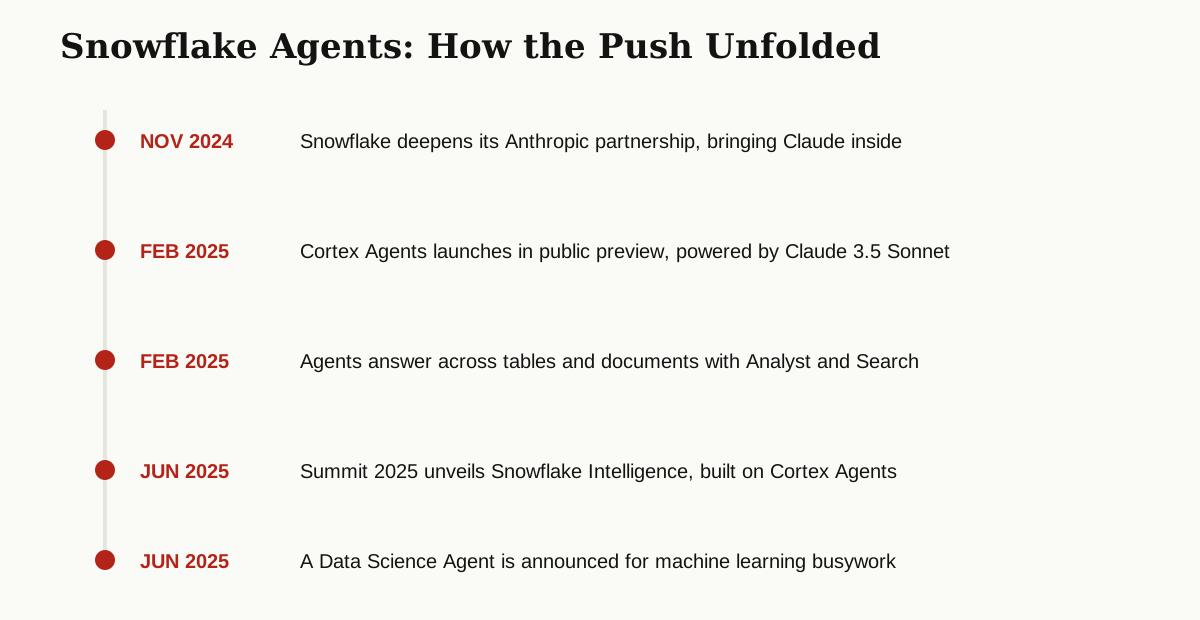
Snowflake’s Agent Push: Start With the Data
Snowflake picked a smart place to start. Its customers already keep their most sensitive business data inside Snowflake, so the company built agents that work on that data without moving it elsewhere.
The push began on February 12, 2025, when Snowflake launched Cortex Agents in public preview, as CIO Dive reported at the time. Cortex Agents is a managed service that takes a question, plans the steps, and pulls answers from both structured tables and unstructured documents. It builds on two older tools: Cortex Analyst, which turns plain English into SQL queries, and Cortex Search, which finds text inside documents. The first version ran on Anthropic’s Claude 3.5 Sonnet model, inside Snowflake’s own security boundary. Snowflake said its setup scored above 90 percent accuracy on complex text to SQL tests, a figure from the company’s own benchmarking, so treat it as a vendor claim.
At Snowflake Summit in June 2025, the company wrapped those agents in a friendlier product called Snowflake Intelligence. It is a chat style experience where any employee can ask questions across sales dashboards, support tickets and documents, and get answers that respect the same access rules as the data underneath. In its Summit 2025 announcements, Snowflake said Cortex Agents was on its way to general availability and previewed a Data Science Agent that automates machine learning busywork for data teams, using Anthropic’s Claude models.
The Anthropic thread runs through the whole story. Snowflake deepened its partnership with Anthropic in November 2024, which is why Claude models run inside Snowflake’s security boundary instead of forcing companies to send sensitive data out to a separate service. For banks, hospitals and other regulated buyers, that detail matters almost as much as the agent itself, and it explains why Snowflake keeps repeating the word governance in every announcement.

The pattern in this snowflake ai agents news is worth noticing. Snowflake is not selling a general purpose worker. It is selling data agents, agents whose whole job is to answer questions and run tasks on data the company already governs. That narrower promise may be easier to keep.
Salesforce and the CRM Agents Race
Salesforce moved first and loudest. Agentforce, its agent platform for sales, service and marketing teams, launched at Dreamforce in September 2024 with a headline price of $2 per conversation, a simple pitch: pay for outcomes, not seats.
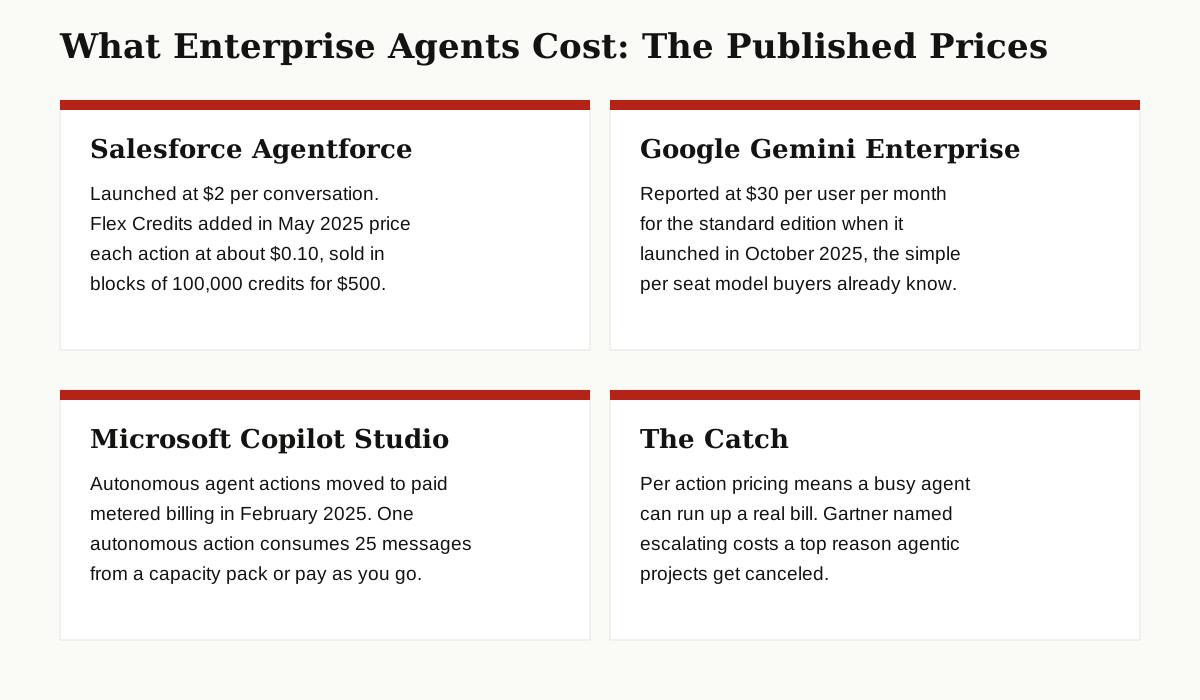
In May 2025, Salesforce added a second way to pay, called Flex Credits, at $0.10 per action, for companies that wanted finer control over the bill. The same month, the company told investors that Data Cloud and AI annual recurring revenue had passed $1 billion, up 120 percent year over year, and that it had closed more than 8,000 Agentforce deals since launch, roughly half of them paid. Those are company reported figures from its earnings calls, not independent measurements.
Salesforce also points to itself as proof. The company says an Agentforce agent on its own help site has handled over a million support requests and resolved the large majority of routine questions without a human agent. Again, that is the company’s own reporting, but it explains the confidence in the sales pitch: Salesforce is its own loudest case study. The pricing drew questions all year, because nobody outside Salesforce could say exactly what counted as one conversation, and that fuzziness is part of why the per action Flex Credits option showed up in May 2025.
At Dreamforce in October 2025, Salesforce renamed the platform Agentforce 360 and pitched the idea of the agentic enterprise, where fleets of agents sit inside every department. Whatever you think of the marketing, the ai agents news enterprise race now has a scoreboard, and Salesforce makes sure everyone can see it.
Microsoft, ServiceNow, SAP and Google: Everyone Ships Agents
The rest of the giants spent 2025 filling in their own squares on the board.
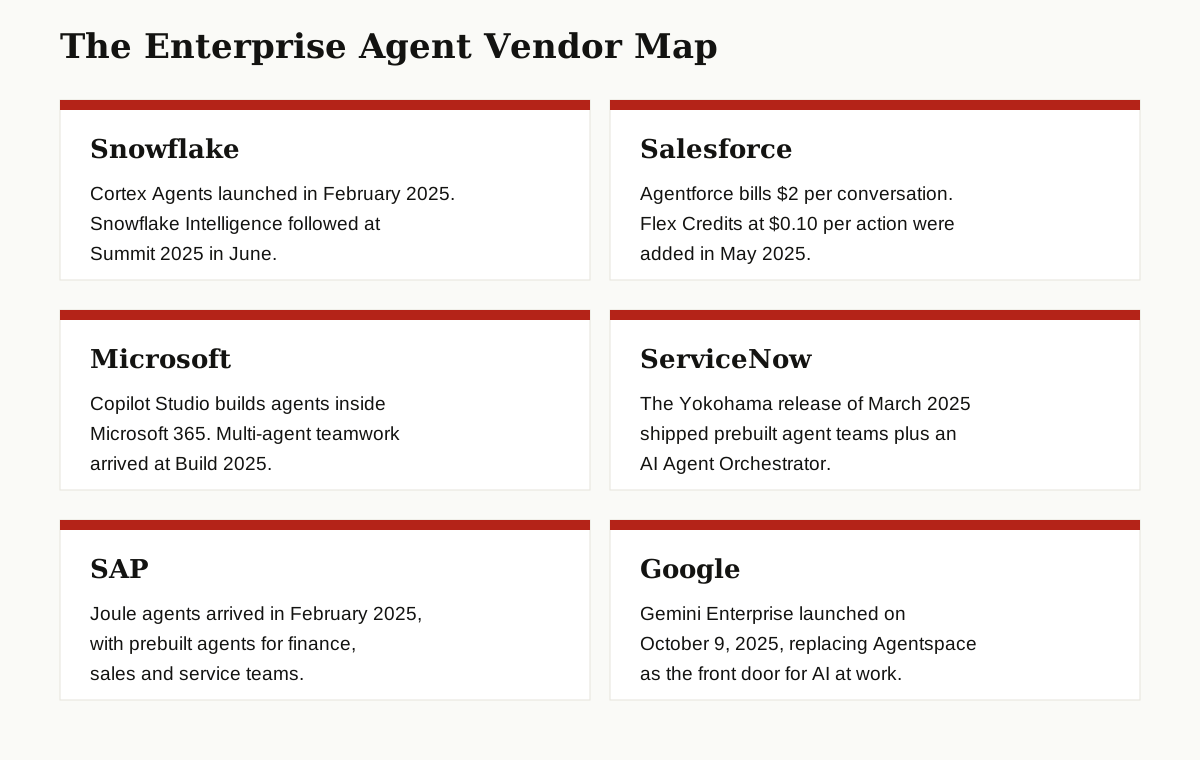
Microsoft put agents inside the tools office workers already open. Companies build agents in Copilot Studio, and from February 1, 2025, autonomous agent actions moved to paid, metered billing, a sign Microsoft expected real usage, not just demos. At Build in May 2025, Microsoft announced Copilot Tuning, which lets a company shape models on its own data, plus multi agent orchestration, so agents built in different Microsoft tools can hand work to each other. It also opened an Agent Store with ready made agents like Researcher and Analyst. The multi agent AI news story matters here, because Microsoft is betting that teams of agents beat one big agent.
ServiceNow used its Yokohama platform release on March 12, 2025, to ship teams of preconfigured AI agents across IT, HR and CRM work. Its AI Agent Studio, for building agents, and AI Agent Orchestrator, for coordinating them, both reached general availability in that release. ServiceNow calls itself the control tower for enterprise agents, a claim every vendor in this article would happily make about itself.
SAP entered in February 2025, when it launched Joule agents alongside its Business Data Cloud product, built with Databricks. Joule is SAP’s copilot, and the new agents came prebuilt for finance, sales and service tasks, with an agent builder so customers can create their own inside Joule studio. At its Sapphire conference in May 2025, SAP expanded the lineup into a network of agents that can execute whole processes, not just suggest answers.
Google may have made the boldest move. It folded its Agentspace product, launched in December 2024, into a new platform called Gemini Enterprise on October 9, 2025. Google Cloud CEO Thomas Kurian called it the new front door for AI in the workplace. As Computerworld reported, employees chat with company data, search across apps like Workspace, Microsoft 365, Salesforce and SAP, and use agents from Google and partners such as Box and ServiceNow, at a reported price of $30 per user per month.
Step back, and the pattern across all six vendors is the same. Each is selling a three part kit: ready made agents for common jobs, a builder for custom ones, and a control panel to watch what the agents did. The names differ, Agent Store, control tower, observability, but the reason does not. Big companies will not let software act on its own until they can see what it touched, what it cost and how to switch it off. The agent race is quietly becoming a governance race.
October 2025: The Loudest Month Yet
If one month showed how fast ai agents news october 2025 was moving, it was October 2025.
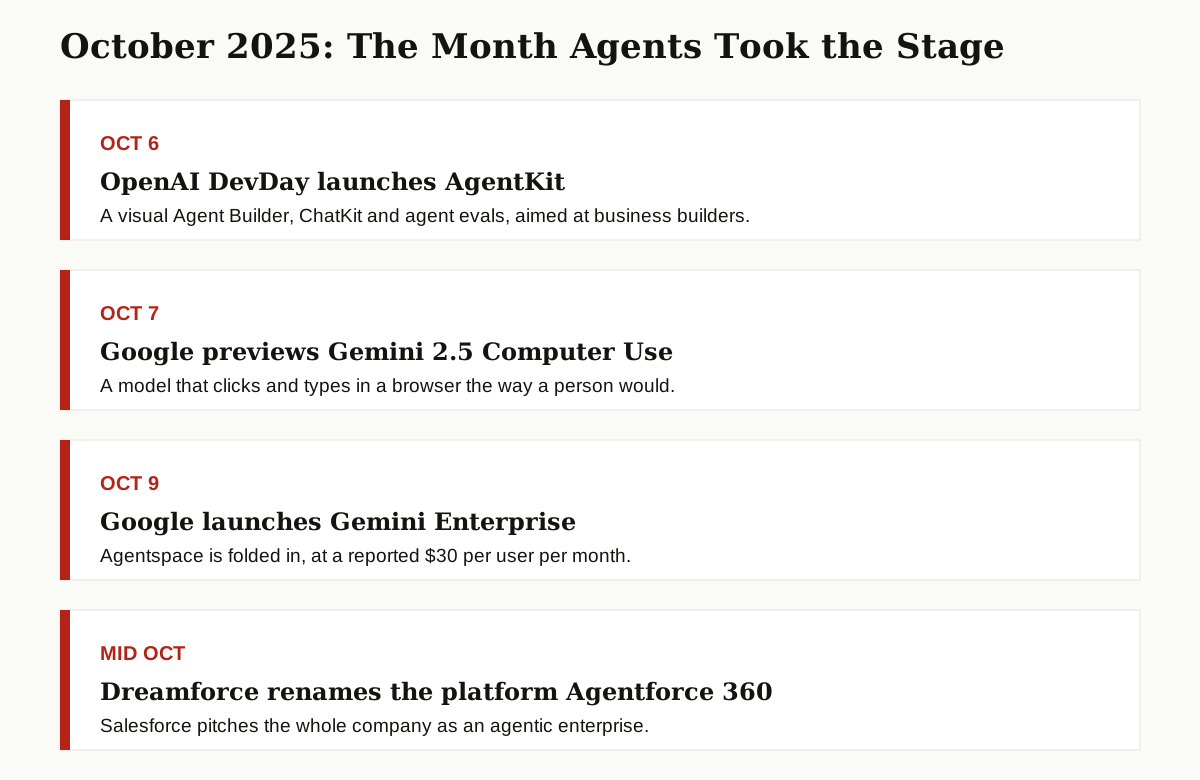
On October 6, OpenAI used its DevDay event to launch AgentKit, a toolkit with a visual Agent Builder, an embeddable chat tool called ChatKit, and evaluation tools for testing agents before launch. In the live demo, an engineer built a working agent in under eight minutes. A day later, Google put Gemini 2.5 Computer Use into public preview, a model that can click and type in a web browser the way a person would. On October 9 came Gemini Enterprise. Mid month, Dreamforce brought the Agentforce 360 rename. Four heavyweight launches in about two weeks is not a trend line, it is a land grab.
The Reality Check: What the Research Says
Now the cold water, because honest enterprise ai agents news today has to include it.
In a press release dated June 25, 2025, Gartner predicted that over 40 percent of agentic AI projects will be canceled by the end of 2027, blaming escalating costs, unclear business value and inadequate risk controls. Gartner also coined a warning label, agent washing, for vendors that relabel old chatbots and automation tools as agents. The firm estimated that of the thousands of vendors claiming agentic AI, only about 130 offer the genuine thing.
A 2025 report from MIT Project NANDA, called The GenAI Divide, was blunter. Studying more than 300 company AI initiatives, it found about 95 percent of generative AI pilots produced no measurable return on the profit and loss statement, against an estimated $30 to $40 billion of enterprise spending. The report’s key lesson was not that the technology is fake. It was that pilots fail when agents are bolted onto the side of a business instead of wired into its real workflows and data.
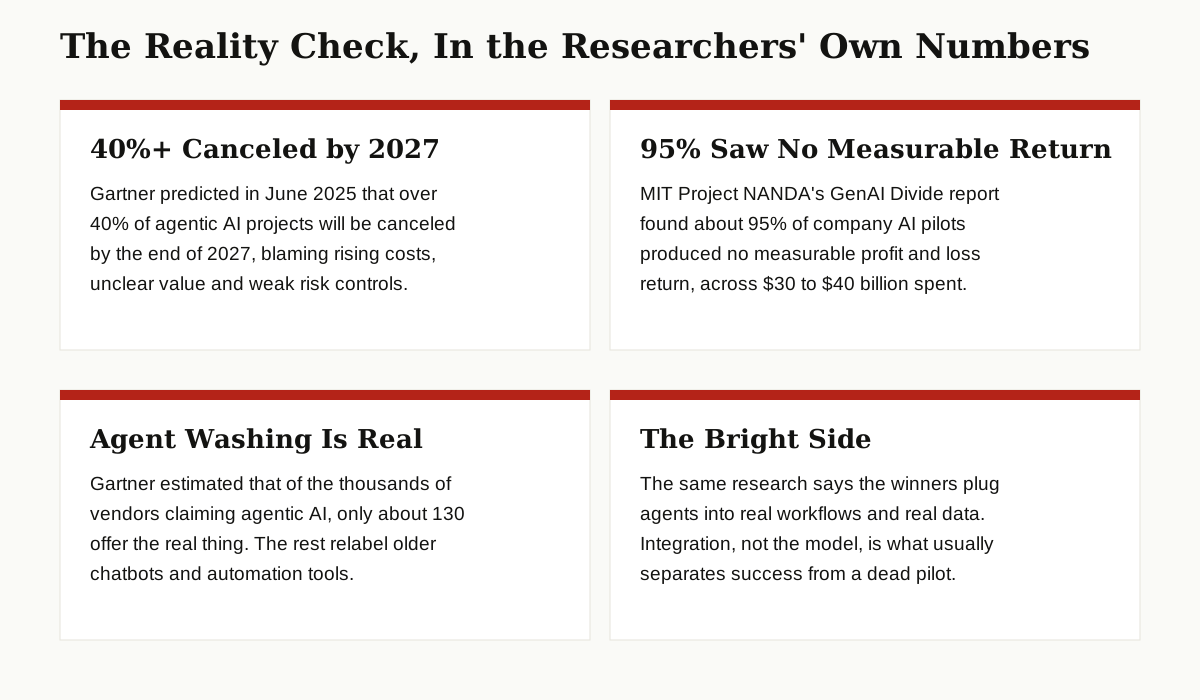
Read together, the two findings draw a fair map. The vendors above are selling real technology, and some customers are getting real value, especially in customer support, IT service and data questions. But a large share of projects are still demos wearing a purchase order.
There is a fair counterpoint, and honest coverage should make it. The MIT report measured fast, measurable profit impact, a high bar that misses slower gains like staff hours saved or faster answers. Its critics also note the sample leaned on interviews. And the busiest agent categories, support, IT help desks and data questions, are exactly where returns are easiest to count. The research does not prove agents are a scam. It proves the average pilot is badly run, usually launched as a demo instead of a change to how work actually flows.
What Buyers Should Ask Vendors
If your company is shopping after reading the enterprise software ai agents news today, take this checklist into the meeting. First, get the pricing models straight, because they are not alike:
- What exactly does the agent do on its own? Ask for the list of actions it can take without a human, and the list it cannot.
- What does one finished task cost? Per conversation, per action and per seat pricing all hide different math. Model your real volumes.
- Whose data does it touch, and under what permissions? The agent should inherit your existing access rules, not bypass them.
- Can we watch it work? Look for logs, accuracy scores and an off switch. Snowflake, Microsoft and ServiceNow all now sell observability tools for this reason.
- What happens when it is wrong? Ask who approves sensitive actions and how errors get caught and rolled back.
- Is this an agent, or a relabeled chatbot? Gartner’s agent washing warning exists because the honest answer is not always yes.
For ideas on where agents genuinely help today, our roundup of agentic AI use cases separates proven jobs from speculative ones.

What to Watch Next
Three things will decide the next chapter of ai agents enterprise news. First, renewal numbers: whether the thousands of Agentforce and Copilot deals signed in 2025 get renewed and expanded in 2026. Second, pricing pressure, because per action bills that surprise a finance team are exactly what Gartner warned about. Third, standards: protocols that let agents from different vendors discover each other and work together would weaken every walled garden described above, which is why the big platforms are moving carefully and pushing their own marketplaces first. A fourth signal is hiring: watch whether companies create real jobs for supervising agents, because that is when the technology stops being an experiment.
The Bottom Line
The story of AI agents in big companies in 2025 is two stories at once. The supply side is real: Snowflake, Salesforce, Microsoft, ServiceNow, SAP and Google all shipped serious agent platforms, and October 2025 showed the race is only speeding up. The demand side is still proving itself, with researchers finding that most pilots have yet to pay for themselves. The winners, on the early evidence, are the boring projects: agents plugged into governed data, doing one clear job, with a human able to check the work. For more coverage in this category, browse our AI news and regulation section.