If 2023 was the year quantum computing chased bigger numbers, 2024 was the year it grew up and started fixing its mistakes. The headlines were still flashy, but the real story was quieter and more important: errors, the problem that has held these machines back for three decades, finally started to bend.
This is a plain-English review of the year: what actually happened, who did it, what the numbers really mean, and what is still missing. It was a huge year for futuristic hardware in general, as our AI chip news coverage shows, but quantum labs spent 2024 on something less glamorous and far more valuable than raw size. They spent it on reliability.
The Basics in One Minute: Bits, Qubits and Teamwork
A normal computer thinks in bits, which are always either 0 or 1. A quantum computer uses qubits, which can hold a blend of 0 and 1 at the same time. That blend is what could one day let quantum machines attack certain problems, like simulating molecules, in ways normal computers cannot copy.
The catch is that qubits are terribly fragile. Heat, vibration, stray radio waves and even the act of checking on them can knock a qubit out of its delicate state. A single physical qubit left alone will usually spoil within a blink.
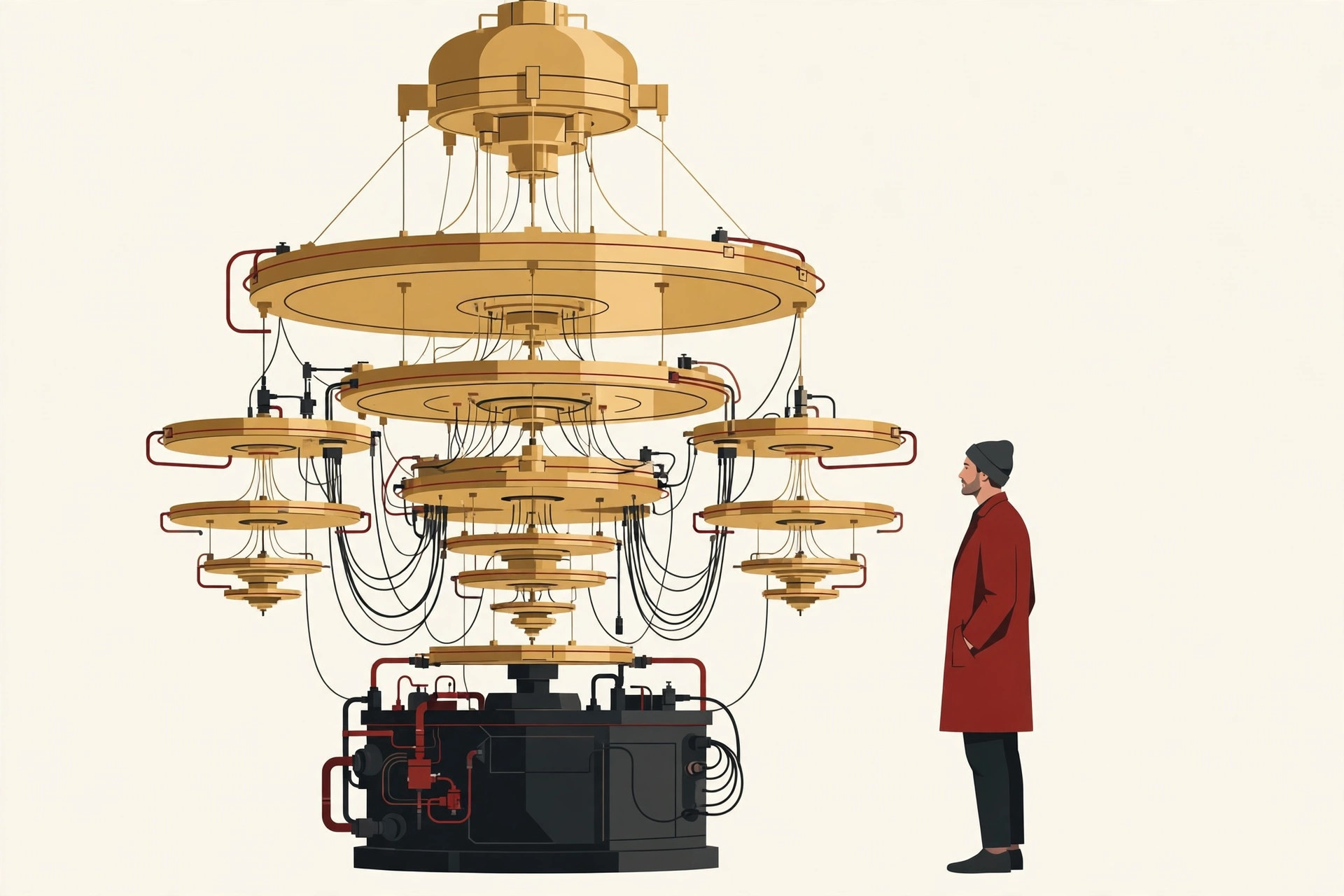
The fix the whole field is betting on is teamwork. Instead of trusting one fragile qubit, you spread one unit of information across many physical qubits that constantly check each other for mistakes. That protected unit is called a logical qubit, and the checking process is called quantum error correction. Think of it as the difference between whispering a message once across a noisy room and having a whole team repeat, compare and correct it as it travels.
Machines built from raw, unprotected qubits belong to what researchers call the NISQ era, short for noisy intermediate-scale quantum. Our guide to NISQ and quantum error correction digs into that era in depth. The theme of 2024 was the field’s first solid steps beyond it.
Google Willow: The Result That Stole December
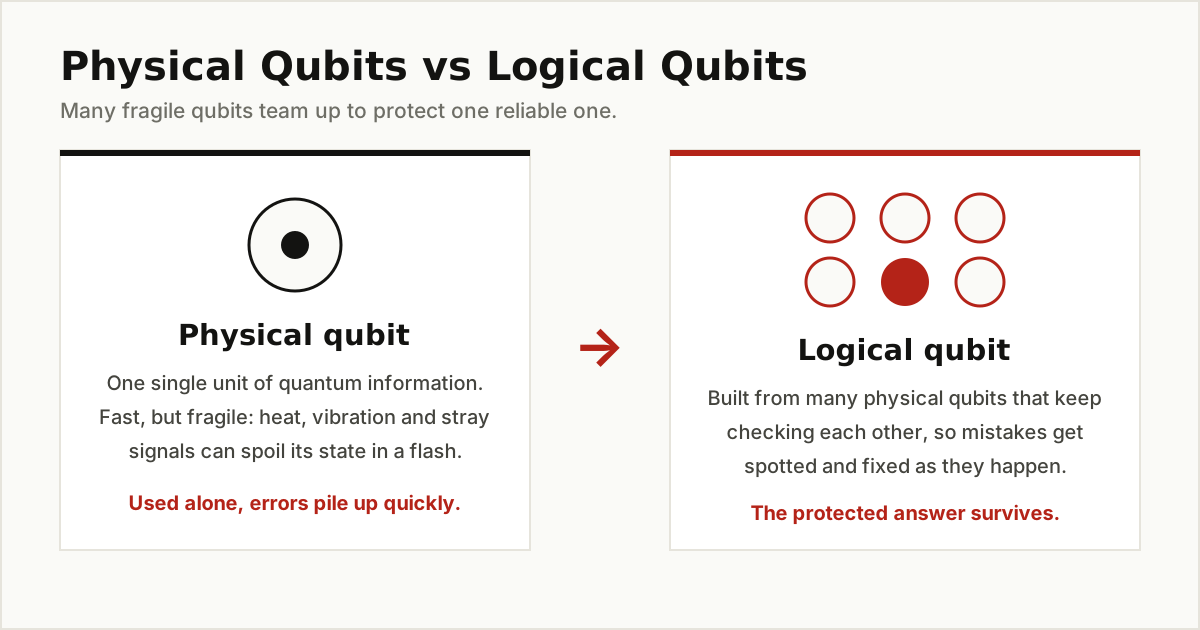
On December 9, 2024, Google announced its Willow chip, a superconducting processor with 105 qubits, and published the science behind it in the journal Nature the same day. Two claims made the headlines, and they are not equal. One is a genuine landmark. The other is a spectacular number that needs an honest footnote.
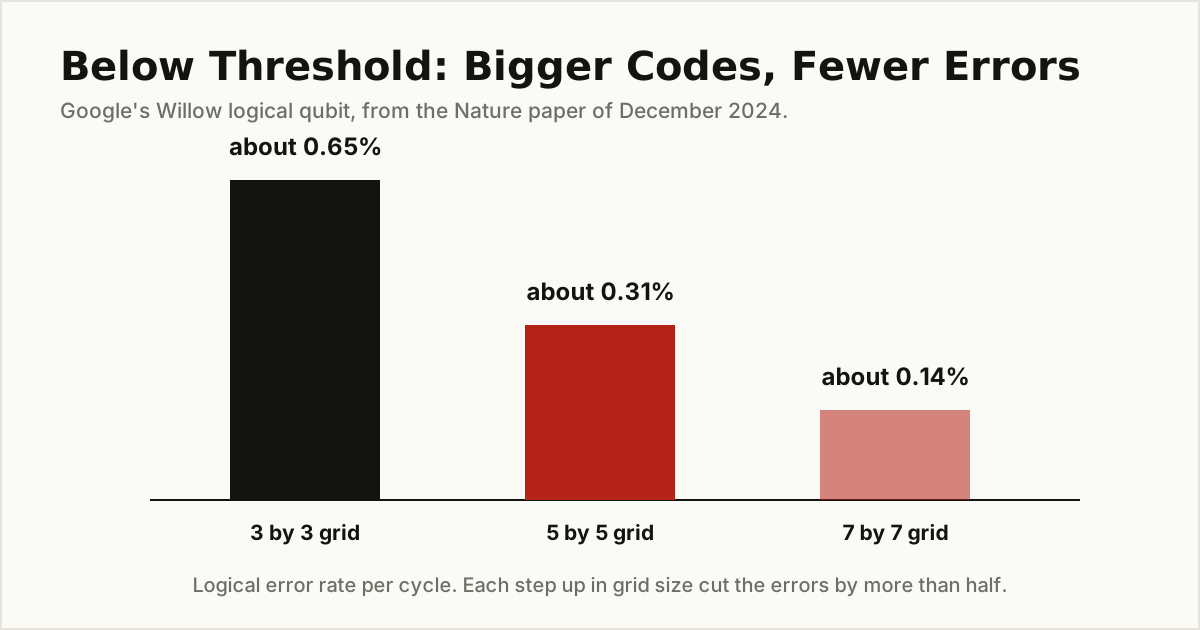
The landmark is error correction. Google’s team built logical qubits as grids of physical qubits, first 3 by 3, then 5 by 5, then 7 by 7. Every time they made the grid bigger, the error rate fell by more than half, dropping to about 0.14 percent per correction cycle for the largest grid. That sounds backwards, because for thirty years bigger quantum systems simply made more mistakes. Physicists call this pattern “below threshold,” and it is the proof the field has wanted since Peter Shor first described error correction in 1995: if bigger codes keep cutting errors, then in principle you can scale all the way up to a reliable machine.
The same experiment passed another test researchers call beyond breakeven. The protected logical qubit held onto its information for about 2.4 times longer than the best single physical qubit inside it. Error correction was no longer just slowing the decay. It was beating the raw hardware.
Now the footnote. Willow also ran a benchmark called random circuit sampling in under five minutes, a task Google estimates would take Frontier, one of the world’s fastest supercomputers, about 10 septillion years. Google itself is upfront about two things: the estimate gave the supercomputer generous assumptions, and random circuit sampling is a test built to be hard for normal computers, with no known real-world use. In Google’s own words, the next challenge for the field is a first computation that is both beyond classical reach and actually useful. Treat the septillion as a speedometer reading on a test track, not as a delivery van doing real work.
Microsoft and Quantinuum: Logical Qubits Learn to Behave
While Google worked with superconducting circuits cooled to near absolute zero, Microsoft spent 2024 proving the same point on a very different technology: trapped ions, individual atoms held and steered with electric fields and lasers, built by its partner Quantinuum.
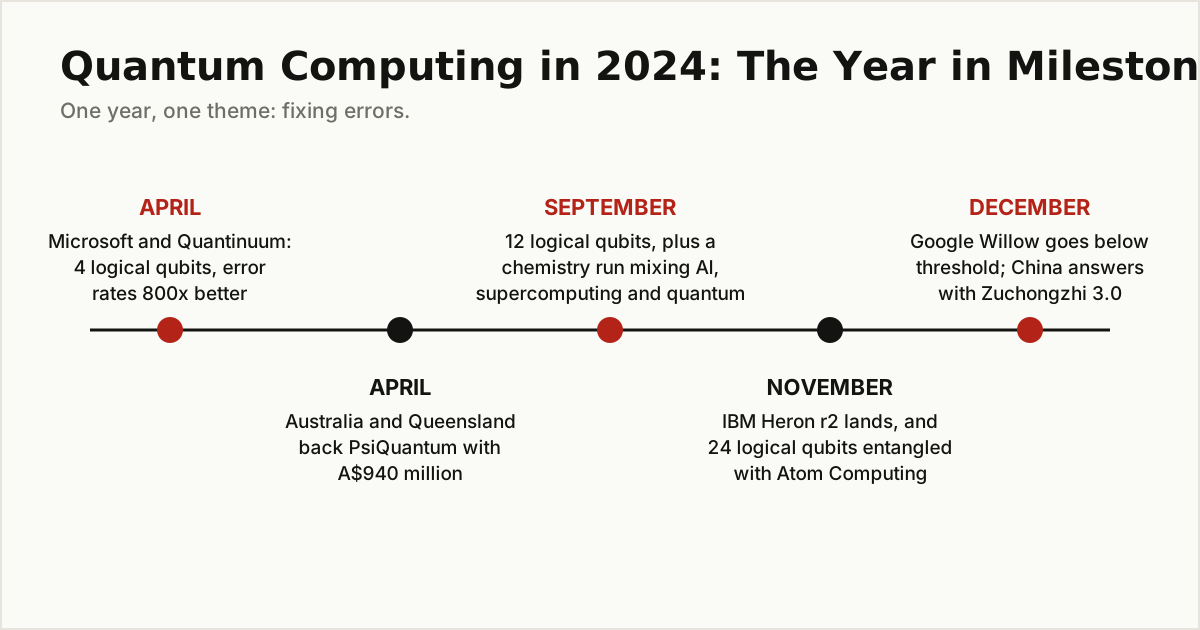
In April 2024, the two companies announced they had created four logical qubits from 30 of the 32 physical qubits on Quantinuum’s H2 machine. According to the companies, those logical qubits made errors at a rate 800 times lower than the physical qubits underneath them, and the system ran more than 14,000 individual experiments without a single error slipping through. Part of the trick was software that could diagnose trouble, correct what it could, and reject runs it could not trust. You can read the details in Microsoft’s announcement of the logical qubit results, which also recaps the April work.
By September, they had tripled the count: 12 logical qubits on the upgraded 56-qubit H2 machine, with error rates the companies measured as 22 times better than the physical qubits when all 12 were entangled together. Entangling is the linking of qubits so they act as one system, and it is where mistakes usually multiply, so holding an advantage there matters.
September also brought a taste of actual work. The partners ran what they described as the first end-to-end chemistry simulation to combine reliable logical qubits with cloud supercomputing and AI, estimating the energy of a molecule fragment that matters in catalyst research. The quantum part was small, just two logical qubits, but it showed the likely shape of useful quantum computing for years to come: a hybrid, where quantum hardware handles one hard kernel of a problem and normal computers do everything else.
Atoms in Laser Tweezers: The November Record
In November 2024, Microsoft turned to a second hardware partner, Atom Computing, whose qubits are neutral atoms held in place by focused beams of light, like tiny eggs in an egg box made of lasers.
The pair reported creating and entangling 24 logical qubits, which they described as the largest number of entangled logical qubits on record at the time. In a second experiment, 28 logical qubits built from 112 physical qubits ran a real algorithm, a standard test called Bernstein-Vazirani, and produced more accurate results than the same task on unprotected qubits. The system could even notice when one of its atoms had drifted away mid-calculation and correct for the loss without stopping.
Just as notable was the commercial step: the companies said customers could order machines built on this design, with more than 1,000 physical qubits, for delivery during 2025. Logical qubits were starting to move from journal papers toward price lists.
PsiQuantum: Australia Places an A$940 Million Bet
Not every 2024 breakthrough involved a working machine. In April, the Australian federal government and the Queensland state government announced a joint investment of A$940 million, about US$620 million, in the American company PsiQuantum, in a package of equity, grants and loans.
PsiQuantum’s approach is photonics: its qubits are particles of light, made with chip technology borrowed from the semiconductor industry. The money funds a site near Brisbane where the company aims to build what it calls the first utility-scale, fault-tolerant quantum computer, a machine its plans describe as being in the regime of one million physical qubits. The company says it is aiming to have the site operational by the end of 2027.
Read this one honestly. It is not a result; it is a very large public bet that a fault-tolerant machine can be built on a deadline, and that the country hosting it will own a piece of the future. Whether the bet pays off depends on engineering that has not happened yet.
IBM Heron r2: Fewer Headlines, Steadier Progress
IBM, the oldest player in the game, had a quieter November announcement. Its Heron r2 processor carries 156 qubits and uses adjustable connections between them, called tunable couplers, to reduce the unwanted cross-talk that causes errors.
IBM’s pitch was about depth rather than records. The company said its systems could now run circuits with up to 5,000 two-qubit operations, nearly twice the size of its 2023 “quantum utility” demonstration, and that software improvements let researchers rerun that 2023 experiment up to 50 times faster, cutting it from 112 hours to about 2.2 hours. No septillions, no world records, just the grind of making existing machines more capable. The field needs that grind as much as it needs landmarks.
Zuchongzhi 3.0: China Matches the Mark
December had one more headline, and it came from the University of Science and Technology of China. A team led by Pan Jianwei posted results for Zuchongzhi 3.0, a superconducting processor with 105 qubits, the same headline count as Willow. The work was later published in Physical Review Letters, one of physics’ top journals.
The Chinese team ran the same style of random circuit sampling test Google uses, on 83 of the chip’s qubits, and estimated that the most powerful classical supercomputers would need billions of years to match the sampling it performed in a matter of minutes. That is the team’s estimate, and the same honest caveat applies as with Willow: this is a benchmark chosen because classical machines hate it, not a useful job of work.
The real message of Zuchongzhi 3.0 is not the speedup claim. It is that at least two labs, on two continents, can now build 100-plus qubit processors of similar quality. Quantum computing is a genuine international race, not one company’s science project.
Quantum Computing Challenges: The Honest Part
A year of real progress can still leave a field far from the finish line, and it is worth being blunt about the problems with quantum computing as they stand now.
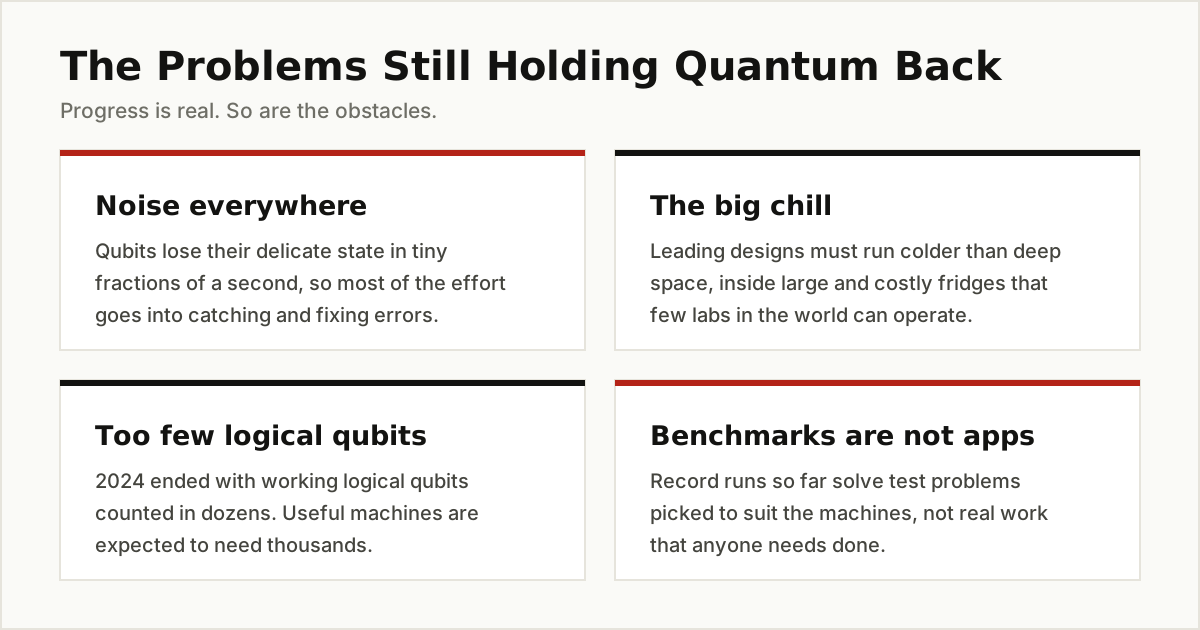
The error rates are still far too high. Willow’s best logical qubit made a mistake roughly once every 700 correction cycles. Long, useful programs may need error rates billions of times lower than that. Below threshold proves the direction is right; it does not mean the journey is short.
The logical qubit counts are tiny. 2024 was a record year, and the records were 4, then 12, then 24 logical qubits. Useful machines are widely expected to need thousands of logical qubits, each built from many physical ones. The gap between dozens and thousands is the whole ballgame for the next decade.
The machines are expensive, rare and extreme. Leading superconducting designs work at temperatures colder than deep space, inside refrigerator systems that fill a room and cost a fortune to run. Trapped-ion and neutral-atom machines avoid some of that, but bring their own speed and scaling headaches.
Benchmarks are not applications. Every speed record in this article is a test problem. Nobody has yet used a quantum computer to design a real drug, crack a real logistics problem, or do anything a paying customer would queue up for. The builders admit this freely; Google calls that first useful, beyond-classical computation the field’s next challenge.

So, Is Quantum Computing Real?
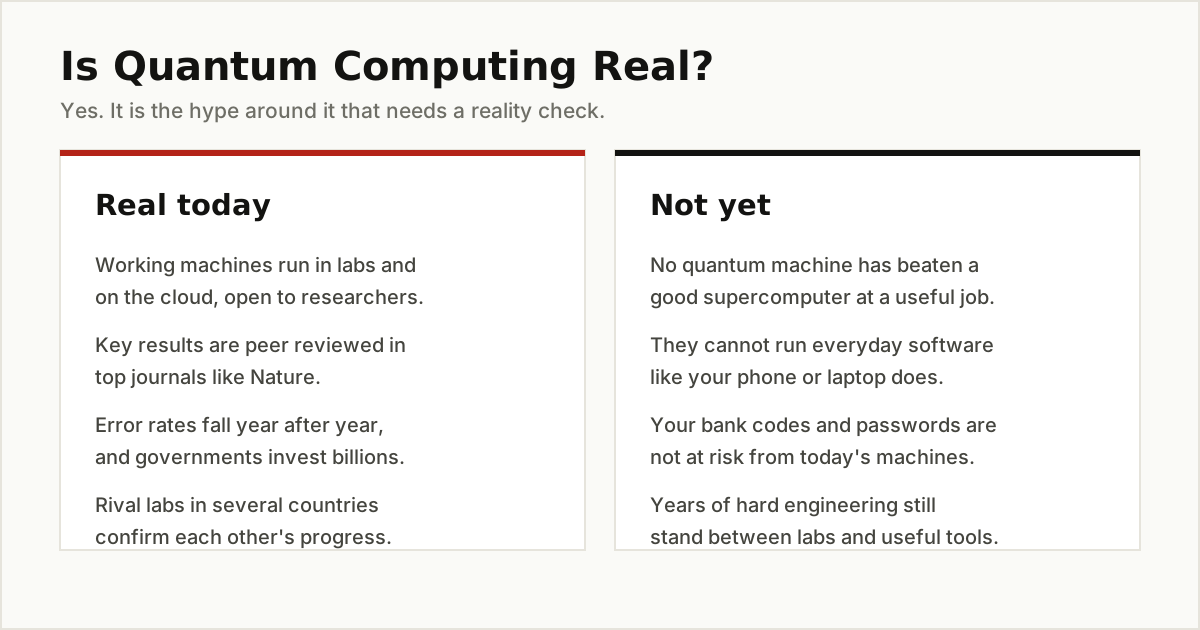
Yes, with a clear head about what “real” means. Quantum computers exist, they run in laboratories and through the cloud, and their results appear in peer-reviewed journals where rivals check the math. Governments are spending billions, and three different hardware technologies made verified progress in a single year. This is not vaporware.
It is also not magic, and it is not coming for your laptop. Today’s machines are research instruments: astonishing physics, disappointing practicality. They cannot run your apps, they will not replace normal computers, and the tiny classical chips inside everyday devices, the kind explained in our guide to what a microcontroller is, face no threat from them at all. The honest summary of 2024 is that quantum computing became more real and stayed not yet useful, at the same time.
The Bottom Line
The latest breakthroughs in quantum computing in 2024 share one moral: the field stopped worshipping qubit counts and started worshipping reliability. Google proved in the Nature paper on Willow that error correction now improves as machines grow, and you can read Google’s own account in the Willow announcement on its blog. Microsoft and its partners turned logical qubits from a concept into a scoreboard. Australia wrote a cheque the size of a small space program. China matched the leaders chip for chip.
None of it makes quantum computers useful yet. All of it makes them more plausible. Watch 2025 and beyond for the only headline that will top this year: a quantum machine doing a job that matters, better than anything classical. Until then, keep exploring our Emerging Tech guides, where we explain the technologies shaping the next decade in the same plain English.