If you have been reading about quantum computers, you may have run into the phrase “s nisq quantum error correction” in a course list, a study guide or a syllabus. It looks like a technical term of its own, so let us clear it up kindly and quickly, because the honest answer makes everything else in this article easier.
There is no separate standard term called “S-NISQ” in quantum computing. The term the field actually uses is NISQ, and the “s” in front is most likely a typo or a leftover from a list that spread from one website to another. So this article explains the real thing: what NISQ means, why today’s quantum computers make so many mistakes, and how quantum error correction, the technology that is supposed to fix those mistakes, actually works.
No physics degree needed. By the end, you will understand the most important idea in quantum computing right now, in plain English.
What NISQ Actually Means
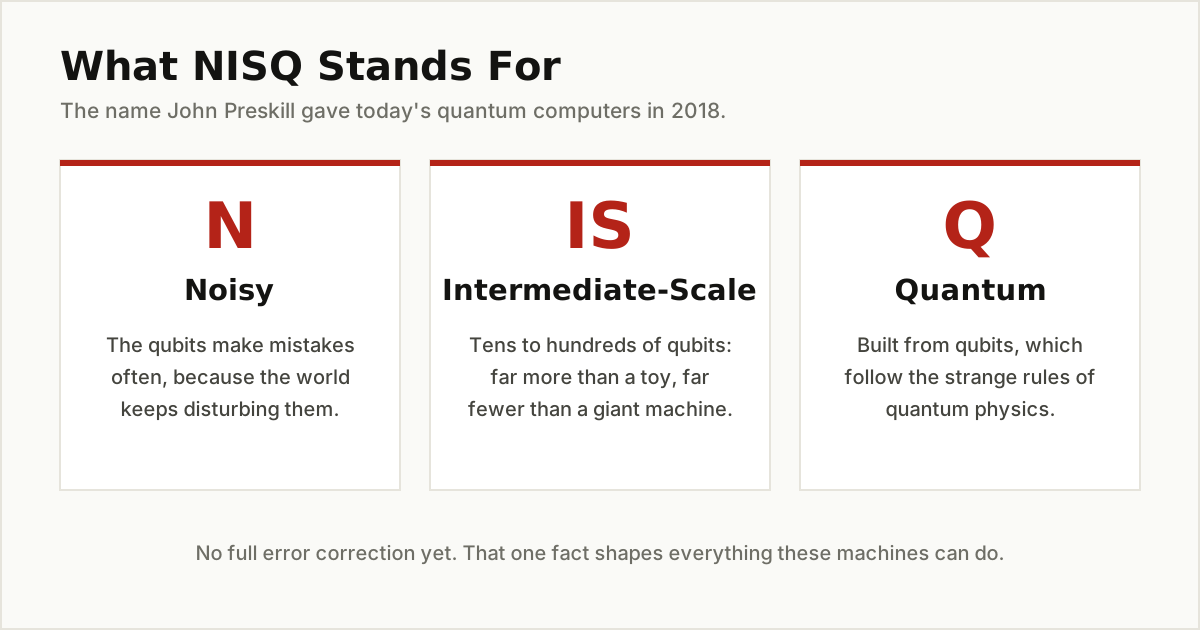
NISQ stands for Noisy Intermediate-Scale Quantum. The name was coined by John Preskill, a physicist at Caltech, in his 2018 paper “Quantum Computing in the NISQ era and beyond”, first posted in January 2018 and published in the journal Quantum later that year. The paper became famous because it gave the whole field an honest label for where it stood.
Each word in the name is doing a job:
- Noisy means the machines make mistakes, often. Their basic parts, called qubits, are disturbed by almost everything around them, and there is no full error correction to clean up after them yet.
- Intermediate-scale means the size is in between. Preskill described machines with roughly 50 to 100 qubits: far beyond a classroom toy, but far smaller than the giant machines that theory says could change the world. Today’s processors range from a few dozen qubits to a few hundred in the systems most researchers actually use.
- Quantum simply means the machines are built from qubits and follow the rules of quantum physics, which let them tackle certain problems in a completely different way from normal computers.
Preskill’s own summary was refreshingly blunt: a 100-qubit quantum computer “will not change the world right away,” and should be seen as a step toward the powerful machines of the future. That is still the fairest description of the NISQ era today. The machines are real, they are improving fast, and they are held back by one stubborn problem: errors.
Why Qubits Make Mistakes So Easily
A normal computer chip is sturdy. The tiny switches inside your phone hold their values through heat, bumps and years of use. A qubit is the opposite. It is one of the most delicate objects humans have ever built a computer from.
Here is why qubits fail so often:
- They are disturbed by everything. Heat, vibration, stray magnetic fields, even the control signals used to operate them can knock a qubit out of its state.
- They forget quickly. A qubit holds its special quantum state only briefly before the state fades away. Physicists call this forgetting “decoherence,” and the time a qubit can remember is its “coherence time.”
- Every operation is a small gamble. Reading a qubit or switching it is never perfect. Microsoft’s quantum documentation puts typical error rates at roughly one bad operation in every 100 to 1,000.
That last point is the killer. A useful calculation needs millions or billions of operations in a row. If one operation in a few hundred goes wrong, errors pile up long before the calculation finishes, and the final answer is garbage. This is why quantum computers cannot simply be made bigger to become useful. Bigger and noisier just means bigger garbage.
The fix, in theory, has been known since the 1990s. It is error correction, and it works nothing like the error correction in normal computers.
What Quantum Error Correction Is
In a normal computer, protecting data is easy: keep three copies, and if one copy differs, trust the other two. Quantum information cannot be copied like that, and there is a worse catch. Reading a qubit directly destroys the very state you are trying to protect. So you cannot just look at your data to check whether it is still correct.
Quantum error correction solves this with a clever detour. Instead of trusting one fragile qubit, the machine spreads a single unit of information, called a logical qubit, across many physical qubits working as a group.
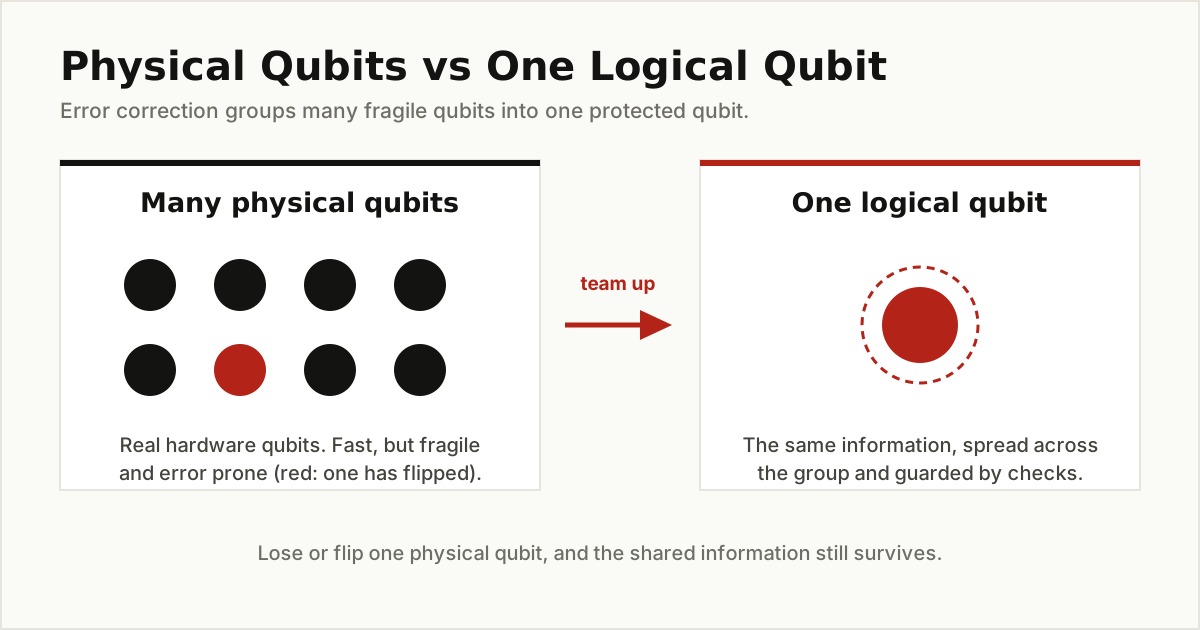
Think of it like a team trying to remember a phone number in a noisy stadium. One person alone will mishear a digit. So the team splits the number up, each member guards a piece, and a captain keeps asking simple questions that reveal whether the pieces still agree, without anyone ever shouting the number itself. If one member’s piece has changed, the pattern of answers shows which piece is wrong, and it gets fixed on the spot.

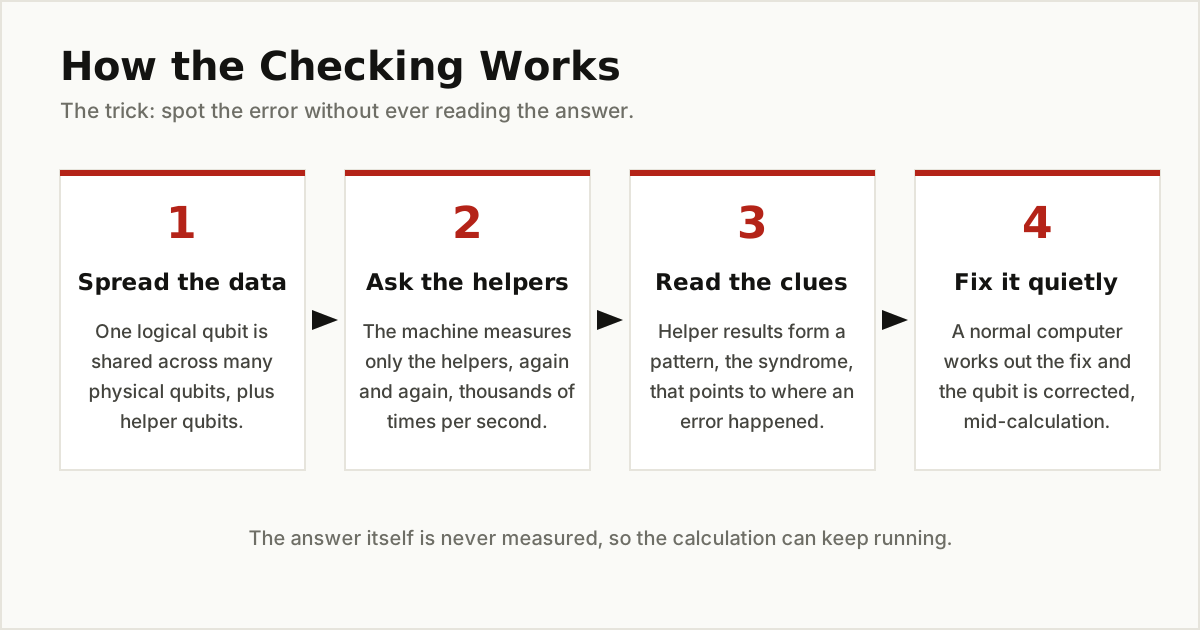
That is almost exactly how the real thing works:
- Data qubits hold the shared information, spread out so no single failure can destroy it.
- Helper qubits sit between them and get measured over and over. Measuring a helper reveals nothing about the answer itself, only about whether its neighbours still agree.
- The pattern of helper results is called the error syndrome. It is a set of clues that points to where an error happened and what kind it was.
- A normal computer reads the clues and applies the fix, all while the quantum calculation keeps running.
There are two kinds of mistakes to catch: a bit flip, where a qubit switches value, and a phase flip, a subtler error with no equivalent in normal computers. A real error correction system has to catch both. The price of all this protection is steep. One logical qubit can need hundreds or even thousands of physical qubits standing guard over it, plus checking machinery fast enough to keep up. That price is the main reason the NISQ era is still with us.
Surface Codes: The Leading Design
Several error correction designs exist, but one has become the front-runner: the surface code. In a surface code, the qubits sit in a flat grid, like squares on a chessboard. Data qubits and helper qubits alternate across the grid, and each helper watches only its immediate neighbours, which suits how real chips are built.
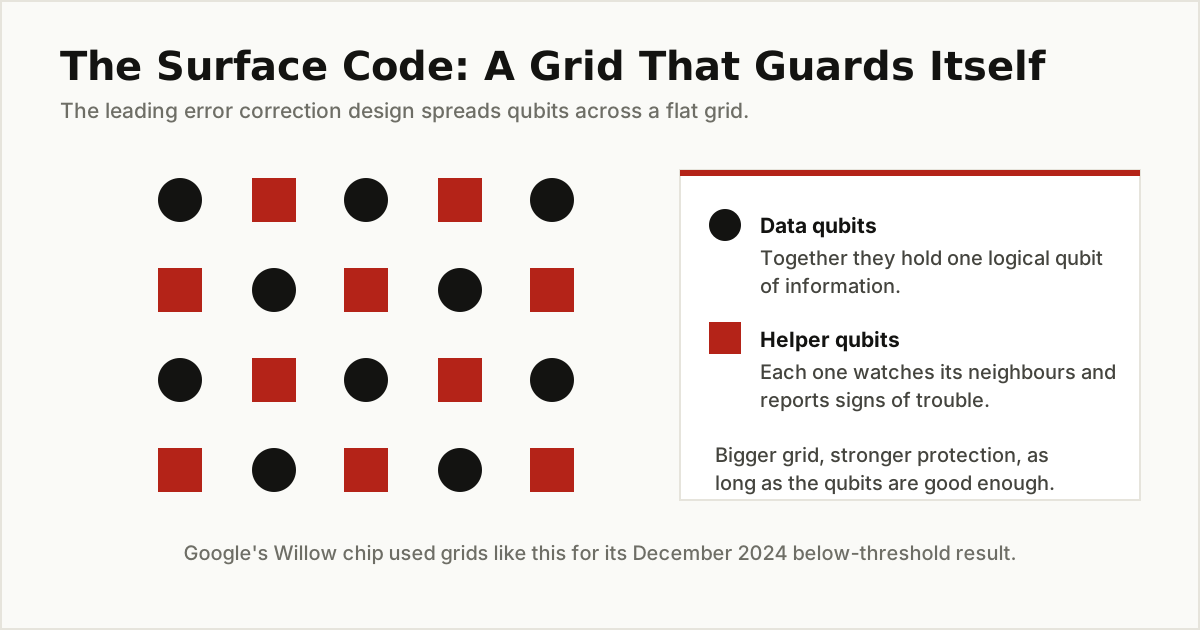
Microsoft’s documentation calls the surface code one of the most promising techniques for large-scale, fault-tolerant quantum computing, mainly because it forgives a lot: it keeps working even when the underlying qubits are fairly error prone, as long as their error rate sits below a tipping point called the threshold.
The threshold is the key idea in the whole field. Above it, adding more error correction makes things worse, because the extra qubits bring extra errors of their own. Below it, something wonderful happens: making the grid bigger makes the logical qubit better, and errors fall exponentially as the grid grows. Cross below the threshold, and in principle you can protect a calculation for as long as you like just by building a big enough grid.
When a machine can keep this up through a whole calculation, correcting errors at every step faster than new ones appear, researchers call it fault-tolerant. Fault tolerance is the finish line of this entire story: a fault-tolerant quantum computer could run long calculations the way a normal computer does, for hours or days, without the answer quietly rotting away. Nothing built yet qualifies. Every result so far, including the famous one below, is a step toward it.
For decades, the threshold was only a theory. Then, at the end of 2024, it happened on real hardware.
Error Mitigation Is Not Error Correction
Before the good news, one honest distinction, because news stories mix these two up constantly.
Error mitigation is what NISQ machines mostly use today. It accepts that errors will happen and attacks them with statistics instead. The calculation is run many times, sometimes with the noise deliberately turned up and down, and clever math estimates the answer you would have seen with no noise at all. It is genuinely useful, and IBM expects mitigation to keep playing a role for years. But mitigation does not fix anything while the calculation runs, and its cost grows steeply as calculations get longer. It cannot carry the field to the giant machines of theory.
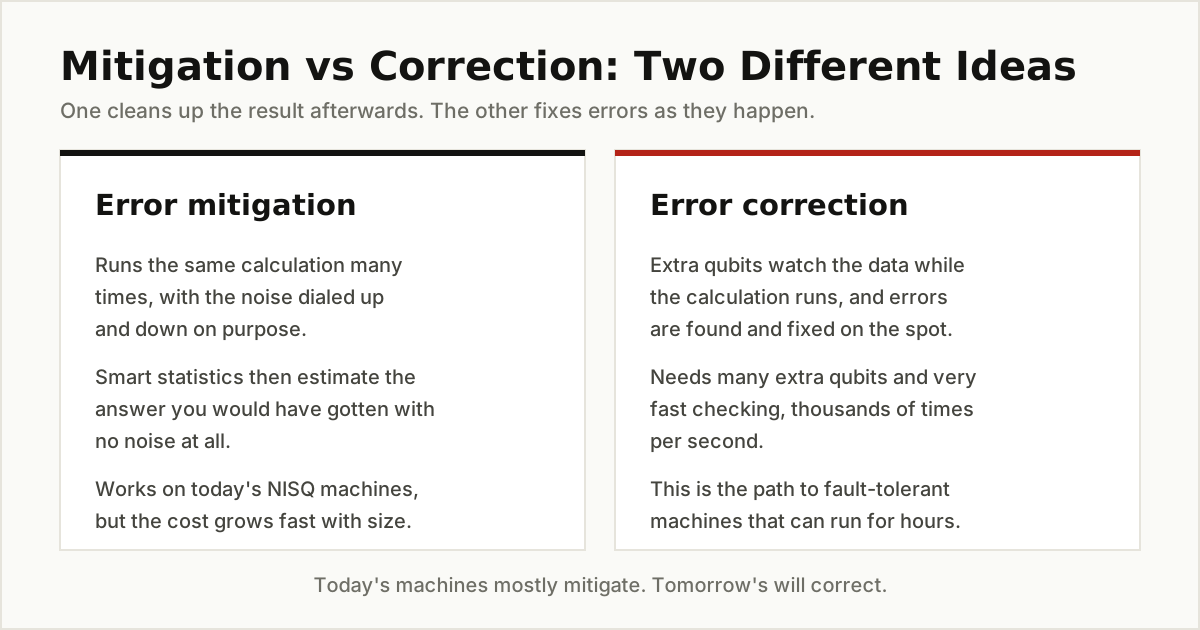
Error correction is the real fix: errors caught and repaired during the run, for as long as the run takes. That is the difference between estimating a clean answer and actually having one. If you want to go deeper, IBM offers a free course on the foundations of quantum error correction through its quantum learning platform.
Where Things Honestly Stand
In December 2024, Google’s quantum team reported in the journal Nature that its Willow chip had run a surface code below the threshold for the first time. The team tested grids of 3 by 3, 5 by 5 and 7 by 7 qubits, and each step up in size cut the logical error rate by more than half. The biggest grid’s error rate fell to about 0.14 percent per checking cycle, and the protected logical qubit held its information longer than the best single physical qubit on the chip. In plain words: for the first time, the protection clearly worked better than the parts it was built from. Our roundup of the latest breakthroughs in quantum computing in 2024 covers that result and the rest of a landmark year in detail.
Now the honest limits, because this result is often oversold:
- It was a protected memory, not a working computer. Willow guarded one logical qubit’s stored information. A useful machine needs many logical qubits doing calculations together.
- The scale is still small. Logical qubits worldwide are counted in the dozens. Useful machines are expected to need thousands of them.
- Roadmaps are targets, not promises. IBM, for example, says its roadmap leads to a large-scale fault-tolerant system called Starling, with 200 logical qubits, by 2029. That is the company’s stated aim, and the field will judge it when it ships, not before.
Set against the daily flood of AI chip news, quantum progress can look slow. But the direction is real, peer reviewed and confirmed by rival labs, which is more than can be said for most technology hype.
What NISQ Machines Are Honestly Good For Today
So what are today’s noisy machines actually for? More than nothing, less than the headlines suggest:
- Research. They are the best tools ever built for studying how quantum systems themselves behave, which was Preskill’s main prediction for them.
- Early chemistry and materials experiments. Small molecules and materials can be explored in ways that teach scientists how future, corrected machines will be used.
- Learning and testing. Algorithms, software and error correction techniques all get developed and debugged on NISQ hardware now, so the field is ready when the hardware matures.
- Benchmarks. Vendors use them to prove their qubits are getting better, year by year.
What they are not for: replacing normal computers. The humble microcontroller inside a washing machine does its job perfectly, every time, for pennies. A NISQ machine costs a fortune to run, needs a room of support equipment, and still loses its train of thought mid-calculation. The two technologies are not rivals. One is finished and everywhere; the other is a promising work in progress.

The Short Version
If you came here looking for “s nisq quantum error correction,” the real subject is NISQ: the Noisy Intermediate-Scale Quantum era, named by John Preskill in 2018. Today’s quantum computers are held back by noise, and quantum error correction, many physical qubits teaming up to protect one logical qubit, checked without ever reading the answer, is the technology meant to free them. Surface codes lead the race, the below-threshold milestone fell in December 2024, and the rest is years of hard engineering.
For more guides like this one, browse the emerging tech category.