Few tech words have been shouted louder, or explained worse, than the metaverse.
In 2021 it was presented as the next version of the internet itself. Companies renamed themselves after it, investors poured in money, and news shows talked about virtual land as if it were beachfront property. A few years later, the same word is often used as a punchline.
Both reactions skip the honest middle. Under the noise there is a real idea, real technology, and real work still going on. This guide explains what the metaverse actually means, where the word came from, what exists today, what the hype got wrong, and what might still come of it. No sales pitch, and no funeral speech either.
What Is the Metaverse, in Simple Words?
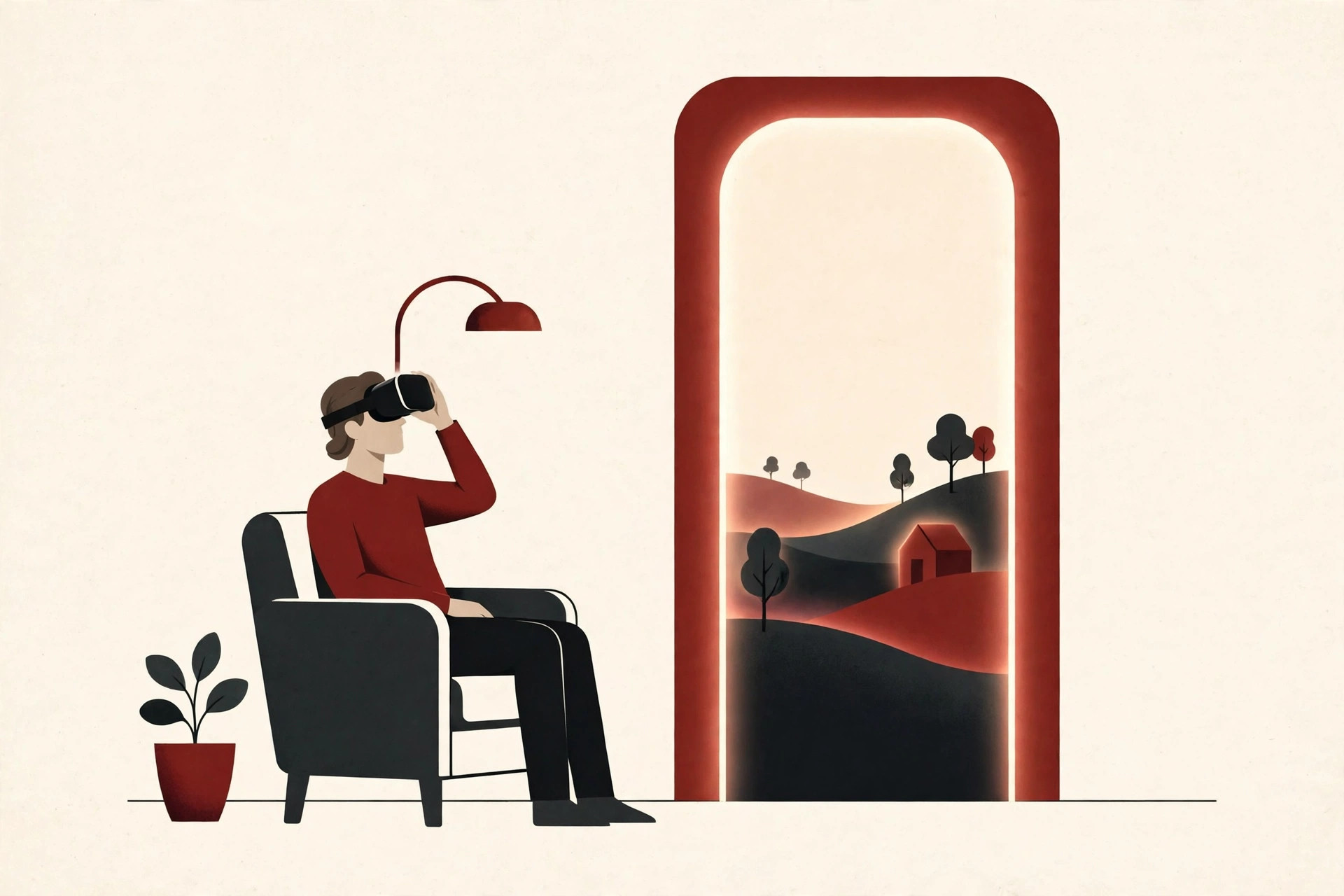
So, what is the metaverse in plain words? It is an idea for the next layer of the internet: shared 3D spaces where people meet, play, work and shop as digital characters called avatars, instead of staring at flat pages and video boxes.
Today, the internet is mostly something you look at. The metaverse is meant to be something you step into. Meta, the company that has bet the most on this idea, calls it “the next evolution in social connection and the successor to the mobile internet.” That is marketing language, but the core idea underneath is simple enough.
Three parts matter most:
- Shared. Other real people are in the space with you, live, at the same time.
- 3D and present. You feel like you are standing somewhere, not just watching a screen.
- Connected. In the full vision, many worlds link together like websites do today, and your avatar and belongings travel with you between them.
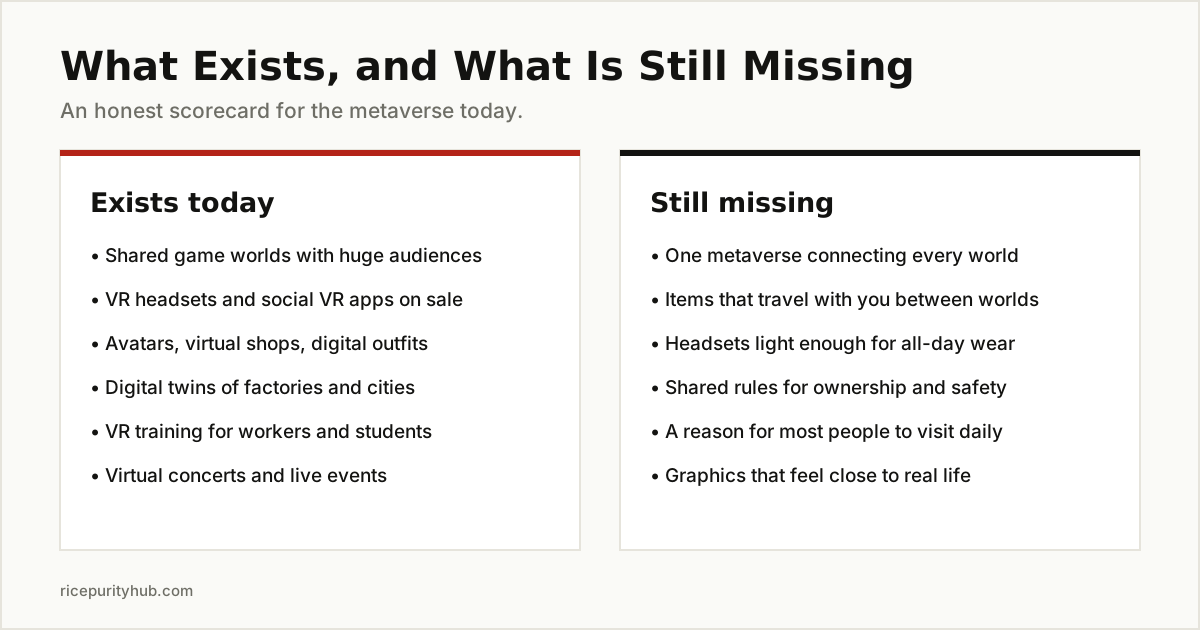
That third part is the one that does not exist yet, and it is the difference between the dream and the current reality. What we have today is a set of separate virtual worlds. What the word promises is all of them joined into one place.
The word people in this field use for the goal is presence: the feeling that you are really in a place with other people, not watching them through a window. A good video call gives you faces and voices. A good virtual world adds the sense of standing next to someone, turning toward them, and sharing the same room. Every piece of metaverse technology, from headsets to avatars, is really chasing that one feeling.
Keep the website comparison in mind. Google is not the internet, and one game is not the metaverse. The metaverse, if it ever fully arrives, will be the whole network, not a single app.
Where the Word Came From
The word metaverse was invented by a novelist, not a company.
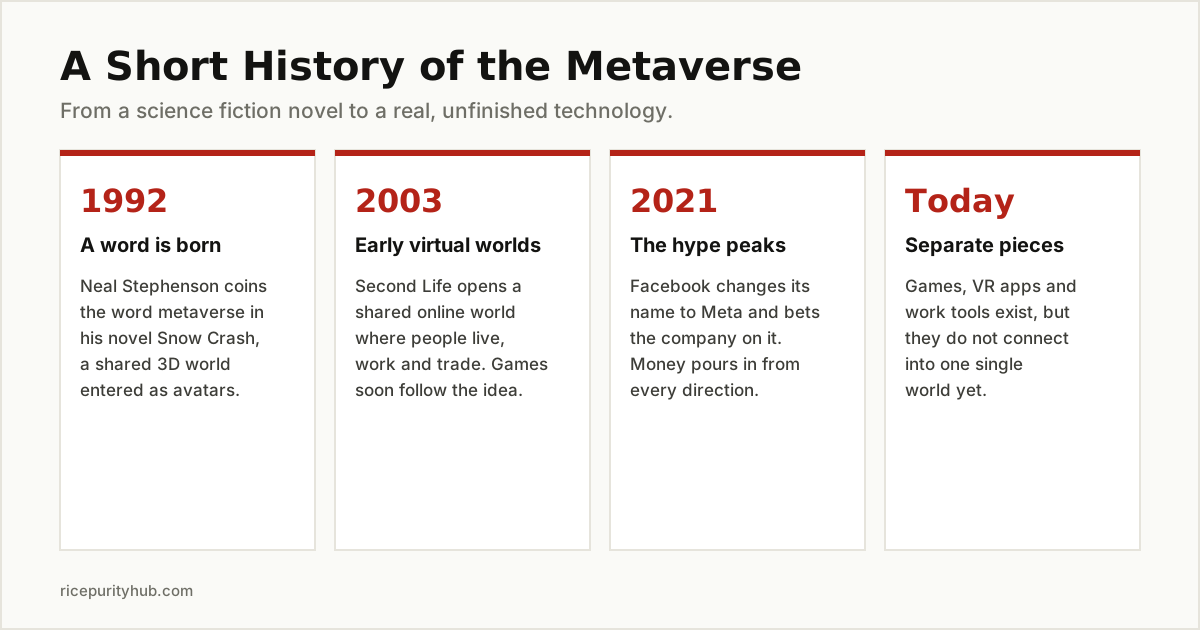
Science fiction author Neal Stephenson coined it in his 1992 novel Snow Crash. In the book, people escape a messy real world by putting on goggles and entering a shared virtual world as avatars. The book also helped popularize avatar as the word for your digital self. Writers kept returning to the idea, and Ernest Cline’s 2011 novel Ready Player One, later a Steven Spielberg film, gave a new generation the same picture: one huge virtual world where people live much of their lives.
Stephenson was imagining, not predicting. Still, builders kept borrowing the blueprint. In 2003, a world called Second Life opened and let ordinary people live, work, trade and build inside a shared online space. It was clunky and it never became mainstream, but it proved that people would spend real time and real money on a virtual life.
Game worlds carried the idea further. Minecraft, Roblox and Fortnite put huge audiences into shared 3D spaces where they build, compete and simply hang out. None of them called it the metaverse at first. The word only exploded in 2021, when the biggest social media company on Earth decided to name itself after it.
What Actually Exists Today
So what can you actually visit right now? More than the jokes suggest, and less than the keynote speeches promised.
Game worlds are the closest thing. Fortnite is a game, but it is also a place where people attend live concerts, watch trailers with friends and buy outfits for their characters. Roblox is a platform full of player-made worlds, and big brands such as Nike and Gucci have built spaces inside it. Britannica describes the metaverse as a network of immersive digital worlds where people move around, interact and exchange goods and services, which is a fair description of what these games already do inside their own walls.

Social VR is the headset version. Put on a Meta Quest headset and you can enter Horizon Worlds, Meta’s own social platform, or VRChat, where people gather in player-made rooms as cartoon avatars to talk, play games and attend events. It feels surprisingly social, and surprisingly unfinished.
Work tools are the quiet version. Microsoft Mesh and Meta’s Horizon Workrooms put remote teams around a virtual table. Companies also build digital twins, exact virtual copies of real factories and warehouses, to test changes before touching the real thing.
You do not always need a headset. Most people who enter these worlds today do it through a phone or a computer screen. Meta itself says the metaverse will include ordinary 2D experiences alongside fully immersive 3D ones, and the big game worlds already work that way.
Notice what all of these have in common. Each one is a single company’s world, with its own account, its own avatar and its own money. Your Fortnite outfit does not work in Roblox. Your Horizon avatar cannot walk into a Microsoft meeting. The pieces exist. The connections do not.
The Pieces It Still Needs
For the separate worlds to become one metaverse, five pieces have to work together.
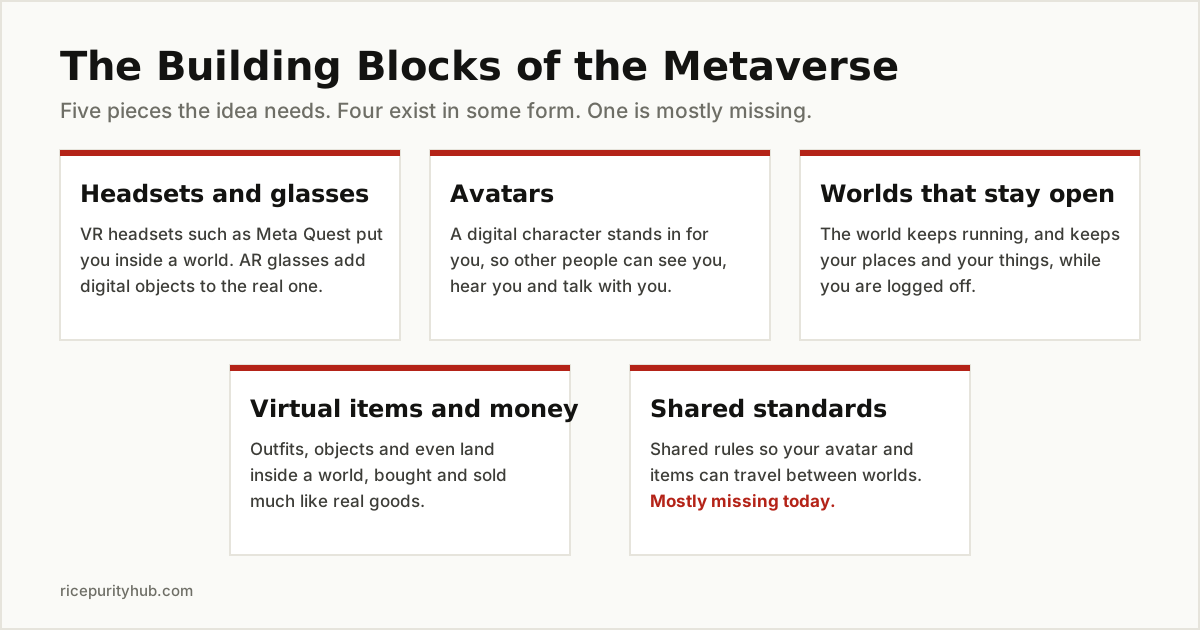
Hardware people actually want to wear. VR headsets like the Meta Quest line are the main door today. They keep getting lighter and sharper, but they are still heavy, tiring and hard to wear for hours. Every headset is a small computer worn on the face, packed with cameras, sensors and chips, down to the tiny controllers described in our guide to what a microcontroller is. Augmented reality takes the other path, adding digital objects to the real room around you, the approach we explore in our piece on ARK augmented reality. Neither path has yet produced glasses that most people would happily wear all day.
Avatars and identity. Your avatar is your face in these worlds. For a real metaverse, one identity would follow you everywhere, the way your email address does. Today, almost every world makes you start over with a new character and a new wallet.
Worlds that stay alive. A metaverse world cannot reset when you log off. It has to keep running, keep your house, your shop and your things, and let life carry on without you. Big games already do this inside their own borders.
Things worth owning. Virtual outfits, objects and land already sell for real money. The open question is ownership: if a world shuts down, does your stuff vanish with it? There is no shared answer yet.
Shared standards. This is the missing piece. The web works because every browser follows the same basic rules, so any site can link to any other site. Virtual worlds have no equivalent rulebook. Until rival companies agree on one, the metaverse stays a set of islands.
The Hype Wave, and What Happened After
On October 28, 2021, Facebook announced it was changing its company name to Meta, and declared the metaverse its future. It was the peak of the wave. Meta committed around 10 billion dollars to the effort that year alone. Other companies rushed in. Virtual land in small worlds sold for silly prices, banks opened virtual branches, and the word appeared in every pitch deck in Silicon Valley.
Then reality sent the bill. TechTarget’s detailed guide to the metaverse describes late 2022 as the moment the bubble popped, and the timing was brutal. ChatGPT arrived in late 2022 and showed the public a technology that worked today, not someday. Attention and money swung to AI almost overnight.
The numbers tell the story. Meta’s Reality Labs division, which builds its headsets and VR worlds, lost 13.7 billion dollars in 2022 alone. Britannica reports that the division’s total operating losses since late 2020 had passed 80 billion dollars by the middle of 2026, and that Horizon Worlds peaked at roughly 300,000 monthly users in early 2022, a small town next to the billions of people on Meta’s social apps. Apple, launching its Vision Pro headset in 2024, carefully avoided the word metaverse and called the same idea spatial computing instead. In early 2026, Meta announced that Horizon Worlds would focus almost entirely on mobile phones rather than headsets, which says a lot about where the original plan landed.
None of this means the work stopped. It means the story changed, from a revolution arriving next year to a technology improving in public, slowly, at great expense.
The Serious Uses Companies Are Testing
Away from the consumer spotlight, the technology found real jobs.
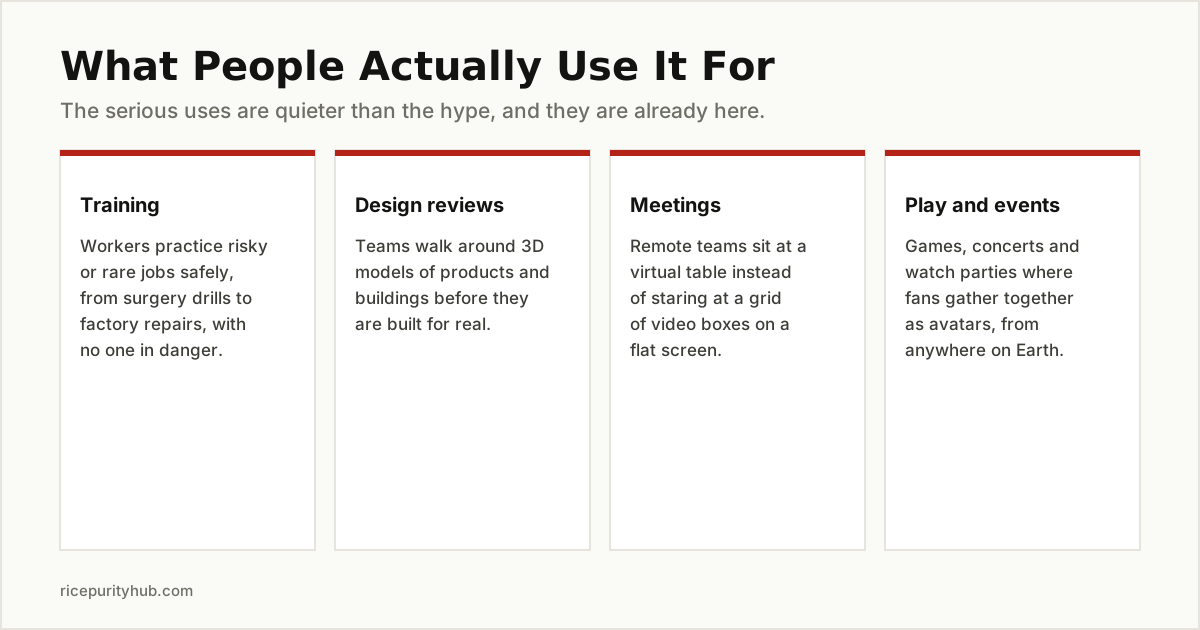
Training. VR is very good at safe practice for dangerous work. New staff can rehearse factory repairs, warehouse tasks and medical procedures inside a simulation where mistakes cost nothing. Companies like it because the lesson sticks better than a slideshow, and nobody gets hurt while learning.

Design and building. Engineers and architects walk through 3D models together before anything is built. NVIDIA’s Omniverse platform is used to build digital twins of factories and warehouses, so a team can spot a bad layout on screen instead of after the concrete is poured.
Meetings and offices. Horizon Workrooms and Microsoft Mesh test a simple idea: a remote meeting where people sit around the same table, point at the same model and see the same gestures, instead of watching boxes on a screen. The headsets are still the weak point, but the idea aims at a real problem with remote work.
Even quiet professions are experimenting at the edges, using augmented reality overlays to place figures and notes over real documents, as our look at augmented reality in accounting shows.
These uses share a pattern. They do not need one giant metaverse. They need good 3D spaces, built for one clear job.
So, Is the Metaverse Real, and Is It Coming?
Here is the honest answer, in three parts.
The pieces are real. Shared 3D worlds, avatars, VR headsets, virtual shops and digital twins all exist and keep getting better. Huge numbers of people already spend time in game worlds that behave like early metaverses, whether or not they ever use the word.
The single metaverse is not real yet. There is no connected network of worlds where your identity and belongings travel with you. What exists is an archipelago: many islands, each owned by one company, with no bridges between them.
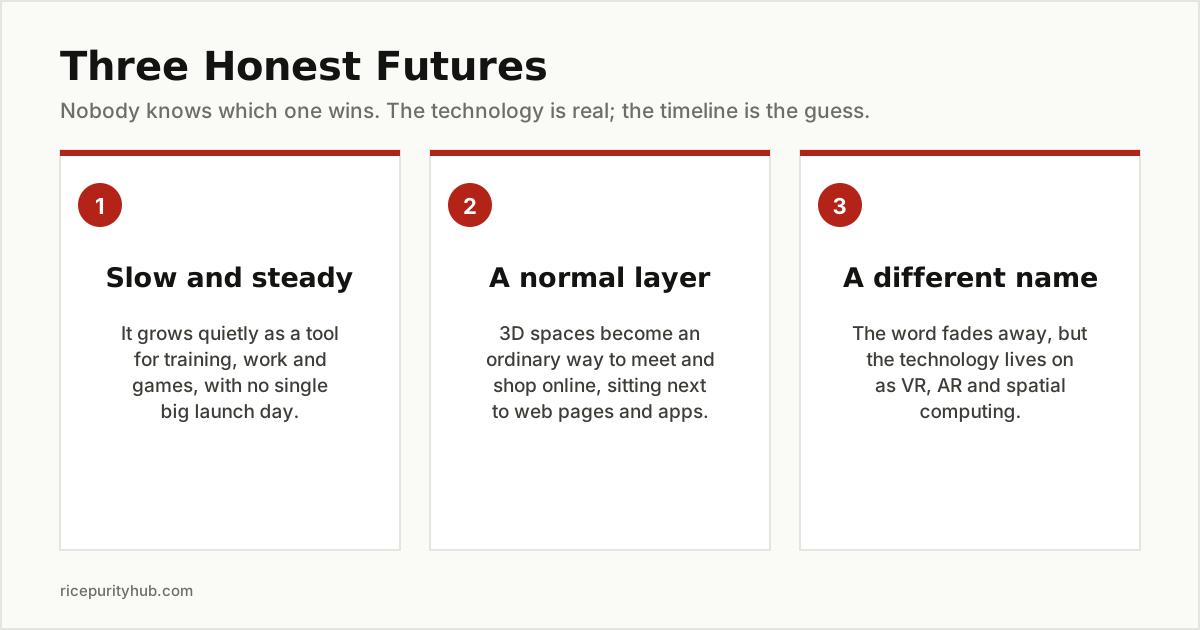
And the timeline is unknown. The internet itself took decades to become ordinary, and it was built on shared standards that rivals agreed to follow. Virtual worlds have not reached that agreement. The metaverse may arrive slowly, it may arrive under a different name, or parts of the idea may simply be absorbed into games, work tools and AR glasses until nobody says the word anymore.
Anyone who gives you an exact year is guessing, including the people selling headsets.
The Bottom Line
The metaverse is best understood as a direction, not a product. The direction is real: toward shared 3D spaces where people meet, play and work as avatars. The product, one connected virtual universe, does not exist yet, and the honest timeline is years of slow building, not one big launch.
Keep exploring with our other Emerging Tech guides, where we break down quantum computing, augmented reality and the tiny chips inside modern devices in the same plain English.