Accounting has a quiet image problem when it comes to new technology. The headlines promise floating dashboards and auditors in headsets, while the real profession still runs on spreadsheets, ledgers and cloud software. So what is the truth about augmented reality in accounting?
The honest answer is that it is a pilot stage topic. A handful of real experiments exist, run by big firms, banks and researchers. Some results are genuinely impressive, especially in training. But no accounting department anywhere does its normal daily work in a headset, and this guide will not pretend otherwise. Below are the uses that are really being tried, what each one has actually proven, and the barriers that explain why progress is slow.
First, the Two Ideas in Plain English
Augmented reality, or AR, adds digital information on top of the real world. You look through a phone camera or a pair of smart glasses, and labels, charts or instructions appear over the real things in front of you. Virtual reality, or VR, does the opposite: the headset shuts out the real world and replaces it with a simulated one. Most consumer AR today runs on the technology in our ARKit explainer, while VR is the technology behind the virtual worlds discussed in our guide to the metaverse.
In accounting and finance, AR is mostly proposed for viewing data and guiding physical work, while VR is mostly proposed for training. That split runs through every example below.
The Honest Status: On the Watch List, Not in the Office
The profession is not ignoring the idea. ACCA, the global accountancy body, lists augmented and virtual reality among the ten technology trends it expects to shape accounting, alongside cloud computing, big data and artificial intelligence. Being on that list means the idea is taken seriously. It does not mean it has arrived.
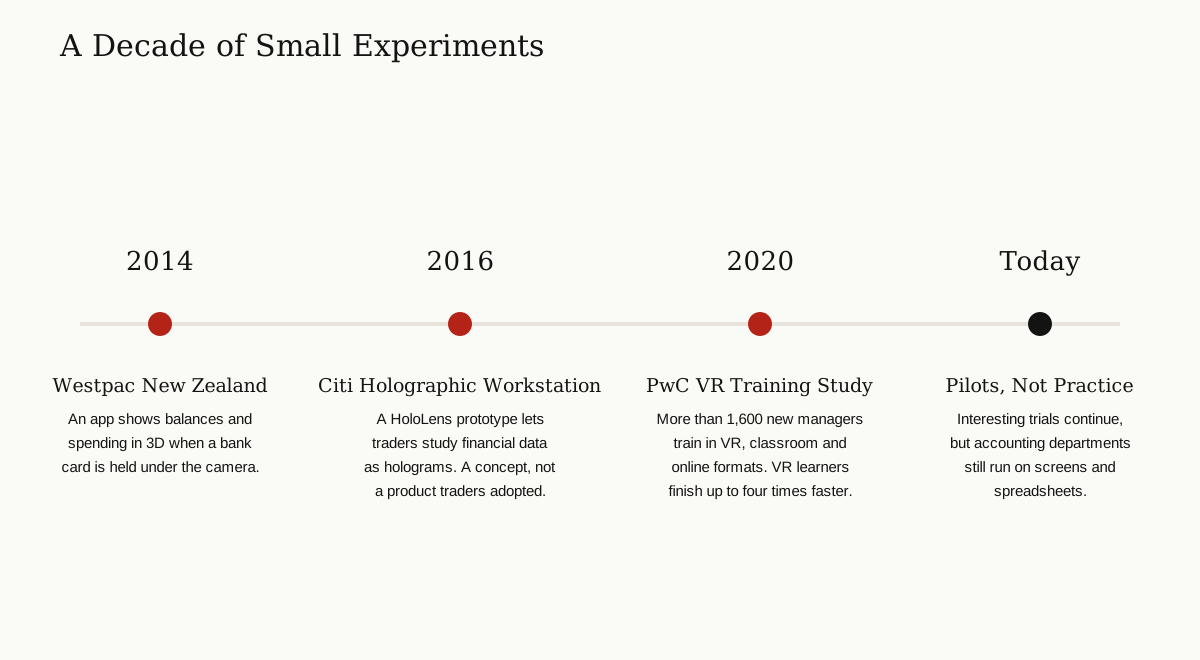
Look at the pattern of the last decade and a clear picture forms: one experiment every few years, lots of press coverage, and then everyday work continues on ordinary screens. With that honesty in place, here are the four uses that keep being tested.
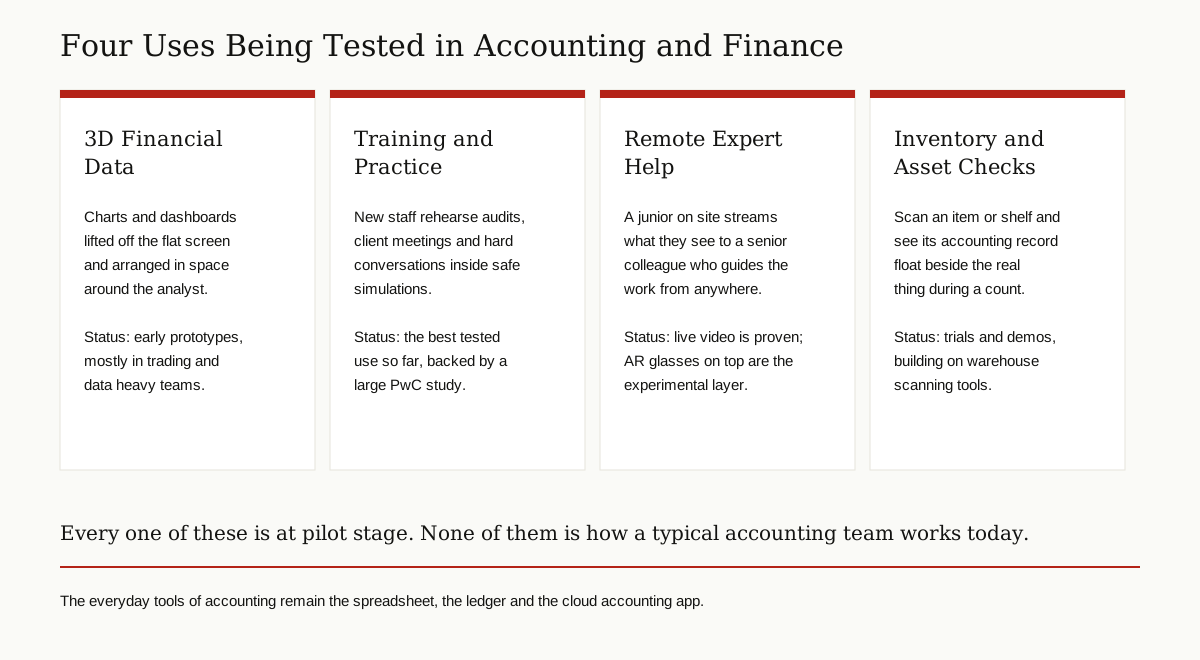
Use One: Seeing Financial Data in Three Dimensions
Accountants and finance analysts work with tables. Traders, who handle even more data at even higher speed, were the first to test what happens when those tables become objects in space. In 2016, the design studio 8ninths demonstrated a prototype built with Citigroup and shown at a Microsoft conference: a Holographic Workstation that used a HoloLens headset to arrange financial data in three tiers around the trader. Market conditions floated at the top as holographic spheres, like a weather system. The trader could use hand gestures and voice to dig into market segments, and study performance on a holographic stage before making a trade. Trade press described the workstation in detail at the time.

It is a striking idea, and an instructive one. It was a proof of concept, built to explore, and traders did not adopt it as their daily desk. For accounting, the lesson is modest: a budget review or a cash flow analysis could one day be a dashboard you walk around, with problem areas rising up in red. Today, that remains a demo, not a product accountants buy.
There is also a hardware lesson in the story. Headset models change every few years, and the device in that 2016 demo has long since been replaced by newer hardware. Finance leaders notice things like that. Building a daily process on top of a device that may be replaced or dropped within a few years is a hard sell in a profession that keeps some of its software for decades. Until headsets become a stable, boring product, the way phones did, three dimensional dashboards will stay a conference attraction.
Use Two: Training People Without Real Clients at Risk
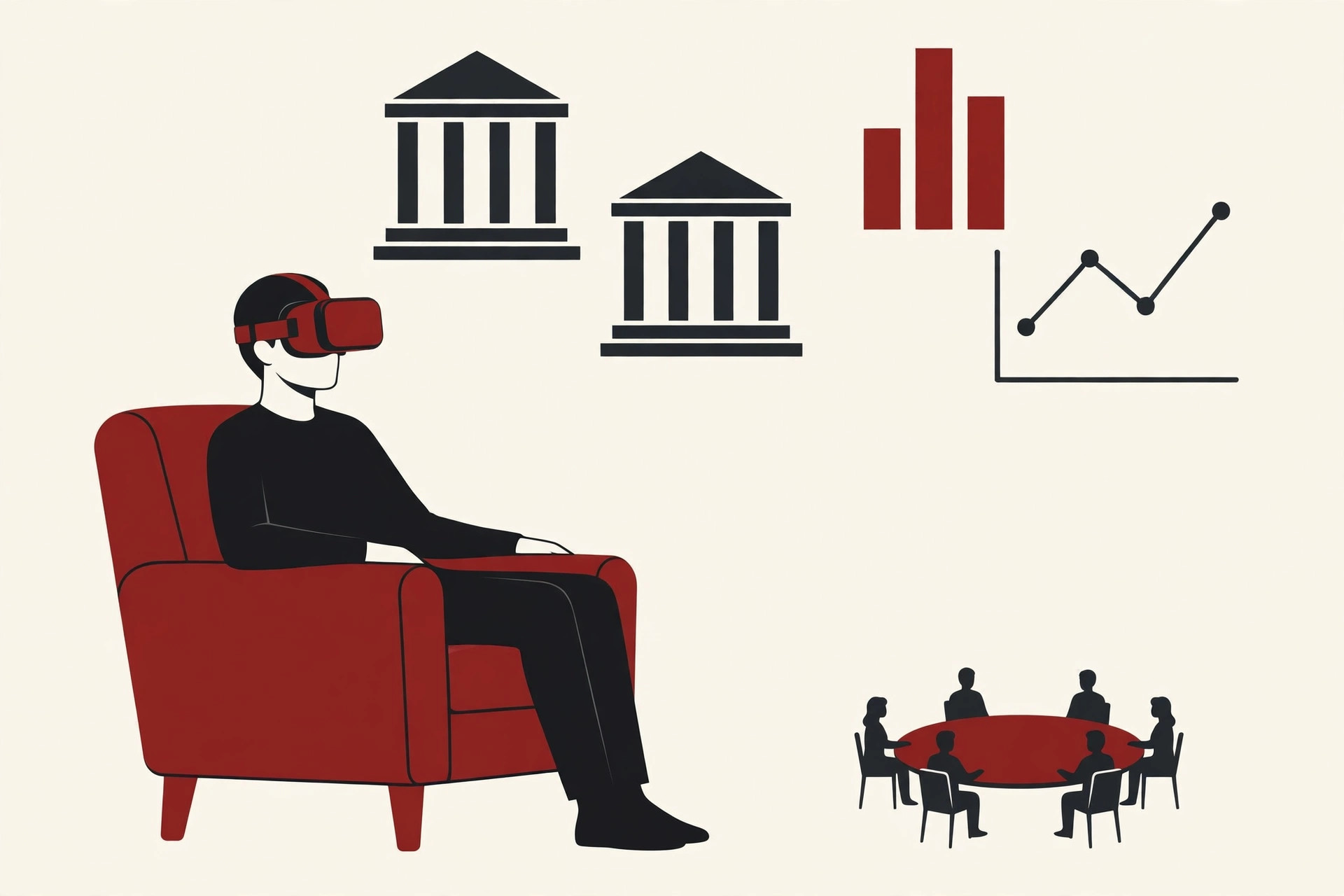
Training is where the evidence is strongest, and the best known experiment comes from inside the profession itself. PwC, one of the largest accounting and professional services firms in the world, ran a large study of VR training and published the results in 2020. More than 1,600 newly promoted managers in 12 locations across the United States took the same course on inclusive leadership, split between a classroom, online learning and VR headsets. The VR group finished on average four times faster than the classroom group. What took two hours in a classroom took about 30 minutes in VR. The VR learners also reported feeling much more confident about acting on what they had learned, and the costs evened out once a few hundred people had been trained, because building VR content costs more up front but each session then runs cheaply.
Two careful notes matter here. The course was about leadership conversations, not tax rules. And the win was in learning speed and confidence, not in accounting accuracy. Still, the transfer to accounting training is easy to picture: a junior auditor could rehearse a difficult client interview, practice a stock count, or walk through a fraud scenario inside a simulation, making every beginner mistake safely before a real client is involved. ACCA research on technology in accountancy education points the same way: about half of the educators and learners surveyed said they had tried augmented or virtual reality for learning, most often for practice tasks and simulations.
Use Three: A Senior Expert in Your Glasses
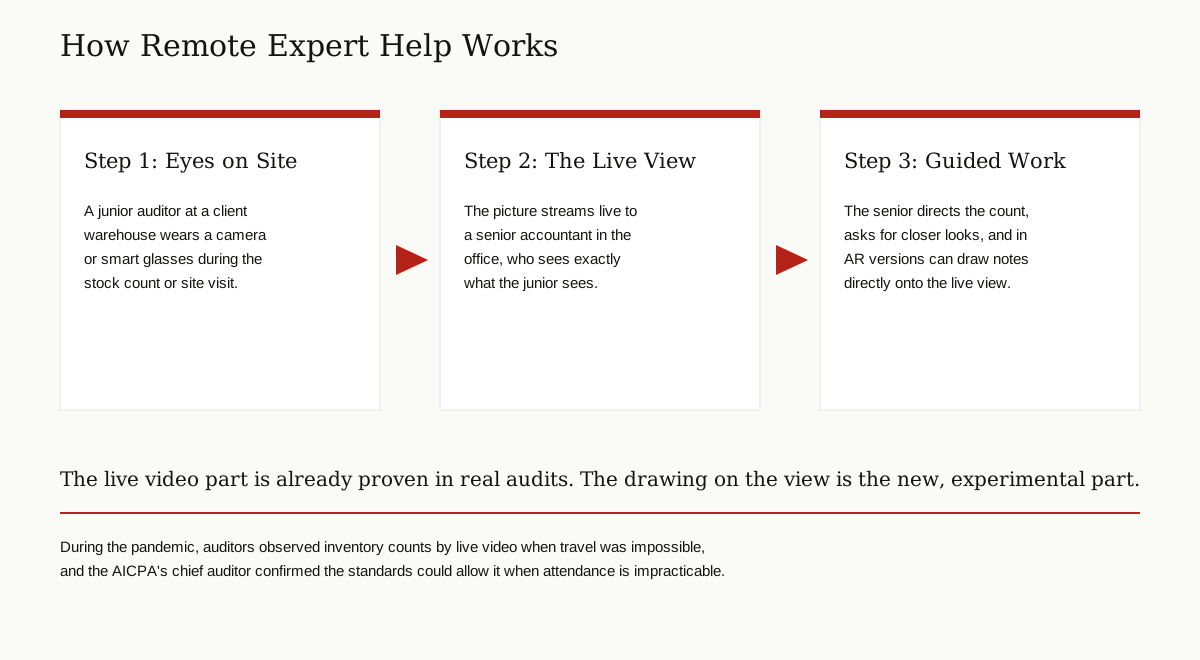
Audits and finance work often happen in two places at once. The junior is at the client warehouse, factory or shop. The senior expert is back at the office. The idea behind remote expert help is simple: the person on site wears a camera, or smart glasses, and streams what they see. The senior watches the same view live, talks them through it, and in AR versions can draw a circle or note directly onto the picture the junior is looking at.
Part of this is already proven practice, and it did not start with AR. During the pandemic, when travel to client sites was impossible, auditors observed inventory counts through live video feeds. The AICPA’s Journal of Accountancy reported on the practice, and the AICPA’s chief auditor at the time, Bob Dohrer, explained that observing inventory without being on site could fit United States auditing standards when attending in person is impracticable. Accounting press from before the pandemic also described firms flying drones over stockpiles to help count them. The camera part, in other words, works and is accepted. The AR layer on top, glasses that also float the inventory record, the last count and the senior’s notes beside the real shelf, is the part still being tested.
Use Four: Scanning Shelves, Machines and Files
A close cousin of remote help is the guided check. An auditor or finance officer walks a warehouse or an office, scans a box, a machine or a vehicle with a phone or headset, and the system shows the record that belongs to it: what the books say it is, when it was bought, what it was worth at the last count. Mismatches get flagged on the spot instead of in a spreadsheet a week later. This leans on the same camera smarts covered in our guide to computer vision applications, and similar scanning is already normal in warehouse logistics. In accounting, though, treat it as trials and demonstrations. It shows up in conference demos and pilot projects far more often than in signed off audit plans.
The same idea fits the fixed asset check, the routine job of walking a site to confirm that the machines, vehicles and computers listed in the asset register are really there and in the condition the books assume. An overlay showing the register entry beside the real machine would make that walk faster and the gaps harder to miss. It is one of the most sensible fits in this whole article, and even this one lives mostly on paper and in pilot projects so far.
The Finance Side: AR in Banking and Payments
The closest thing to a real consumer launch came from banking, and it is older than most people expect. In 2014, Westpac New Zealand released an app that its makers described as a first for account management. Hold your bank card under the phone camera, and the app showed your balance, your last five transactions and your spending sorted into categories as 3D charts. It flagged when a payment was due, let you pay on the spot, and helped you find the nearest branch or cash machine. The same bank also trialled showing account balances on Google Glass, the early smart glasses.
Notice what made the banking experiments different from the accounting ones: they ran on phones that customers already owned. No headset purchase, no training course, no change to anyone’s daily routine. That is a large part of why banking got a real product out of the door in 2014, while accounting, where the interesting uses mostly need glasses or headsets worn by staff, is still at the trial stage.
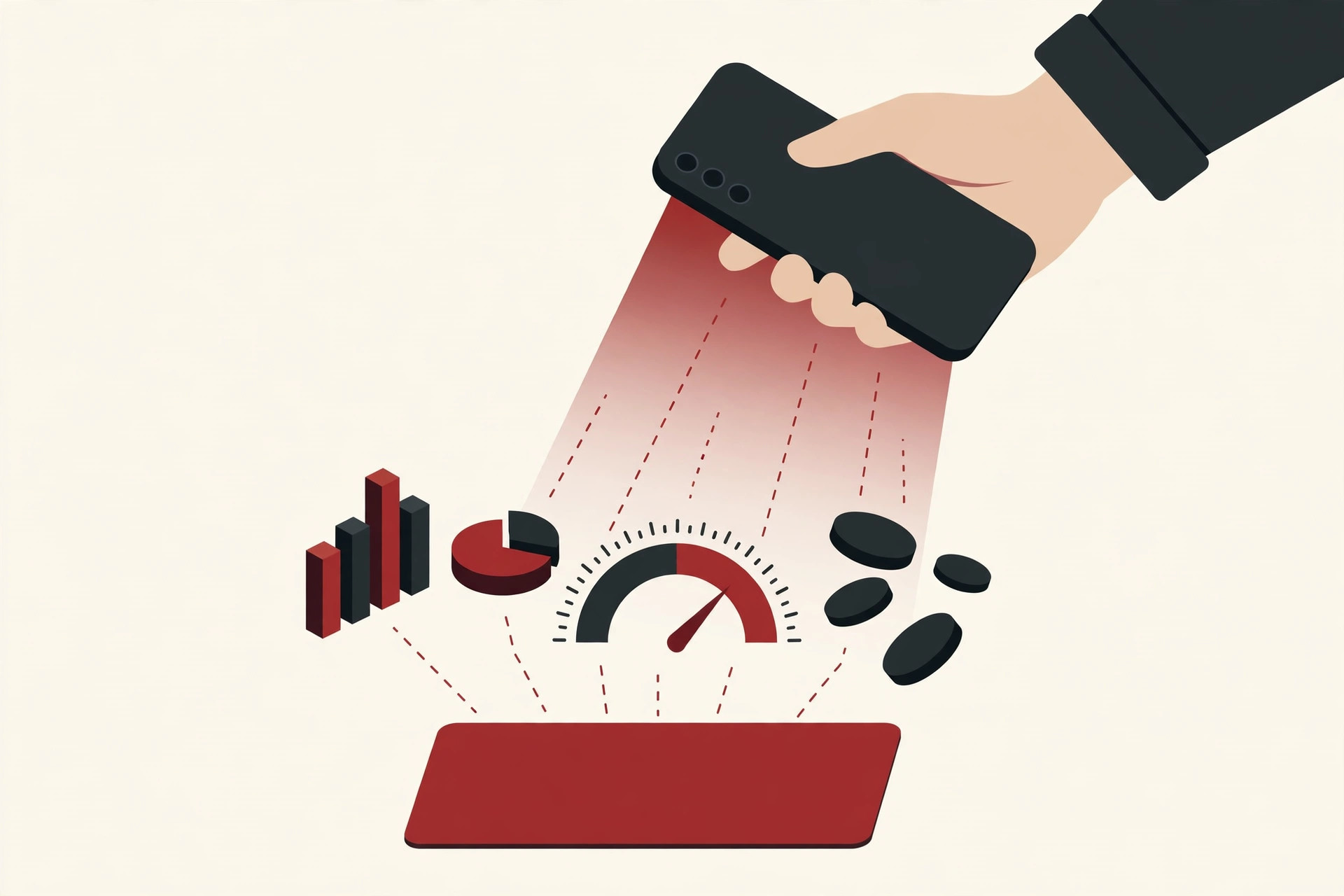
That one app quietly contains most of the AR in banking story. The branch and cash machine finder, where you hold up your phone and see markers over the street in front of you, became the most common banking use of AR, offered by many banks in the years after. Augmented reality payments stayed at the concept stage: point the camera at a bill, a product or a code, see the amount and details confirmed in front of you, then approve. And virtual reality banking went the way of trials too, with banks testing virtual branches and meetings with advisers inside VR spaces. Enjoyable demos, decent press, and no sign that customers preferred them to a normal app.

Why Most Firms Are Still Waiting
Four barriers explain the slow pace, and none of them is a lack of imagination.
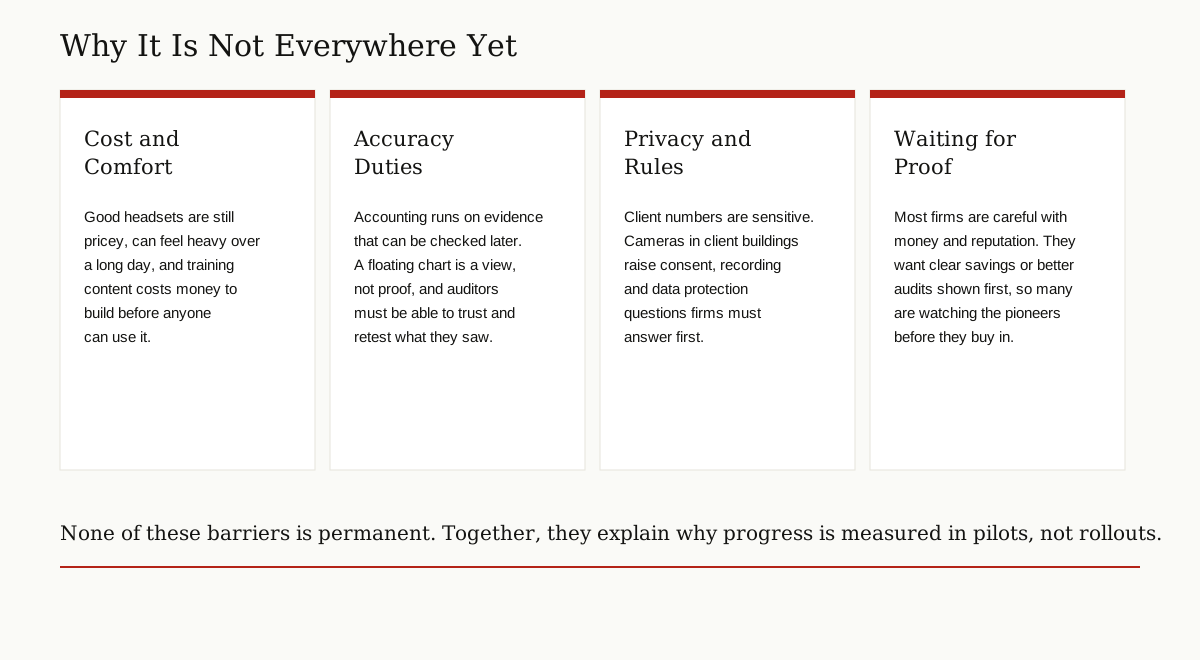
- Cost and comfort. Capable headsets are not cheap, wearing one for hours is tiring, and as the PwC study found, immersive training content costs more to build than a classroom course. The maths only works at scale.
- Accuracy duties. Accounting is a profession built on evidence. A chart floating in the air is a view of the numbers, not proof of them. Any tool that touches audit work has to produce records that can be checked, stored and retested.
- Privacy and regulation. Client financial data is sensitive, and cameras in client buildings raise real questions about consent, recording and data protection. Firms have to answer those before the glasses come out, not after.
- Waiting for proof. Most firms are careful buyers. They want a clear saving or a clearly better audit before spending, so many are happy to let the pioneers pay for the experiments.
The Fair Verdict
Augmented reality in accounting is real, but it is real in the way prototypes are real. The ideas are being tested by serious organizations, the training evidence from PwC is genuinely encouraging, and the remote help pattern has already proven itself in plain video form. What has not happened, anywhere, is the everyday adoption the hype suggests.
If the technology does spread, expect the order to be training first, remote expert help second, and data dashboards a distant third. Expect it to arrive quietly, inside software firms already use, rather than as a dramatic headset launch. And expect the spreadsheet to survive all of it. The likeliest future is not accountants replaced by holograms. It is accountants using one more viewing tool, occasionally, for the few jobs where seeing beats reading.
For individual accountants, the practical advice is dull but useful. Do not buy a headset for work yet. Do watch what your existing software providers ship, because the first AR feature you actually use will probably arrive as a small extra inside a tool you already pay for, most likely in a training course or in a mobile app for stock counts and site visits.
For more guides like this one, browse the emerging tech category.