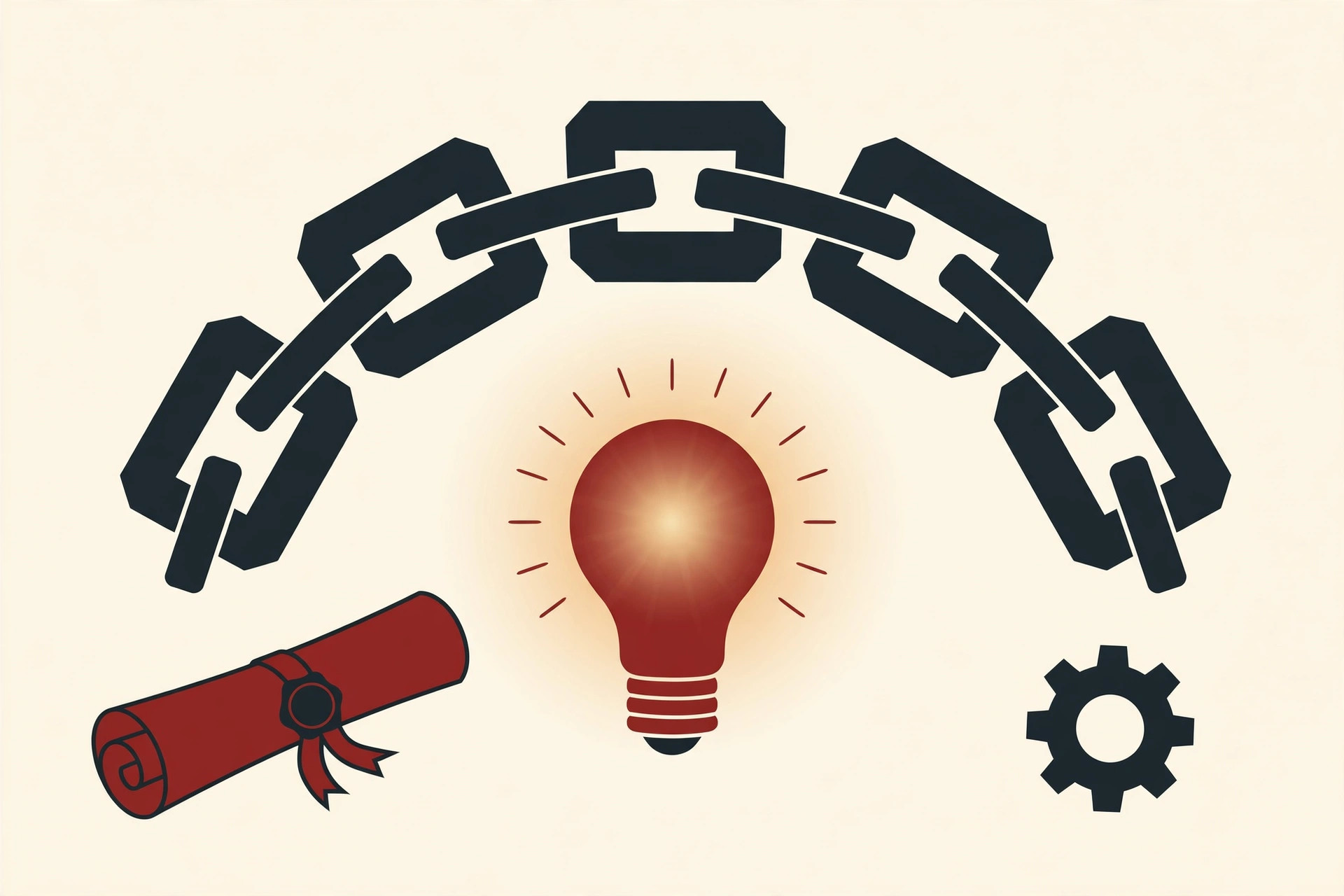
Two designers argue over the same logo. A songwriter hears her melody in an advert she never approved. A small company finds cheap copies of its product selling online under its own brand name.
Most intellectual property fights come down to two simple questions. Who had this first? And who owns it now?
That is why blockchain in intellectual property gets so much attention. A blockchain promises a shared record of dates and ownership that nobody can quietly rewrite later. Some of that promise is real, and IP offices in Europe are already using the technology. Some of it is hype, and one famous misunderstanding about NFTs has cost buyers real money.
This guide walks through the real uses first, then the limits, in plain English.
Blockchain in One Minute
A blockchain is a notebook that many computers keep copies of at the same time. When someone adds an entry, it is grouped with other entries into a block. Each block is locked to the block before it with math, forming a chain. If anyone later tries to change an old entry, the chain no longer fits together, and the change is easy to spot.
That is why people call a blockchain tamper-evident. It does not make cheating impossible in theory, but it makes quiet cheating very hard to hide.
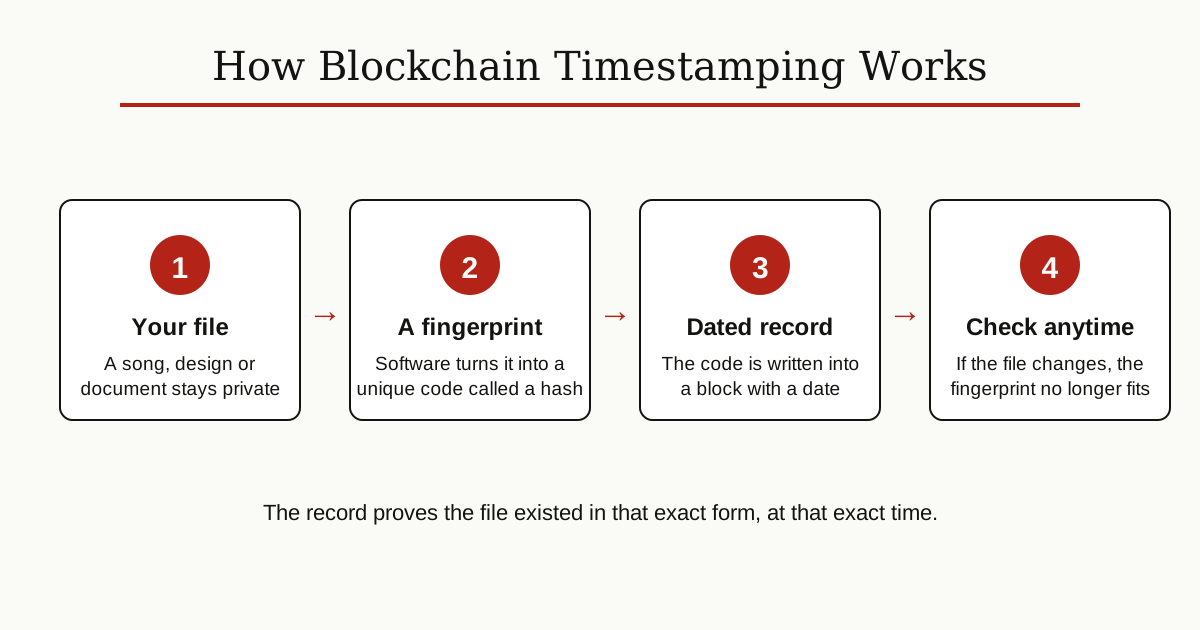
One more idea matters for everything below. A blockchain usually does not store your actual file. It stores a hash, which is a short code made from the file, like a fingerprint. Change even one letter in the file and the fingerprint changes completely. The file itself stays private on your own computer.
Why IP Runs on Dates and Records
Intellectual property is the law that protects creations of the mind: songs, books, software, logos, designs and inventions. Lawyers group it into a few big families, mainly copyright, trademarks, designs and patents.
Almost every right in those families depends on records. Copyright arguments often turn on when a work was created. Trademark arguments turn on who used a name first. Patent arguments turn on who invented something first and what was already known.
Paper records, email trails and office registers do this job today, but they can be slow, scattered across countries, or hard to trust. A shared ledger that every office and owner can read is an attractive fix, which is why blockchain intellectual property protection has moved from conference talk to real projects.
Use 1: Timestamping, or Proving a File Existed
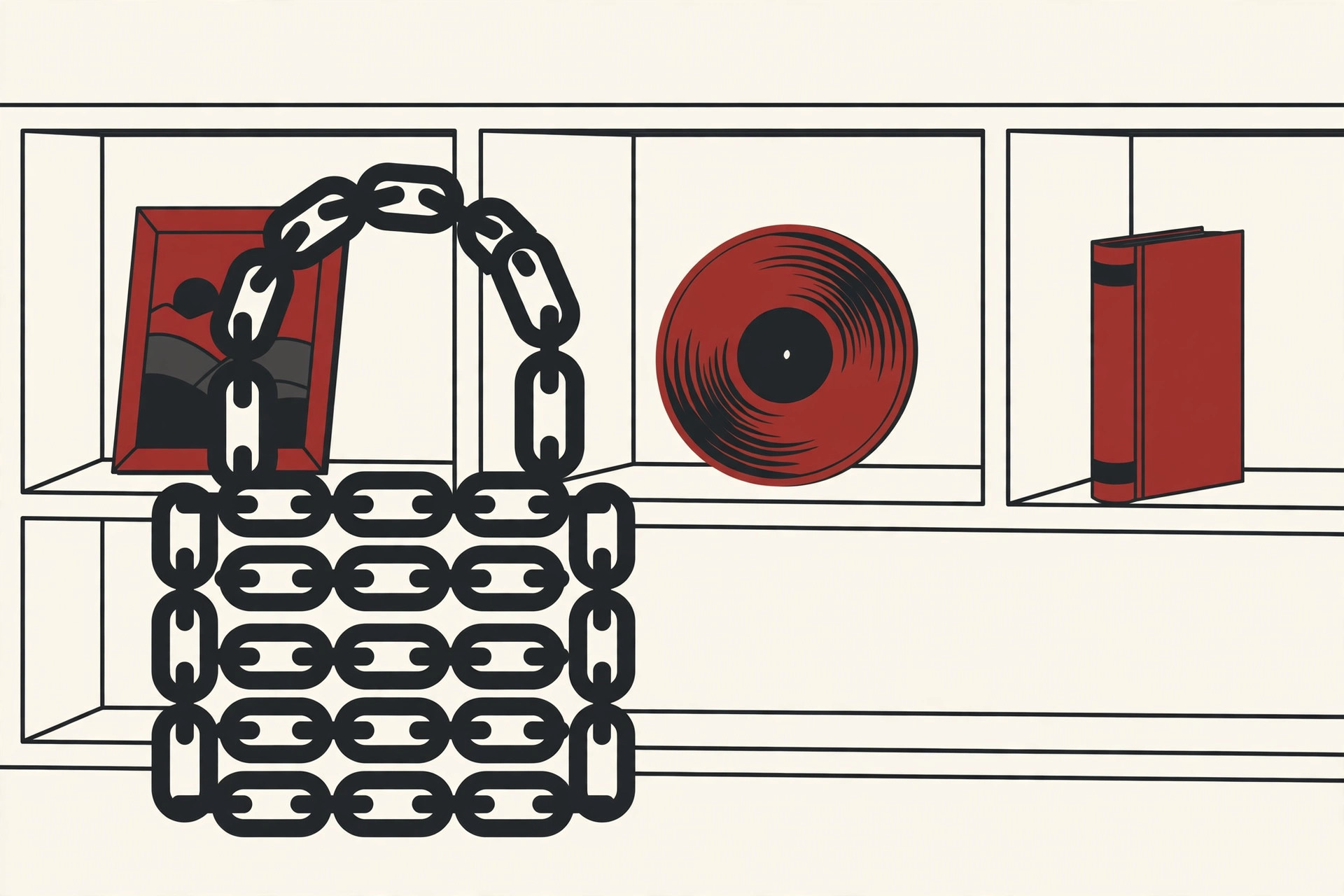
The simplest and most honest use is timestamping. A creator runs a file through fingerprint software, and the fingerprint is written into a blockchain with a date and time attached. Months or years later, the creator can show the original file, prove its fingerprint matches the dated record, and demonstrate that the work existed in that exact form on that date.
This helps most where there is no official register at all. Copyright, for example, begins the moment you create a work in most countries. Nobody stamps it for you. Your own dated evidence may be the best proof you ever get.
The idea is respectable enough that the World Intellectual Property Organization, known as WIPO, tried a version of it. In May 2020, WIPO launched WIPO PROOF, a service that gave any file a dated digital fingerprint, stored by WIPO itself. Strictly speaking, it was not a blockchain. WIPO acted as the trusted referee instead of a public chain.
Then comes the honest part of the story. WIPO member states decided to shut the service down, and in its notice ending WIPO PROOF, WIPO said token creation would stop on February 1, 2022, while existing tokens would keep support for five more years. The market had filled with private timestamp tools, and the official experiment was no longer needed. Private services still offer blockchain timestamps today, but the lesson stands: even the world’s IP organization treats this as a useful extra, not a revolution.
Use 2: One Shared Record of Who Owns What
Ask a music company who owns a popular song and the answer can be surprisingly messy. A song might have several writers, a singer, a producer and a publisher, each owning a share. Records of those shares live in different offices and old contracts, and they often disagree. When the records are wrong, royalties go to the wrong people or to nobody at all.
A shared ledger attacks that problem directly. If every owner and every share is written into one record that all sides can see and nobody can secretly edit, there is one version of the truth to argue from. The same idea works for photo libraries, design files and software, anywhere that ownership questions start with “whose is this, exactly?”
On top of shared records sit smart contracts. A smart contract is a small program stored on a blockchain that runs by itself when conditions are met. Think of a vending machine for payments. When a song is streamed or a photo is licensed, the contract can split the money between the writer, the singer and the label at once, following the shares written into it. No office clerk, no waiting, and the same rule applies every time.
Smart contracts cannot fix bad data, though. If the shares written into the contract are wrong, the machine will pay the wrong people very efficiently. That theme returns in the limits section below.
Use 3: IP Offices Are Testing It for Real
The strongest proof that this is more than hype comes from an official register in Europe. In April 2021, the European Union Intellectual Property Office, the EUIPO, launched the first European IP register on a blockchain. Its first block was created on April 17, 2021, and the system now carries trademark and design records shared between the EUIPO and national IP offices. The two big European search tools, TMview and DesignView, are connected to it, and Malta was the first national office to join the network, in July 2021. The law firm Clifford Chance documented the launch in detail at the time.
A WIPO Magazine article explains why offices care: blockchain records could make registering designs and trademarks faster, cheaper and more secure, and could hold evidence of how a trademark has actually been used. WIPO has also published a white paper on blockchain in IP ecosystems and runs a task force where IP offices work on shared standards, because a ledger only helps if everyone writes to it in the same way.
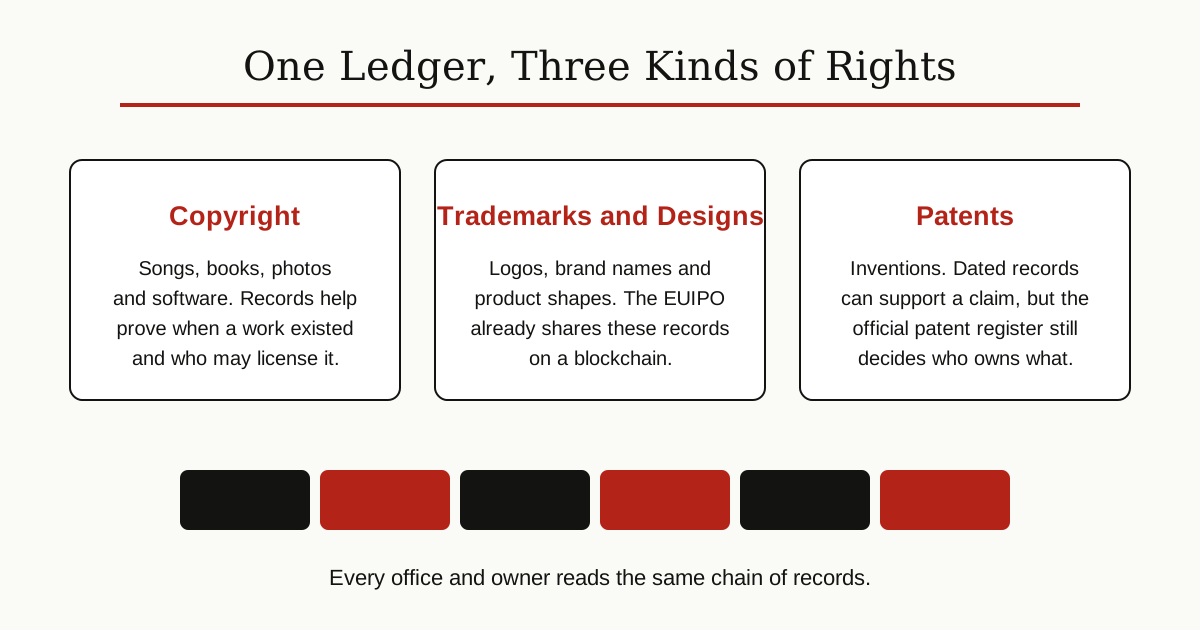
Notice what the EUIPO system is and is not. It is a shared pipe for records that offices already hold, so they can trust the data they exchange. It did not replace the official register, and it did not move the law onto a blockchain. The register is still the law. The blockchain is the delivery truck, not the courthouse.
Patents and Trademarks: Where It Gets Complicated
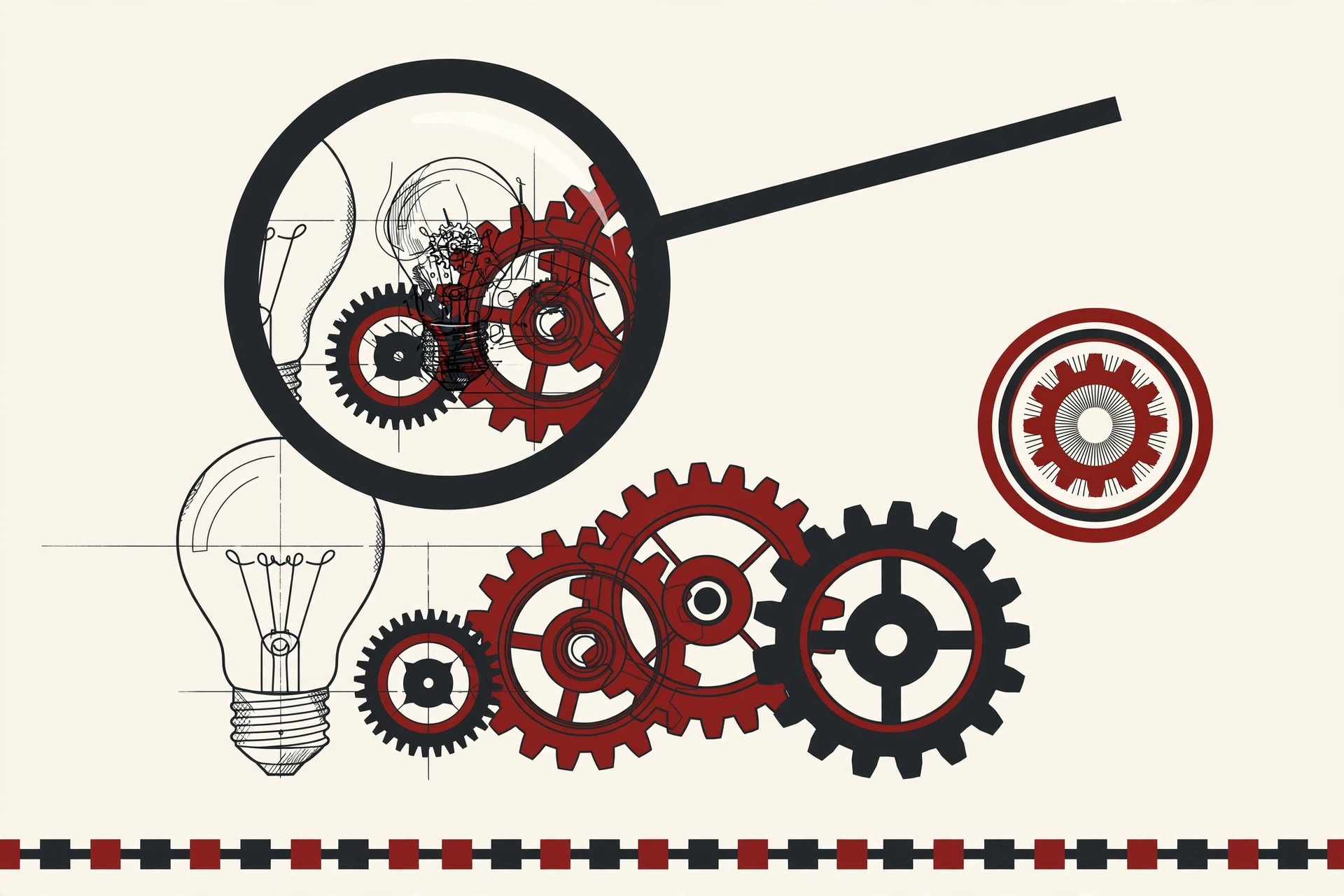
With patents, the relationship runs in both directions. On one side, dated blockchain records can support an inventor’s story about when work was done. On the other side, a large share of blockchain patents are patents about blockchain itself: companies have filed thousands of applications for inventions built on ledgers. That flood creates its own problems. Patent offices judge new ideas against earlier inventions, called prior art, and blockchain ideas are often described in shifting, confusing language, which makes those searches harder and disputes more likely.
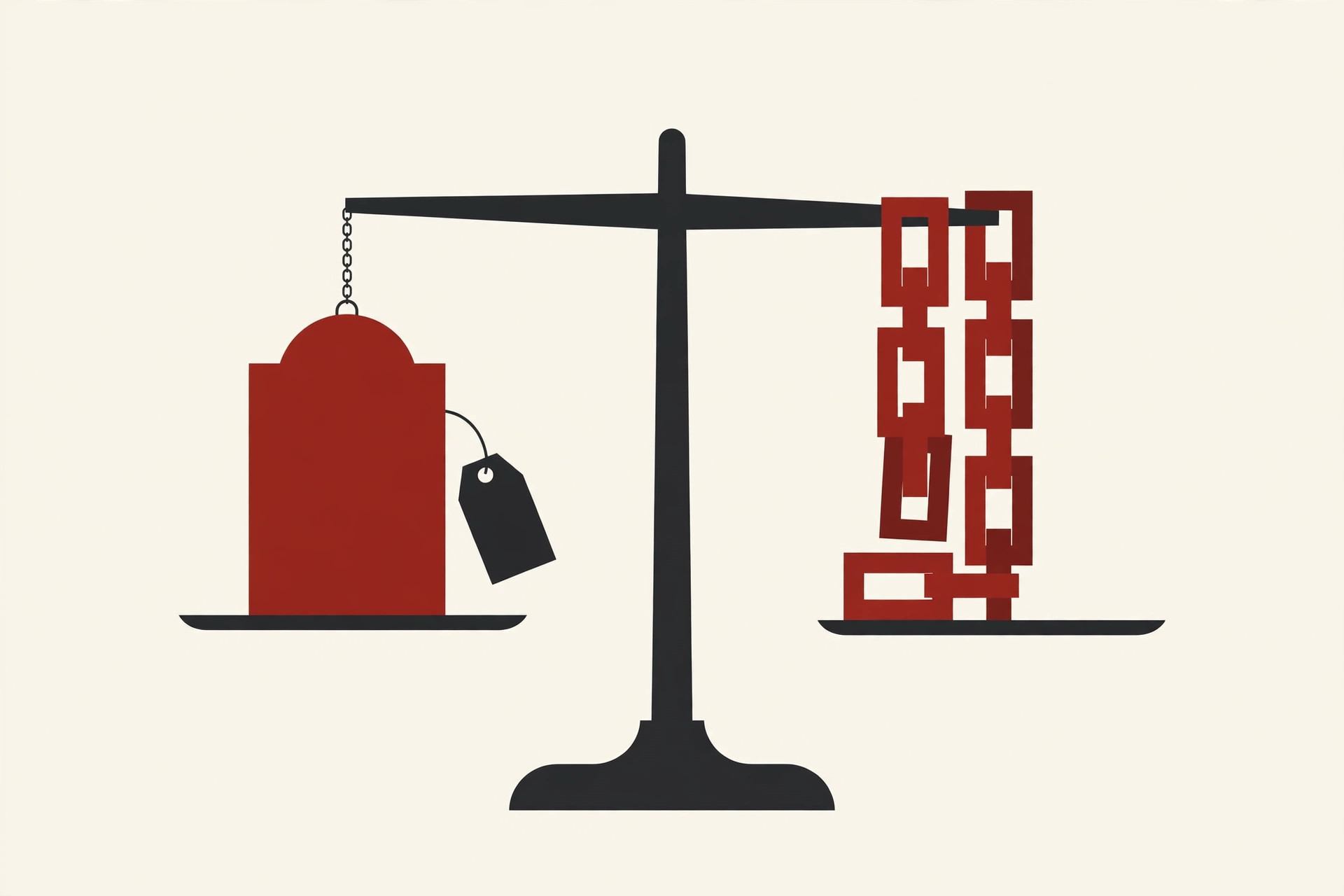
Trademarks have a different knot. Owning a mark is not only about registering it. Owners may need to show they have genuinely used the mark in business, and collecting that proof years later can be slow and expensive. A dated ledger of first use, product launches and sales could make that evidence far easier to present. But there is a catch that shows up in many blockchain patent and trademark issues: rights change hands in the real world. If a trademark is sold with a paper contract and nobody updates the ledger, the beautiful shared record is simply out of date, and the wrong person looks like the owner.
Use 4: Fighting Fakes
Counterfeiting is where IP meets the physical world, and blockchain records can help there too. The pattern works like this. A brand gives each product, or each batch, a digital token and a code on the packaging. Every step of the journey, factory, shipper, warehouse and shop, is added to the record. A buyer, or a customs officer, scans the code and checks the history. A genuine product has a full journey behind it. A fake usually has a copied code and no matching history.
It is the same trick used by many connected products in our internet of things examples, where tags and chips link physical things to digital records. The EUIPO has pushed this idea through its Anti-Counterfeiting Blockathon Forum, which brought experts together to design blockchain tools against fakes, and it has published terms for a system built on the European Blockchain Services Infrastructure, where rights holders can hold digital credentials for their marks in an IP wallet and share proof of authenticity with partners and customs.
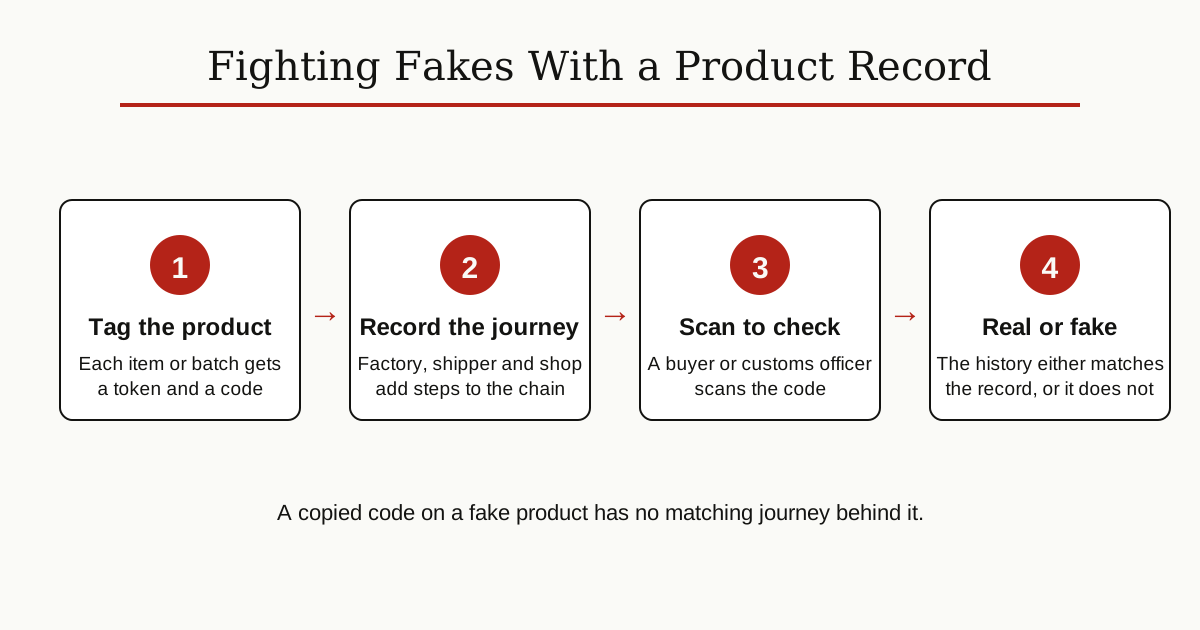
Honest limit, stated early because it matters: the record proves things about the code, not about the object in your hand. If a counterfeiter copies a real code onto a thousand fake bags, the scan alone cannot tell them apart. The technology helps enforcement teams spot patterns and prove cases. It does not make fakes impossible.
NFTs: The Most Misunderstood Corner
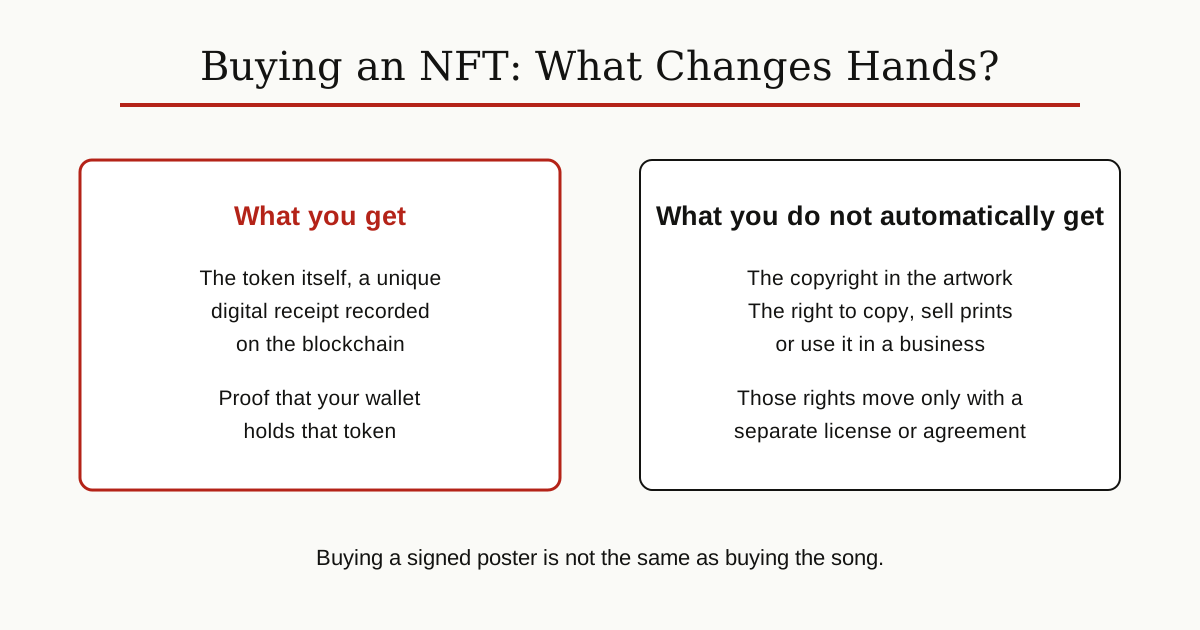
No guide to this topic is complete without clearing up NFTs, because the misunderstanding is expensive. An NFT, short for non-fungible token, is a unique token recorded on a blockchain, usually pointing at a piece of digital art, music or a collectible.
Here is the part many buyers got wrong. Buying an NFT does not, by itself, give you the copyright in the artwork. What you buy is the token, closer to a signed receipt than to the work itself. The copyright normally stays with the creator. You cannot legally print the art on shirts, use it in your business, or stop others from viewing it, unless a separate license or agreement that comes with the token says you can. Some projects do grant wide rights. Many grant almost none. The token never decides this; the terms do.
The same confusion follows digital goods into virtual worlds, as our explainer on what is the metaverse shows: owning a token that points at an item is one thing, and owning the legal rights in the underlying creation is another. Read the license before you read the price.
The Limits: What a Ledger Cannot Do
Balanced guides owe you this section, and this topic needs it more than most.
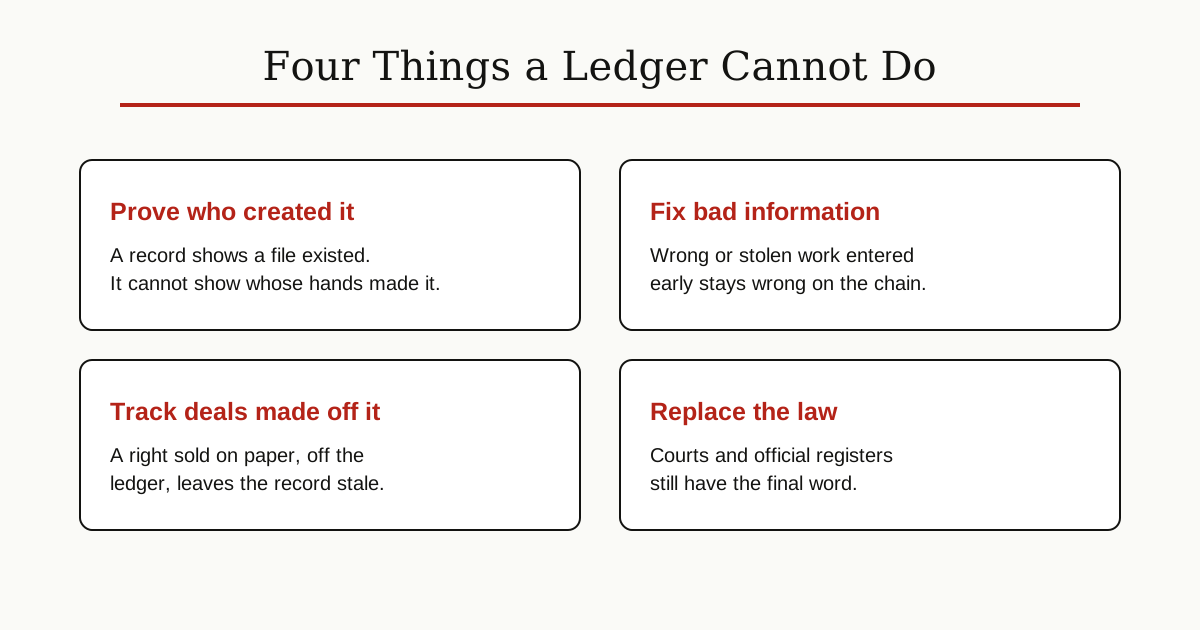
A timestamp proves existence, not authorship. The record shows a file existed at a time, in a form, held by someone. It cannot show that the person who recorded it created it. A thief who steals an unpublished manuscript could timestamp it before the real author does. Courts know this, which is why blockchain records support a case instead of settling it.
Garbage in, garbage out. A blockchain protects whatever was written into it, true or false. Wrong owner names, wrong shares and stolen work all become very durable once recorded. Keeping records accurate is a human discipline, the same one behind good compliance monitoring, and no chain can do it for you.
The real world keeps moving off the chain. Rights are sold, companies merge, licenses expire, often on paper. Every off-ledger deal makes the ledger a little more stale, unless someone does the unglamorous work of updating it.
Law still differs by country. What counts as strong evidence in one court may carry little weight in another, and the rules for digital records are still developing. The official registers remain the source of truth for patents and trademarks, and the experts at WIPO itself say common international standards would be needed before blockchain takes a bigger role.
The Bottom Line
Blockchain in intellectual property is neither magic nor a scam. It is a very good notebook. Used well, it gives creators dated proof that a work existed, gives industries one shared record of who owns what, helps IP offices exchange records they can trust, and gives enforcement teams new tools against fakes. The EUIPO register and the short life of WIPO PROOF show both sides of the story: real institutions are building with it, carefully, and real institutions also walk away when a tool stops earning its place.
What a blockchain cannot do is decide who truly created something, fix false information, or replace the official registers and courts that give IP rights their force. Treat it as strong supporting evidence and good plumbing for records, and it earns its place. Treat it as a replacement for the law, and it will disappoint you.
This article is general information, not legal advice. For a real dispute or a valuable right, talk to a qualified IP lawyer in your country.
Keep exploring with our other emerging tech guides, where we break down new technology in the same plain English, one honest claim at a time.