Search for Kendrick Lamar AI and you will find songs, clips and heated arguments. Some of them sound a lot like Kendrick Lamar. Almost none of them are really him.
Here is the short, honest answer. Kendrick Lamar has not released an AI song. What happened is stranger: during his huge 2024 feud with Drake, other people used AI voice clones around him. A fan fooled thousands of listeners with a fake Kendrick track, and Drake himself used AI voices of two other rappers to taunt him. This guide walks through the verified facts, explains how these clones are made, and shows you how to spot a fake.
What Actually Happened: The Fake Kendrick Songs
The leaked diss that was never real
In April 2024, the feud between Drake and Kendrick Lamar was at full heat. Drake had released his diss track Push Ups, and fans were waiting for Kendrick to answer. Then a short track, known as One Shot, started spreading online as Kendrick’s leaked response.
It sounded close enough to fool a lot of people. But people near Kendrick pushed back fast. Battle rapper Daylyt, an associate of Lamar, posted that the track was, in his words, 10000 percent AI. Days later, a TikTok creator named SyTheRapper took credit and posted a video showing exactly how he made it. According to NME’s report on the fake track, he wrote the lyrics himself, recorded them in his own voice, and used AI to rebuild the recording as an AI Kendrick Lamar voice clone. He said he expected listeners to spot the fake at once, but many people believed it was real.
That is the core of the Kendrick Lamar AI story. The most famous kendrick lamar ai song was not made by Kendrick, his label or his team. It was made by one creator with a laptop, during the loudest week of the feud.
When Drake used AI voices against Kendrick
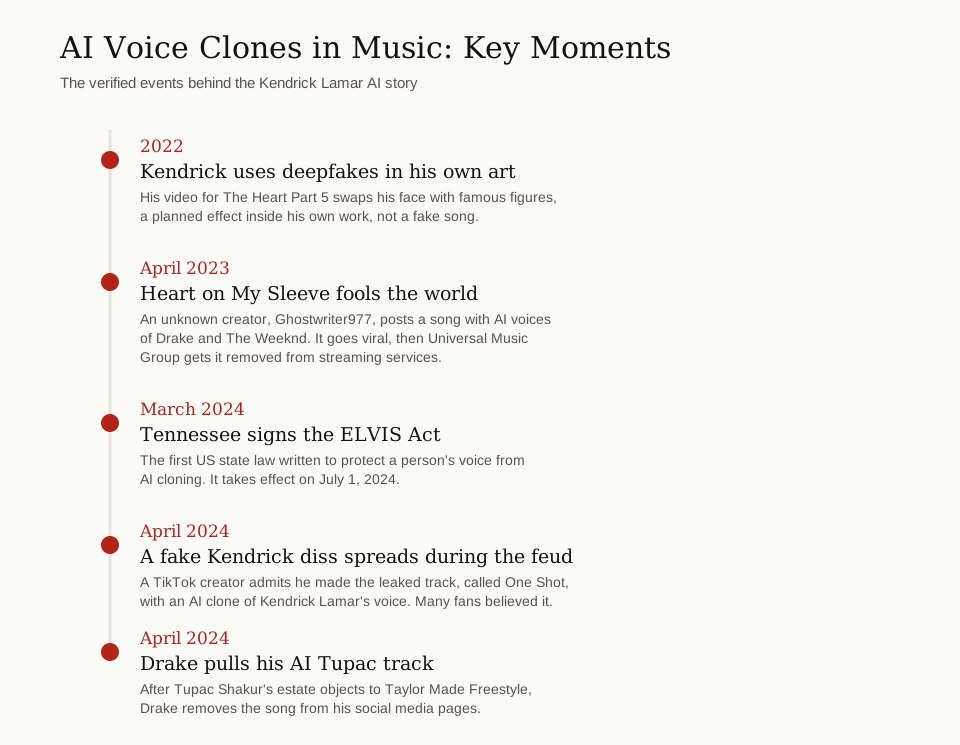
The clones did not only come from fans. On April 19, 2024, Drake posted a diss track called Taylor Made Freestyle on social media. It featured AI generated verses in the voices of Tupac Shakur and Snoop Dogg, two West Coast legends, both aimed at Kendrick Lamar.
The reaction was quick. Billboard reported that Howard King, the lawyer for Tupac Shakur’s estate, sent Drake a cease and desist letter. The letter called the track a flagrant violation of Tupac’s publicity and the estate’s legal rights, and a blatant abuse of his legacy. It also said using Tupac’s voice against Kendrick, a friend of the estate, made the insult worse. Drake removed the track from his social media pages on April 26, 2024. It had never been released on streaming services. You can read the full sequence in the timeline of the Drake and Kendrick Lamar feud.
The fake song that started the alarm
One year earlier, the music world had already seen where this was heading. In April 2023, an unknown creator called Ghostwriter977 released Heart on My Sleeve, a song with AI vocals made to sound like Drake and The Weeknd. It was an original song, written by a human, but the voices were clones.
The track went viral, with millions of views across platforms. Universal Music Group, the label behind both real artists, pushed back hard and got it removed from Spotify, Apple Music, YouTube and other services. In its statement, UMG asked whether the industry wanted to be on the side of artists, fans and human creative expression, or on the side of deep fakes, fraud and denying artists their due compensation. The Recording Academy later said the song could not win a Grammy, because the vocals were not legally obtained. The full story is told on the Heart on My Sleeve Wikipedia page.
Kendrick and deepfakes, in his own art
There is one more twist. Kendrick Lamar has used deepfake technology himself, openly, in his own work. In his 2022 video for The Heart Part 5, his face morphs into the faces of other famous Black figures, including Will Smith and Kobe Bryant. As the BBC has explained, the video was directed by Lamar and Dave Free, and the effect was a planned part of the art.
The difference matters. Using the technology on yourself, with a team and a clear idea, is one thing. Copying another person’s voice without asking, and posting it as a leaked song, is something else entirely.
Kendrick Lamar AI Generated Songs: How Voice Clones Are Made
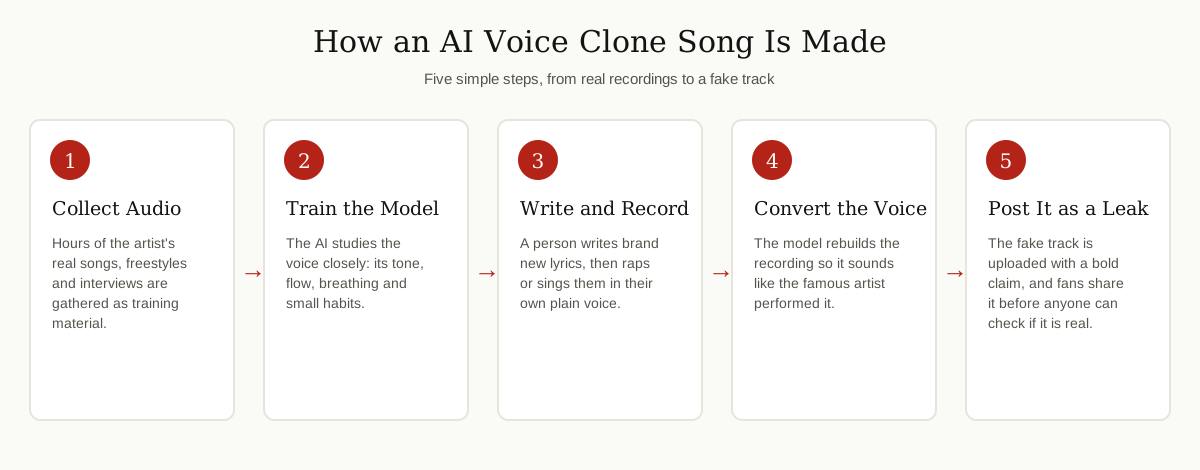
You do not need a studio to make a kendrick lamar ai generated track. The basic process, the same one SyTheRapper showed on TikTok, has five steps.
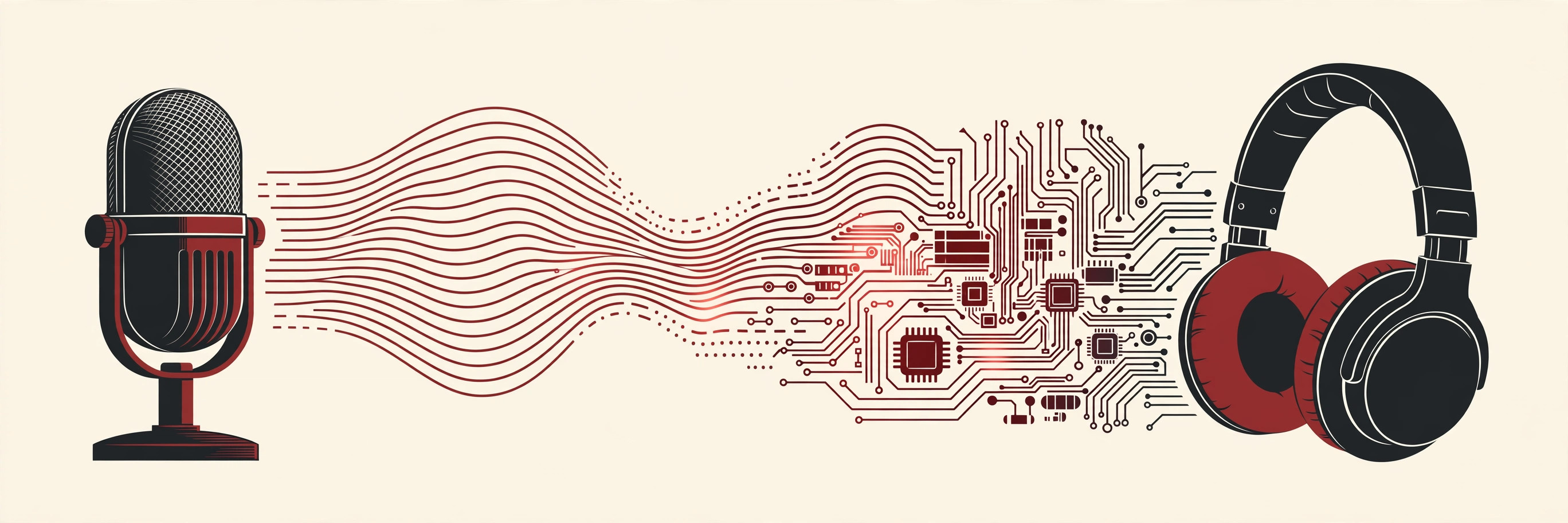
First, the creator collects hours of the artist’s real recordings: songs, freestyles and interviews. Second, an AI model studies that audio and learns the voice, meaning its tone, rhythm, breathing and habits. This is the same kind of pattern learning used in machine learning models across the tech world. Third, the creator writes new lyrics, sometimes with help from the language tools explained in our guide to natural language processing, and records them in their own voice. Fourth, the model converts that recording so it sounds like the artist performed it. Fifth, the track is posted as a leak, with a bold claim attached.
The tools behind this are getting cheaper and easier every year. That is why the number of fake songs keeps growing, and why simply trusting your ears is no longer enough.
Why the Fakes Spread So Fast
Fake songs are built for the way social media works. A few things made the Kendrick Lamar AI fakes travel especially fast:
- Silence creates a vacuum. Kendrick is famously quiet between albums. When fans are desperate for a response, a fake one fills the gap.
- Feuds create hunger. During a rap battle, every snippet feels like breaking news, and nobody wants to be the last to hear it.
- Short clips hide the flaws. A 30 second snippet gives your ear less time to notice the small things that sound wrong.
- Sharing is faster than checking. A striking claim gets reposted in seconds. The fact check arrives hours later, to a smaller crowd.
- Copies survive takedowns. Even after a fake is removed, screen recordings and reuploads keep it alive. Singer Sheryl Crow made this point to the BBC about Drake’s AI Tupac track: even after he took it down, people would still find it.
The result is a strange new problem. During the feud, fans started doubting real tracks too, asking if genuine leaks were AI. Once trust breaks, it breaks for everyone.
How to Spot a Fake Kendrick Lamar Song
You cannot always trust your ears, but you can trust a routine. Run through these checks before you believe, or share, any surprise track.
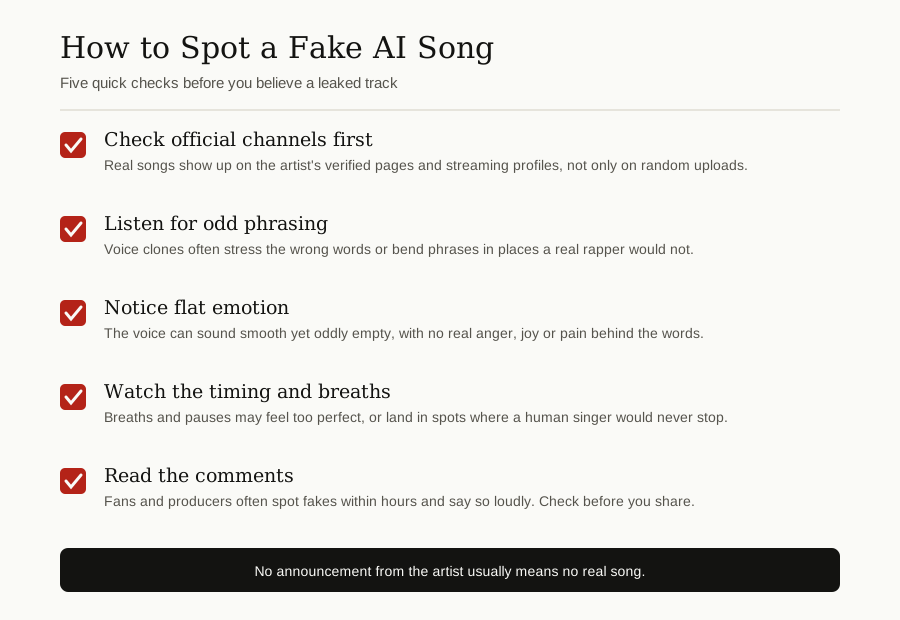
Check the official channels. Real Kendrick Lamar music appears on his verified streaming profiles and is announced by his label and team. A song that exists only as a random social media upload is a red flag.
Listen for odd phrasing. Clones often put stress on the wrong word, or bend a phrase in a way the real artist would not. Kendrick’s delivery is precise, so clumsy moments stand out.
Notice flat emotion. AI voices can sound smooth but strangely empty. A diss track should burn with anger. If the feeling seems painted on, be careful.
Watch the timing. Breaths in clone tracks can feel too clean, or land in places where a real rapper would never stop for air.
Read the comments and the news. Producers and fans often expose fakes within hours, just as Daylyt did with One Shot. A quick search for the track name plus the word fake takes one minute.
What Artists and Labels Are Doing About AI Voices
The response has come from several directions at once:
- Labels use takedowns. UMG got Heart on My Sleeve removed from the big streaming services within days, and labels keep filing removals for clone tracks.
- Estates send legal letters. The Tupac estate’s letter forced Drake to pull Taylor Made Freestyle within a week.
- Platforms add labels. YouTube and TikTok now have rules that require creators to label realistic AI made content, so listeners can see what they are hearing.
- Award rules are tightening. The Recording Academy has said songs with uncleared AI vocals are not eligible for Grammy awards.
- Artists speak out. Many musicians have publicly criticized voice cloning without consent, and fan backlash has been loud as well.
There is also a calmer path. When the Beatles released Now and Then in 2023, AI was used to clean up an old John Lennon demo recording, with the surviving band members and his estate involved. Same family of technology, opposite approach: permission first.
The Law and Your Voice: Rights in Plain Words
This section is general information, not legal advice. But the basic ideas are simple.
Copyright protects creative works: the written song and the actual recording. A clone track with new lyrics may not copy a recording directly, which is why copyright alone has not settled these cases.
The right of publicity is a different idea. Many US states say a person controls the commercial use of their name, likeness and voice. A voice clone is built to trade on exactly that identity.
New laws are arriving. Tennessee passed the ELVIS Act, signed on March 21, 2024 and in force from July 1, 2024. It is widely described as the first US law written specifically to protect voices from AI cloning. It protects a voice even when the sound is a simulation, not the real thing, and it allows lawsuits and even criminal charges for violations. At the national level, US lawmakers have proposed a federal bill called the NO FAKES Act to cover digital replicas, but it has not become law.
The honest summary: the law is catching up, state by state, and the biggest cases so far have been settled by takedowns and legal letters rather than courtrooms.
What This Means for Fans and for Music
The Kendrick Lamar AI saga teaches one big lesson: a voice is no longer proof. For a century, hearing a singer meant the singer was there. That shortcut is gone.
For fans, the fix is boring but strong. Wait for official channels. Check before sharing. Treat every too perfect leak as a claim, not a fact. If you want to dig into how posts, chats and claims live on long after the moment passes, our guide to the AI chatbot conversations archive shows how the internet keeps receipts.
For music, the fight is really about consent and credit. AI voices used with permission can restore old recordings and open new creative doors, as the Beatles example showed. AI voices used without permission turn a person’s identity into raw material. The next few years of law, platform rules and fan habits will decide which version wins.
The Bottom Line
There is no secret Kendrick Lamar AI album and no real leaked AI diss from Kendrick himself. The verified story is this: a TikTok creator fooled fans with a clone during the 2024 feud, Drake used AI voices of Tupac and Snoop Dogg against Kendrick and had to pull the track, and the year before, a fake Drake and Weeknd song forced the whole industry to react. Kendrick’s own use of the technology, deepfake faces in his own video, shows he is not against the tools. Like most artists, the line is about permission.
So the next time a shocking new Kendrick track appears out of nowhere, take one minute, run the checks above, and let the facts catch up with the noise. For more explainers like this, browse our AI, ML and Data Science category.