Two years ago, a humanoid robot was something you watched in a video. It walked, it waved, maybe it did a backflip, and then the video ended. Today, humanoid robotics news tells a different story. Robots with legs and arms are clocking in at warehouses, loading parts at car plants, and taking preorders for home delivery.
This roundup explains what actually happened in 2024 and 2025, company by company, with the hype stripped out. Every milestone below was checked against company announcements and trusted reporting, and every big number is labeled with where it came from. Because in humanoid robots news, the gap between a demo and a real job is the whole story.
What Counts as a Humanoid Robot?
A humanoid robot is a robot shaped like a person: two legs, two arms, and a head-like section that holds cameras and sensors. Not every robot in the news fits this shape. Robot arms bolted to factory floors are not humanoids. Neither are the wheeled boxes rolling around Amazon warehouses.
Why copy the human shape at all? Because the world is already built for it. Warehouses have shelves at human height. Homes have stairs, narrow doors and light switches placed for human hands. A robot built like a person can, in theory, walk into these spaces and work without the building being rebuilt around it. That is the bet behind almost every story in current robotics humanoid news.
The hard part is that the human shape is also the hardest shape to engineer. Two legs are tricky to balance. Hands are incredibly complex. And a robot that falls over near people is not a product, it is a lawsuit. Keep that in mind as we go through the big stories.
The Big Stories, Company by Company
Figure AI: The BMW Test That Turned Heads
Figure AI, based in California, became the face of the humanoid wave. In February 2024, the company raised $675 million from backers including Microsoft, Nvidia and Jeff Bezos, at a valuation of $2.6 billion, according to the company’s announcement. Money like that demands proof, and Figure went looking for it at BMW.
At BMW’s Spartanburg plant in South Carolina, Figure 02 robots spent about 11 months loading sheet metal parts onto welding fixtures. When the test ended, the robots came back scratched and dirty, which the company proudly showed off as proof of real work. BMW and Figure reported that the robots loaded more than 90,000 parts and helped build over 30,000 BMW X3 vehicles. It was one narrow, repetitive job, but it was a real job on a real production line.
Figure then raised the stakes. In September 2025, the company announced a funding round of over $1 billion at a $39 billion valuation. Weeks later, in October 2025, it unveiled Figure 03, a new model designed for both factory work and, one day, the home. You can see the current lineup on the Figure AI website. The honest reading: Figure has the money and one solid factory story, but it has not yet shown robots doing many different jobs well.
Agility Robotics: The First Paid Warehouse Work
If Figure won the headlines, Agility Robotics won the history books. Its robot, Digit, is a tall, thin two-legged machine built for one main job: picking up plastic totes, the bins warehouses use to move goods, and carrying them to conveyor belts.
Amazon started testing Digit in one of its warehouses in October 2023. Then, in June 2024, logistics giant GXO signed a multi-year robots-as-a-service agreement with Agility and put Digit to work at a Spanx warehouse in Georgia. GXO and Agility described it as the first commercial deployment of humanoid robots in the world, and the first deal of its kind. Agility has said Digit moved more than 100,000 totes at that site.
The detail that matters most is the business model. GXO did not buy robots like office furniture. It pays for robot work as a service, closer to hiring staff than buying machines. IEEE Spectrum’s reporting on Digit explains how Agility redesigned the robot around the hard lessons of those first warehouse years: safety, uptime and fixing problems fast. That boring, practical focus is exactly why Digit leads on real deployments.
Boston Dynamics: Atlas Goes Electric, Hyundai Opens Its Doors
Boston Dynamics is the old name in this field. Its hydraulic Atlas robot spent a decade amazing the internet with parkour and dance videos. In April 2024, the company retired that robot and, one day later, unveiled an all-electric Atlas, as TechCrunch reported at the reveal. The new version is quieter, stronger in the ways factories care about, and built for real work instead of research tricks.
The business plan runs through Hyundai, which owns Boston Dynamics. Hyundai announced plans to test Atlas in its own car plants starting in 2025 and to buy Boston Dynamics robots in large numbers over the coming years, with reporting putting the long-term order talk in the tens of thousands of units. If that happens, Atlas skips the hardest step every startup faces: finding a first customer. Its customer is its parent.
Tesla Optimus: The Biggest Promise, the Slowest Start
No company talks bigger about humanoids than Tesla. Elon Musk has said Optimus could one day be Tesla’s biggest product. The record so far is more modest. Musk said in January 2025 that Tesla would build around 10,000 Optimus robots that year, with several thousand doing useful work. Reporting through 2025 told a slower story: production paused for design changes, the robot’s hands proved hard to build at volume, and actual output was reported in the hundreds, not the thousands.
Tesla also had an honesty problem early on. At its October 2024 “We, Robot” event, Optimus robots served drinks and chatted with guests, and reporting later confirmed that humans were remotely helping to operate them. That does not make Optimus fake, but it does mean the videos were not proof of robots thinking for themselves. Optimus remains the project with the biggest factory muscle behind it and the most to prove.
Apptronik: The Quiet Contender
Austin-based Apptronik has been building toward this moment for years, and its robot Apollo is now in serious company pilots. Mercedes-Benz agreed in March 2024 to test Apollo in its factories, a deal that later deepened when Mercedes invested in the company. GXO also ran a pilot with Apollo in its warehouses.
In February 2025, Apptronik raised $350 million in a Series A round led by B Capital and Capital Factory, with Google taking part, according to TechCrunch. The round later grew past $403 million. Apptronik also signed a manufacturing partnership with Jabil, a giant contract manufacturer, which is a practical sign the company plans to build Apollo in real numbers, not one at a time.
Unitree: The Price Shock From China
China’s Unitree took a completely different path: make it cheap and sell it now. In May 2024, Unitree launched the G1, a smaller humanoid with a starting price of about $16,000. That is less than many research labs used to pay for a single robot arm.
The G1 is not a factory worker. It is a research and development platform, and it has spread through universities, labs and demo stages around the world. Its real impact on humanoid robotics news is pressure: when a capable robot body costs $16,000, Western rivals charging many times more have to explain what buyers get for the extra money.
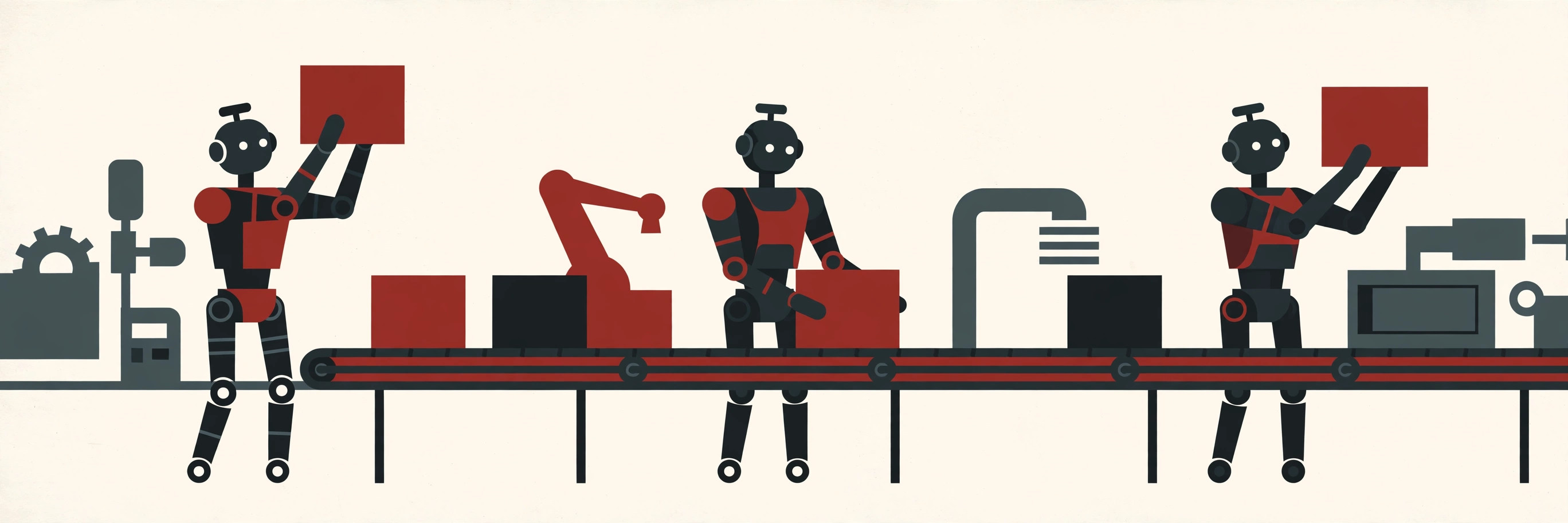
Where Humanoid Robots Actually Work Today
Strip away the announcements and the picture is small but real. Humanoids today do a short list of jobs, in a short list of places.
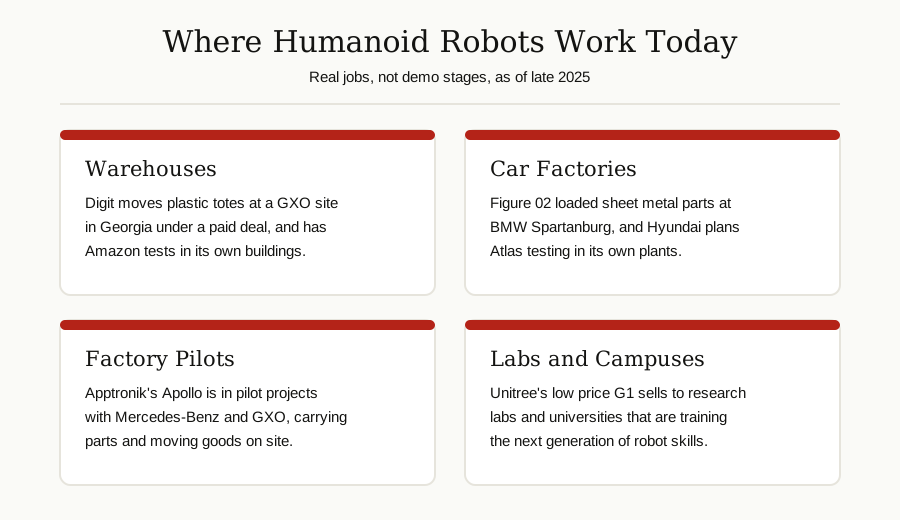
Warehouses lead the list, because the work is repetitive and the buildings are controlled. Car factories come next, with Figure at BMW, Apollo at Mercedes-Benz pilots, and Atlas heading into Hyundai plants. Research labs are the third home, full of Unitree G1 units learning new tricks.
Notice what is missing: hospitals, restaurants, shops and streets. Those places are messy, crowded and unpredictable, and no company has yet put a humanoid to paid work in them for long. When robotics news humanoid today headlines suggest robots are everywhere, remember that “everywhere” so far means a handful of warehouses and car plants.
This is also where better robot brains come in. The same agentic AI systems that let software plan multi-step tasks are being adapted to give robots step-by-step instructions, and computer vision is what lets a robot find the right box on the shelf. The body was the hard problem of the last decade. The brain is the hard problem of this one.
The Home Robot Push: 1X NEO
The boldest story of late 2025 came from 1X, a company backed by the OpenAI Startup Fund and EQT. While rivals chased factories, 1X went straight for the living room. On October 28, 2025, it opened preorders for NEO, a soft-covered home humanoid priced at $20,000, or $499 a month, with the first United States deliveries planned for 2026. The company said its first year of production sold out within days, a claim worth treating as a company claim until the robots are in homes.
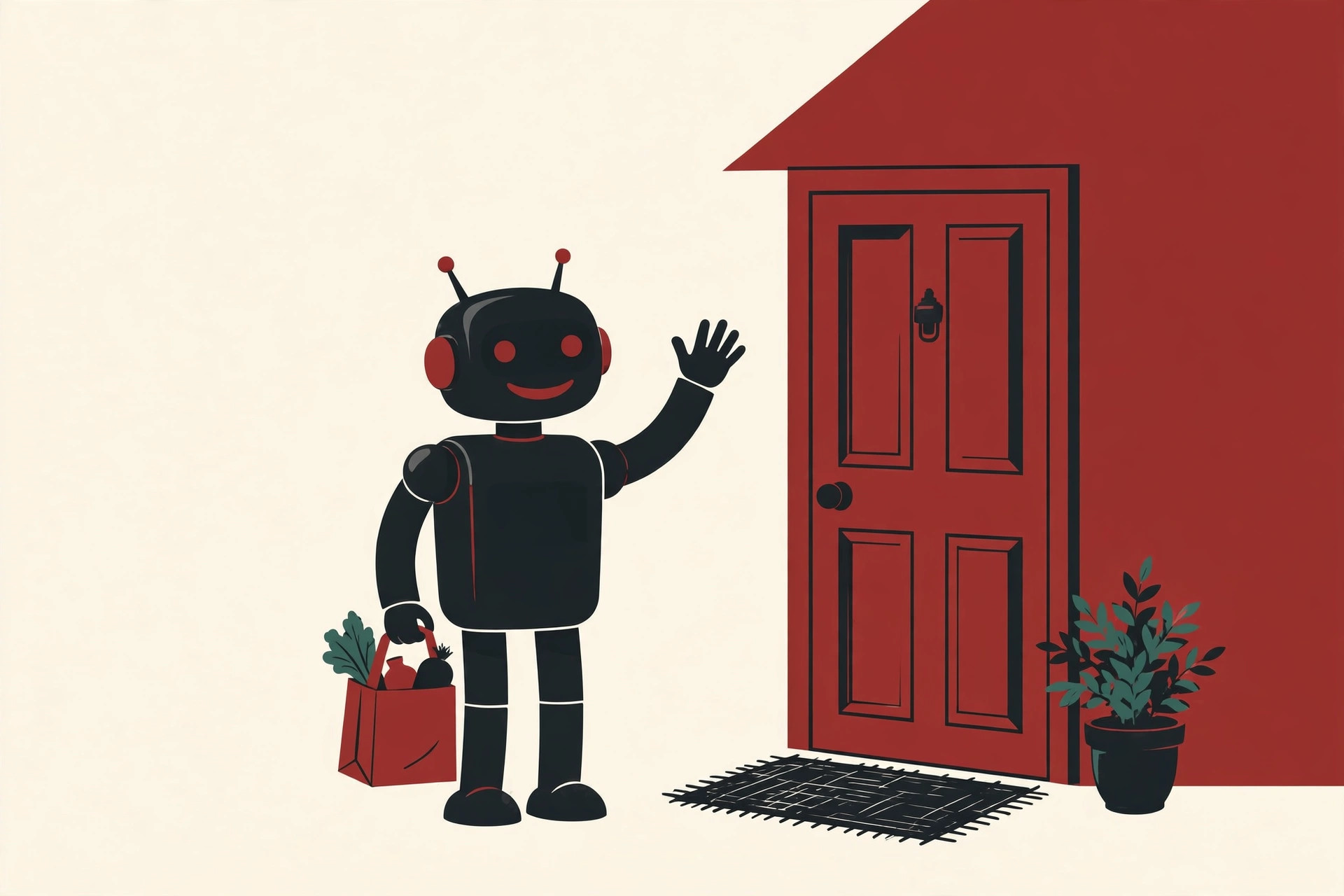
NEO is designed to feel safe: it is light for a humanoid at about 66 pounds, covered in soft material, and built to be quiet. It is pitched at chores like fetching items, tidying and loading the dishwasher. But 1X is unusually open about the catch. For chores NEO has not learned yet, buyers can schedule an “Expert Mode” session in which a human operator remotely guides the robot through the task. In other words, the first home humanoids will sometimes be a person in a call center driving your robot. Honest, useful, and a clear sign of how far home robots still have to go.
The Money: Funding and the Business Race
The funding numbers explain why this field moves so fast and promises so much.
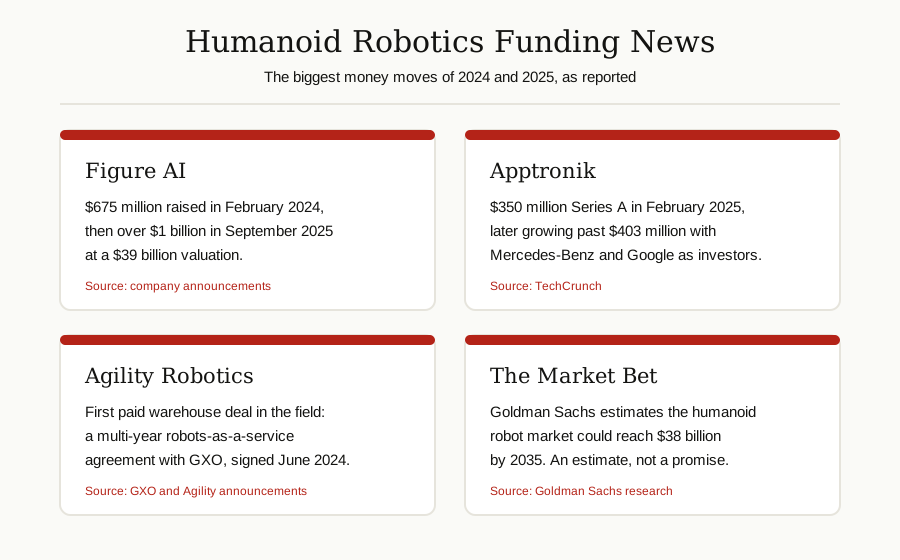
Investors are not really betting on 2025 robot sales, which are tiny. They are betting on position. Goldman Sachs has estimated the humanoid robot market could reach $38 billion by 2035, and every company in this article wants to be the name factories and homes trust when that market arrives. That is why valuations sound unreal next to current revenue. They are prices on a future that has not happened yet.
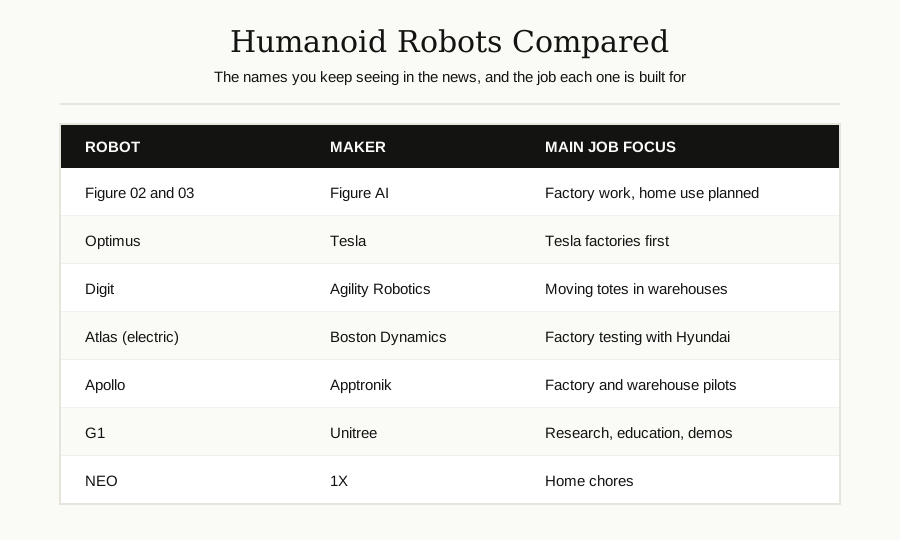
The Honest Reality Check
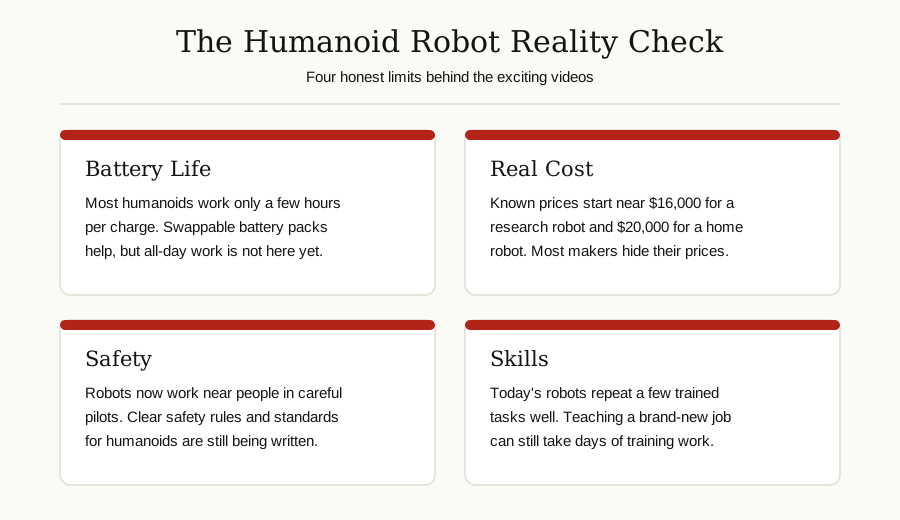
Four limits keep showing up in every serious report. First, batteries: most humanoids work for a few hours per charge, and swappable packs are a workaround, not a cure. Second, hands: gripping new objects without crushing or dropping them is still the hardest engineering problem in the field, and it is the reason Tesla’s production slipped. Third, skills: robots today are good at a few trained tasks and slow to learn new ones, with reports saying a basic new task can take days of training. Fourth, safety: a 100-plus-pound machine walking among people needs rules, and the standards for humanoids are still being written.
Add one more limit that rarely makes the videos: many impressive demos are partly remote-controlled, as with Tesla’s event robots and 1X’s Expert Mode. Remote help is a fair training tool, but any demo that does not say who is driving should be watched with care.
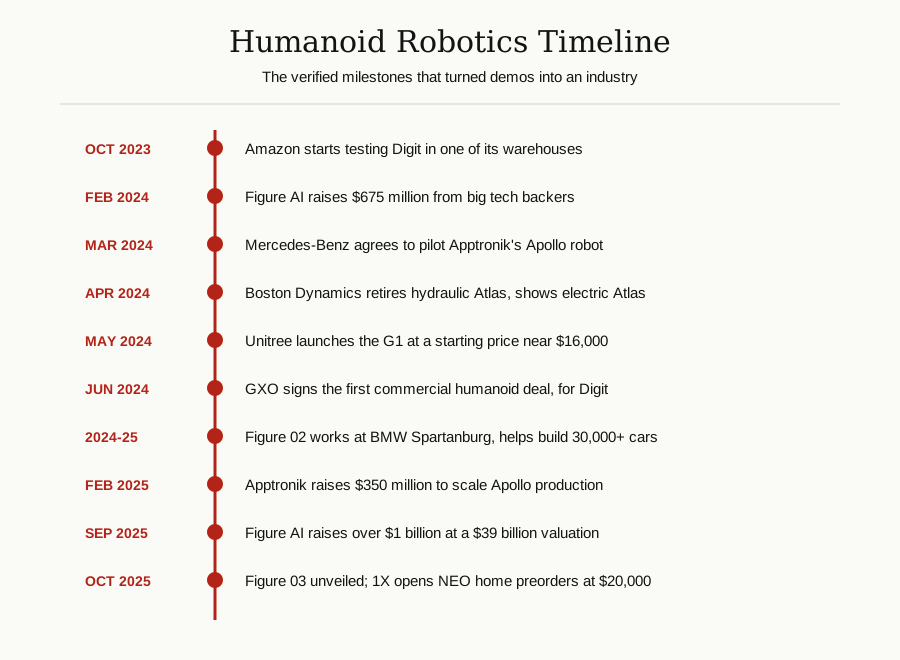
What to Watch Next
The next phase of humanoid robotics news will be decided by deliveries, not unveilings. Watch whether 1X actually ships NEO units to homes in 2026 and how much remote help those homes end up using. Watch Hyundai’s Atlas testing, because a car giant deploying its own robots at scale would be the industry’s biggest proof point yet. Watch Figure’s factory output, and watch whether Tesla turns its production talk into robots doing verified useful work.
Also watch prices. Unitree has already shown the body can get cheap. If a Western rival answers with a genuinely lower-cost work robot, the market changes from pilots to purchases very quickly. For more background on how these machines learn, our guide to machine learning algorithms is a good place to start, and you can follow the rest of our coverage in the AI news and regulation section.
Conclusion
The humanoid robot wave is real, but it is earlier than the headlines suggest. In 2024 and 2025, humanoid robots earned their first paid warehouse job, finished an 11-month shift at BMW, took home preorders at $20,000, and pulled in billions of dollars of investment. They also fell short of big promises, leaned on hidden human help, and stayed inside a small number of controlled buildings.
That mix is what honest humanoid robotics news looks like right now: real progress, real limits, and a race that will be won by the company whose robots show up for work every day, not the one with the best video.