You sit down to get something done. You open the document, check one message, glance at a notification, answer a quick question, and suddenly 40 minutes have passed and the real work has barely started. If that sounds familiar, the problem is not your character. It is your setup.
Focus is not a talent some people are born with. It is a skill, and like most skills it responds well to a few simple methods used consistently. This guide explains how to focus in plain steps: why focus breaks so easily today, how to give your brain one clear target, how to use time on purpose, and how to build the habit slowly so it lasts.

Why Focus Is So Hard Right Now
Most advice on how to focus starts with willpower. That is the wrong place to start, because three forces are working against you, and none of them care how determined you feel.
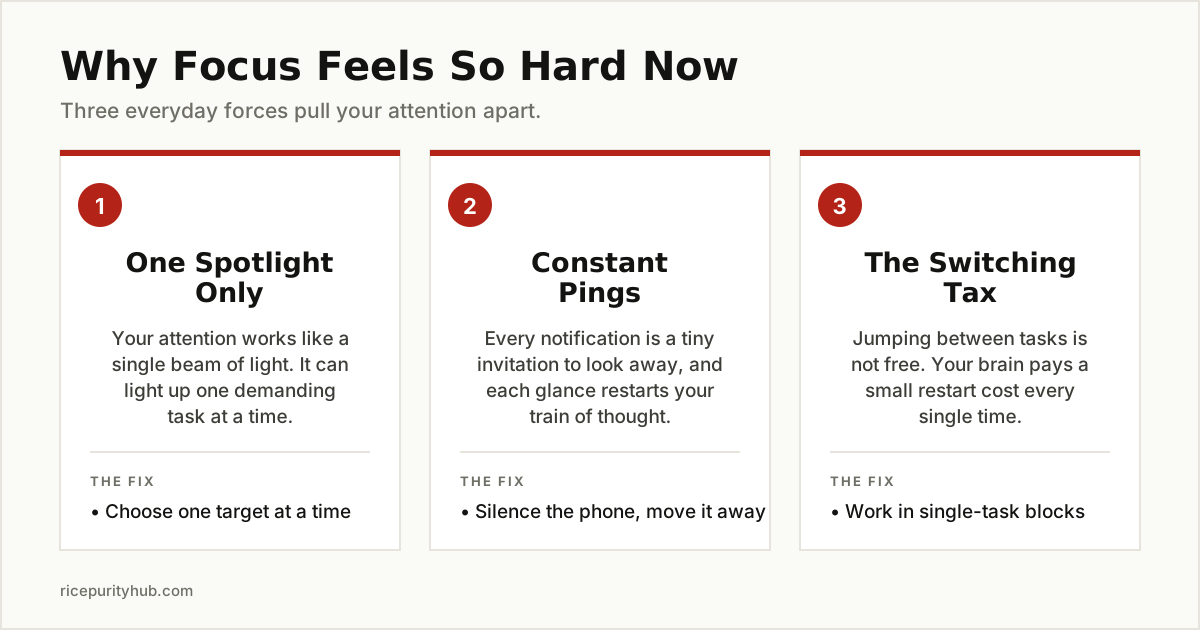
Your attention is limited. Think of attention as a single spotlight. It can shine brightly on one demanding task at a time. When you try to spread it across a report, a chat window, and a news feed at the same time, each one gets a dimmer light. This is normal brain design, not a personal flaw.
Your phone is built to interrupt you. Every ping, badge, and buzz is a tiny invitation to look away. Each glance feels harmless, but each one breaks your train of thought, and rebuilding that train of thought takes real effort. A day full of small interruptions adds up to a day where deep work never quite begins.
Multitasking is a myth. This is the big one, and it is backed by research. The American Psychological Association explains that when people think they are multitasking, the brain is actually switching back and forth between tasks. In experiments published in 2001, researchers Joshua Rubinstein, Jeffrey Evans, and David Meyer found that people lost time every time they switched, and the loss grew bigger when the tasks were more complex or less familiar.
The APA describes the switch as two steps happening in your head: goal shifting, where you decide to do this instead of that, and rule activation, where you turn off the rules of the old task and turn on the rules of the new one. Each step is quick, sometimes a few tenths of a second, but they add up across hundreds of daily switches. Meyer has said that the brief mental blocks created by shifting between tasks can cost as much as 40 percent of someone’s productive time.
The APA gives a sharp example of why this matters beyond the desk: losing just half a second to a switch can make a life or death difference for a driver on a phone traveling at 30 miles per hour, because the car keeps moving while the mind is somewhere else. Your work is less dangerous, but the mechanism is identical. Every switch is a small restart, and restarts are where time and accuracy quietly leak away.
Once you see focus this way, the goal changes. You do not need more discipline. You need fewer switches.
Start With One Clear Target
The single most useful focus habit is also the simplest: decide, in advance, exactly what this work session is for.
Not “work on the project.” That is a fog, and your brain wanders in fog. Instead, pick one small, finishable target: “write the introduction,” “solve problems 1 to 10,” “reply to the three client emails.” A clear target gives your spotlight somewhere to land, and it gives you a finish line you can actually reach.
A quick way to do this:
- Write the target at the top of a page or a note, in one short sentence.
- Make it small enough to finish in one sitting.
- If it is too big, cut it down until the first step is obvious.
When the target is clear, starting gets easier, because there is nothing to decide. Decision is where focus goes to die. Remove the decision, and the work begins.
Here is the difference in practice. “Study biology” can mean almost anything, so every few minutes you stop and renegotiate with yourself about what to do next. “Read pages 40 to 52 and write three questions about them” is finished the moment it is finished. The second version also makes the timer method below far more useful, because the timer then measures progress toward a finish line instead of just measuring time passing.
Give Your Work a Time Box
Time blocking is a plain idea with a fancy name. It means giving a task a set home in your day, with a start time and an end time, the way a meeting has. Instead of a long to-do list you graze on all day, you work on one thing during its block, and the rest waits its turn.
The most famous version of this idea is built for focus sessions, and it is worth learning properly.
The Pomodoro Technique
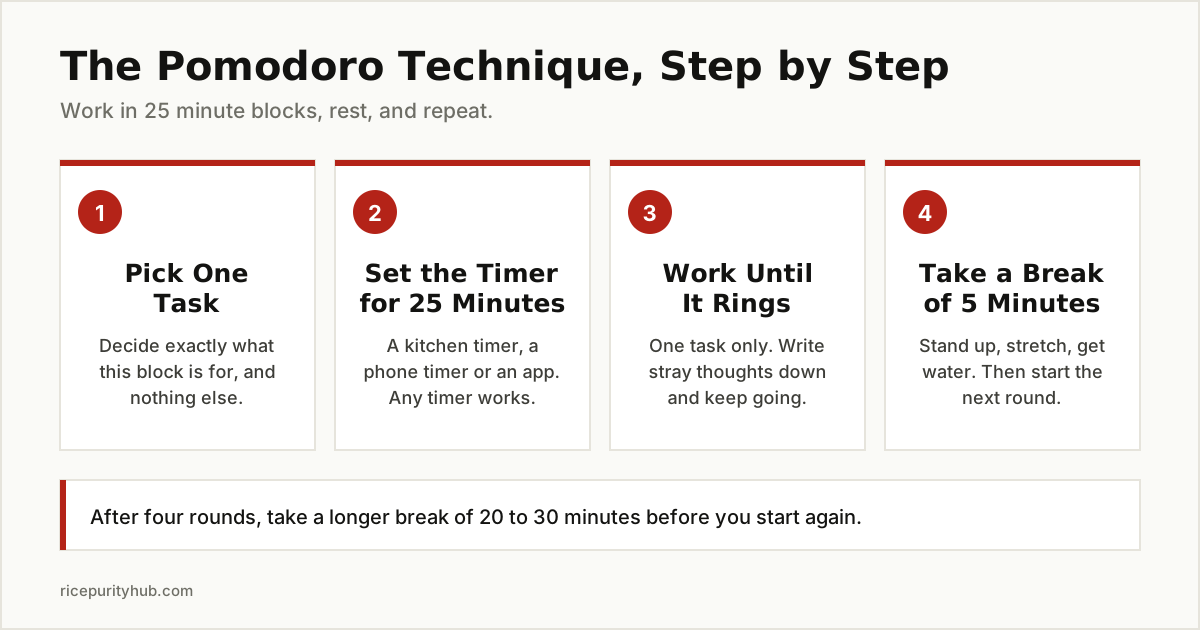
The Pomodoro Technique was created by Francesco Cirillo in the late 1980s, when he was a university student struggling to study. He used a tomato shaped kitchen timer (pomodoro is the Italian word for tomato) and built a simple rhythm around it:
- Decide on one task.
- Set the timer for 25 minutes.
- Work on that task, and nothing else, until the timer rings.
- Take a short break of about 5 minutes.
- After four rounds, take a longer break of 20 to 30 minutes.
Two rules make it work. First, a pomodoro cannot be split. If something interrupts you, you write it down, deal with it later, and return to the timer. Second, the breaks are part of the method, not a reward you skip when you feel busy. The break is what lets the next round start fresh.
You do not need a tomato timer. A phone timer, a kitchen timer, or a simple app all work. The timer matters less than the promise: for this block, there is one task, and the clock is watching so your willpower does not have to.
If 25 minutes feels too long at first, that is fine. The habit plan further down starts at 15 minutes on purpose. And if your work takes a while to load into your head, like writing or programming, you may later prefer longer blocks of 40 to 50 minutes. The exact number matters less than the shape of the method: one task, a visible timer, a real break.
Set Up Your Space So Focus Is Easy
Willpower is a weak tool. Environment is a strong one. The easier you make it to stay on task, the less often you have to fight yourself.
- Move the phone. The strongest move is another room. If that is not possible, face down, on Do Not Disturb, and out of arm’s reach is a decent second best.
- Clear the desk. Keep only what the current task needs. Everything else is a small visual reminder of something else you could be doing.
- Open one tab. Or at least close the ones that call to you. Twenty open tabs are twenty tiny open doors.
- Tell people. A short “I am heads down until 11” prevents most interruptions before they happen. At work, agreeing on quiet hours is much easier when your team collaboration tools are set up to respect them, with notifications batched instead of constant.
The Academic Success Center at Oregon State University gives students the same core advice: choose a space with few interruptions, turn off alerts, set the phone to Do Not Disturb, and work in small bursts with breaks in between. It is simple guidance because the simple things are what work.

Park Stray Thoughts on a Capture List
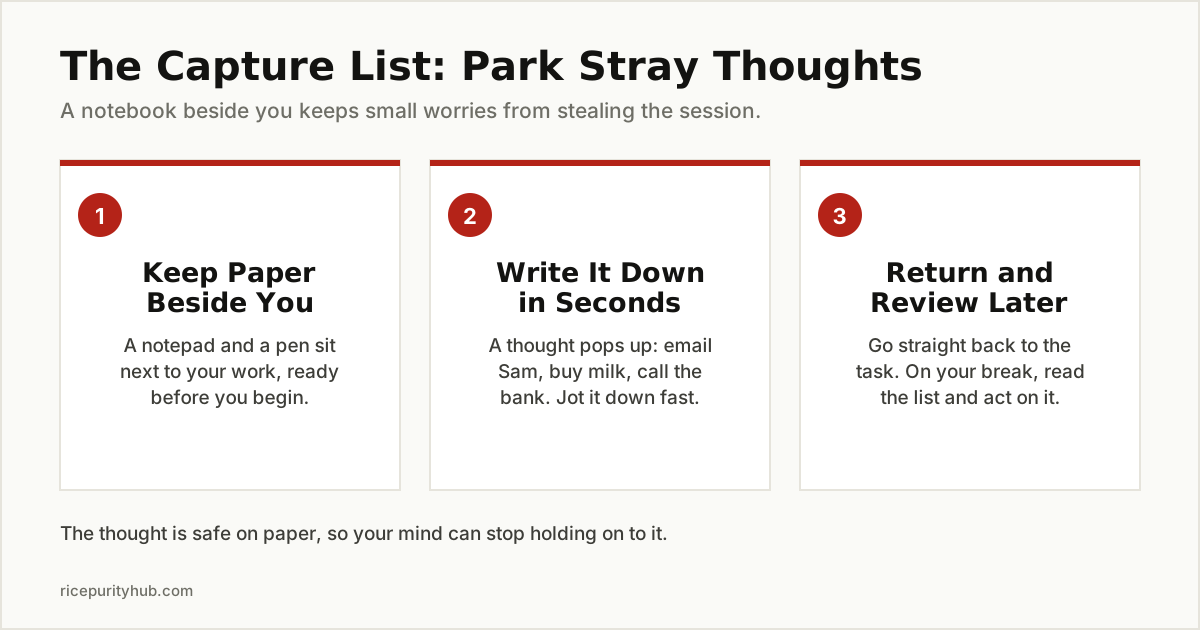
Even in a quiet room with the phone away, your own mind will interrupt you. You will remember an email, a bill, a birthday, a brilliant idea for a different project. These thoughts feel urgent because your brain is afraid you will forget them.
The fix takes about two seconds. Keep a notepad, or a notes app you use only for this, beside you. When a stray thought appears, write it down in a few words and return to the task immediately. The thought is now safe on paper, so your mind can let go of it. This is your capture list, and the rule is strict: capture during the session, act during the break.
Writing things down the moment they appear is a powerful habit beyond focus sessions too. It is the same skill that sits behind clear records at work, as our guide on how to write meeting minutes shows: the page remembers, so people do not have to.
At the end of the day, give the list two minutes of attention. Anything that still matters becomes a target for tomorrow or goes onto your real to-do list. Anything that does not can be crossed off with a clear conscience. Most items turn out to be smaller than they felt in the moment, which is exactly why writing them down works: paper is calmer than memory.
Work With Your Energy, Not Against It
How to focus is partly a scheduling question. Your sharpness is not flat across the day. Most people have a few hours when their mind is naturally clear, and a stretch, often after lunch, when everything feels like walking through mud.
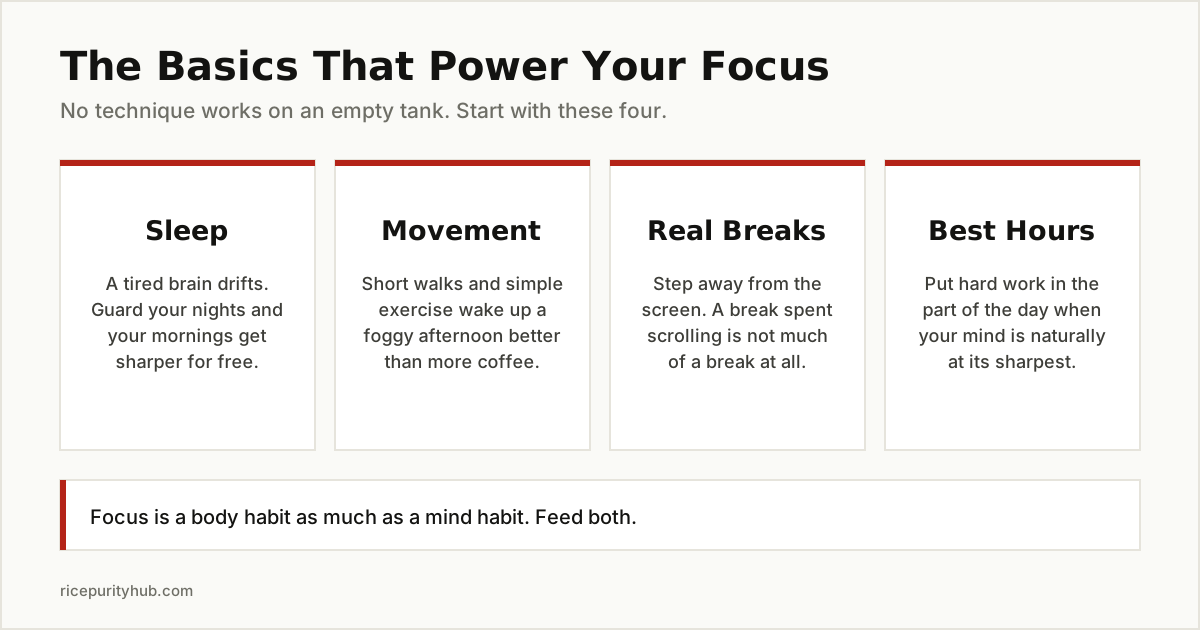
For one week, simply notice: when did work feel easy today, and when did it feel heavy? Then put your hardest task in your best hours and save email, admin, and easy tasks for the low stretch. This one change costs nothing and pays back every single day.
Three basics support all of it:
- Sleep. A tired brain drifts, rereads the same line, and reaches for the phone. Guarding your sleep is the cheapest focus upgrade there is.
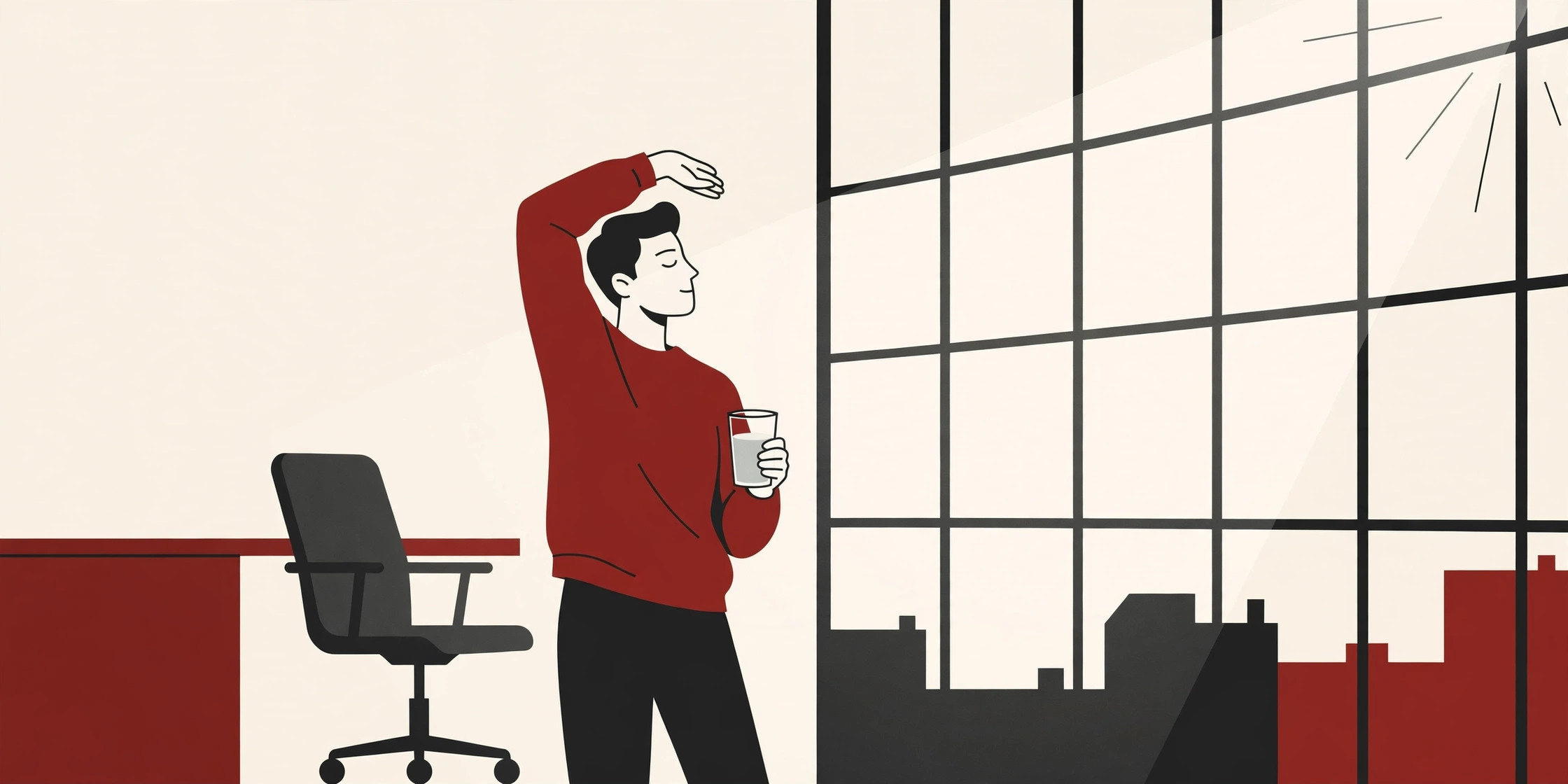
- Movement. A short walk, stretching, or simple exercise clears a foggy afternoon better than another coffee. Use your Pomodoro breaks to move, not to scroll.
- Real breaks. A break where you keep feeding your brain new content is barely a break. Step away from the screen, look at something far away, get water, and let your mind idle for a few minutes.
- Food and water. Oregon State’s concentration guide makes a blunt point: learning and hard thinking are work, and your brain needs fuel. Keep water on your desk, and do not schedule your hardest thinking for a moment when you are running on empty.
Build the Habit Slowly
Here is where most people fail: they read a guide like this, attempt a heroic four hour focus session the next morning, crash by lunch, and conclude that focus methods do not work for them.
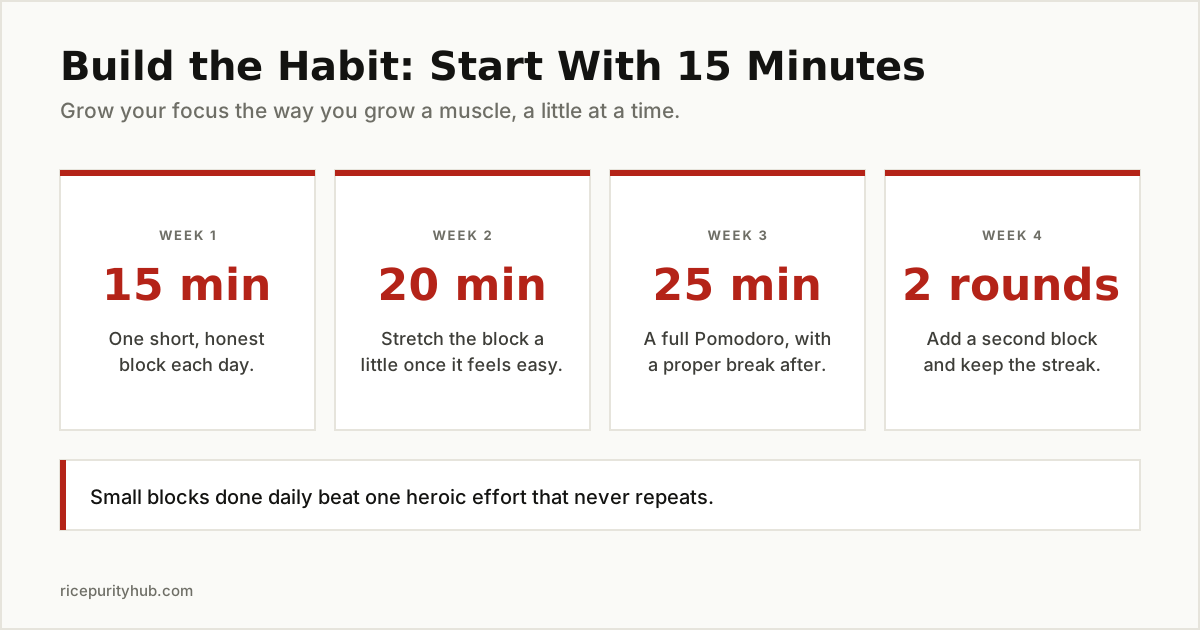
Build it like a muscle instead. Start with 15 focused minutes once a day. That is all. One target, phone away, timer on, capture list beside you. When 15 minutes feels easy, usually after a week or so, move to 20. Then try a full 25 minute Pomodoro. Then add a second round.
Small blocks done daily beat one heroic effort that never repeats. Within a few weeks, sitting down and starting will feel noticeably easier, because starting is the part you have been practicing.
One honest note. This guide covers everyday focus for work and study. If you find that trouble concentrating is constant, shows up in every part of life, and does not improve with good sleep and good habits, that is worth discussing with a doctor. There is no weakness in checking.
The Bottom Line
How to focus is not a mystery, and it is not about trying harder. Protect one clear target. Work in timed blocks with real breaks. Keep your phone out of reach and your stray thoughts on paper. Put hard work in your best hours, and grow the habit in small daily steps.
Pair these methods with the right productivity tools and the system gets even easier to keep. Start tomorrow morning with a single 15 minute block. That is enough to begin. For more guides like this one, browse the business productivity category.