If you have searched the Play Store lately and thought it felt smaller, you were right. In a cleanup that ran through 2024 and 2025, Google deleted apps from the Play Store by the million. Whole categories shrank, old favorites vanished, and the store that once bragged about having the most apps quietly cut its catalog almost in half.
So why does Google delete apps from the Play Store at this scale? The short answer is that the company decided the store had become too crowded with broken, spammy and dangerous apps, and it started enforcing its own rules far more strictly. Here is what actually happened, in numbers, and what it means for you.
The Big Cleanup, in Numbers
The headline figure comes from Appfigures, an app analytics firm. According to Appfigures data reported by TechCrunch in April 2025, the Play Store went from about 3.4 million apps at the start of 2024 to around 1.8 million apps a little over a year later. That is a drop of about 47 percent. Over the same period, Apple App Store barely moved, growing slightly from 1.6 million to 1.64 million apps, which shows this was a Google decision, not an industry trend.
Google confirmed to TechCrunch that its updated policies and enforcement caused the drop. The turning point was July 2024, when Google raised the minimum quality bar. Before that, the company mainly removed apps that crashed or refused to install. After July 2024, apps also had to offer real functionality and engaging content. Apps that did almost nothing, such as a single static page, one wallpaper, or a simple PDF viewer, no longer qualified, and huge numbers of them were removed.
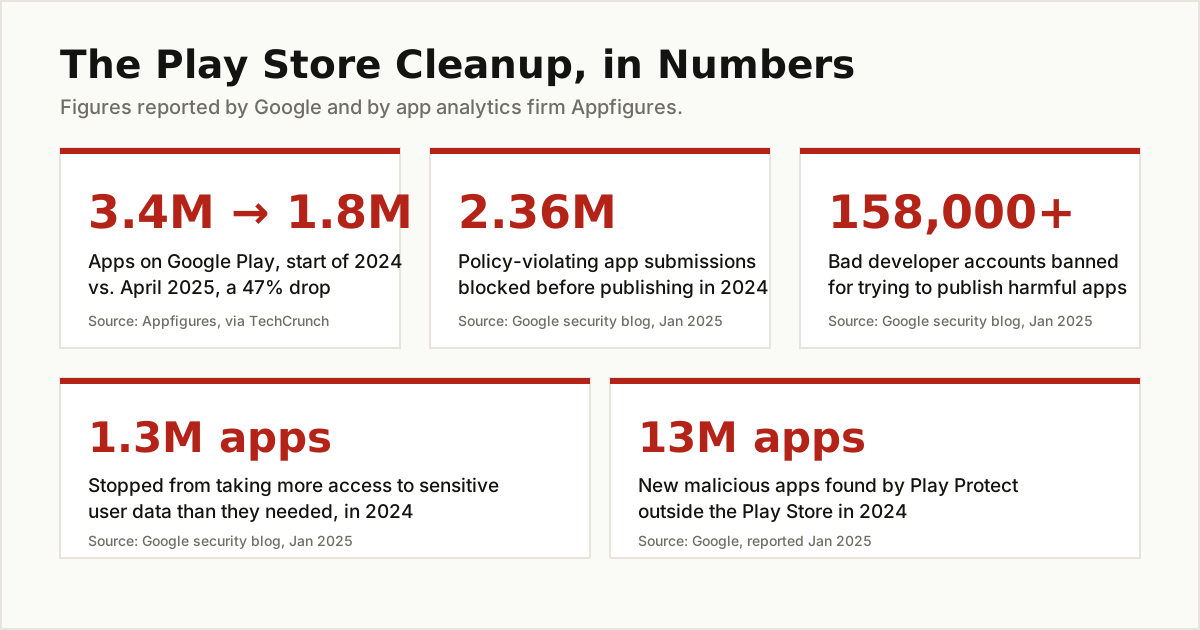
The cleanup was not only about apps already on the store. In its report on how it kept the ecosystem safe in 2024, published on the Google security blog in January 2025, Google said it prevented 2.36 million policy-violating apps from being published at all, and banned more than 158,000 bad developer accounts that tried to publish harmful apps. Google also said it stopped 1.3 million apps from gaining more access to sensitive user data than they needed.
One more thing is worth noting for balance. The smaller store did not mean a dead store. Appfigures also found that brand new app releases worldwide actually rose by about 7 percent year over year in early 2025. Fewer apps survived, but developers kept building.
Why Apps Get Deleted
A google play store app removal usually happens for one of a handful of reasons. Some are about safety, and some are simply about quality.

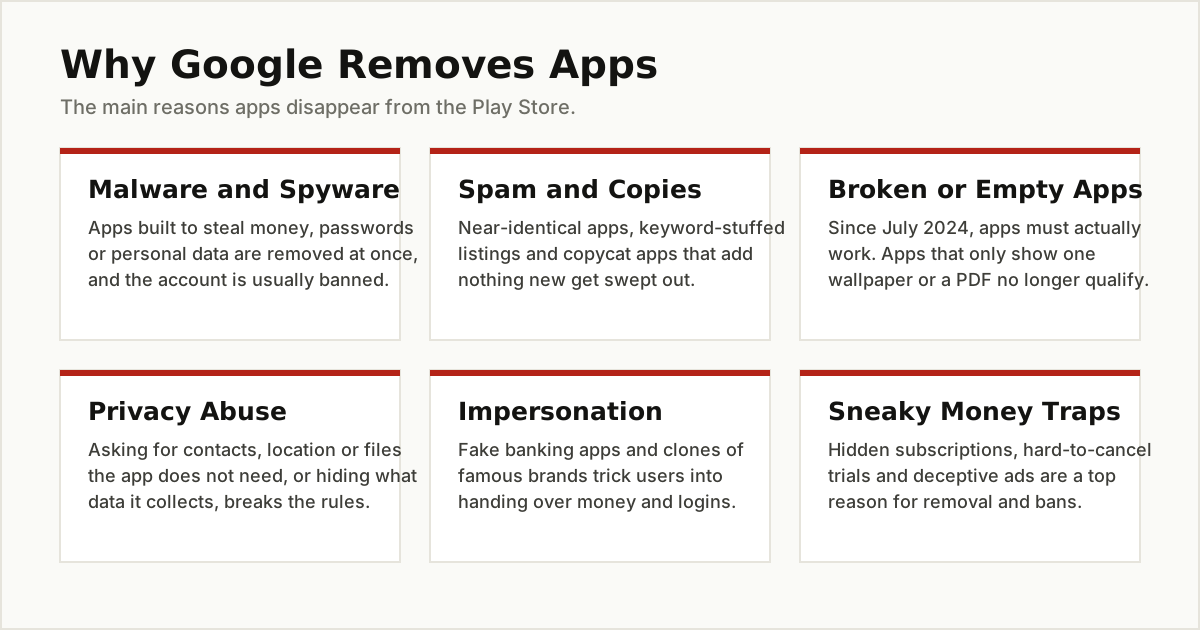
Malware, spyware and fraud. This is the most serious group. Apps that steal banking logins, quietly sign users up for paid subscriptions, or spy on messages and photos are removed as soon as Google finds them, and the developer account is normally banned for good.
Broken and empty apps. This is the group that explains the huge 2024 numbers. Under the policy update, an app has to do something useful and do it reliably. Apps that crash on open, freeze, or offer almost no content are removed, even if they are harmless.
Spam and copies. The store used to be full of near-identical apps: fifty flashlight apps from one account, or listings stuffed with keywords. Google treats repetitive, low-effort publishing as spam, especially when the same app is uploaded again and again under slightly different names.
Privacy abuse. Apps must explain what data they collect in the Data Safety section of their listing, and they can only ask for permissions they genuinely need. A photo editor that demands access to your contacts and call history is exactly the kind of google play policy violations case that gets an app pulled. Google said it prevented 1.3 million apps from taking excessive access to sensitive data in 2024 alone.
Impersonation and deception. Fake versions of famous banking apps, crypto apps and games are a constant problem. If an app pretends to be from a company it has no link to, or its listing promises features the app does not have, it breaks the deceptive behavior policy.
The Malware Fight Behind the Scenes
Blocking apps at the door is only one layer. Google deletes apps from the Play Store when its scans find hidden malicious code, and it also runs Play Protect, the security system built into Android phones, which scans apps on the device, including apps installed from outside the store. According to The Hacker News coverage of Google 2024 safety report, Play Protect identified 13 million new malicious apps in 2024 that came from outside Google Play, and its daily scans covered more than 200 billion apps.
Google also says AI now does much of the heavy lifting in reviews. In the same January 2025 report, the company said that over 92 percent of its human reviews for harmful apps are AI-assisted, which helps reviewers spot hidden malicious behavior faster. It is one reason the company can process millions of submissions a year, a scale we also discuss in our explainer on what agentic AI is and how automated systems act on rules.
The trend continued in the following report. For 2025, Google said it blocked 1.75 million policy-violating apps and banned more than 80,000 bad developer accounts, lower numbers than 2024. Google credits the drop to deterrence: as verification and pre-launch checks got stricter, fewer bad actors bothered trying. That claim comes from Google itself, so read it as the company view, but the direction matches what outside analysts observed.
The New Developer Verification Rules
The biggest change is not about apps at all. It is about the people behind them. Under the new system, Google deletes apps from the Play Store and blocks installs elsewhere when the developer behind an app refuses to prove who they are.
In August 2025, Google announced a system called android developer verification on the Android Developers Blog. The idea is simple: before an app can be installed on a certified Android device, its developer must be registered and verified by Google. This applies to apps from Google Play, from other app stores, and from direct downloads alike. Google compared it to an ID check at the airport: the check confirms who the developer is, it does not review what is inside the app.
Google gave two main reasons. First, its analysis found over 50 times more malware coming from internet downloads than from apps on Google Play. Second, banned developers kept coming back under fresh names. Real identity checks make that comeback much harder, because a banned developer cannot simply open a new anonymous account.
Here is how the rollout works. Verification opened to all developers in March 2026. The requirements took effect on September 30, 2026, for certified Android devices in Brazil, Indonesia, Singapore and Thailand, across participating stores including Google Play and the Samsung Galaxy Store. Google plans to expand the system globally during 2027. Developers who publish on Google Play mostly verified back in 2023, and Google says Play automatically registered about 99 percent of Play apps, so the new burden falls mainly on developers who distribute outside Play.
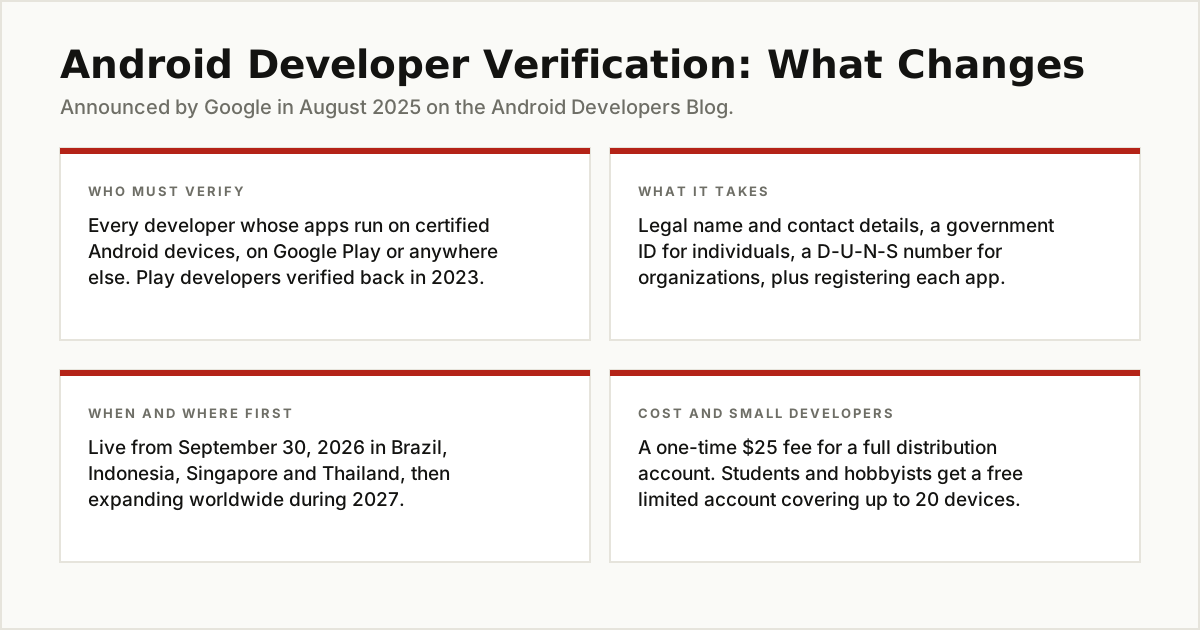
What does a developer have to hand over? A legal name, address, email and phone number. Individuals verify with a government-issued ID. Organizations also provide a D-U-N-S number, the business ID issued by Dun and Bradstreet. Each app must be registered by its package name, and the developer proves ownership with the app signing key. A full distribution account in the new console carries a one-time fee of 25 dollars, matching the existing Play Console fee. Students and hobbyists can use a free limited distribution account instead, which needs no government ID and covers up to 20 devices.
Google also added a pressure valve for users. According to Google Android Help pages, if you try to install an app from an unverified developer, the phone will block it, but you can bypass the block once by completing an advanced flow in settings. The company says plainly that sideloading is fundamental to Android and is not going away.
What This Means for Users
For most people, the cleanup is quietly good news. When Google deletes apps from the Play Store for being broken, fake or data-hungry, search results get cleaner, and the odds of installing something harmful go down. The apps that remain are more likely to be maintained, because their developers passed identity checks and keep up with policy changes.
There are a few practical points to know:
- Installed apps do not disappear. If an app on your phone is removed from the store, it stays on your device. It just stops receiving updates, so check now and then whether key apps are still supported.
- Some disappearances are not Google’s fault. New European rules require developers to publish a name and address to sell apps in the EU. Coverage of the Appfigures data noted that some developers pulled their own apps rather than share a home address.
- Play Protect still matters. Most malware found in 2024 came from outside the store, so the warnings your phone shows about unknown apps are worth reading, not tapping through.
What Developers Must Do
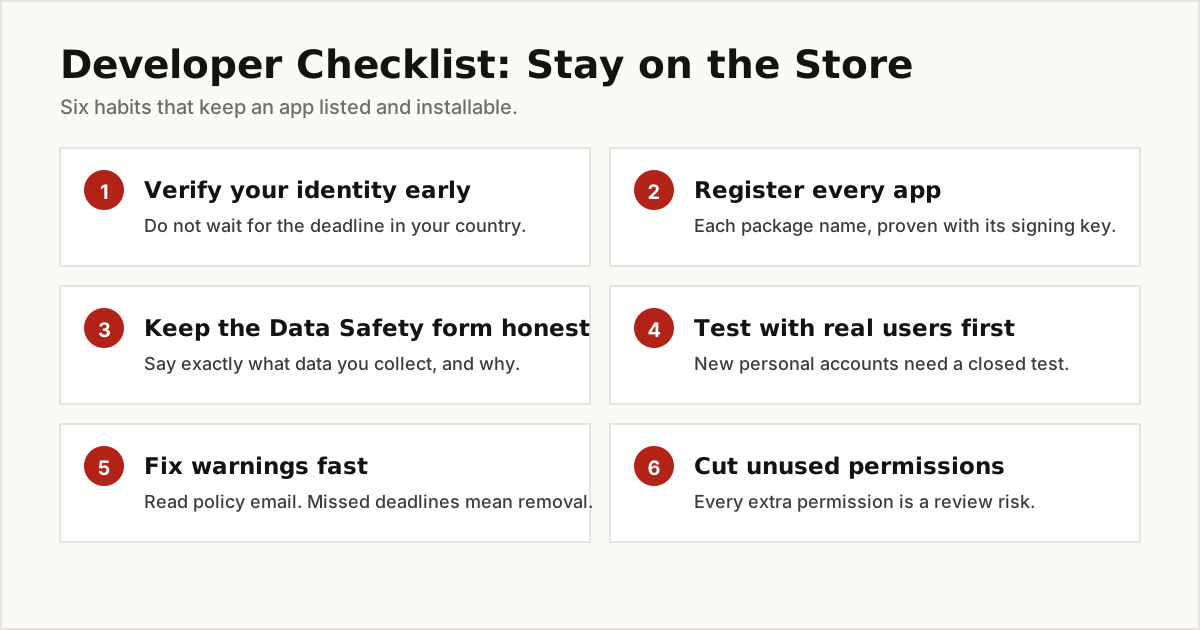
If you publish Android apps, the message from the last two years is clear: the open door era is over, and staying listed is now an ongoing job, not a one-time upload. Start with identity. If your apps run on certified devices, you need to be a verified developer, and if any of your Play package names were not auto-registered, register them yourself before the deadline reaches your country.
Beyond verification, the day-to-day rules matter just as much:
- Keep your Data Safety answers accurate, and only request permissions your app truly needs.
- If you open a new personal developer account, expect a closed testing period with real testers before you can launch.
- Read policy emails and act on warnings inside the deadline. Many removals happen because a fixable warning was ignored.
- Update your app regularly. Old, abandoned apps that no longer meet current Android requirements are prime candidates for removal.
- If you also distribute outside Play, register those builds too. The verification rule follows the app, not the store.
The Honest Downside: Small Developers and Sideloading
It would be wrong to present this as a simple win. The same system that stops scammers also puts paperwork in front of honest small developers, and that is the center of a real debate.
Open source developers raised the loudest concerns. The team behind F-Droid, the long-running open source app store, warned that many volunteer developers cannot or will not hand identity documents to Google, and that their apps could become uninstallable on normal phones even though the apps themselves are safe. A public campaign called Keep Android Open gathered signatures from developers and digital rights groups making the same point: Android was sold for years as the open alternative to the iPhone, and identity checks controlled by Google change that bargain.
Cost is another friction. Twenty-five dollars is small for a company, but in many countries it is real money for a student or a hobbyist, and the free limited account only covers 20 devices. There is also a fairness question about the quality purge itself: automated enforcement at this scale makes mistakes, and small developers say appeals can be slow and unclear when an app is removed by a system rather than a person.
Google’s side of the argument is also real. Fraudulent banking apps cause genuine harm, often in the very countries where verification started first, and banks federations in Brazil publicly supported the move. The advanced flow for power users, the free hobbyist account, and exemptions for company-managed devices were all added after feedback. Where you land depends on how much you value an open platform versus a safer one, and reasonable people land in different places. What is not in doubt is the direction: Google deletes apps from the Play Store more aggressively than ever, and from now on it also checks who is standing behind every app that remains.
Conclusion
The story behind the headlines is not one big deletion day. Google deletes apps from the Play Store in a steady flow: millions of harmful submissions blocked before launch and more than 158,000 bad accounts banned in 2024, all documented in Google’s 2024 ecosystem safety report, plus a one-time quality purge that cut the catalog from about 3.4 million apps to about 1.8 million, according to Appfigures. On top of that, developer verification now ties every app to a real, checked identity, starting in four countries and going global in 2027.
For users, the result is a smaller but cleaner store, much like the safer search experience people want when they learn how to turn off Google AI results they do not trust. For developers, the takeaway is simple: verify early, follow the policies in the ai news and regulation category, and treat compliance as part of building the app. The rules are not getting looser, and the developers who plan for them will be the ones still listed when the next cleanup comes. If you want to see how the same pattern of AI screening shows up in other Google products, our guide to computer vision applications is a good next read.