If you are applying to a University of California campus this year, you have probably typed some version of this question into a search bar: do UC colleges check for AI? It is a fair question, and you deserve a straight answer instead of scary rumors.
Here is the honest short version. UC has not published a public list of AI detection tools, and no official UC page says that every essay is run through a named detector program. What UC has published is clear and firm: your answers must be your own work, written in your own voice, and every part of your application can be verified. UC admissions directors have also given direct guidance on AI tools, including which uses are fine and which ones cross the line.
So the real question is not only whether a machine might catch you. It is whether your answers sound like you, tell your real story, and follow the rules you agreed to when you signed the application. This guide walks through what UC officially says, what detection can and cannot do, and how to use AI help in safe ways.
What UC Officially Says About AI and Your Application
Let us start with the rules, because they matter more than any rumor. When you submit a UC application, you sign the Statement of Application Integrity. In plain words, it says that all information in the application must be complete, accurate, and your own work.
UC’s own guidance page for the personal insight questions repeats the same idea in friendly language. UC tells students that answers should reflect their own ideas and be written by them alone. Family, teachers, and friends can offer suggestions, just like a counselor would. But you may not copy from sources, and you may not use anyone else’s words as your own.
UC has also spoken directly about AI tools. In guidance shared with school counselors, UC admissions directors say they understand that many students are already exploring AI tools while working on their personal insight questions. Their view, in plain terms, is this:
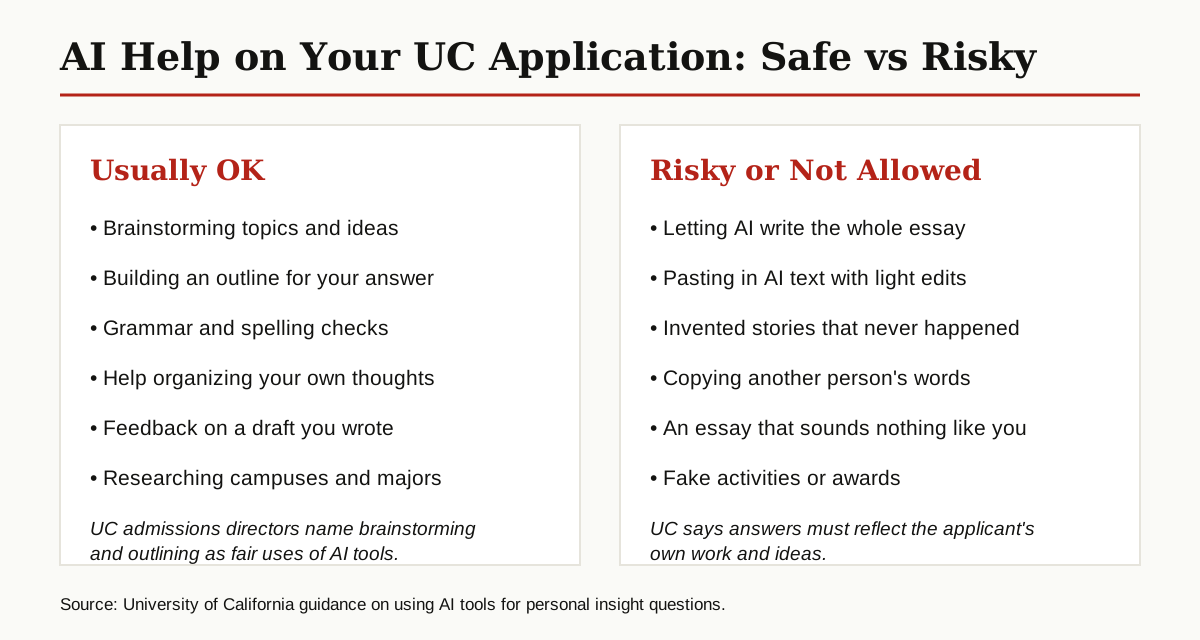
- AI tools can be useful in early parts of the writing process, such as brainstorming, outlining, or helping you clarify and organize your thoughts.
- A response that relies heavily, or entirely, on AI generated text could violate the application integrity policy, especially if the writing does not reflect your independent thinking or gets flagged for plagiarism.

There is one more voice worth hearing. Robert Penman, who leads undergraduate admissions at UC Davis, has said that a personal insight question written by AI is not going to be very good, because it teaches the reader nothing about the student. It cannot show your hopes, your struggles, or what you achieved. A machine simply does not know your life.
That is the core of UC’s position. The personal insight questions exist so readers can hear from you. An AI written answer fails that purpose even before anyone talks about rules.
Can Colleges Really Detect AI Writing?
Now for the technology question: can colleges detect AI essays with software? Tools that claim to spot AI writing do exist, and many schools and teachers use them. These detectors study patterns in the text, such as how predictable the word choices are, and then give a score or a guess.
Here is the honest part that many websites skip. These tools are not reliable. Studies and real classroom cases have shown two kinds of mistakes:
- False alarms. A student writes an essay fully by hand, and the tool still flags it as AI written. Formal, careful writing can look machine made to a detector.
- Misses. A student lightly rewrites AI text, and the tool waves it through as human writing.
Because of this, no fair reader treats a detector score as proof. And remember what the detectors cannot do at all: they cannot check whether your story is true, and they cannot tell whether the voice sounds like a real teenager who lived those moments. Human readers can. Experienced UC readers review thousands of applications, and generic, polished, empty writing stands out fast. How these language models write explains why AI text tends to sound smooth but vague.

So when students ask do colleges check for AI, the fuller answer is that checking is a mix of software signals, reader judgment, and UC’s right to verify anything in your file. UC has confirmed that application information is subject to verification, and if an applicant is selected for verification and does not comply, the application is cancelled.
What Happens If an Application Looks AI Written?
This is where honesty matters most, so let us separate what UC has put in writing from what is simply a risk.
What is in writing: UC’s integrity statement lists penalties for falsified application information. Those penalties go up to and including denial of admission, withdrawal of an admission offer, cancellation of registration, expulsion, or revocation of a University of California degree. Work that is presented as yours but was not written by you falls on the wrong side of that statement, and UC’s counselor guidance connects AI heavy responses to this policy directly.
What is a risk rather than a published rule: UC has not published a step by step process that says, first a detector flags you, then this exact thing happens. Anyone who claims to know a precise campus by campus detection process is guessing. What we can say is that a suspicious file can lead to questions, verification requests, or worse, and that you would have to respond with proof the work is yours. Keeping your drafts is a simple way to protect yourself.
There is also a quieter, more common cost. Most AI written answers do not get anyone in trouble. They just do not work. A smooth essay with no real details gives readers nothing to remember, and readers can only judge what is on the page. In a pool with tens of thousands of applicants, forgettable is its own penalty.

Safe Ways to Use AI Help
The good news is that you do not have to avoid AI tools completely. UC’s own guidance leaves room for sensible help, and many students use it well. Safe uses share one trait: the ideas, the story, and the final words are still yours.
- Brainstorming. Ask an AI tool for ten possible angles on a question, then pick the one that matches your real life. If you want ideas on how people save and reuse tool chats, our guide to the AI chatbot conversations archive shows how these tools store your history.
- Outlining. Share your own notes and ask for help arranging them into a clear order.
- Grammar and spelling checks. A quick pass to catch typos is like using a spell checker, and UC says answers are not judged on grammar anyway.
- Feedback on your draft. Paste your own draft and ask what is unclear. Then rewrite in your words.
- Research. Ask about majors, campus programs, or deadlines, and confirm facts on official UC pages.
Some students also simply turn off AI features in their everyday apps while they write. If that sounds like you, our step by step guide on how to turn off Google AI can help you focus.
Risky Uses to Avoid
The risky list is just as clear, and it follows one rule. If the tool is doing the thinking or the writing for you, stop.
- Letting AI write a full personal insight answer, even once, and submitting it.
- Taking AI text and swapping a few words so it sounds slightly different. The ideas are still not yours, and the voice rarely matches yours.
- Inventing stories, hardships, or achievements with AI help. A made up story is false information, full stop.
- Copying answers from websites, older applicants, or sample essays.
- Asking AI to imitate a sincere teenage voice. Readers spot the performance, and it still is not your work.
Also, be careful with free AI humanizer tools that promise to beat detectors. UC’s rule is about authorship, not about a software score, so an answer that passes a detector can still break the policy and still read as empty.
How to Keep Your Essay in Your Own Voice
Voice sounds like a fuzzy idea, but it is practical. Your voice is the way you naturally explain things: your sentence length, your word choices, the small details you notice. UC readers are looking for exactly that, because they want to meet a person, not a template.
A few habits keep your voice safe:
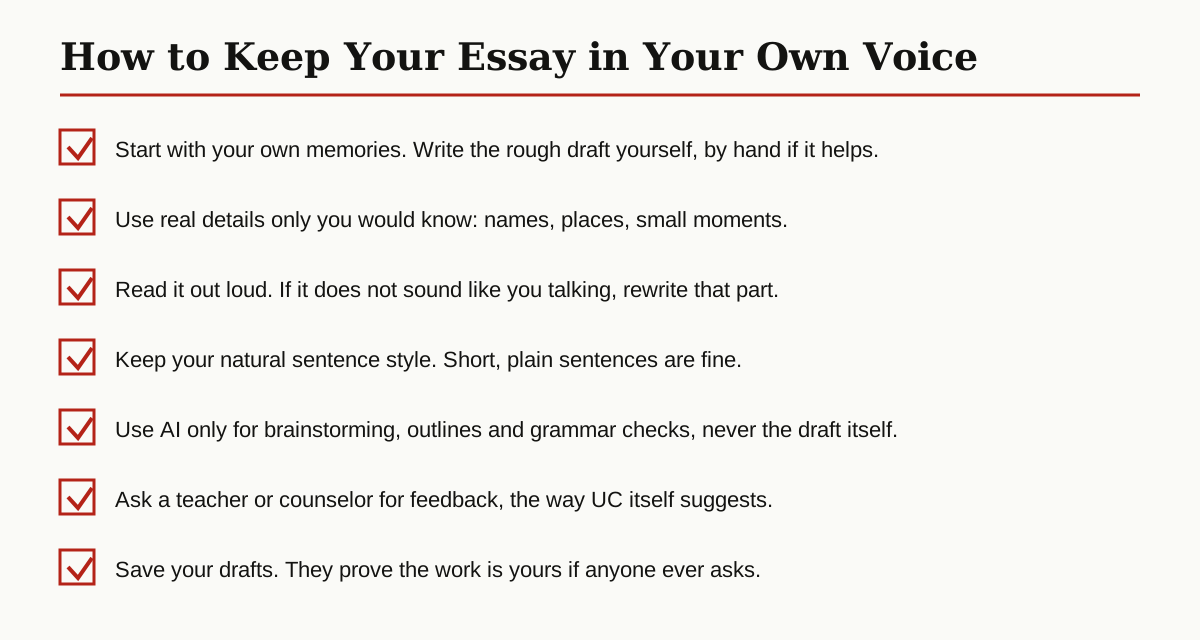
- Write the first draft yourself, before opening any AI tool. Even a messy draft locks in your real thoughts.
- Use details that only you know. The smell of the garage where you fixed bikes. The exact words your grandmother said. AI cannot invent your memories, and readers can feel the difference.
- Read every answer out loud. If a sentence sounds like a brochure, rewrite it the way you would say it to a friend.
- Keep your drafts and notes. They show your process if UC ever asks.
- Cut every sentence you would not be able to explain in a conversation.
If you want to see how this site organizes guides like this one, browse the AI, ML and Data Science category for more plain English explainers.
Final Advice for Students and Parents
For students: the strongest applications are not the most polished ones. They are the most specific and honest ones. Pick questions that fit your real experiences, write early, and let the answers sound like you on a good day. If AI helps you brainstorm or clean up typos, fine. The moment it starts writing sentences for you, close the tab.
For parents: your best role is the one UC itself describes. You can listen, ask questions, and offer feedback, the same way a teacher or counselor would. Resist the urge to rewrite. An answer polished by an adult voice raises the same questions as an answer written by a machine, because readers compare the writing to everything else in the file.
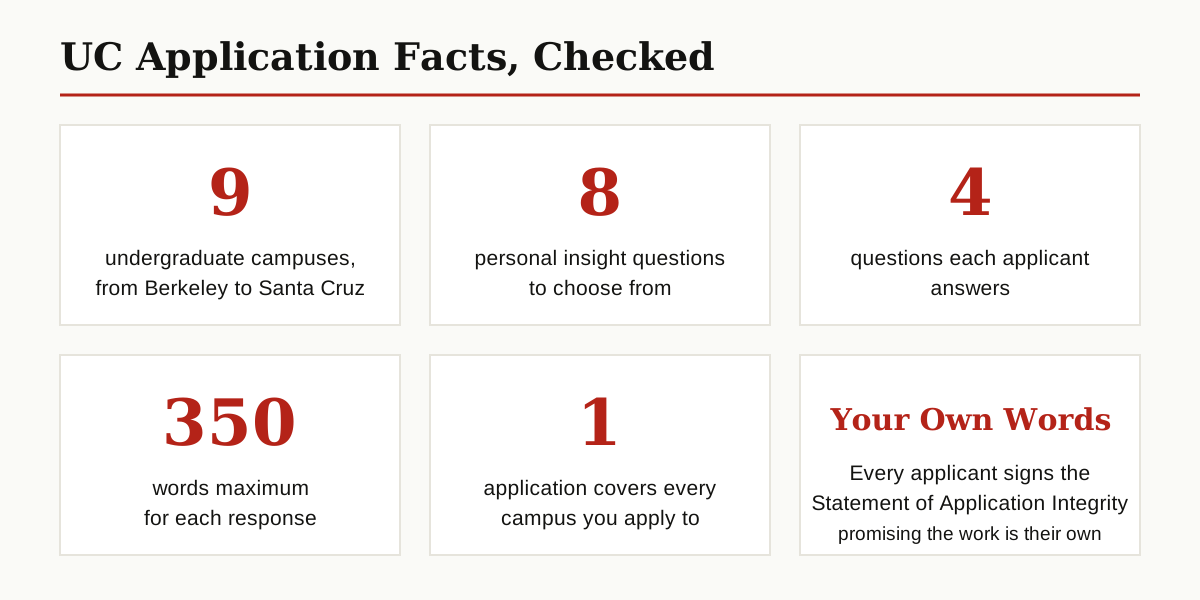
And for both of you: begin on the official UC application site, read the personal insight guidance carefully, and treat third party claims about secret detection systems with healthy doubt. UC’s expectations are public, and they have not changed: your story, your words.
Conclusion
So, do UC colleges check for AI? UC does not publish a detector list, but it verifies applications, trains readers to spot writing that is not genuine, and holds every applicant to a signed promise that the work is their own. Its admissions directors have said plainly that AI can help you brainstorm and organize, while answers built on AI text can break the integrity rules and will not impress anyone anyway.
Write your own story, use tools only at the edges, and you will never have to worry about the question again. You can read UC’s counselor guidance on AI use in PIQs in the official UC admissions presentation (PDF).