Computer vision is the part of AI that learns to see. It reads photos, watches video, measures depth and spots disease in scans. Because it moves so fast, this roundup of computer vision research news keeps only the stories that were checked, dated and tied to a real lab, paper or award.
Some of these releases will quietly change the apps on your phone. Others matter because they show where the whole field is heading: models that learn without labels, worlds a machine can walk through, and vision systems small enough to run on a laptop. For the wider picture, this sits alongside the rest of our AI news and regulation coverage.
How to Read Research News Without the Hype
Most computer vision research news arrives dressed up. A lab posts a striking demo, headlines call it a breakthrough, and two weeks later nobody remembers it. A few simple checks separate the real advances from the noise.
- Who published it? A paper, an official lab blog or a conference award can be checked. A lone social media post cannot.
- Is anything public? When code and model files are released, rival teams test the claims within days. That is the strongest sign a result is real.
- Whose test produced the score? Labs often grade their own homework. A score matters more when it comes from a shared test that many teams use.
- What is missing? Honest releases name their limits, such as short memory, narrow data or high cost. If a post lists no limits at all, be careful.
Keep those four checks in mind, and the six stories below read very differently from a hype reel. Each one passed at least three of them.
The Big Stories in Computer Vision Research
Six stories carry most of this year’s computer vision research news. Two came from Meta’s labs, one from an Oxford team working with Meta, one from Google DeepMind, one from Google’s health team, and one from the open source community at Hugging Face.
Meta SAM 3: Name It, and It Outlines Every Match (November 19, 2025)
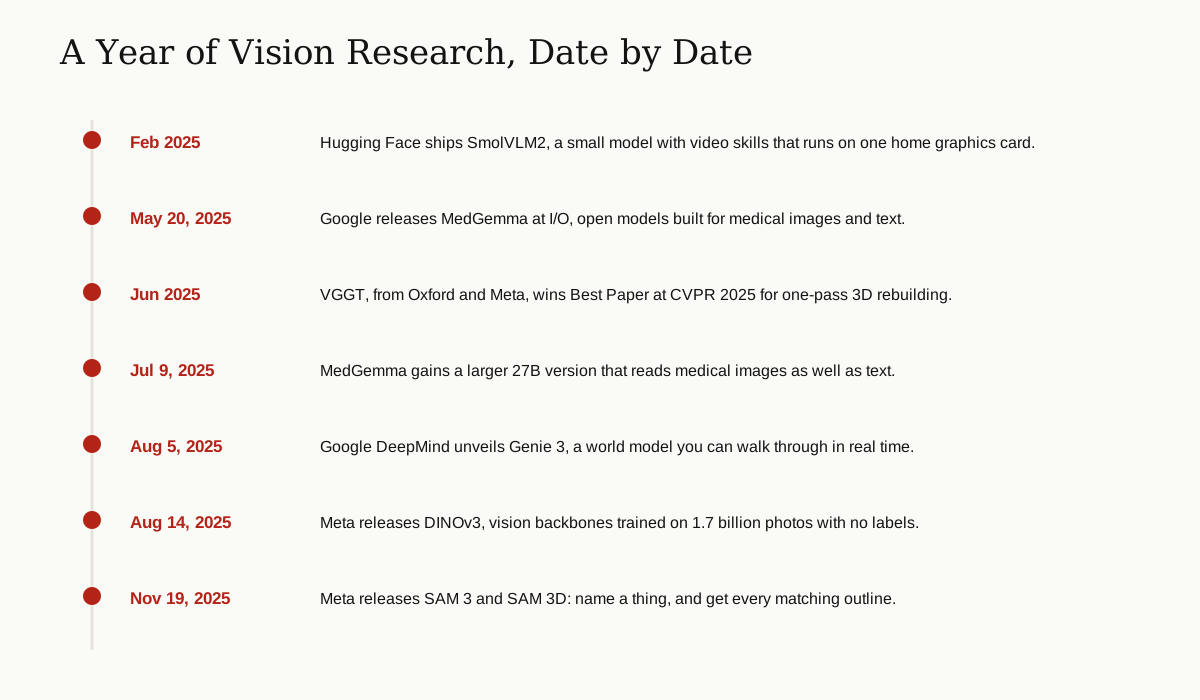
Segmentation means drawing the exact outline of a thing in a picture, pixel by pixel. Meta’s earlier Segment Anything models could outline one object at a time, after a person clicked on it. SAM 3, released on November 19, 2025, changed the question. You type a short phrase, such as “yellow school bus”, or show the model one example image, and it returns outlines and tracking IDs for every matching object in a photo or video at once. Meta calls this promptable concept segmentation.
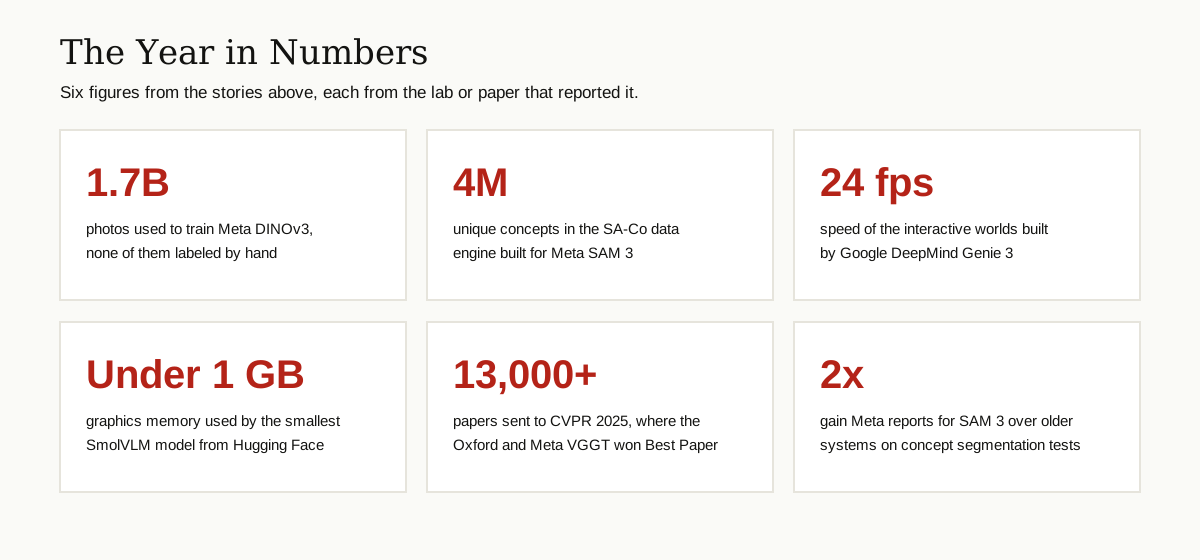
The scale behind it is new too. To teach the model, Meta built a data engine that produced about 4 million unique concept labels across images and videos, including hard lookalike cases designed to trip it up. In Meta’s SAM 3 publication, the team reports roughly double the accuracy of earlier systems on this concept task, in both images and video. A companion release, SAM 3D, rebuilds 3D objects and scenes from a single photo.
Why it matters: outlining objects by hand is the slow, costly step behind training data, video editing and photo tools. A model that finds every match from a phrase turns hours of clicking into one request. It is the rare piece of computer vision research news that changes daily work within weeks, helped by the fact that Meta released the model and its new SA-Co test set openly.
DINOv3: Learning to See Without Labels (August 14, 2025)
Most vision models learn from photos that humans labeled by hand, and labeling is slow and expensive. DINOv3, released by Meta’s FAIR research team on August 14, 2025, skipped the labels entirely. It learned by studying 1.7 billion photos on its own, a method called self-supervised learning, and grew to 7 billion parameters, the largest in its family.
According to Meta, the result is a general purpose set of eyes. Used as a frozen backbone, meaning a ready made vision core that other teams plug into their own tools, DINOv3 beat systems built for single jobs on several hard tests, such as judging depth and outlining objects in fine detail. Meta released a family of sizes, including small distilled versions for modest hardware, under a license that allows commercial use.
The early field results are concrete. The World Resources Institute used DINOv3 to estimate tree canopy height in Kenya, and project reports say the average error fell from 4.1 meters with the older model to about 1.2 meters. NASA’s Jet Propulsion Laboratory has also tested it for Mars rover vision, where labeled training photos of another planet are, to put it mildly, scarce. For fields like satellite mapping and medicine, where labels are rare, that is the real breakthrough.
VGGT: 3D From Photos in Seconds, and a Best Paper Prize (June 2025)
Rebuilding a 3D scene from flat photos used to mean a slow chain of steps: match points between photos, work out where each camera stood, then polish the result with heavy math. VGGT, built by researchers at the University of Oxford’s Visual Geometry Group together with Meta, does the whole job in one pass. Feed it anywhere from one photo to a few hundred, and within seconds it returns camera positions, depth maps and a 3D point map of the scene.
The field noticed. As Oxford’s news report on the award explains, VGGT won the Best Paper Award at CVPR 2025, the top computer vision conference, held in Nashville in June 2025. It was picked from more than 13,000 submitted papers. The team released the code and model openly, so other researchers could build on it the same week.
Why it matters: robots, drones, mapping tools and augmented reality glasses all need fast 3D understanding of the world around them. A single model that turns ordinary photos into reliable 3D in seconds makes that far cheaper to build, and it shows how thoroughly the transformer design, first built for language, has taken over vision as well.
Genie 3: A World You Can Walk Through (August 5, 2025)
Video models learned to make clips. World models try to go further: they build a place that reacts while you move through it. On August 5, 2025, Google DeepMind announced Genie 3, which turns a text prompt into an interactive world you can navigate in real time, at 24 frames per second and 720p resolution. DeepMind says the world stays consistent for a few minutes, a big jump from the 10 to 20 seconds its earlier Genie 2 managed, and you can change events with new prompts, such as calling in rain or adding an object.
DeepMind is open about the limits. The worlds last minutes, not hours. The range of actions is narrow, and the places are invented rather than exact copies of real locations. Access began as a limited research preview for a small group of academics and creators.
Why it matters: a world model is video understanding turned inside out. To keep a scene steady while you move, the model must grasp depth, physics and cause and effect. DeepMind’s stated goal is training ground: endless practice worlds where robot and software agents can learn safely before facing the real one. Whether that promise holds is exactly the kind of claim our four checks are for, and so far the release is honest about where it stands.
MedGemma: Open Models That Read Medical Images (May to July 2025)
Medical imaging is where vision research meets real stakes, and where labeled data is hardest to share. Google’s answer is MedGemma, a family of open models built on its Gemma 3 line and tuned for medical text and images. The first models arrived at Google I/O on May 20, 2025, including a 4 billion parameter version that reads images and text together. Google trained it on de-identified medical data covering chest X-rays, skin images, eye scans and tissue slides. A larger 27 billion parameter version that also reads images followed on July 9, 2025, along with MedSigLIP, a small image encoder for sorting and matching scans.
Two things make this research news rather than product news. First, the models are open: any hospital or research team can download them from Hugging Face under Google’s Health AI Developer Foundations terms, test them on local data, and keep patient scans inside their own building. Second, Google is careful with its claims. Its model card warns that teams should validate the models on their own data before trusting them, which is the medical way of saying these are starting points for developers, not finished diagnostic tools.
Why it matters: small clinics and research groups could never train a model like this alone. An open, medically tuned starting point, checked honestly, is how vision tools for health spread beyond a few rich hospitals.
SmolVLM: Vision Models That Fit in a Laptop (2025)
The other race in vision is about size. Hugging Face’s SmolVLM family asks how much seeing you can fit into very little memory. In the team’s paper, SmolVLM: Redefining Small and Efficient Multimodal Models, the smallest model has 256 million parameters and runs in under 1 GB of graphics memory, yet on the authors’ tests it beat Idefics-80B, a model about 300 times larger from an earlier generation. The largest SmolVLM, at 2.2 billion parameters, is the practical pick for most people.
In February 2025, the follow up SmolVLM2 added video skills at the same small scale, summarizing clips on a single consumer graphics card instead of a data center. Hugging Face released the models openly under the Apache 2.0 license, free for personal and commercial use.
Why it matters: small models change who gets to use vision AI. They run offline, keep private photos and documents on the device, cost almost nothing to operate, and work where internet access is poor. When people talk about the latest computer vision research, they usually mean the biggest model of the month. SmolVLM is the reminder that smaller is also a breakthrough.
Research Areas Heating Up
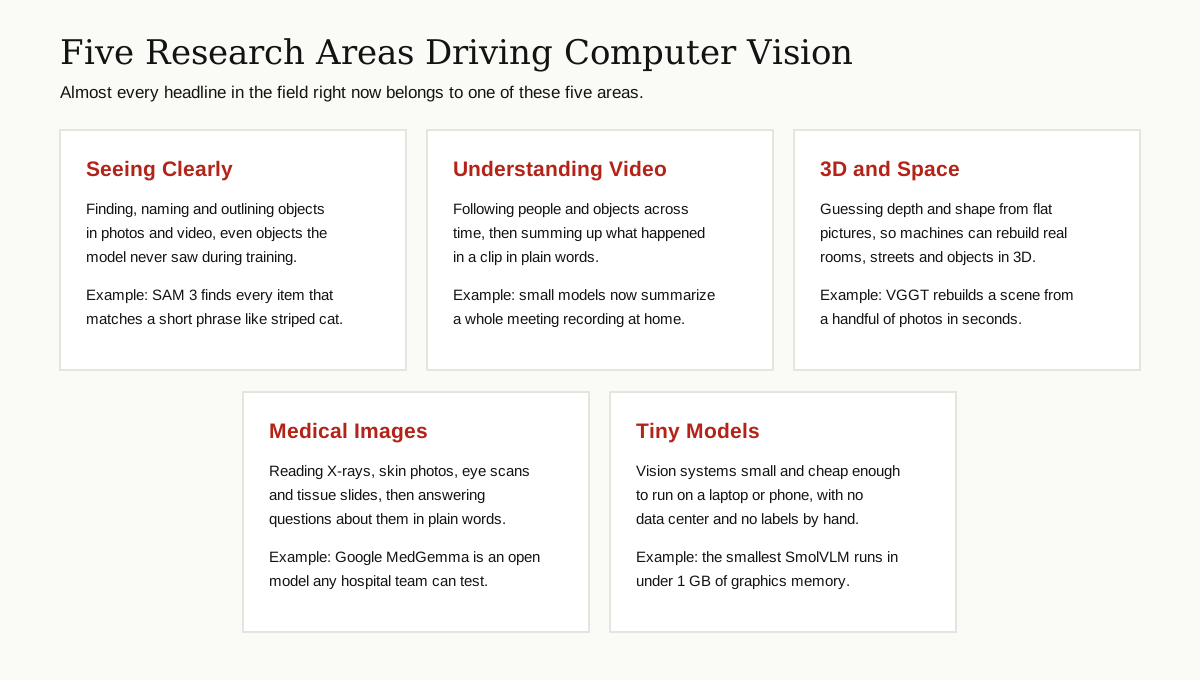
Read together, this year’s computer vision research news points in four clear directions.
Vision and language are merging. The strongest new systems read words and pictures together. SAM 3 takes text prompts, MedGemma answers questions about scans, and SmolVLM chats about photos and clips. The same merger powers consumer tools covered in our guide to computer vision applications and our explainer on how AI visual search works.
Video is the new frontier. The race is about memory: how long a model can follow objects and keep a scene consistent. SAM 3 tracks concepts through video, SmolVLM2 summarizes clips, and Genie 3 holds a world together for minutes.
Space is the third sense. Depth and 3D used to be side topics. VGGT, SAM 3D and world models made spatial understanding a headline area, because robots and glasses need it.
Open is the default. Nearly every story above shipped code, weights or a public test set. That openness is why claims in this field get checked faster than in most of AI.
From Paper to Product
Research reaches real life through a fairly reliable pipeline, and this year’s stories sit at different points along it. SAM 3 already powers creator tools: coverage of the launch noted Meta demonstrating it inside its Edits app for isolating subjects in video. DINOv3 jumped straight into field work with the World Resources Institute and NASA’s Jet Propulsion Laboratory. SmolVLM runs today on ordinary laptops through free apps. MedGemma is earlier in the pipeline, in the hands of developers who must still validate it before any clinical use.
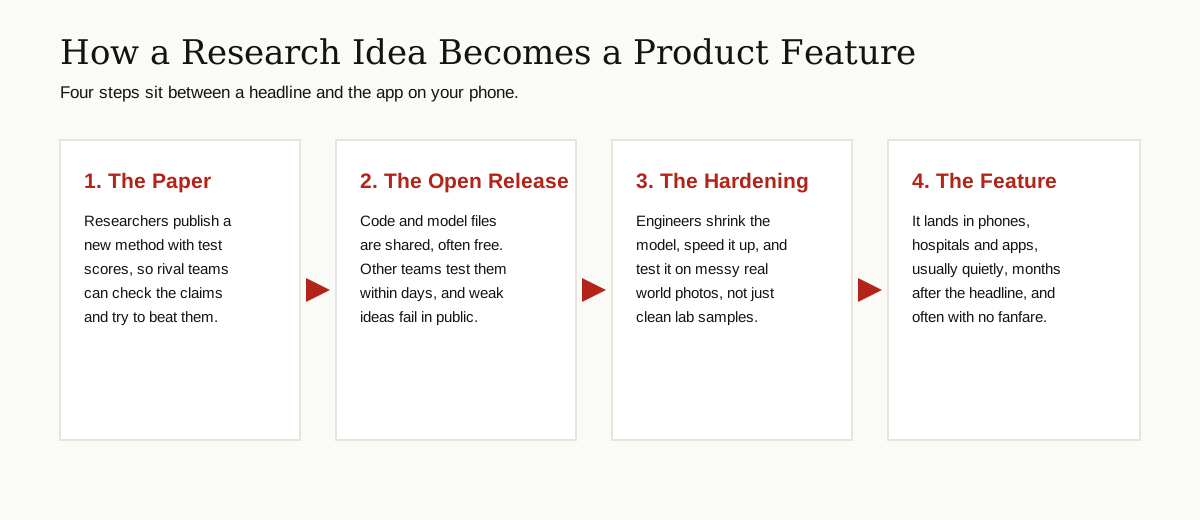
The pattern to remember: the headline is step one, not the finish line. The releases worth trusting are the ones that survive steps two and three, public testing and real world hardening.
Open Problems Researchers Admit
For all the progress, honest papers and lab blogs keep returning to the same four problems, and they are worth knowing before the next headline lands.
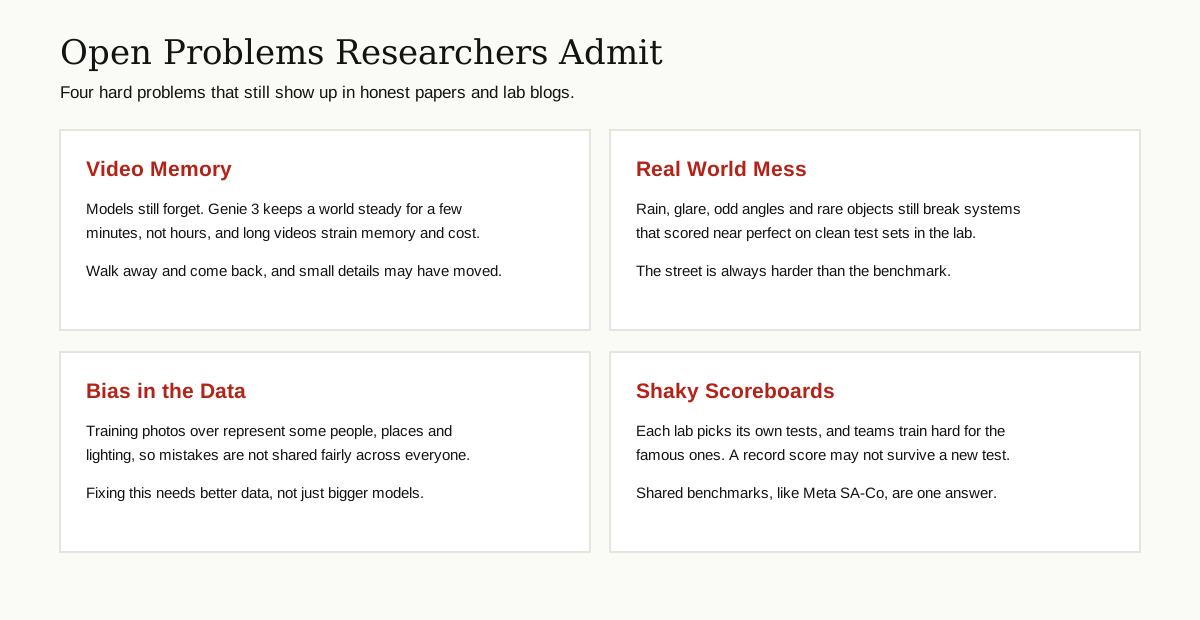
Video memory is the clearest one: minutes of consistency is progress, but films, security footage and robot shifts run for hours. Real world mess is the second: rain, glare and strange angles still fool systems that ace lab tests. Bias is the third: training photos over represent some people and places, so errors fall unevenly. And the scoreboards themselves are the fourth: with every lab choosing its own tests, shared benchmarks like SA-Co matter more than any single record score.
What to Watch Next
The next wave of computer vision research news is easy to spot if you know the calendar. Watch for longer video memory from the world model teams, for SAM family updates as other labs answer Meta’s concept idea, and for medical models moving from open release toward regulated clinical trials. Conference season will bring the next VGGT moment, most likely at CVPR in June 2026. Vision also keeps colliding with language models, so our LLM news roundup is worth reading alongside this one.
Conclusion
The computer vision research news that matters most is rarely the loudest. This year it was a model that outlines anything you can name, eyes that learned from 1.7 billion unlabeled photos, a best paper that rebuilds 3D scenes in seconds, a walkable world model, open medical models, and vision systems small enough for a laptop. Different labs, different goals, one shared direction: machines that see more, with less help, in more places. We will keep checking the claims, one release at a time.