Every year, new practice platforms promise to replace books completely. Yet the same handful of books keeps showing up in success stories from engineers who landed jobs at top companies. There is a simple reason. A platform gives you problems. A good book teaches you how to think about problems you have never seen, in a sensible order, with the reasoning shown step by step.
This guide to the best coding interview books covers the classics that are still worth your money and time. Every fact below was checked against the publisher or the authors themselves: editions, years, question counts and what is actually inside. For each book you get the honest limits too, because no book is right for everyone.
Quick Picks: The Short List
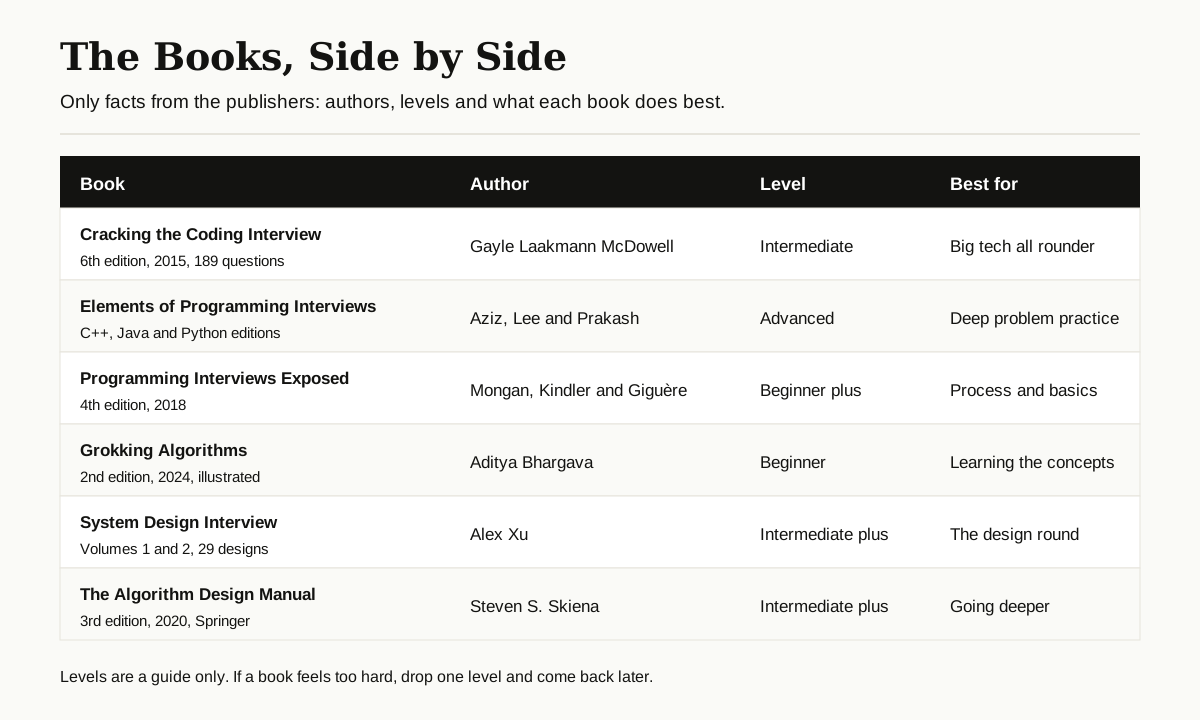
Short on time? Start here. These six books cover almost every goal, from your first data structures course to a senior level design round.
| Book | Author | Best for | Level |
|---|---|---|---|
| Cracking the Coding Interview | Gayle Laakmann McDowell | Big tech all rounder | Intermediate |
| Elements of Programming Interviews | Adnan Aziz, Tsung-Hsien Lee, Amit Prakash | Deep problem practice | Advanced |
| Programming Interviews Exposed | John Mongan, Noah Suojanen Kindler, Eric Giguère | The interview process | Beginner to intermediate |
| Grokking Algorithms | Aditya Bhargava | Learning concepts visually | Beginner |
| System Design Interview | Alex Xu | The design round | Intermediate to advanced |
| The Algorithm Design Manual | Steven S. Skiena | Going deeper on algorithms | Intermediate to advanced |
The Books, One by One
Cracking the Coding Interview, by Gayle Laakmann McDowell
This is the book most people mean when they talk about a programming interview book. McDowell worked as a software engineer and interviewer at Google, Microsoft and Apple, and it shows. The 6th edition, published in 2015 by her own company CareerCup, contains 189 programming questions with detailed solutions.
What makes it special is the teaching method. Each question comes with hints, like the nudges a real interviewer gives you, and the solutions walk through how to derive the answer instead of just printing final code. The book also reviews big O notation, data structures and core algorithms, shares five strategies for attacking problems you have never seen, and looks behind the scenes at how big companies hire. A full section covers the behavioral side, which many candidates ignore until it costs them an offer.
The limits are honest ones. The code is mostly Java, though the ideas transfer to any language. The book is big, and true beginners can feel lost in the first chapters. It also came out in 2015, so it says nothing about newer interview formats. For a standard big tech loop, it is still the safest first purchase.
Elements of Programming Interviews, by Aziz, Lee and Prakash
If Cracking the Coding Interview is the friendly coach, Elements of Programming Interviews is the strict training partner. Written by Adnan Aziz, Tsung-Hsien Lee and Amit Prakash, it comes in separate editions for C++, Java and Python, so you train in the language you will actually interview in.
The Python edition alone packs over 250 problems with detailed solutions, 200 figures and 300 tested programs, plus about 150 extra variants that stretch each problem further. Problems are sorted by topic and difficulty, each one has hints, and the book opens with study plans for different timelines, from a weekend sprint to a full semester. The style is denser and more mathematical than McDowell’s, and the problems are, on average, harder.
That is exactly why experienced engineers love it, and exactly why beginners should wait. If you already write code daily and want the highest difficulty per page, this is your book. If arrays and recursion still feel shaky, start somewhere gentler and come back.
Programming Interviews Exposed, by Mongan, Kindler and Giguère
Now in its 4th edition from 2018, published by Wiley, Programming Interviews Exposed takes a different angle. Authors John Mongan, Noah Suojanen Kindler and Eric Giguère care as much about the process as the problems: how phone screens work, what interviewers are actually listening for, and how to reason out loud so your thinking gets credit even when your code is not perfect.

You still get the classic coverage of linked lists, trees, recursion and sorting, and the fourth edition added material on probability, data science, statistics and machine learning questions. At 384 pages it is the lightest book on this list, which makes it a kind first step, especially for people interviewing outside the giant tech companies.
The trade off is depth. The problem bank is smaller, and strong candidates will outgrow it quickly. Think of it as the best first two weeks of preparation, or a confidence builder before you move to a harder book.
Grokking Algorithms, by Aditya Bhargava
Grokking Algorithms is not really an interview book. It is an illustrated introduction to algorithms, published by Manning, with a second edition released in 2024. Aditya Bhargava explains big O, sorting, recursion, hash tables, graphs, Dijkstra’s algorithm, greedy algorithms, dynamic programming and k-nearest neighbors using more than 400 hand drawn style illustrations and short Python examples. The second edition added full chapters on trees and updated all code to Python 3.

Nothing here is dumbed down, it is just explained the way a patient friend would explain it, with pictures. If you open Cracking the Coding Interview and realize the concepts themselves are the problem, close it, read this first, then go back. You will move twice as fast.
The limit is scope. There is no interview strategy and only light practice, so it cannot be your only book. As a foundation builder, though, nothing else comes close. You can see the full contents on the Manning book page.
System Design Interview, by Alex Xu
Senior and even mid level loops include a system design round, and this is where Alex Xu’s books own the shelf. System Design Interview, Volume 1, published in 2020 by ByteByteGo, teaches a repeatable framework for design questions, then works through 16 designs step by step: a rate limiter, a URL shortener, a web crawler, a notification system, a chat system, YouTube and Google Drive, among others.
Volume 2, from 2022 and co-authored with Sahn Lam, adds 13 harder designs with over 300 diagrams, including a proximity service, Google Maps, a payment system, a digital wallet and a stock exchange. The diagrams are the real star. They make abstract ideas like sharding and queues feel concrete.
Be clear about what this book is not. It contains no coding questions, and it assumes you already know basic building blocks like databases and caches. It is a second phase book, best read alongside your coding practice, or right after it. The authors keep the same visual teaching style on ByteByteGo.
The Algorithm Design Manual, by Steven S. Skiena
The oldest style book here is a university textbook that interview candidates adopted for themselves. Steven Skiena’s The Algorithm Design Manual, in its third edition from Springer in 2020, runs 793 pages and splits in two. The first half teaches you how to design algorithms, told through war stories from real consulting work. The second half, the Hitchhiker’s Guide, is a catalog of the 75 algorithmic problems that show up most often in practice, with pointers to the best known solutions.
Exercises include job interview problems from major software companies, and the code is written in C. This is the book to reach for when you keep asking “but why does this work” and want answers that go one level deeper than interview books usually go.
The cost of that depth is weight, in every sense. It is too much book for a four week deadline, and beginners will drown. Keep it as your reference and your long term upgrade.
Which Book for Which Goal?
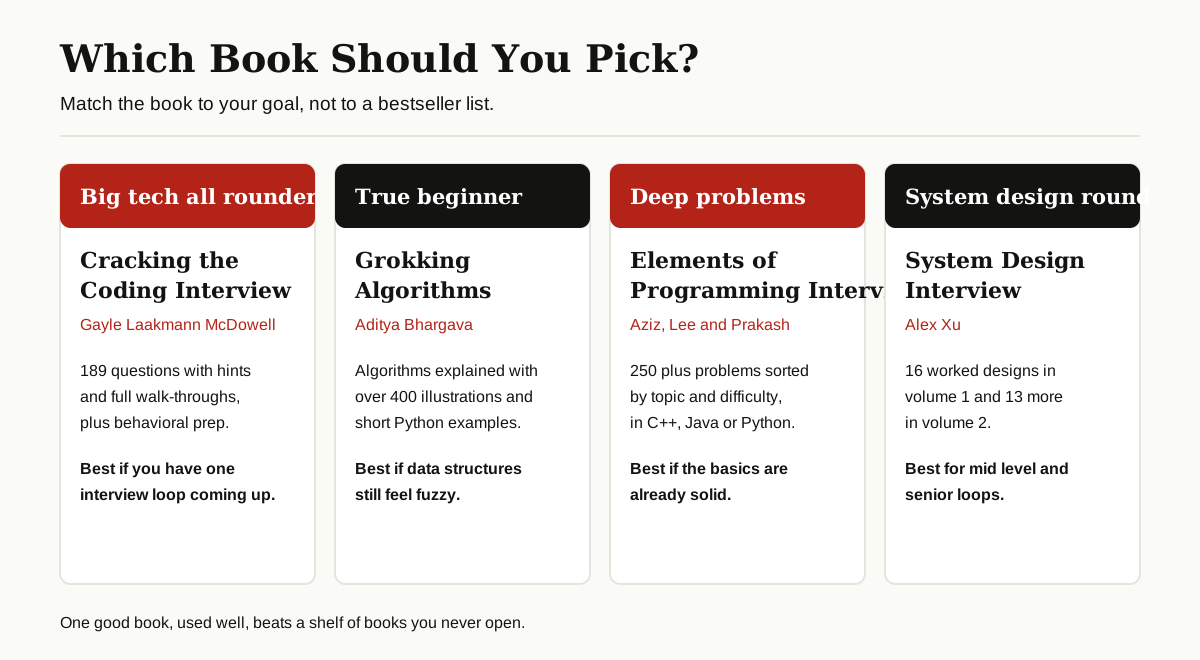
The best coding interview books all do one job well. Pick by the job in front of you:
- One shot at a big tech loop: Cracking the Coding Interview. It is the only book here that covers coding, concepts and behavioral prep in one place.
- Self taught or rusty on fundamentals: Grokking Algorithms first, then Cracking the Coding Interview.
- Strong coder, hard interviews ahead: Elements of Programming Interviews, in your own language edition.
- Nervous about the process itself: Programming Interviews Exposed, for phone screens, communication and approach.
- Senior role with a design round: System Design Interview, both volumes, after your coding base is set.
- Long term mastery: The Algorithm Design Manual, read slowly alongside everything else.
A Simple Study Plan
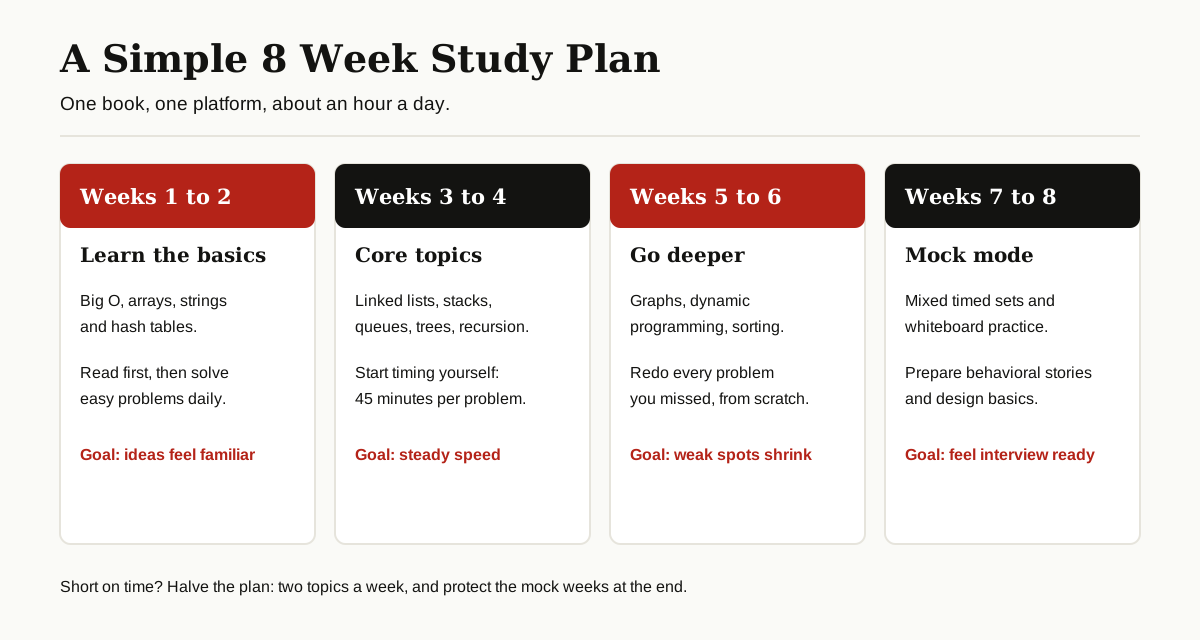
A book without a plan becomes a paperweight. Here is a plain eight week rhythm that works with any of the best coding interview books, at about an hour a day.
Weeks 1 to 2: Learn or refresh the basics. Big O, arrays, strings and hash tables. Read the matching chapters, then solve easy problems until the ideas feel boring.
Weeks 3 to 4: Move to linked lists, stacks, queues, trees and recursion. Start timing yourself, about 45 minutes per problem, and say your reasoning out loud as you go.
Weeks 5 to 6: Tackle graphs, sorting and dynamic programming, the topics most people fear. Keep a mistake list, and redo every missed problem from a blank page.
Weeks 7 to 8: Switch to mock mode. Mixed problem sets under time pressure, whiteboard practice with a friend, behavioral stories prepared, and system design basics if your loop includes them.
Books vs Online Practice Platforms
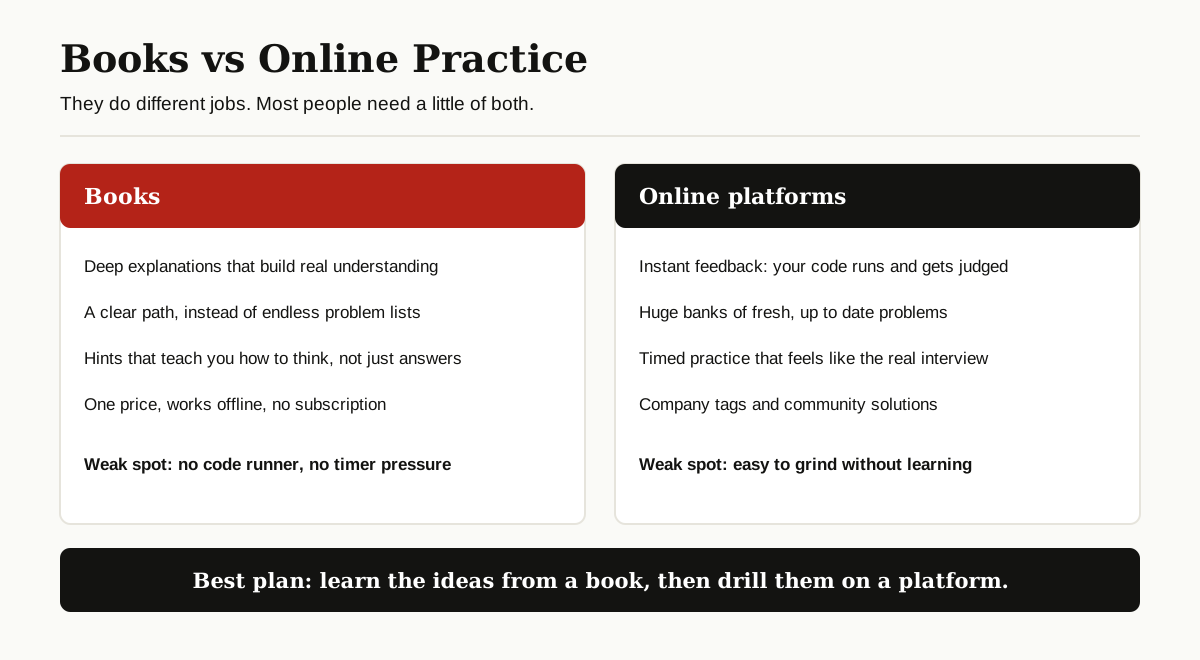
It is tempting to pick a side, but the honest answer is that they do different jobs. The best coding interview books explain why a solution works, in a planned order, with hints designed to teach. Platforms like LeetCode and HackerRank give you something no book can: a code runner, instant verdicts, timers and thousands of fresh problems, including ones tagged by company.
Platforms have a quiet weakness. Without the underlying concepts, it is easy to grind hundreds of problems, memorize patterns you do not understand, and freeze when an interviewer changes one small detail. Books have the opposite weakness. You can feel prepared and still fall apart under a ticking clock.
So use each tool for its strength. Learn from the book in the morning, drill on the platform in the evening. And as our guide to the best AI coding assistants shows, modern AI tools can explain a stuck point or review your code, but they cannot sit the interview for you.
How to Use a Book Well
The difference between people who crack the interview and people who just own the books is method, not talent. Four habits matter most.
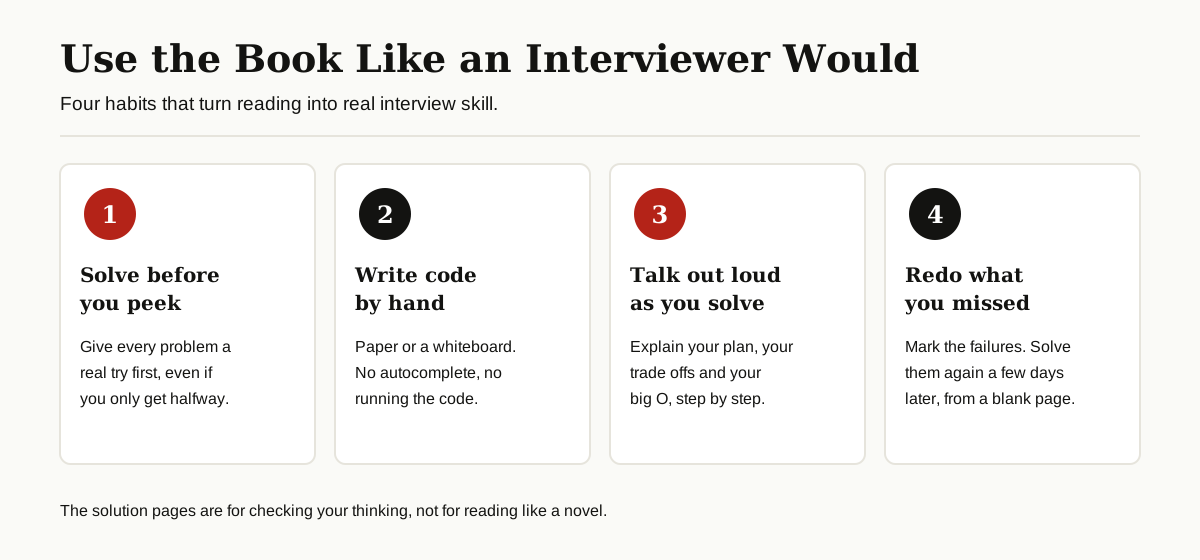
- Solve before you peek. Struggle with each problem for a real stretch of time. Use the book’s hints one at a time, the way an interviewer would offer them.
- Write code by hand. Paper or a whiteboard, no autocomplete, no running it. Then check your work against the solution and note every difference.
- Test like an interviewer is watching. Run mental test cases, including empty inputs and edge cases. Our software testing basics guide shows the mindset.
- Redo your misses. Keep every failed problem in a list, save your attempts somewhere durable like a version control system repo, and solve each one again a few days later without looking.
Mistakes to Avoid
- Reading solutions like a novel. Recognition is not skill. You only know a problem when you can solve it cold.
- Buying five books at once. One book finished beats five books started. Add a second only for a clear gap, like system design.
- Skipping the basics to chase hard problems. Most rejections happen on medium problems done slowly or sloppily, not on the hardest question in the bank.
- Ignoring the non coding rounds. Behavioral answers and clear communication are graded too. Two of the books above cover them for a reason.
- Memorizing answers. Interviewers change the numbers, the constraints and the story. Understanding travels, memorized code does not.
Conclusion
The best coding interview books have survived a decade of free videos and giant problem banks because they teach judgment, not just answers. If you buy one book, make it Cracking the Coding Interview. If you are starting from zero, put Grokking Algorithms in front of it. If you are aiming high, add Elements of Programming Interviews and Alex Xu’s design volumes.
Then do the unglamorous part: one hour a day, problems solved by hand, misses redone until they are easy. That is how a book on a shelf turns into an offer letter.
Looking for more? Browse our other guides in Software Development.