
A short claim has been spreading across posts, podcasts and board decks: AI transformation is a problem of governance, not a problem of technology.
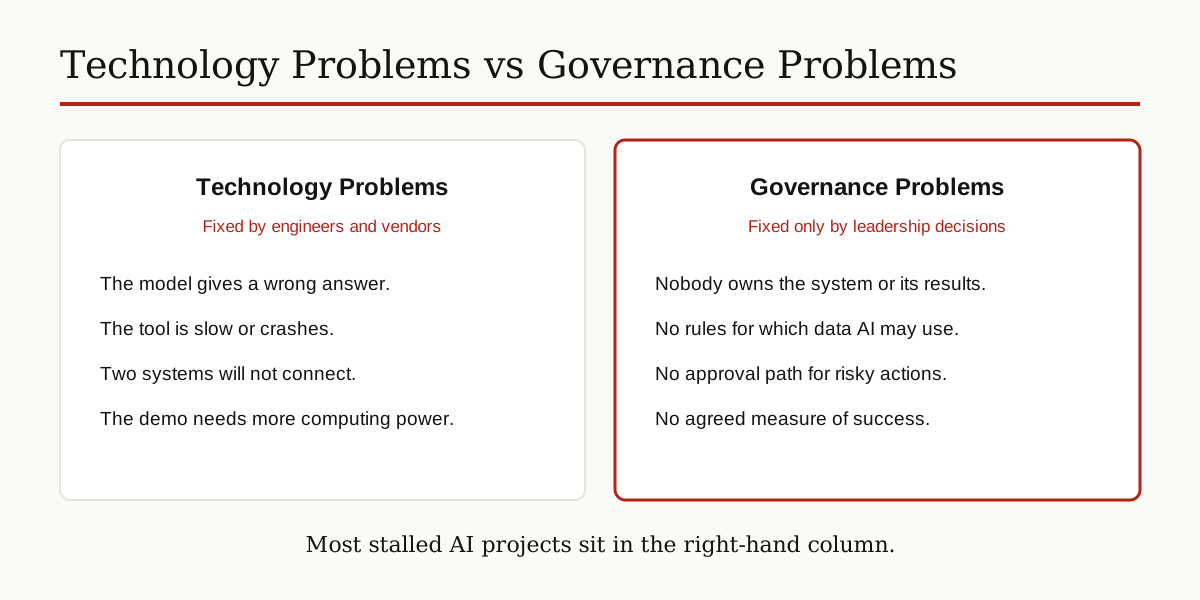
In plain words, it says this. Companies are not failing at AI because the models are too weak or the software is not ready. They are failing because nobody is clearly in charge: nobody has decided who owns each AI system, what it is allowed to do, which data it may touch, and who answers when it goes wrong.
The line spread because it names what people inside stalled projects already feel. The demo worked. The pilot impressed everyone. Then the project hit a wall of unanswered questions, and quietly died. This guide explains where the claim comes from, what the research actually shows, and how leaders fix the problem once they see it.
Where the Claim Comes From
Honesty first: one-liners like this spread in pieces, and no single original post can be pinned down and verified as the source. The phrase moved through posts on X, podcast conversations and essays during 2025 and 2026, picking up support each time a new study landed on the same conclusion.
One of its clearest public champions is Anthony Habayeb, the CEO of Monitaur, a company that sells AI governance software. On The Pre-Read podcast, in an episode titled “Who Owns What Your AI Does?”, he argued that AI transformation is a problem of governance, not technology. His practical point is worth noting: companies do not need to invent a brand new governance system from zero. They need to make better use of the controls their finance and audit teams already run, and aim those controls at AI. Trade publications such as Channel Insider have covered his argument in detail.
Whoever said it first, the idea stuck because the evidence keeps agreeing with it.
What AI Governance Actually Means
Governance sounds like a heavy word, but the idea is simple. AI governance is the set of decisions, roles and rules a company uses to stay in control of its AI.
A company has governance when it can answer five plain questions:
- Who decides where AI gets used in our business?
- Who owns each AI system once it is running?
- Which data is each system allowed to use?
- How much risk is acceptable, and which actions need a human to approve them first?
- How do we check the results, and what happens when something goes wrong?
If those answers are missing or fuzzy, the company does not have governance, no matter how advanced its tools are. IBM’s overview of AI governance describes the same idea as the guardrails that help organizations use AI responsibly and consistently.
One useful distinction: governance is not the same as government regulation. Regulation is the law, written outside the company. Governance is the company’s own house rules. Laws like the EU AI Act matter, and we track them in this category, but a company cannot wait for perfect laws. It has to govern itself now.
The Evidence: Projects Fail on Organization, Not Models
The claim would be just a slogan if the research did not back it up. It does, from several directions at once.

The MIT finding. In 2025, Project NANDA, a research group based at the MIT Media Lab, published a report called The GenAI Divide: State of AI in Business 2025. The team reviewed more than 300 public AI efforts, interviewed executives and surveyed leaders. Their headline finding: about 95 percent of generative AI pilots showed no measurable return on profit and loss, despite an estimated 30 to 40 billion dollars of enterprise spending. The small group that did succeed was not using magically better models. Those companies connected AI to real workflows and real data, and gave it time to adapt to how people actually work.
The abandonment numbers. Surveys from S&P Global Market Intelligence found that 42 percent of companies abandoned most of their AI initiatives in 2025, up sharply from 17 percent the year before. Companies are not short of tools or enthusiasm. They are short of follow-through, and follow-through is a management job.
The Gartner warning. In June 2025, Gartner predicted that over 40 percent of agentic AI projects will be canceled by the end of 2027, naming three causes: escalating costs, unclear business value and inadequate risk controls. Read that list again. None of the three is a model problem. Gartner analyst Anushree Verma put it bluntly: “Most agentic AI projects right now are early stage experiments or proof of concepts that are mostly driven by hype and are often misapplied.”
The RAND root causes. Researchers at the RAND Corporation who studied failed AI projects reached a similar conclusion. The root causes were usually organizational: goals that business and technical teams never agreed on, and success defined so poorly that nobody could tell whether the project had worked.
Different researchers, different methods, same fault line. That is why the phrase “AI transformation is a problem of governance” keeps coming back: it summarizes what the data keeps showing.
The 5 Governance Problems That Stall AI Transformation
When you look inside stalled projects, the same five problems appear again and again.
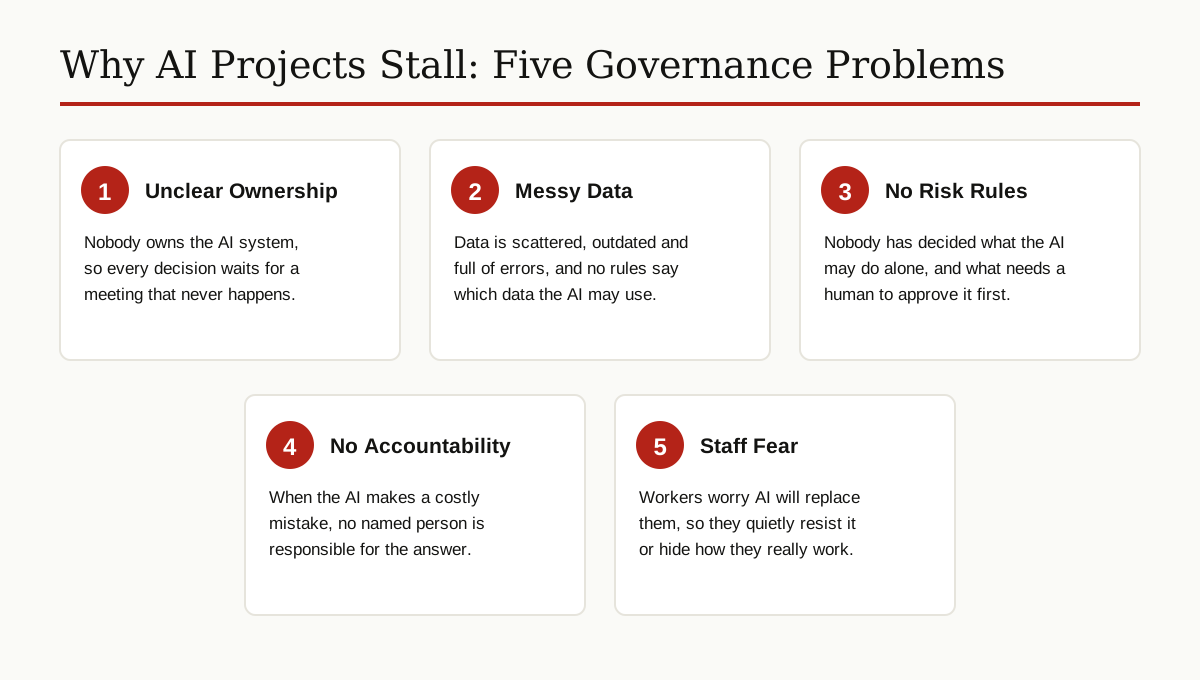
1. Unclear Ownership
The pilot belongs to everyone, which means it belongs to no one. The innovation team built it, IT is supposed to run it, and the business unit was supposed to benefit from it. Every decision needs a meeting, and the project slowly starves.
2. Messy Data, With No Data Rules
AI feeds on data, and company data is usually scattered across systems, outdated and full of errors. Worse, nobody has written down which data each AI system may use. So legal and security teams block launches at the last minute, because the data question was never answered at the start.
3. No Rules for Risk
Nobody has decided what the AI may do on its own and what needs a human signature first. Without that line, cautious leaders do the only safe thing available: they say no to everything, or they delay until the project loses its sponsor.
4. No Accountability
When the AI makes a costly mistake, who stands up and answers for it? In most stalled projects, nobody can say. Often the deeper problem sits underneath: success was never defined in numbers, so no one can be accountable for reaching it, and no one can prove the pilot worked when budget season arrives.
5. Staff Fear and Quiet Resistance
Workers who believe AI is coming for their jobs do not refuse out loud. They cooperate politely and keep their real workarounds hidden, feed the new system poor data, or wait for it to fail. A transformation that never brings its own people along is governing the software and ignoring the humans.
Signs Your Company Has a Governance Problem
You do not need an audit to spot the pattern. If several of these sound familiar, governance is the bottleneck, whatever the technology budget says.
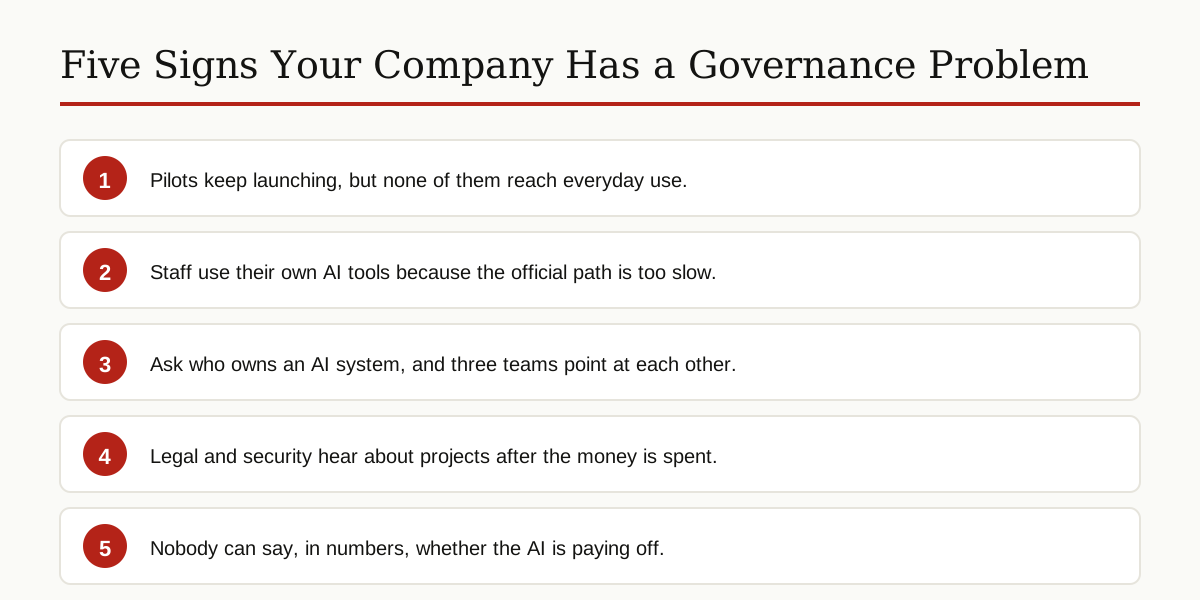
Pilots multiply but never graduate. Employees adopt their own AI tools in secret because official approvals take months. Legal hears about projects after the contract is signed. And when leaders ask what all the AI spending has delivered, the room goes quiet, because nobody agreed on the scoreboard at the start.
How Leaders Fix It, Step by Step
The good news: governance problems are leadership problems, and leadership problems can be fixed with decisions. Here is the sequence that works, in order.
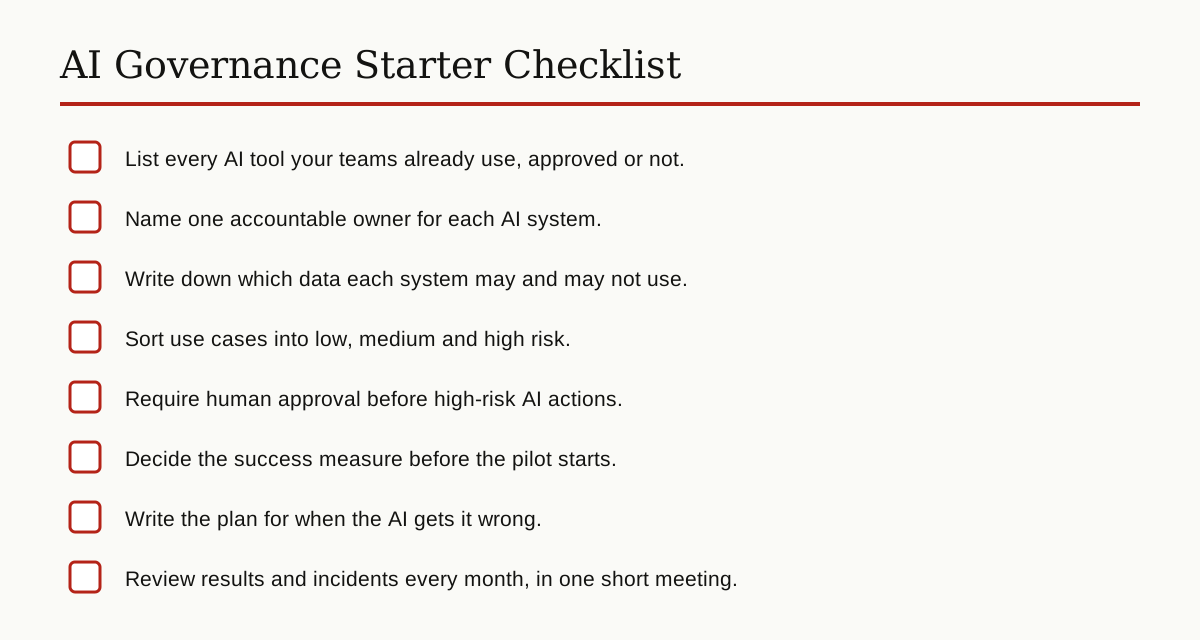
- Take an honest inventory. List every AI tool in use, including the unofficial ones staff signed up for themselves. You cannot govern what you cannot see.
- Name an owner for every system. One real person, with a name, who is accountable for results and for problems. Not a committee.
- Write the data rules. For each system, state plainly which data it may use, which data is off limits, and how long outputs and logs are kept.
- Sort use cases by risk. A tool that drafts meeting notes is not in the same class as a system that approves loans or talks to customers alone. Low risk gets a fast lane. High risk gets human approval, testing and monitoring.
- Define success before the pilot starts. One number, one owner, one date. This single habit kills the endless pilot, because everyone knows in advance what “it worked” means.
- Start narrow, then expand. Pick one painful, well-defined problem and solve it completely before scaling. This is exactly the approach in our guide to building agentic AI applications with a problem-first approach.
- Review on a schedule. A short monthly review of results, costs and incidents keeps small problems small, and builds the evidence leaders need to fund the next stage.
Notice what is not on this list: buying a bigger model. The technology step comes after the decisions, which is the whole point of saying AI transformation is a problem of governance.
Governance Without Killing Speed
The most common objection is that governance will slow everything down. Done badly, it does. Done well, it is the thing that removes delay.
Think of it as lanes on a road. Low-risk, proven uses get a green lane: pre-approved tools, pre-approved data, no fresh paperwork each time. New or risky uses get a careful review, once, and then they can join the fast lane too. Teams move quickly because the answers already exist, instead of renegotiating every question on every project.

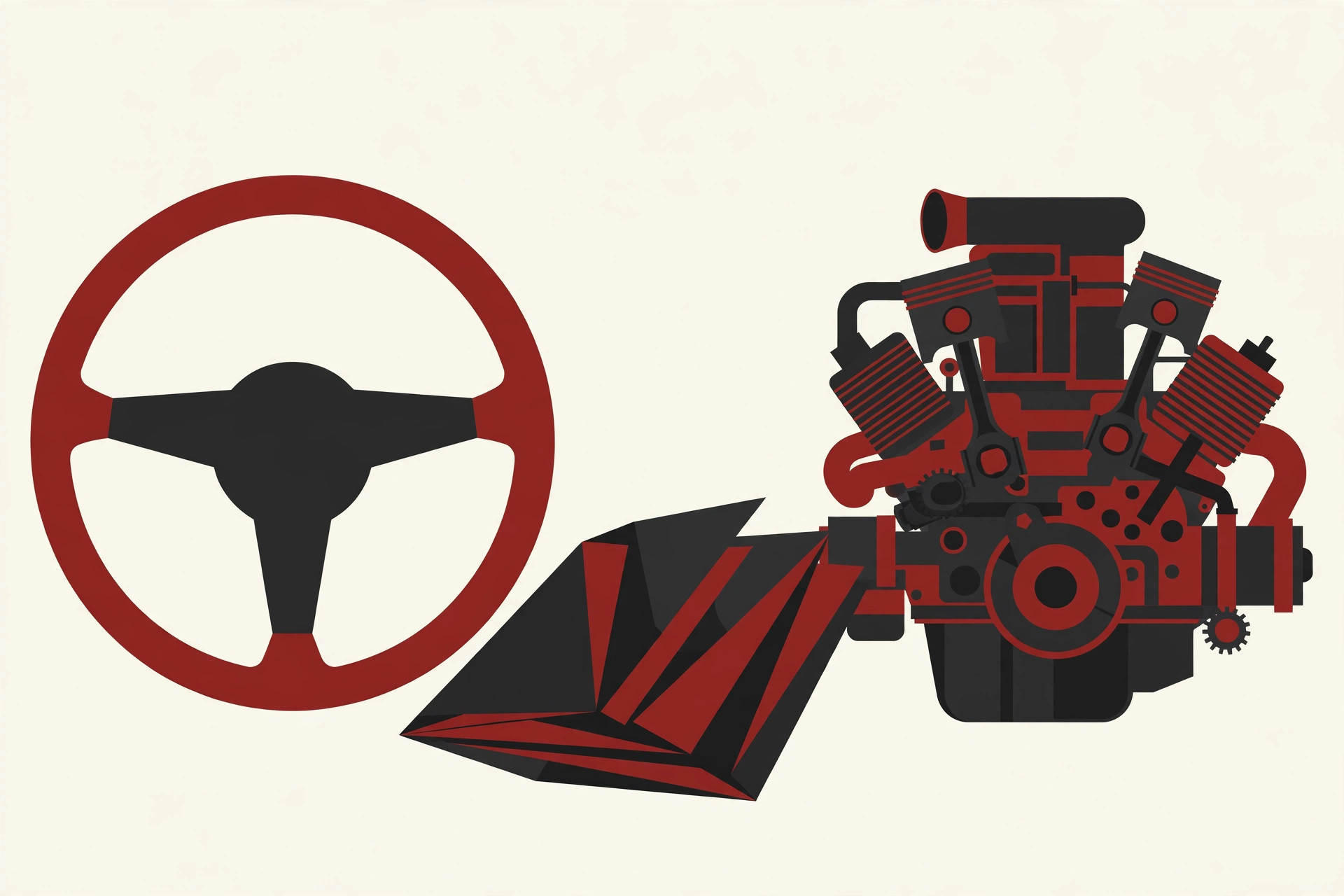
This balance matters even more as AI starts acting on its own. An agentic AI system can book, buy, send and change things without waiting for a person. The practical use cases for agentic AI are exciting precisely because the systems act, and acting systems need boundaries set in advance: spending limits, approval steps and logs. With agents, governance is not the brake. It is the steering wheel.
A Simple Starter Framework
You do not need a hundred-page policy to begin. If AI transformation is a problem of governance, the fix has to be a working system, not another slogan. Five building blocks cover most of what stalled projects are missing.
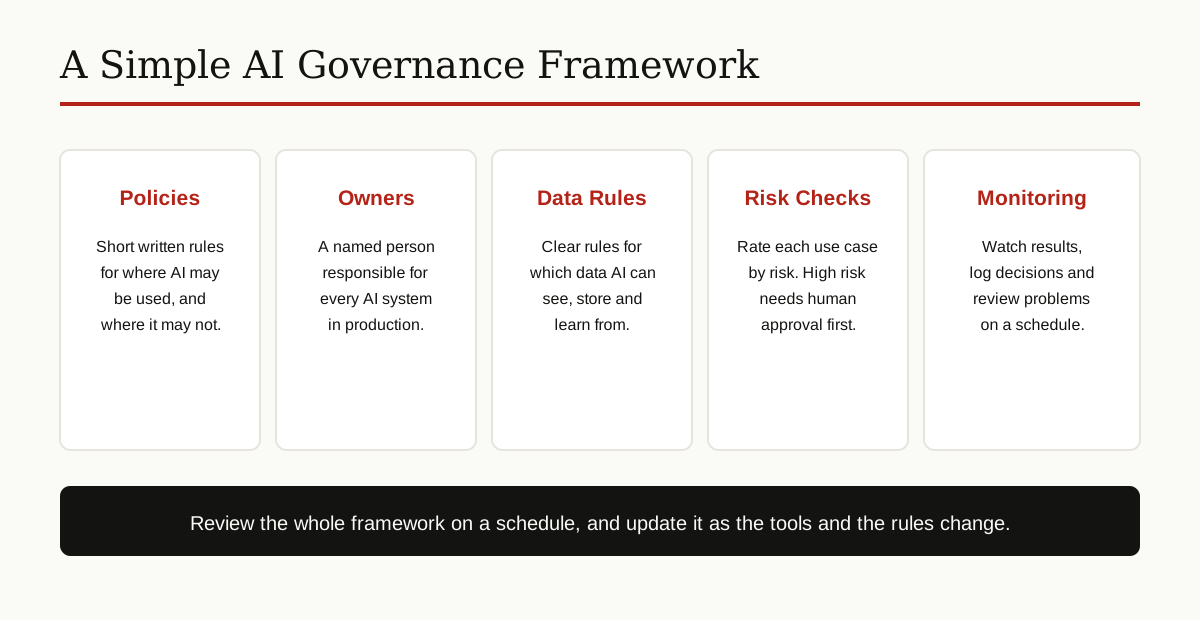
Policies say where AI may be used and where it may not. Owners make every system somebody’s clear responsibility. Data rules control what the AI can see and keep. Risk checks match the level of caution to the level of danger. Monitoring watches results after launch, because a system that was safe in January can drift by June.
Turn those blocks into habits with a one-page checklist your leadership team reviews monthly.
The Bottom Line
The viral line survives because it is true in the way that matters: the technology is available to everyone at falling prices, so it cannot be the thing that separates winners from losers. When people say AI transformation is a problem of governance, this is what they mean: the hard part was never the model, it is the management wrapped around it. The separator is whether a company has decided who is in charge, what the rules are, and how success gets measured. In short, its governance.
If your AI projects keep stalling, resist the urge to shop for a better model. Spend one hour on the five questions in this guide instead. Who decides? Who owns it? What data is allowed? What needs human approval? How will we know it worked? Companies that can answer those questions find that the technology suddenly starts working too.
For more on how rules and policy are reshaping AI, browse our AI news and regulation coverage.