If you draw, film, design or compose for a living, few years have moved as fast as the one covered in this roundup. AI image models got sharper, AI video learned to talk, design apps learned to build working prototypes, and the music business went from suing AI companies to signing contracts with them.
This is our plain English tour of AI creative tools news that actually matters: the launches, the legal turns and the small print that changes how you can use the results. Every item is dated, and every claim is pinned to the company that made it or the outlet that reported it. If you also make AI portraits and avatars, you may enjoy our earlier guide to Vheer AI after this one.
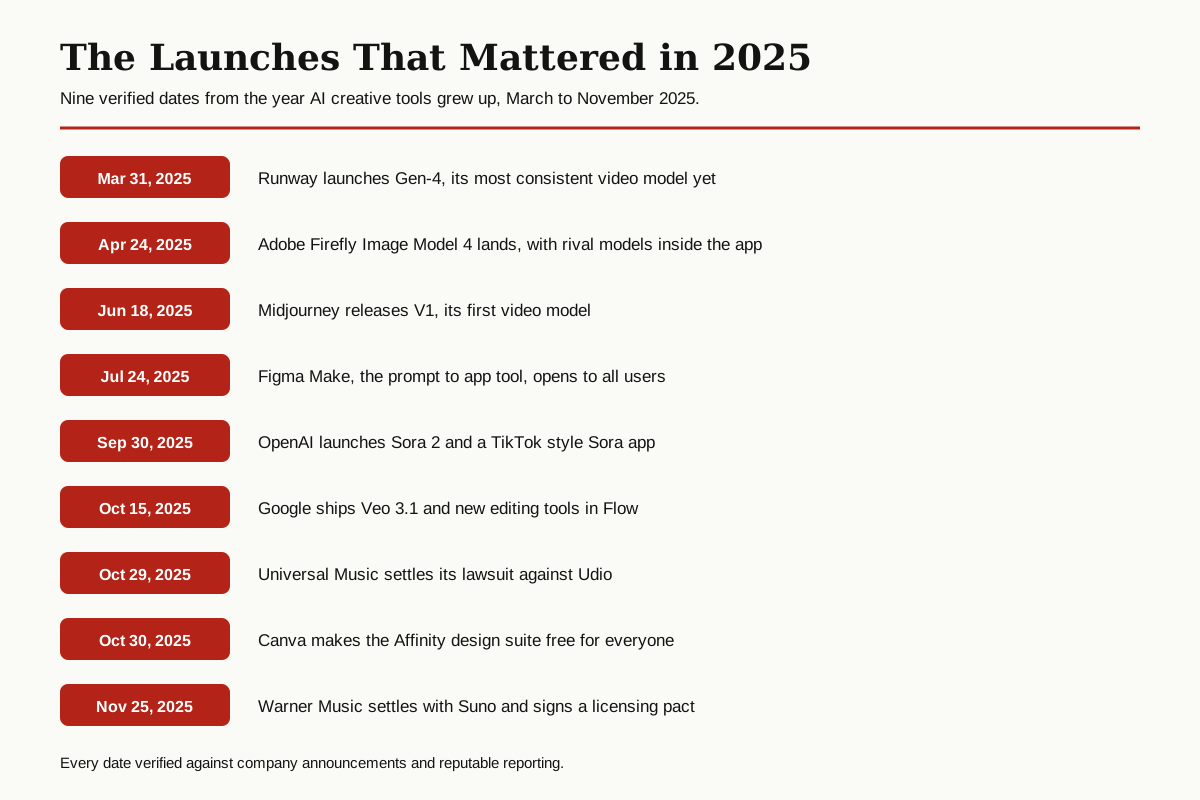
Image Tools: Sharper Pictures, Rival Models Under One Roof
The image story of 2025 was less about one magic model and more about where models live. On April 24, 2025, at its MAX London event, Adobe launched Firefly Image Model 4 and Firefly Image Model 4 Ultra. Adobe says the standard model is its fastest and most controllable yet, with images up to 2K resolution, while Ultra is built for complex scenes full of small details. The Firefly video model also became generally available, and a moodboarding tool called Firefly Boards opened in public beta.
The bigger surprise was the guest list. The redesigned Firefly app now lets you generate with rival models inside Adobe’s walls, including OpenAI’s GPT image generation, Google’s Imagen 3 and Veo 2, and Flux 1.1 Pro, with more partners promised. Adobe’s pitch for its own models stays the same: Firefly models are trained on licensed Adobe Stock and public domain content, which Adobe markets as the commercially safer route. Partner models, Adobe notes, follow their own terms.
OpenAI’s own image tool had its viral moment in March 2025, when image generation inside ChatGPT sparked a flood of anime style portraits of users and their families. The fun came with a debate that follows this whole article: copying a famous studio’s style may feel harmless, but the artists whose work defined that style were never asked.
Midjourney, the image tool many digital artists still reach for first, kept polishing its signature look. Its bigger move, into video, is in the next section, along with the lawsuit that landed one week before it.
Video Tools: The Loudest Year Yet
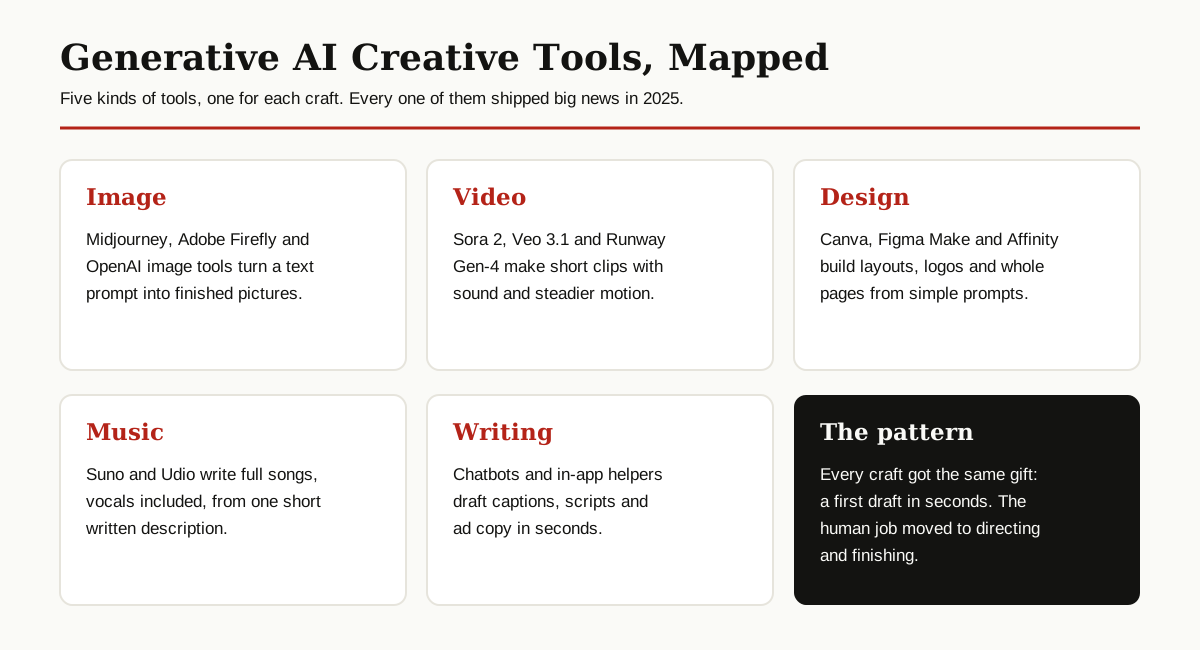
No part of AI creative tools news was louder than video. The headline act was OpenAI’s Sora 2, launched on September 30, 2025. OpenAI calls it more physically accurate, more realistic and more controllable than the first Sora, and for the first time the videos arrive with synchronized sound: dialogue, background noise and effects generated with the picture.
Sora 2 did not arrive quietly inside ChatGPT. It came with its own social app, called Sora, first offered to iPhone users in the United States and Canada by invite. The star feature, called cameo, lets you record a short clip of yourself so the app can place your face and voice inside generated scenes. OpenAI said the app passed one million downloads in under five days, faster than ChatGPT itself, and it topped the United States App Store chart.
The fun lasted about a week before the lawyers arrived. Feeds filled with clips of famous film and cartoon characters, and Hollywood agencies and unions pushed back. OpenAI responded that rightsholders would get more detailed control over how their characters appear. We covered that week in depth in our AI news today October 12 2025 roundup.
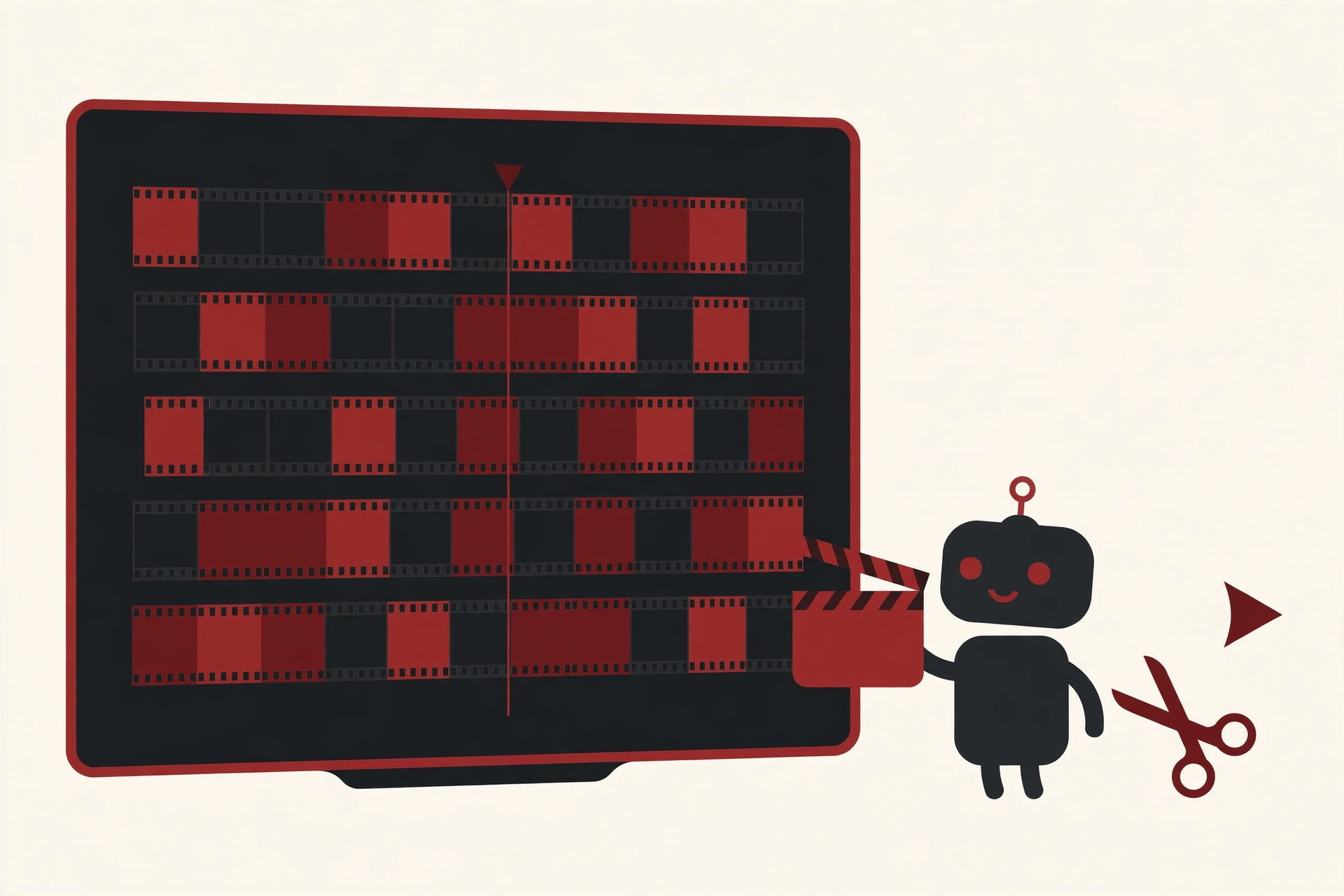
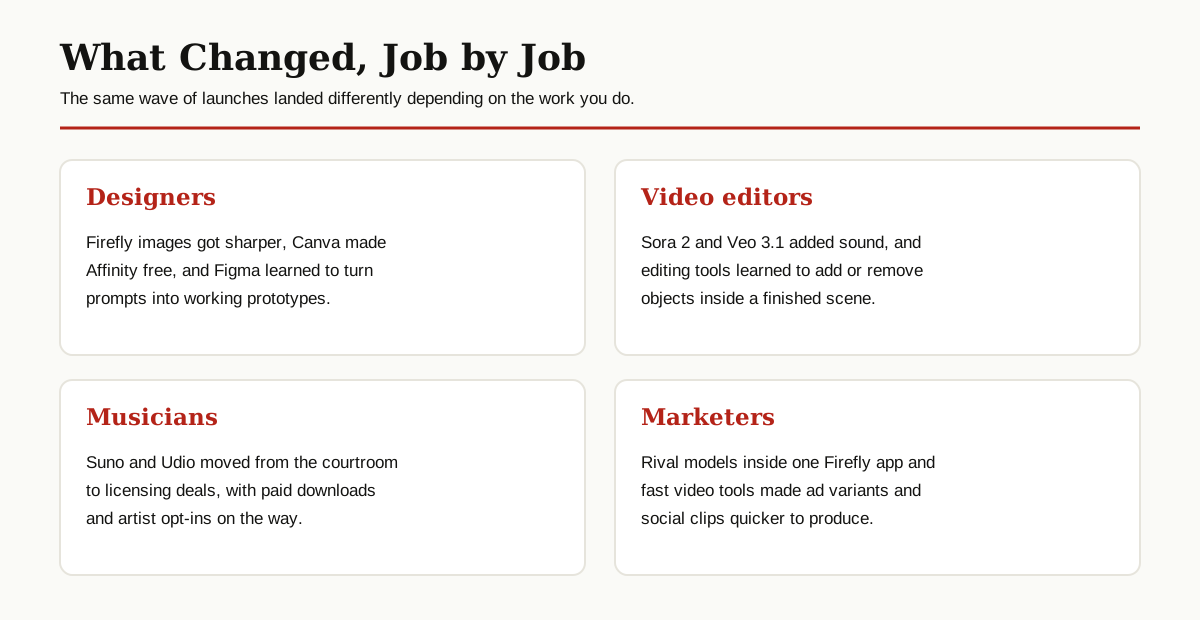
Google answered on October 15, 2025 with Veo 3.1, released in its Flow filmmaking tool, the Gemini app and its developer APIs. The update added audio to tools that were silent before, including Ingredients to Video, which blends people and objects from several reference images into one scene, and Frames to Video, which builds the motion between a first and last image. Flow also gained editing tricks creators asked for: Insert adds an object with matching light and shadow, Remove erases one and rebuilds the scene behind it, and Extend keeps a shot rolling past the standard eight seconds. Google said Flow users had already generated more than 275 million videos in the tool’s first five months. It was one of the headline stories in our latest AI news October 2025 roundup.
Runway, the tool many filmmakers started with, moved earlier. Its Gen-4 model launched on March 31, 2025, and Runway says its References feature can keep the same character, place or object consistent across scenes from a single reference image. In July 2025 the company announced Aleph, a model that edits footage you already have: type a request, and it can remove an object, change the lighting or generate a new camera angle. Aleph rolled out first to enterprise and creative partner users. Runway also shipped Gen-4 Turbo, a faster variant the company says can produce a ten second clip in about thirty seconds, which matters when you are testing five versions of one shot.
And Midjourney joined the race on June 18, 2025 with V1, its first video model. As PetaPixel reported, V1 animates a still image into a five second clip, with low or high motion settings, and clips can be extended in small steps up to 21 seconds. Midjourney said a video job costs about eight times an image job, and founder David Holz called V1 a stepping stone toward real time open world simulations.
Design Tools: Prompts That Build, and a Pro Suite Gone Free
Design tools wrote quieter AI creative tools news, but it may change daily work the most. On July 24, 2025, Figma announced that Figma Make was available to all users. Make turns a written prompt, plus your existing designs if you attach them, into a working, clickable prototype rather than a flat picture. Figma’s other AI features also left beta the same day, and the company introduced AI credits to meter heavier use. Figma Sites, for publishing real websites from a design, stayed in beta.
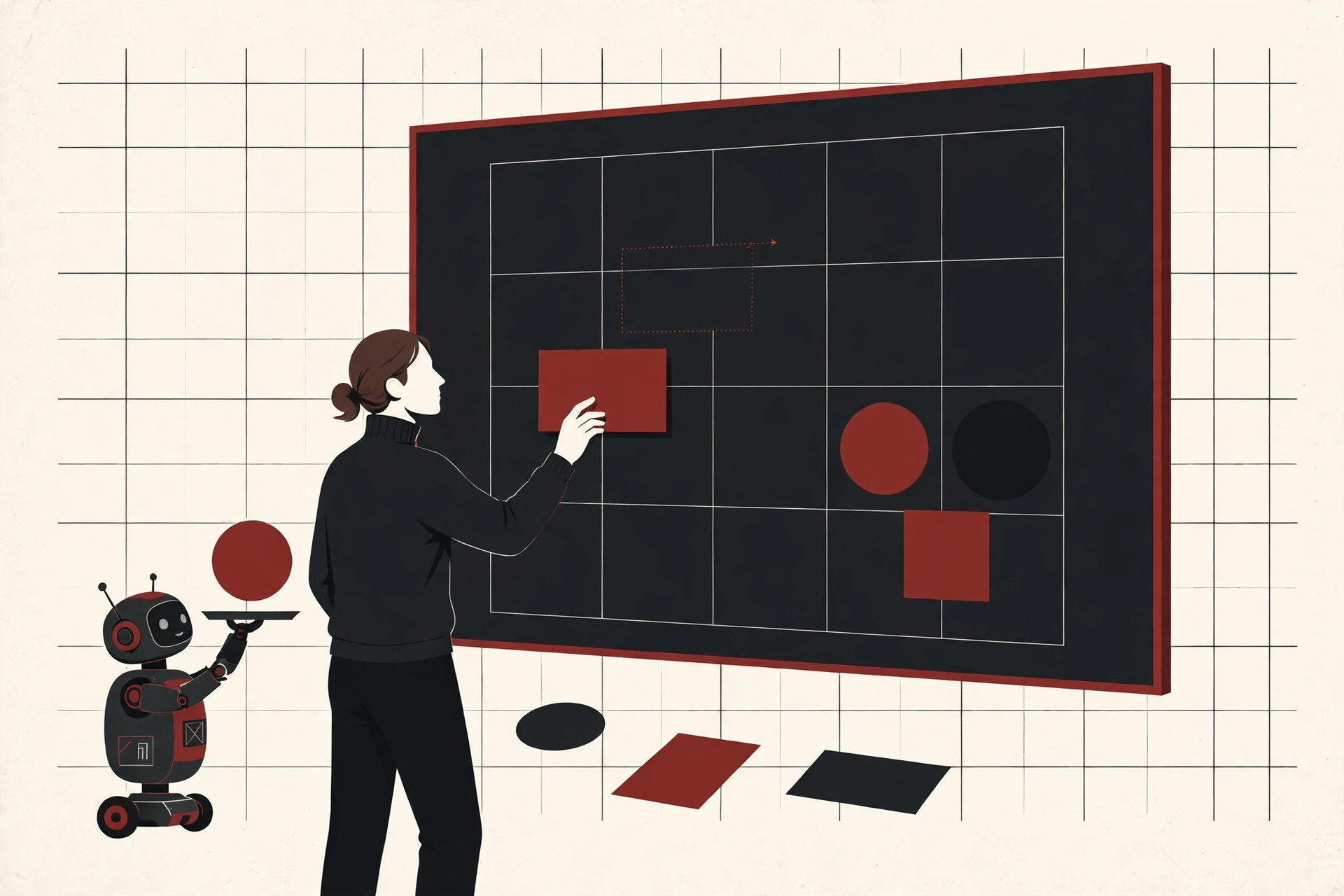
Canva took two swings. In April 2025 it launched Canva AI, an assistant that generates designs, images and even simple code from a prompt. Then, on October 30, 2025, Canva unveiled what it calls its Creative Operating System, including its own design model that, Canva says, produces designs as editable layers instead of flat images.
The same day brought the year’s best bargain. Affinity, the professional suite Canva bought in 2024, was relaunched as a single app combining vector design, photo editing and page layout, and made completely free. The catch is small and stated clearly: the Canva AI features inside Affinity, such as generative fill, need a paid Canva plan. For freelancers who pay Adobe every month, a free and capable rival is real news.
Music Tools: From the Courtroom to the Contract
Music is where AI creative tools news took its sharpest legal turn. Start with the background: in June 2024, the major record labels, acting through the RIAA, sued Suno and Udio, the two best known AI song generators. The labels said both companies trained their models on copyrighted recordings without permission, and the complaints asked for damages of up to 150,000 dollars per song.
Through late 2025 the lawsuits started turning into deals. On October 29, 2025, Universal Music Group settled with Udio. The pair announced a licensing agreement and a new, licensed version of Udio’s service planned for 2026. While it prepares that platform, Udio paused downloads, so songs made there stay inside the app for now. Warner Music Group followed with its own Udio settlement on November 19, 2025.
Six days later, on November 25, 2025, Warner settled with Suno too, in what Warner called a landmark pact. Suno agreed to launch new, licensed models in 2026 that will replace its current ones. Warner’s artists and songwriters can opt in before their names, images, voices or compositions are used, and downloading audio will require a paid account, with monthly caps on paid plans. In a twist nobody predicted, Suno also acquired Songkick, Warner’s concert discovery app.
Be clear about what did not happen. Sony Music settled with nobody and is still suing both Suno and Udio, and Universal is still in court against Suno. The settlements are confirmed; a full peace treaty is not.
The Copyright Thread Running Through All of It
One question sits under almost every story above: can an AI company train on creative work it did not license? The tool makers argue that training is fair use under United States law, a bit like a student learning by studying the greats. Creators answer that a student does not then open a shop selling endless copies in their style. No court has given the final word yet, which is why the settlements matter: they pay for peace without settling the principle.
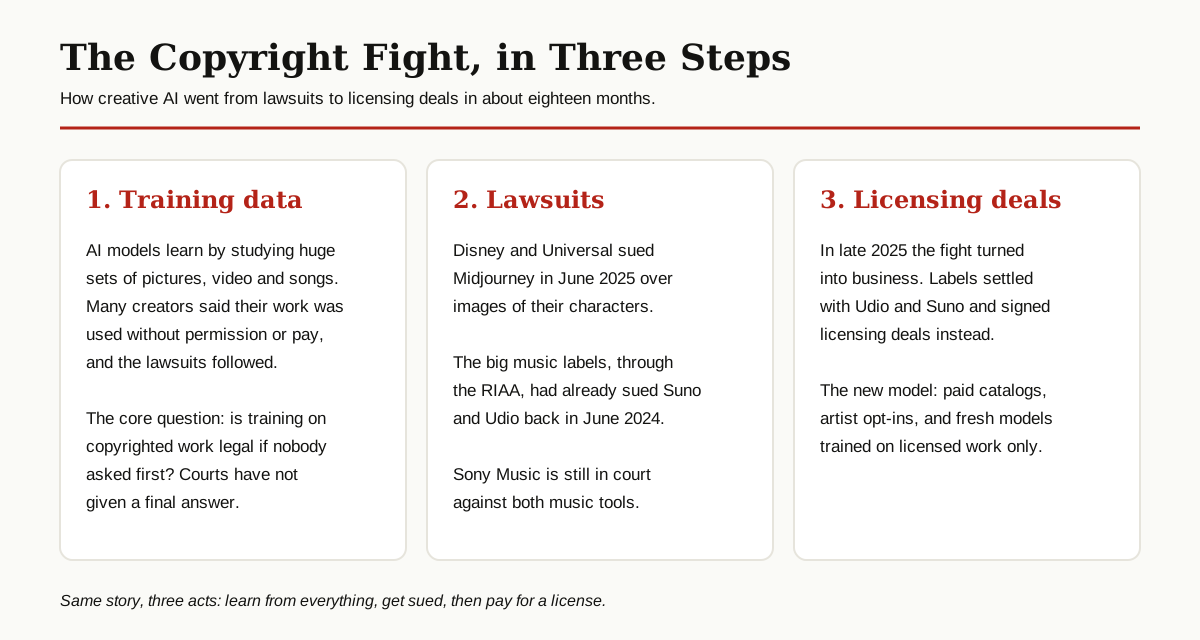
Hollywood tested the same question in images. On June 11, 2025, just a week before Midjourney launched V1, Disney and Universal sued the company, calling it a bottomless pit of plagiarism in their complaint and pointing to generated images of their famous characters. Warner Bros. Discovery filed a similar suit later in the year. Midjourney disputes the claims, and the cases are still running.
The practical response, everywhere, is paper trails. Sora clips carry visible watermarks and C2PA origin data, Google marks Veo output with its SynthID watermark, and Adobe attaches content credentials that say which model made an image. The labels, meanwhile, are building the licensed lane: opt-ins, paid catalogs and models trained on cleared music. If you sell creative work, that lane is the safer road.
What Creators Should Do With This News
So what should you do with all of it? A few habits will keep you on the right side of a fast moving story:
- Pick tools by their training story. For paid client work, a model trained on licensed material is a safer bet than one still fighting in court.
- Keep famous characters and voices out of client work. A cartoon mouse in a client ad is a legal risk, whatever app made it.
- Read the download rules before you build on a tool. Udio paused downloads after its settlement, and Suno downloads are set to become paid only. A tool that cannot export is a toy, not a pipeline.
- Save your receipts. Keep your prompts, plan details and license terms for the work you deliver. Clients are starting to ask how assets were made.
- Learn to direct. References, storyboards and clear notes now matter more than button skills, because the models supply the first draft.
What to Watch Next
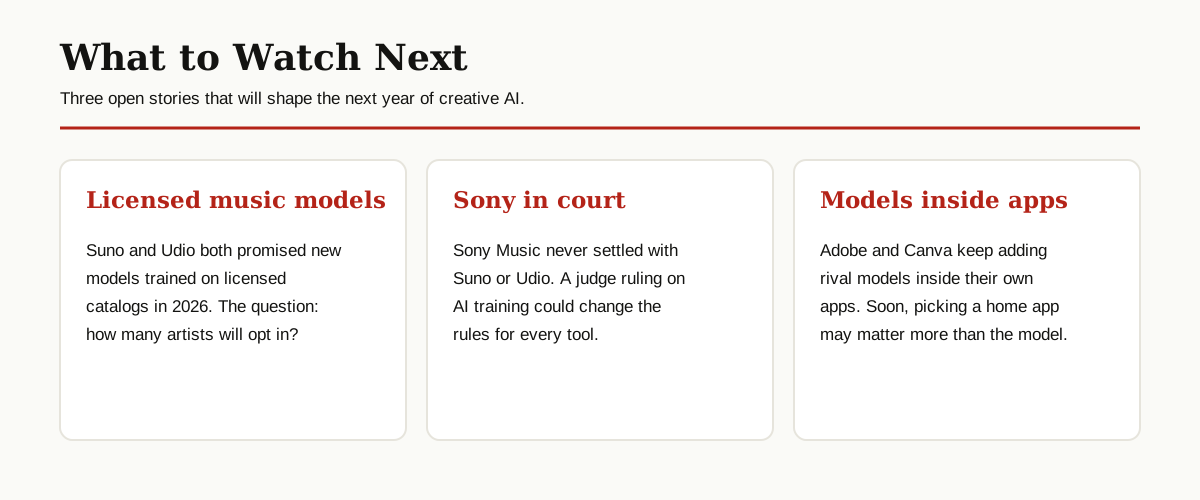
Three stories will decide how 2026 feels. First, the licensed music models promised by Suno and Udio: if big artists opt in, AI songs gain a legal catalog; if they stay away, the catalogs stay thin. Second, Sony’s court cases: one clear ruling on training could reset the rules for every tool in this article. Third, the app wars: Adobe and Canva keep adding rival models inside their own apps, so your home app may soon matter more than any single model.
Conclusion
Read together, the AI creative tools news of 2025 tells one story. The tools got dramatically better: video with sound, consistent characters, designs you can edit layer by layer, and a pro design suite that costs nothing. At the same time, the rules got real, as lawsuits turned into licenses and watermarks became standard practice. Creators who learn both halves, the making and the rights, are the ones this wave will reward. We will keep updating this page as the licensed music models ship and the remaining court cases move. For the wider world of AI rules and rulings, keep an eye on our AI News and Regulation coverage.