People still search for AI news today, October 12, 2025, because that date sat in the middle of one of the busiest weeks the AI world had seen. This article is a look back at that specific week, roughly October 9 to October 15, 2025, plus the Monday just before it, because several of the week’s biggest stories broke on October 6 and were still unfolding on the Sunday in between.
So treat this as a time capsule, not a live feed. Every story below carries its real date and the source that reported it, so you can see exactly what readers of AI news today, October 12, 2025 were waking up to. For the wider view of the whole month, our October 2025 AI news roundup covers the full four weeks at a higher level. This page goes deeper on one week inside it.
The Top Stories of That Week
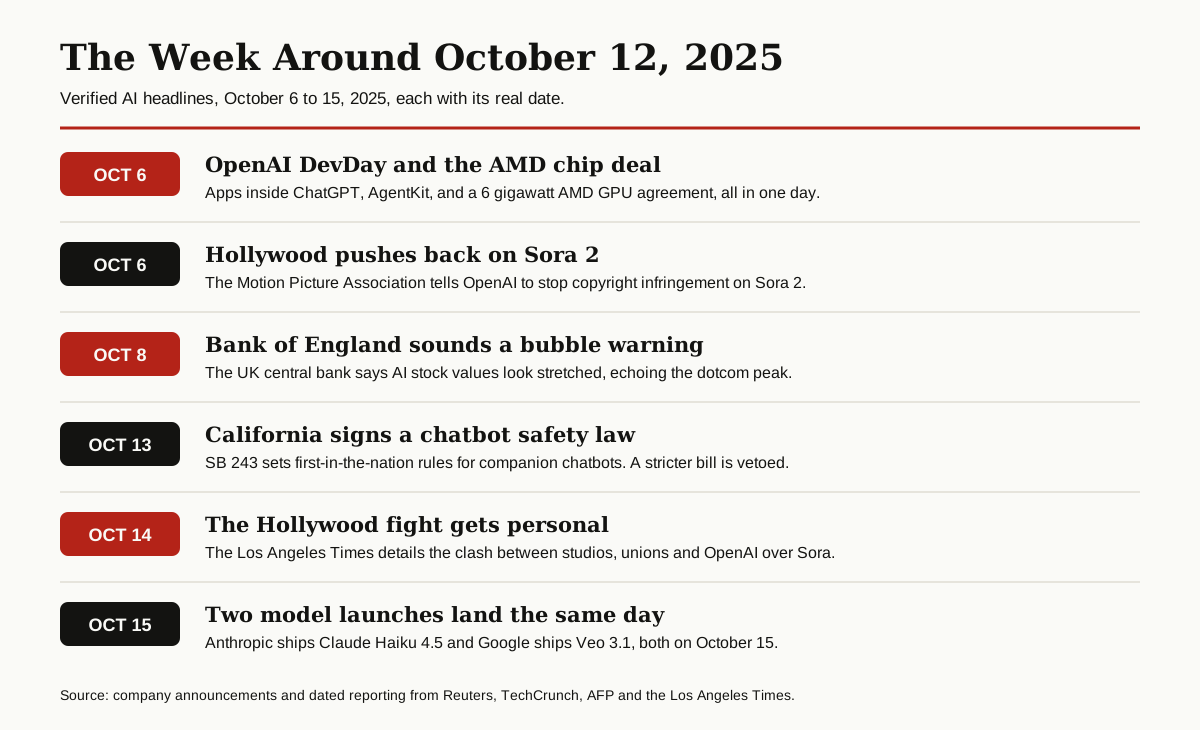
OpenAI DevDay Turns ChatGPT Into a Platform (Monday, October 6)
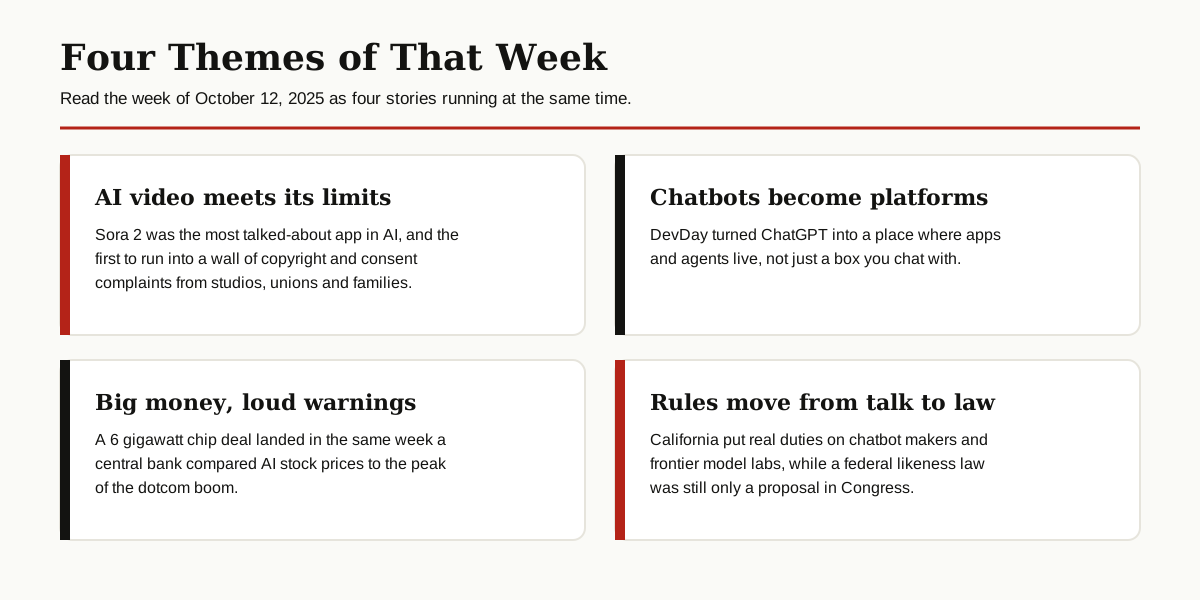
OpenAI held its DevDay developer conference in San Francisco on October 6, 2025, and used it to change what ChatGPT is. The company announced apps that run inside ChatGPT itself, starting with names like Spotify, Canva, Figma, Zillow and Booking.com, built with a new Apps SDK. It also launched AgentKit, a set of tools for building AI agents, made its Codex coding tool generally available, and added GPT-5 Pro and Sora 2 to its API. Sam Altman told the crowd that ChatGPT had passed 800 million weekly users and that more than 4 million developers were building on OpenAI tools. The message of the day was simple: ChatGPT was no longer just a chatbot. It was becoming a platform, and the rest of the week kept arguing about what that platform should be allowed to do.
OpenAI Signs a 6 Gigawatt Chip Deal With AMD (Monday, October 6)
The same morning, OpenAI and AMD announced a multi-year deal for OpenAI to deploy 6 gigawatts of AMD graphics processors, starting with 1 gigawatt of MI450 chips in the second half of 2026. AMD also gave OpenAI a warrant for up to 160 million shares, roughly a tenth of the company, which would vest as the chips are deployed and AMD’s share price hits set targets. Reuters reported that AMD’s stock jumped more than 20 percent on the news. Why it mattered: weeks after a huge Nvidia deal, OpenAI was spreading its bets across chip makers, and the sums involved had become hard to picture. Six gigawatts is about the power use of several million homes, all pointed at training and running AI models.
Hollywood Tells OpenAI to Police Sora 2 (Monday, October 6)
While developers celebrated, Hollywood declared war. On October 6, the Motion Picture Association (MPA), which speaks for the major studios, issued a public statement about Sora 2, OpenAI’s video app, which had launched at the end of September. “Since Sora 2’s release, videos that infringe our members’ films, shows, and characters have proliferated on OpenAI’s service and across social media,” said MPA chairman Charles Rivkin, calling on OpenAI to take “immediate and decisive action.” The app had filled with clips of protected characters, from Mario to Pikachu, because OpenAI had started with an opt-out approach: characters were usable unless rights holders objected. Just days earlier, on Friday, October 3, Altman had already promised in a blog post that rights holders would get “more granular control” and a move toward opt-in permission. The MPA statement, covered by AFP and outlets such as PetaPixel on October 9, showed the studios did not think a promise was enough. Talent agencies and SAG-AFTRA added their own warnings during the week, a rare moment of Hollywood speaking with one voice.
A Central Bank Warns of an AI Bubble (Wednesday, October 8)
On October 8, the Bank of England’s Financial Policy Committee published its sharpest warning yet about the AI boom. Reported by Reuters the same day, the bank said that “on a number of measures, equity market valuations appear stretched, particularly for technology companies focused on artificial intelligence,” and that “the risk of a sharp market correction has increased.” It compared some measures to the peak of the dotcom bubble. Kristalina Georgieva, head of the International Monetary Fund, struck a similar note, saying valuations were heading toward levels last seen during the internet boom 25 years earlier. Coming two days after the giant AMD deal, the warning framed the week’s split personality: record spending on one side, and senior financial officials asking what happens if the mood turns.
Two Model Launches Land on the Same Day (Wednesday, October 15)
The week closed with a double launch. On October 15, Anthropic released Claude Haiku 4.5, the newest version of its smallest model. TechCrunch reported that Anthropic pitched it as offering coding performance close to its Sonnet 4 model at one third of the cost and more than twice the speed, with a score of 73 percent on the SWE-Bench Verified coding test. Anthropic product chief Mike Krieger said the model would let big models plan while fast Haiku agents do the work. The same day, Google released Veo 3.1, its updated video generation model, into the Gemini app, its Flow filmmaking tool and its developer APIs, adding stronger editing features such as inserting and removing objects and extending scenes, according to Google’s developer blog. The timing was not lost on anyone: Google’s answer to Sora 2 arrived while Sora 2 was still the week’s biggest argument.

The Hollywood Fight Gets Its Long Read (Tuesday, October 14)
On October 14, the Los Angeles Times published a detailed account of the clash, describing how a tool launched with excitement had put OpenAI on the defensive within days. The piece walked through the flood of videos using actors’ faces and famous characters, the statements from the MPA, agencies and unions, and OpenAI’s reply that it was “engaging directly with studios and rightsholders, listening to feedback, and learning from how people are using Sora 2,” in the words of Varun Shetty, its vice president of media partnerships. Long features like this matter in a news week: they turn a fast dispute into the reference version of the story that everyone else then argues about.
The Regulation Thread: California Moves First
Running under the product news was a legal story with a longer fuse. On September 29, Governor Gavin Newsom had signed SB 53, the Transparency in Frontier Artificial Intelligence Act, the first United States law aimed squarely at the makers of the most powerful AI models. Analysis of the law was still landing in the week itself, including an October 6 breakdown by lawyers at Morgan Lewis. SB 53 requires large developers to publish safety frameworks, report critical safety incidents to the state’s Office of Emergency Services, and protect whistleblowers, with civil penalties of up to 1 million dollars per violation enforced by the state attorney general. It takes effect on January 1, 2026. Anthropic publicly supported the bill, Meta called it a step in the right direction, and trade groups such as the Chamber of Progress campaigned against it, a split we track in our EU AI Act news coverage when comparing the American state-by-state path with Europe’s single rulebook.
Then, on Monday, October 13, Newsom acted again. As CalMatters reported, he signed SB 243, making California the first state to regulate AI companion chatbots. The law, written by Senator Steve Padilla, requires operators to tell users they are talking to an AI, to keep minors away from sexually explicit chatbot content, to run protocols for suicidal thoughts and self-harm with referrals to crisis services, and to give minors regular break reminders. The same day, he signed AB 853, which adjusts California’s AI Transparency Act on content provenance data, and vetoed AB 1064, a stricter bill that would have barred companion chatbots for under-18s unless companies could show the software would not encourage harmful behavior. In his veto message, Newsom said the bill’s broad limits could amount to a total ban on conversational AI for teenagers. Child safety groups, including Common Sense Media, accused him of bowing to tech pressure. The context was grim and real: the debate ran in the shadow of lawsuits and reporting about teenagers harmed after long talks with chatbots, including the death of 16 year old Adam Raine, whose parents sued OpenAI.
The Culture Fight: Faces, Voices and the Dead
Not every fight that week was about money or law. Some of it was about grief. In the days around October 6 and 7, Zelda Williams, the daughter of Robin Williams, posted a public plea on Instagram about the Sora videos people kept sending her. “Please, just stop sending me AI videos of Dad,” she wrote. “It’s dumb, it’s a waste of time and energy, and believe me, it’s NOT what he’d want.” She described watching her father’s legacy reduced to something that just looks and sounds like him, built so strangers could chase likes.
Her post landed because it named the week’s real tension. Sora 2 had shot to the top of the App Store charts, and its most shared clips were not landscapes or jokes. They were resurrections: Michael Jackson taking a selfie, Martin Luther King Jr. placed in scenes his family called disrespectful, cartoon characters in police body camera spoofs. OpenAI’s likeness policy was opt-in for living people, but the dead had become a gray zone, and families, including those of Robin Williams, George Carlin and Dr. King, were the ones speaking up. Anyone reading AI news today, October 12, 2025 saw both stories side by side: an app celebrated as a creative breakthrough, and the families of the famous dead asking to be left in peace.
What Happened Next on the Biggest Story
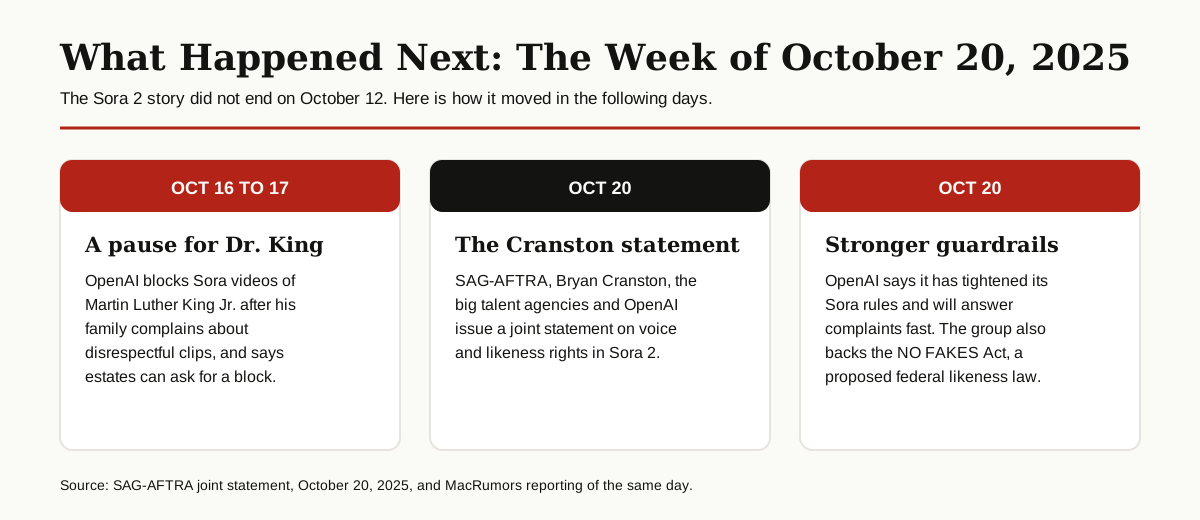
The Sora 2 argument, the loudest thread in the AI news today, October 12, 2025 coverage, did not cool down after that Sunday. It escalated, then settled into an uneasy deal. Late the following week, around October 16 and 17, OpenAI paused Sora generations of Martin Luther King Jr. after his family and estate complained about disrespectful depictions, and said that representatives of public figures could request that a likeness not be used in Sora cameos.
Then, on Monday, October 20, 2025, the story reached its formal turning point. MacRumors reported that OpenAI, SAG-AFTRA, actor Bryan Cranston, and the big talent agencies UTA, CAA and the Association of Talent Agents had issued a joint statement. Cranston’s voice and face had appeared in Sora videos even though he had never opted in. OpenAI expressed regret, said it had strengthened its guardrails around voice and likeness, and promised to respond quickly to complaints. “I was deeply concerned not just for myself, but for all performers whose work and identity can be misused in this way,” Cranston said. The statement also backed the NO FAKES Act, a proposed federal law on digital likeness that Congress had not passed. In other words, the biggest story behind AI news today, October 12, 2025 ended the month with rules written by negotiation, because no law yet covered the ground. We keep following threads like this in our agentic AI news coverage, where the same consent questions show up for AI agents that act in a person’s name.
How to Read Dated AI News
The week behind the AI news today, October 12, 2025 searches is also a good lesson in how to read AI news in general, because almost every trap showed up in seven days.
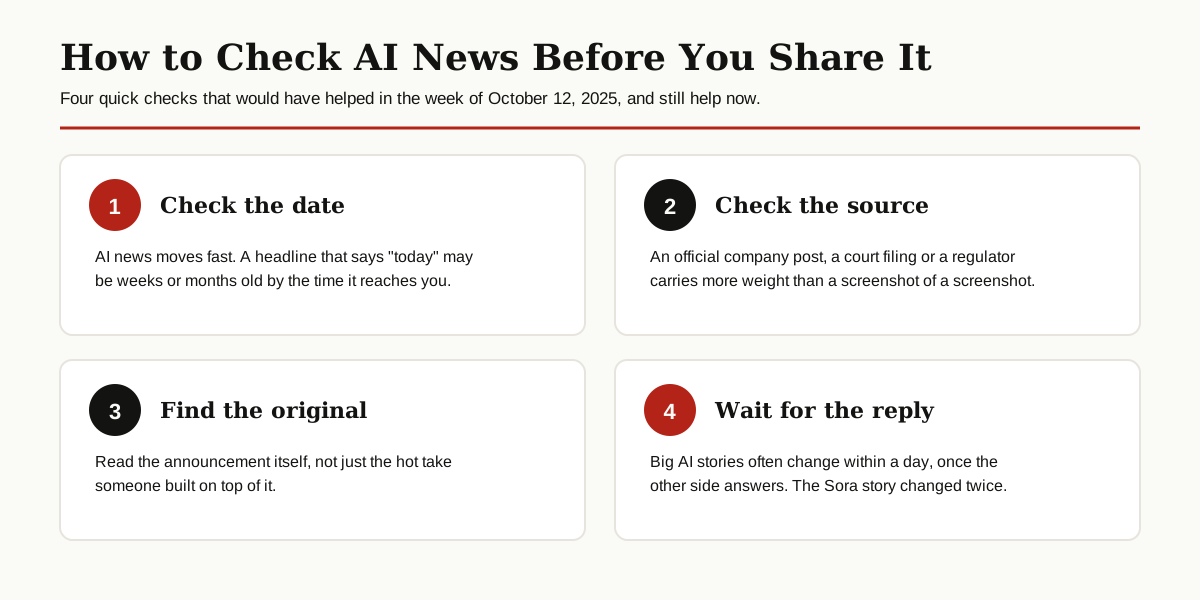
- Check the date before the claim. The MPA statement was dated October 6, but it was still being shared as fresh news on October 12. In AI, a week is a long time.
- Check who is speaking. An official announcement (the AMD deal on OpenAI’s own site), a regulator’s report (the Bank of England), a union statement and an anonymous viral clip are four different kinds of evidence.
- Find the original. Altman’s blog post promised rightsholders more control on October 3. Headlines about it ran for days afterward, sometimes without the promise’s limits attached.
- Wait for the second act. Anyone who stopped reading on October 12 missed the MLK pause and the October 20 joint statement, which changed what the Sora story actually meant.
The Bottom Line
Looked at whole, AI news today, October 12, 2025 was a week when the AI industry ran in two directions at once. OpenAI tried to turn ChatGPT into a platform and signed one of the largest chip deals in history, while a central bank warned that AI stock prices echoed the dotcom peak. California wrote real laws for chatbots and frontier models while Congress still debated. And a video app famous enough to top the charts spent the week learning, in public, that making anyone’s face is not the same as having their permission. The launches, dated October 15, from Anthropic and Google almost felt quiet by comparison, which may be the week’s strangest fact of all: in October 2025, two major model releases in one day counted as the calm part. For more dated roundups like this one, browse our full AI News and Regulation section.