Job boards are full of a title that barely existed a few years ago: generative AI data scientist. It sounds impressive, but what does this person actually do all day?
In plain words, a generative AI data scientist is a data expert who builds tools with AI that can create new things: answers, summaries, support replies, product text, code, and sometimes images. The technology behind it is called generative AI, and its best known tools are chatbots like ChatGPT.
If you already know what a data scientist is, picture that same job with a new center of gravity. The classic role revolves around numbers in tables. This newer role revolves around words, documents, and very large language models.

What Does a Generative AI Data Scientist Do All Day?
The core job is simple to say: turn a big language model into a tool that real people can trust. That breaks down into a few daily tasks.
First, they connect the model to useful knowledge. A chatbot that only knows its training data will guess when it does not know your company handbook. So they build search systems that find the right page in your documents and hand it to the model before it answers. This pattern is called retrieval augmented generation, or RAG for short.
Second, they write and refine prompts. A prompt is the instruction you give the model. Small changes in wording can turn a vague answer into a clear, correct one, so they test many versions.
Third, they measure quality. They build test sets of real questions, score the answers, and hunt for weak spots: wrong facts, rude tones, made up details. Fixing those weak spots is most of the job.
They also build the answer keys behind those tests. To know whether the AI is improving, someone has to write good example questions, decide what a correct answer looks like, and grade hundreds of replies. That grading data, often called an evaluation set, is the quiet backbone of the whole role. Without it, every change is a guess.
Finally, they work with people. Product managers, support teams, and lawyers all care about what the AI says, and the data scientist explains what is working and what is not, in plain language.
How the Role Grew Out of Classic Data Science
For years, data science meant tables: sales rows, click logs, sensor readings. The models predicted numbers, like how many bikes a shop would sell next month. If that world is new to you, our guide to machine learning algorithms explains the main types in plain English.
Then large language models arrived. These models are trained on huge amounts of text, so they can read and write. IBM describes generative AI as technology that creates original content, from text and images to audio and code. Suddenly companies did not just want predictions. They wanted helpers that could draft emails, answer customer questions, and search years of documents in seconds.
That shift created the generative AI data scientist role. The statistics and coding skills of the old job still matter, but now the raw material is language instead of spreadsheets.
Hiring followed fast. Banks, hospitals, online stores, and software firms all wanted the same thing: a person who understands data and can also make language models behave in the real world. Job posts quietly merged two older wish lists, the statistician and the software builder, into a single role.
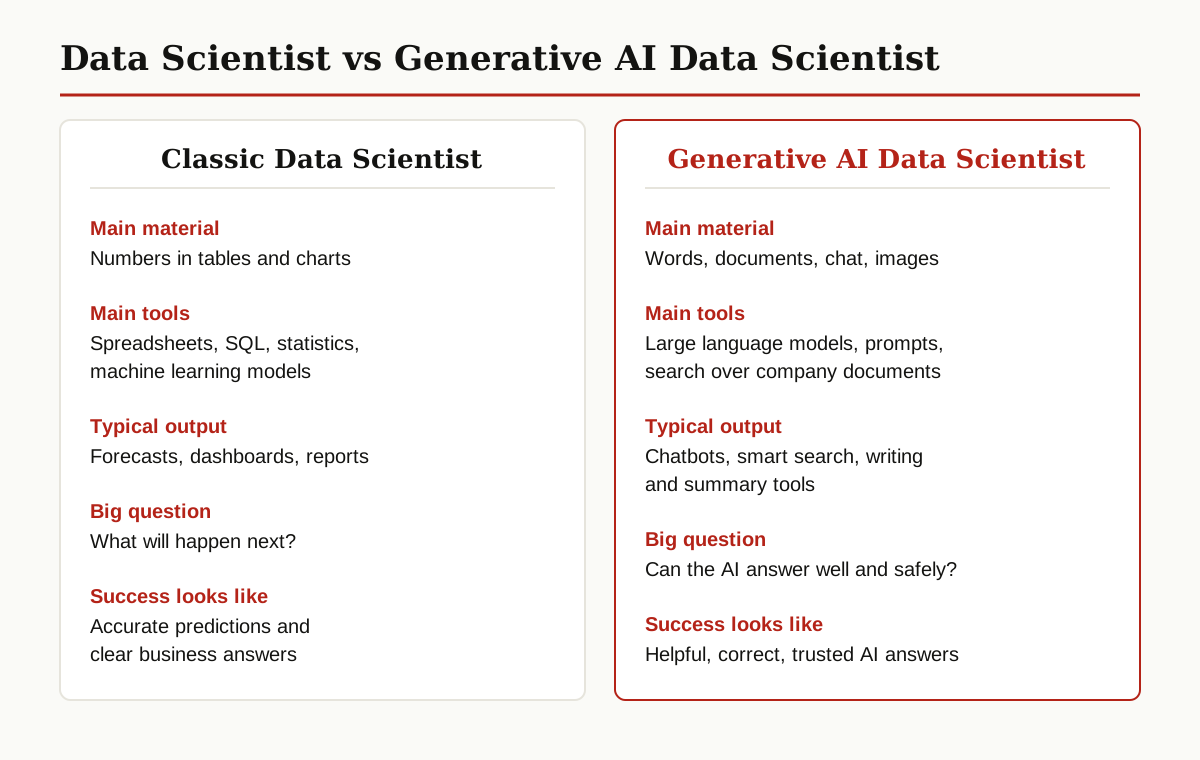
Data Scientist vs Generative AI Data Scientist
The two roles share the same roots, but their daily work looks quite different.
| Topic | Classic Data Scientist | Generative AI Data Scientist |
|---|---|---|
| Main material | Numbers in tables | Text, documents, chats, images |
| Main tools | SQL, statistics, classic models | Language models, prompts, document search |
| Typical output | Forecasts, dashboards, reports | Chatbots, smart search, writing tools |
| Big question | What will happen next? | Can the AI answer well and safely? |
| Quality check | Prediction accuracy | Answer quality, tone, and safety |
| Key risk | Wrong numbers | Confident but made up answers |
One more difference matters. A classic model gives the same output for the same input, every time. A language model can answer the same question three different ways. So people in this role spend far more time on testing, guardrails, and careful wording than a classic role ever needed.
Skills You Need
Employers usually want a mix of hard skills and people skills. Here is the honest list.

Technical skills
- Python and SQL. Python is the daily language of the job, and SQL gets data out of databases.
- Machine learning basics. You should understand how models learn, how to test them, and how to read accuracy numbers without fooling yourself.
- Language model know-how. How large language models work, what tokens and context windows are, and why models sometimes make things up.
- Prompting and RAG. Writing clear instructions for models, and building search that feeds them the right documents.
- Evaluation. Building test questions, scoring answers, and comparing two versions of a system fairly.
- Language basics. A little knowledge of how computers handle text helps a lot. Our guide to natural language processing is a friendly place to start.
People skills
- Clear writing. You will write prompts, test notes, and summaries that busy people must understand fast.
- Product sense. The best model is useless if it solves a problem nobody has. Good questions beat fancy math here.
- Patience with mess. Real company documents are disorganized, outdated, and full of errors. Your job includes cleaning that up.
- Honesty about limits. Managers love big promises. This role needs someone who says what the AI cannot do yet.
Tools of the Trade
The toolbox is not exotic. Most of it is software you can start learning today, for free or close to it.
- Python libraries like pandas for data work and scikit-learn for classic models.
- Model APIs from providers such as OpenAI, Anthropic, and Google. An API is simply a way for your code to send text to a model and get an answer back.
- Open model hubs like Hugging Face, where you can download models and test data sets.
- Vector databases such as Pinecone, Weaviate, or the open source Chroma. These store text in a way that lets you search by meaning, not just by exact words. They power the document search behind most chatbots.
- Frameworks like LangChain and LlamaIndex, which connect models, prompts, and document search into one app.
- Evaluation tools that score batches of answers, so you can prove a change made things better instead of just feeling it did.
You do not need to master all of these before applying anywhere. One framework, one model API, and one vector database, used well in a real project, teach you more than a long list of names.
Cost tracking belongs in the toolbox too. Every question sent to a large model costs money, so these specialists watch usage dashboards and pick the cheapest model that still answers well. A small model that answers everyday questions correctly almost all of the time often beats a giant, pricey one.
A Realistic Workday
No two days are identical, but a normal day in this job looks something like this.
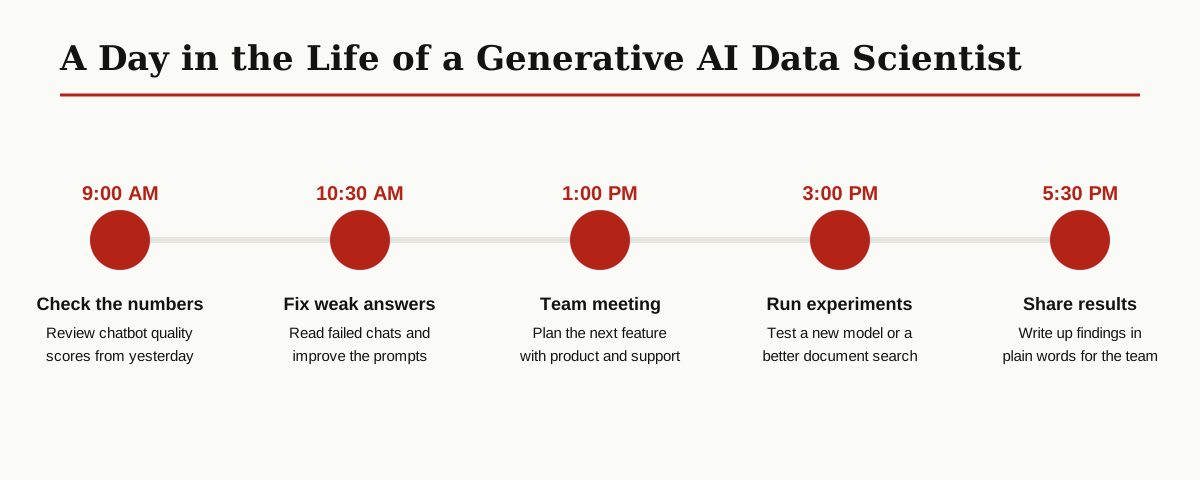
The morning starts with quality scores from the company chatbot. A few answers slipped overnight, so you read the failed chats and spot a pattern: the model struggles with refund questions. Before lunch, you improve the prompt and add two missing help pages to the document search.
The afternoon is a mix of a planning meeting with the product team and an experiment: does a newer model answer the same test set better, and at what cost? You end the day writing a short summary of the results in plain words, so the whole team knows what changed and why.
Pay and Demand: The Honest Picture
Let us be straight with you: there is no official salary table for this exact job title yet, because the role is too new. Anyone who quotes you one perfect number for it is guessing.
What we can verify is the wider field. The US Bureau of Labor Statistics reports that data scientists in the United States earned a median pay of $120,230 a year in May 2025, and it expects the field to grow about 35 percent from 2025 to 2035, far faster than average.
In practice, pay for this specialty sits at the high end of data roles, because the skill set is new and fewer people have real experience with it. Big tech firms and finance companies pay the most. Small companies pay less, remote roles vary a lot, and city matters. Treat exact figures on random websites as rough guides, not promises.
How to Become One, Step by Step
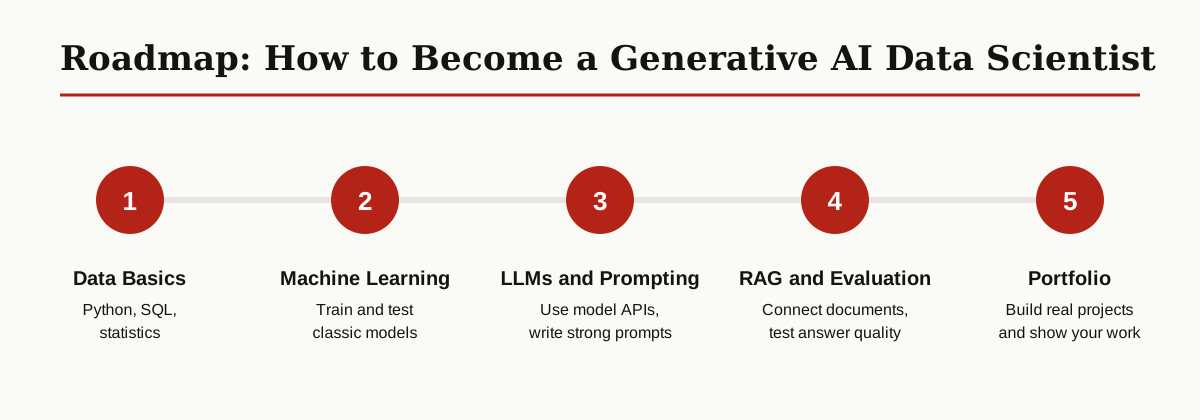
- Learn the data basics. Get comfortable with Python, SQL, and core statistics. You need these every single day.
- Learn classic machine learning. Build a few prediction models and learn how to test them honestly.
- Move to language models. Use a model API, learn how prompts work, and study why models invent facts.
- Build a RAG project. Take a set of real documents, build search over them, and connect a model that answers questions with sources.
- Learn evaluation. Create a test set, score answers, and show before and after results. This skill sets you apart.
- Publish a portfolio. Put two or three finished projects online with clear write ups. Show the problem, your approach, and your results.

Most people who land a generative AI data scientist job follow this road over one to two years of steady practice, often while already working in a data or software role. There is no shortcut, but every step builds directly on the one before it.
If you already work as a data analyst or a classic data scientist, you are closer than you think. Your statistics, SQL, and business knowledge all carry over. The gap is mostly language models, document search, and evaluation, and each of those can be learned project by project.
Who Should Chase This Role, and Who Should Not
This role is a great fit if you like language, writing, and messy real world problems. If reading fifty chatbot conversations to find where the AI went wrong sounds oddly fun, you will probably enjoy the work.
It is a poor fit if you only want deep math research, or if you dislike writing and talking to nontechnical teams. It is also the wrong target if you hope to skip the data basics entirely. The generative AI layer sits on top of classic data skills, not instead of them.
The Bottom Line
A generative AI data scientist takes the core skills of data science and points them at models that read and write. The work is part coding, part testing, part detective work on bad answers.
Demand is strong, pay sits at the high end of data roles, and the entry road is clear: data basics first, language models second, real projects always. Start where you are, build one honest project, measure it carefully, and write about what you learned. That evidence is exactly what hiring managers believe. You can explore more roles and guides in our AI, ML and Data Science category.