Every few decades, one region grabs hold of a new technology and refuses to let go. For personal computers it was Silicon Valley. For the internet it was Silicon Valley. And for artificial intelligence, despite strong competition from New York, London and Beijing, it is Silicon Valley again.
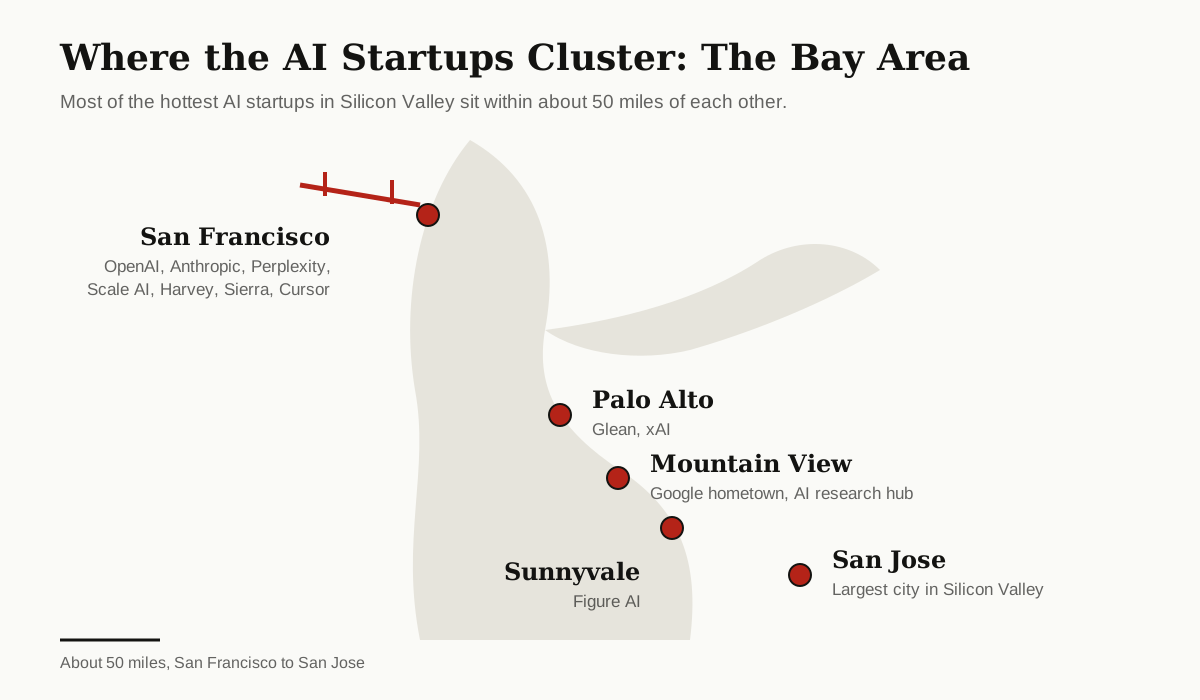
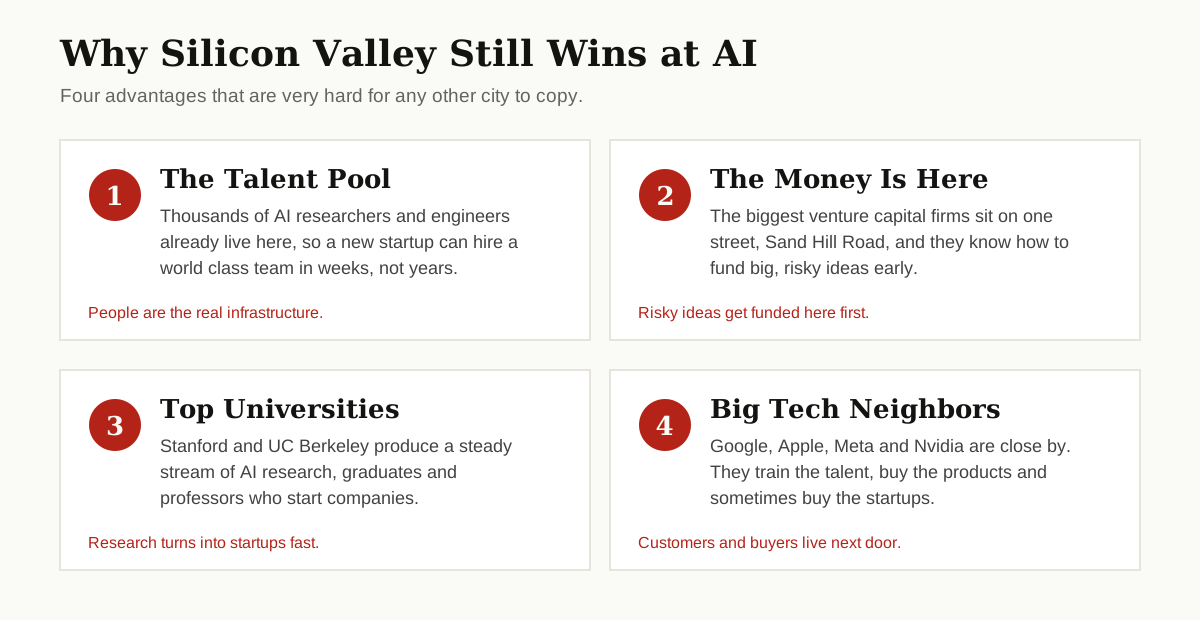
The hottest ai startups in silicon valley are not spread across the whole map. Most of them sit in a tight strip of Northern California, from San Francisco down to San Jose, close to Stanford University, close to the big venture capital firms, and close to each other. When a researcher leaves a famous lab on a Friday, she can interview at five AI startups the next week without ever leaving the Bay Area.
There is hard data behind the hype. Stanford University tracks the global AI race every year in its AI Index Report, and the United States, led by California, keeps producing the most notable AI models and the most new AI companies. Money follows the talent, and the talent keeps choosing the Bay Area.
This guide names the AI startups in Silicon Valley that matter most in 2026, explains what each one actually builds in plain English, and shows you how to judge the next rising star for yourself.
What Makes a Startup “Hot”?
Hot is a slippery word, so let us pin it down. The best ai startups tend to share the same five traits, and you can use this list to check any company you hear about.
- A painful problem. The product solves something people or businesses genuinely struggle with, like slow legal work or messy company data.
- Real usage. People actually use the product every week, and usage keeps growing without heavy advertising.
- A strong technical team. The founders and early engineers often come from top labs, top universities or earlier successful startups.
- Serious backing. Well known investors have funded the company, which signals that smart outsiders checked the idea and the team.
- Good timing. The company rides a real shift in technology, like cheaper computing or a new kind of AI model, instead of fighting against the market.
Notice what is not on the list: a famous founder, a slick launch video, or a big valuation headline. Lists of the coolest startups come and go. Usage and revenue do not.

The Hottest AI Startups in Silicon Valley to Watch in 2026
Here is the shortlist. It mixes the giant model labs that everyone watches with focused startups that own one clear job, like legal work, coding help or company search. All of them are based in San Francisco or the wider Silicon Valley area.
1. OpenAI
OpenAI is the company that started the current AI wave. Founded in San Francisco in 2015, it launched ChatGPT in late 2022 and turned the chatbot into a household tool used around the world. Its GPT models also power thousands of other products through its developer platform, so even people who never open ChatGPT often end up using OpenAI technology through someone else’s app. What keeps OpenAI hot is range: it sells to everyday consumers, to businesses, and to the developers building the next wave of AI products, all at the same time.
2. Anthropic
Anthropic, founded in San Francisco in 2021 by former OpenAI researchers including Dario and Daniela Amodei, builds the Claude family of AI models. The company is famous for its focus on safety, meaning it spends unusual effort on making its models behave predictably and refuse harmful requests. That careful image has helped Anthropic win trust with large businesses that want AI help without AI surprises. You can read its research and product updates on the official Anthropic site. For many developers, the real contest in AI models is now a two horse race between Anthropic and OpenAI.
3. Perplexity
Perplexity wants to replace the search results page with a straight answer. Founded in San Francisco in 2022, the company runs an AI answer engine: you ask a question, and it replies with a clear written answer plus the sources it used, so you can check the facts yourself. That source first style has made Perplexity a favorite of students, researchers and journalists. It matters because search is one of the biggest businesses on the internet, and Perplexity is the clearest sign that AI startups in Silicon Valley are willing to challenge even Google on its home ground.
4. Cursor (Anysphere)
Cursor is an AI code editor built by a San Francisco company called Anysphere, and it became a word of mouth hit among programmers. Instead of bolting AI onto an old editor, Cursor was designed from the start around the idea that you write code with an AI partner: you can ask it to write a function, explain a bug, or change code across many files at once. Developers praise it because it understands the whole project, not just the file on screen. When experienced engineers switch tools this fast, investors and founders pay attention.
5. Scale AI
Every AI model learns from data, and Scale AI built a business supplying that data. Based in San Francisco, Scale AI helps model builders and large organizations label, check and improve the data their AI systems train on, and it also builds AI tools for government and enterprise customers. It is less famous with the public than ChatGPT, but inside the industry it is seen as a backbone company: when AI labs need better training data or careful testing of a model before release, Scale is one of the first names called. Boring sounding work, extremely powerful position.

6. Databricks
Databricks started in San Francisco and grew out of research at UC Berkeley, the same place that produced the popular Apache Spark data tool. Its platform helps companies store huge amounts of data and build AI applications on top of it, all in one place. That pitch sounds technical, but the idea is simple: before a business can use AI, it needs its data organized, and Databricks sells the organizing. Because nearly every large company struggles with messy data, Databricks has grown into one of the most valuable software companies in the Valley while still moving like a startup.
7. Glean
Glean, based in Palo Alto, builds an AI search assistant for the inside of a company. Ask it a question like “what did we decide about pricing last spring?” and it searches your email, chat apps, documents and wikis, then answers with links to the real sources. Anyone who has wasted an hour hunting for a file at work understands the appeal instantly. Glean shows where a lot of enterprise AI is heading: not replacing office workers, but quietly removing the most annoying parts of office work, one lost document at a time.
8. Harvey
Harvey is an AI platform built only for legal work, and it is based in San Francisco. Law firms and in house legal teams use it to draft documents, review contracts and research case law much faster than doing everything by hand. Law is a smart target for AI: the work is built on text, the hours are expensive, and accuracy matters more than creativity. Harvey grew quickly by selling to top law firms that are normally slow to try new tools. If AI can win over cautious lawyers, it can win over almost any profession.
9. Sierra
Sierra, founded in San Francisco by Bret Taylor, a former top executive at Salesforce and Facebook, and Clay Bavor, builds AI agents that handle customer service for big brands. Instead of the dumb chatbots everyone hates, Sierra’s agents can check an order, change a delivery, or process a return by actually connecting to a company’s systems and following its rules. The pitch to businesses is simple: happier customers at a lower cost than a call center. Sierra is a leading example of the agent trend, where AI stops just chatting and starts doing real tasks.
10. Figure AI
Figure AI brings AI into the physical world. Based in Sunnyvale, in the heart of Silicon Valley, the company builds humanoid robots designed to work in warehouses and factories, doing the lifting, carrying and sorting jobs that are hard to staff. Its robots have already been tested in real car factories, which separates Figure from companies that only show polished demo videos. Robotics is slower and harder than software, because atoms do not move as fast as bits. But if Figure pulls it off, it could end up as important as any company on this list.
The List at a Glance
Short on time? Here are the ten companies in one table.
| Company | Based In | What It Builds |
|---|---|---|
| OpenAI | San Francisco | ChatGPT and the GPT AI models |
| Anthropic | San Francisco | Claude AI models with a safety focus |
| Perplexity | San Francisco | AI answer engine for search |
| Cursor (Anysphere) | San Francisco | AI code editor for programmers |
| Scale AI | San Francisco | Data and testing for AI models |
| Databricks | San Francisco | Data platform for building AI apps |
| Glean | Palo Alto | AI search inside a company’s tools |
| Harvey | San Francisco | AI assistant for legal work |
| Sierra | San Francisco | AI agents for customer service |
| Figure AI | Sunnyvale | Humanoid robots for warehouses and factories |
How These Startups Hire (and How to Get In)
Here is a useful secret: the hottest ai startups in silicon valley are almost always hiring, and they hire far beyond AI researchers. They need software engineers, product managers, designers, salespeople, support staff and people who understand the industries they sell to, like law or logistics.
Three paths work best. First, learn the core skills. If you want a technical role, our guide on machine learning models explains the building blocks these companies expect you to know. Second, understand the roles before you apply. Many people aim for the wrong job title, so read our breakdown of what a data scientist does to see how data jobs differ from engineering jobs. Third, apply where startups actually post jobs. Company careers pages are the obvious stop, and Y Combinator, the famous startup program, runs a popular jobs board for its companies.
One honest warning: competition is fierce. These firms can pick from applicants around the world, so a small portfolio of real projects usually beats a long list of courses.
What Could Slow Them Down
A fair guide should name the risks too, because not every hot startup stays hot.
Cost. Training and running big AI models burns through computing power and cash at a shocking rate. Startups that cannot turn usage into steady revenue may struggle when funding gets tighter.
Big tech competition. Google, Microsoft, Meta and Apple are not standing still. They can copy a startup’s best feature and ship it to billions of users, which is why the smartest silicon valley ai companies dig into one niche or one industry deeply.
Rules and trust. Lawmakers in the US and Europe are writing new rules for AI, and one public failure, like a chatbot giving dangerous advice, can slow a whole category down. Safety work is not just good manners; it is survival.
Talent prices. When every lab wants the same small pool of researchers, salaries climb to levels that only the richest companies can match. That squeezes younger startups hardest.
None of these risks erase the lead the region has built. They just mean the list will keep changing, and a few names here will look very different in two years.
The Bottom Line
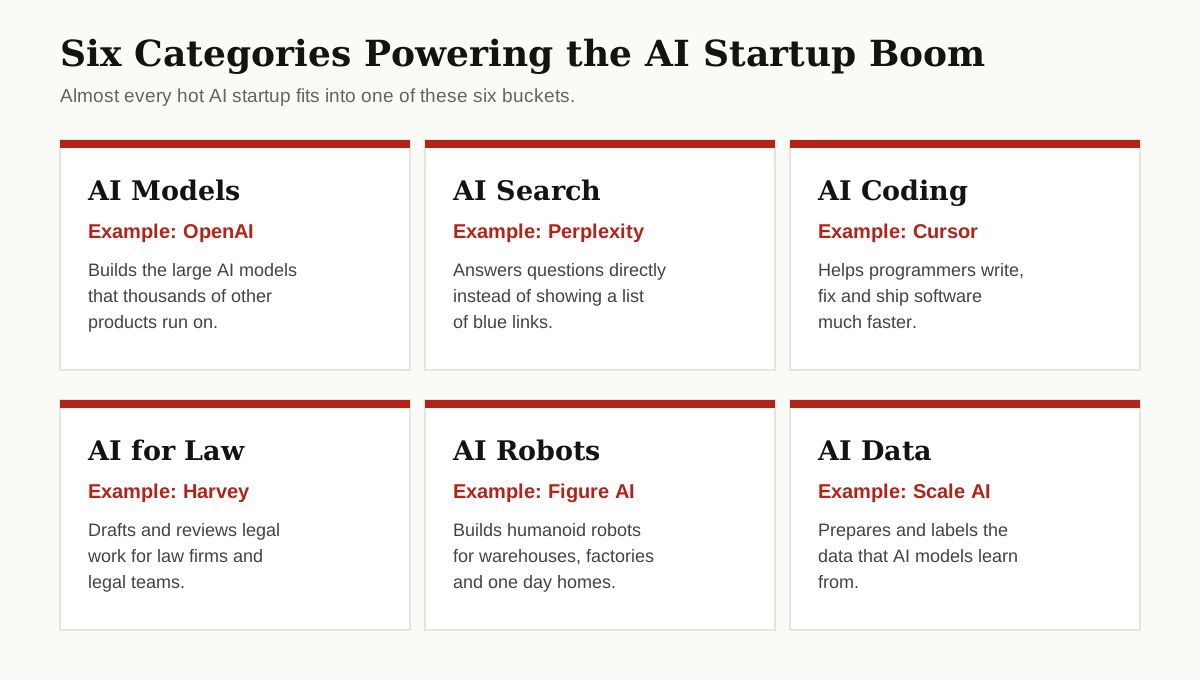
The hottest ai startups in silicon valley share an address, but not a strategy. OpenAI and Anthropic build the models. Perplexity and Glean rebuild search. Cursor, Harvey and Sierra sell AI that does one job very well. Scale AI and Databricks sell the data foundations, and Figure AI is betting the future has arms and legs.
Watch what they ship, not what they announce. Products with real users survive every funding winter, and the Bay Area keeps producing them because talent, money, universities and customers all sit within a short drive of each other. For more plain English guides to the people and ideas shaping AI, browse our AI, ML and Data Science guides, including our walkthrough of the machine learning algorithms that power nearly every product on this list.