If you only followed the product launches, you missed half the story. October 2025 was the month the AI race turned openly into a race about money: company structures, chip contracts, power plants and stock market records.
This edition of ai industry news for October 2025 follows the business side of the industry. For the product and model stories from the same month, see our general October 2025 roundup, which covers the OpenAI DevDay announcements and the Character.AI decision in one place. Here, the subject is cash: who spent it, who raised it, who warned about it, and what it means for jobs.
The Mega Deals
OpenAI and Microsoft rewrite their partnership
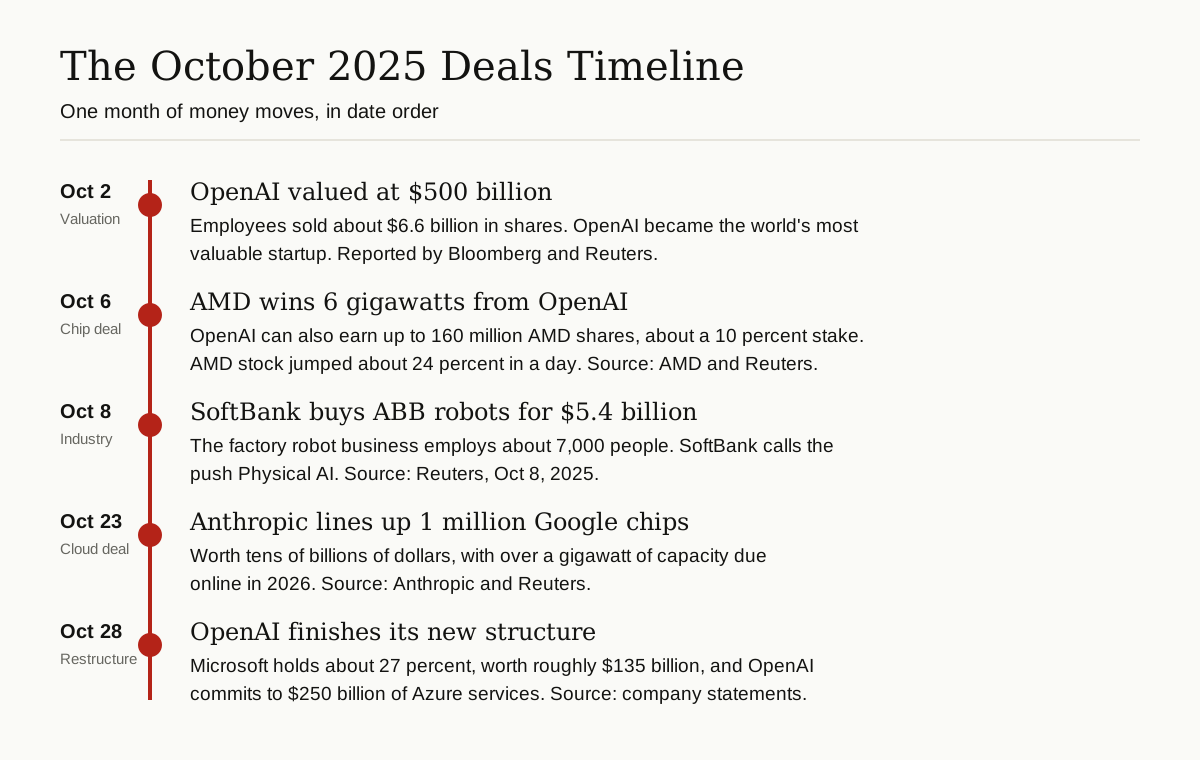
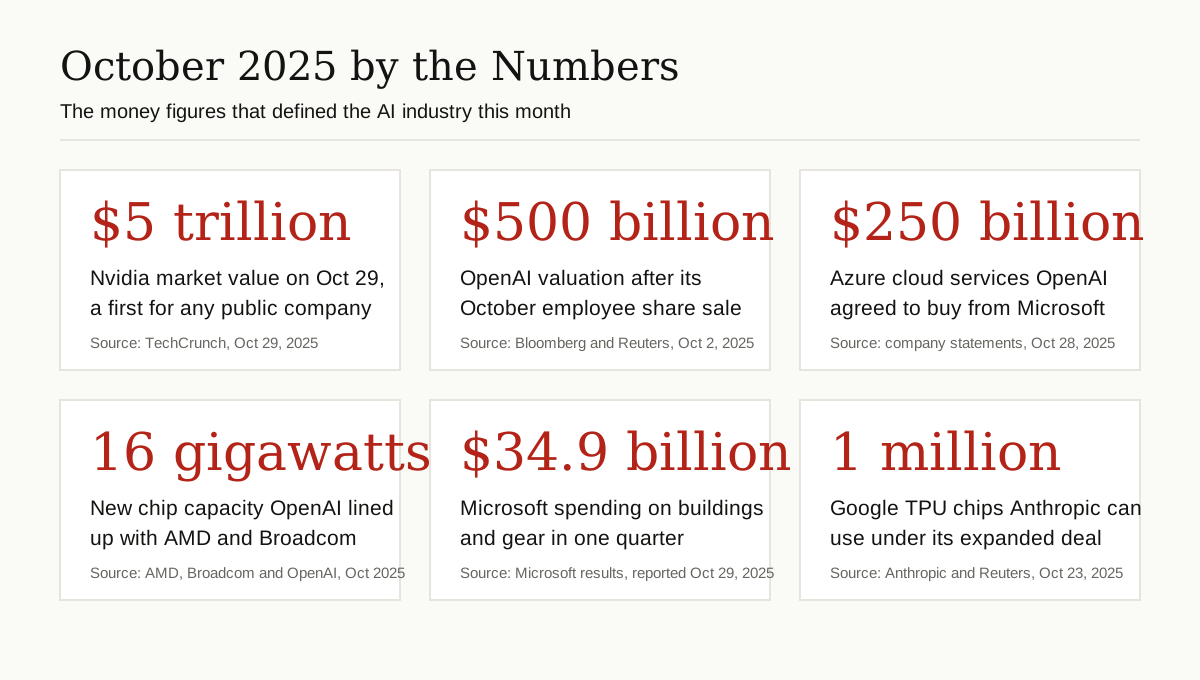
On October 28, OpenAI completed the restructuring it had been negotiating for more than a year. Its business arm is now a public benefit corporation called OpenAI Group PBC. In plain words, that is a for-profit company that is legally allowed to chase profit while also weighing a public mission. The nonprofit OpenAI Foundation keeps overall control and holds shares worth about $130 billion.
Microsoft, OpenAI’s biggest backer since 2019, came out holding about 27 percent of the new company, a stake valued at roughly $135 billion, according to the companies. Microsoft had invested about $13.8 billion in OpenAI over the years. As part of the new deal, OpenAI contracted to buy an additional $250 billion of Azure cloud services, and Microsoft keeps its rights to OpenAI’s models and products through 2032. In return, Microsoft gave up its right of first refusal, meaning OpenAI can now buy computing power from rivals without offering Microsoft the job first. Any future claim by OpenAI that it has reached AGI, short for artificial general intelligence, will be checked by an independent expert panel.
Why it matters for the ai industry news reader: the deal turned the world’s most important AI partnership into a normal, priced shareholding, and it locked in a quarter trillion dollars of future cloud spending in a single signature. GeekWire’s breakdown of the new Microsoft and OpenAI deal has the full terms.
AMD and Broadcom win a place in OpenAI’s future
Three weeks earlier, on October 6, AMD announced that OpenAI will deploy 6 gigawatts of AMD graphics processors, starting with 1 gigawatt of its MI450 chips in the second half of 2026. A gigawatt is roughly the output of one large power station, and in ai industry news it has become the standard unit for bragging about data center size.
The unusual part was the payment. AMD gave OpenAI a warrant, a formal right to buy shares later at a fixed price, covering up to 160 million AMD shares at one cent each. The shares are earned in slices as the chips are deployed and as AMD’s stock hits set price targets. If OpenAI earns them all, it would own about 10 percent of AMD. Investors loved it: AMD’s stock rose about 24 percent on the day, Reuters reported, and AMD executives said they expect the deal to bring in tens of billions of dollars over time.
A week later, on October 13, OpenAI added Broadcom. The two companies will build 10 gigawatts of custom AI accelerators designed by OpenAI itself, with rack deployments starting in the second half of 2026 and finishing by the end of 2029. You can read the details in OpenAI’s own announcement of the Broadcom collaboration. The pattern is clear: OpenAI no longer wants to depend on one chip supplier, and it is willing to sign decade scale contracts to spread the risk.
Anthropic rents a million Google chips
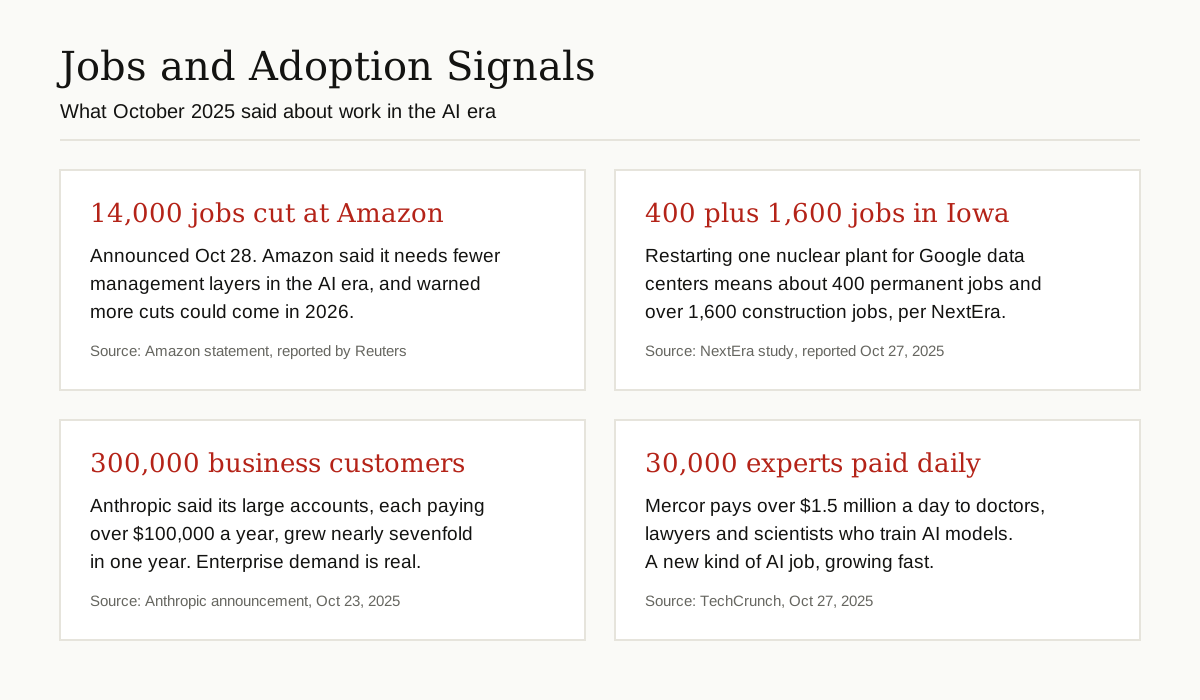
On October 23, Anthropic said it will expand its use of Google Cloud and can draw on up to one million of Google’s TPU chips. TPUs are Google’s own AI processors, built as an alternative to Nvidia graphics chips. The deal is worth tens of billions of dollars and should bring more than a gigawatt of new capacity online in 2026, Reuters reported. Anthropic also shared an adoption signal that matters later in this article: it now serves more than 300,000 business customers, and its large accounts, the ones paying over $100,000 a year, grew nearly sevenfold in a year.
The Data Center and Power Race
Deals are promises. The spending reports that landed in the last week of October showed the promises turning into concrete and copper.
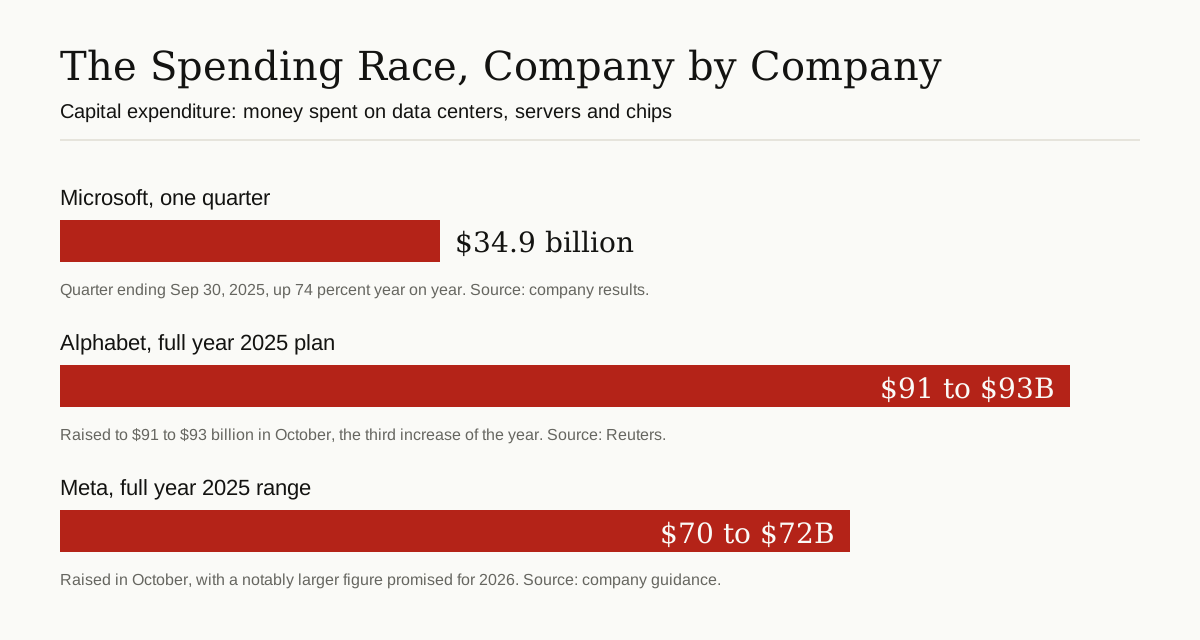
Capital expenditure, shortened to capex, is money a company spends on long lasting assets like buildings and servers. In the quarter ending September 30, Microsoft spent $34.9 billion on capex, up 74 percent from a year earlier and well above what analysts expected, according to CNBC and New York Times reporting on its October 29 results. The same week, Alphabet raised its 2025 capex plan to $91 to $93 billion, its third increase of the year, Reuters reported. Meta raised its 2025 range to $70 to $72 billion and told investors the 2026 figure would be notably larger. Amazon, reporting on October 30, had earlier told investors that its quarterly spending pace of about $31 billion was a fair guide for the rest of the year.
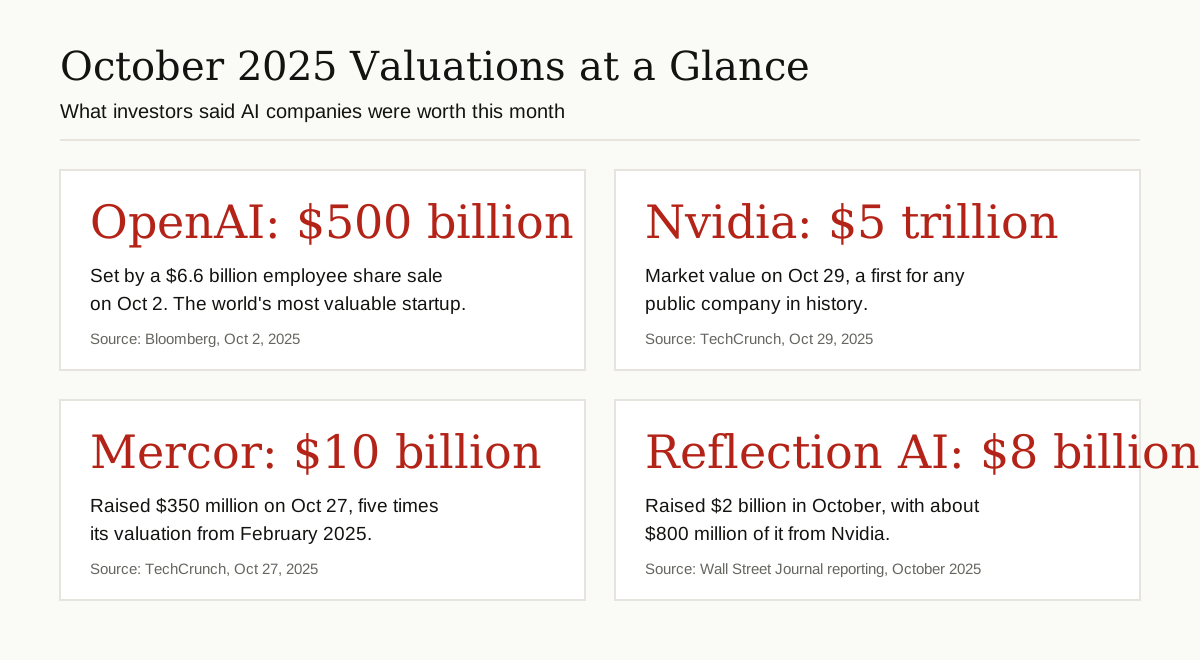
Standing behind all of it was Nvidia. At its GTC conference on October 28, chief executive Jensen Huang said the company expects about $500 billion in AI chip sales through 2026 and is helping build seven new supercomputers for the United States government. A day later, Nvidia became the first public company in history to reach a $5 trillion market value, as TechCrunch reported on the $5 trillion milestone. It had crossed $4 trillion only three months earlier.
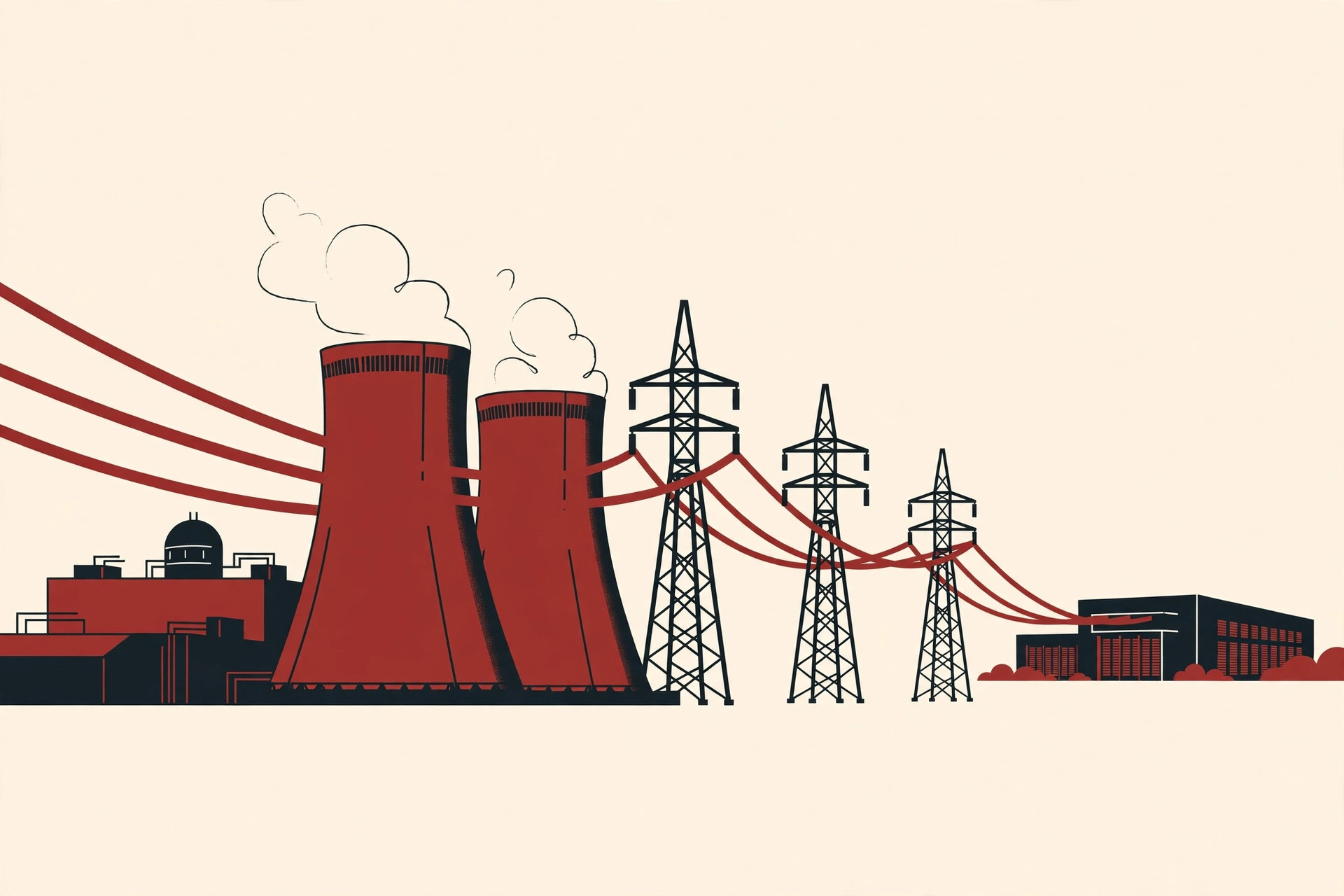
None of these machines run without electricity, and October produced the month’s most symbolic power deal. On October 27, NextEra Energy and Google announced an agreement to restart the Duane Arnold nuclear plant in Iowa, Reuters reported. The 615 megawatt plant shut down in 2020 after storm damage. Google signed a 25 year deal to buy most of its output for its Iowa data centers, and the plant is expected back online in early 2029, once regulators approve. A study cited by NextEra estimated the restart would support more than 400 permanent jobs and over 1,600 construction jobs. When a tech company helps bring a closed nuclear plant back to life, the power shortage behind ai industry news today stops being abstract.
Funding and Valuations
Private money moved just as fast as public money.
On October 2, OpenAI completed a secondary share sale, a deal where employees and early holders sell their own shares rather than the company issuing new ones. About $6.6 billion of stock changed hands at a $500 billion valuation, Bloomberg reported, with buyers including Thrive Capital, SoftBank, Dragoneer, Abu Dhabi’s MGX and T. Rowe Price. The price made OpenAI the most valuable startup in the world, ahead of SpaceX.
Smaller rounds told the same story at smaller scale. Reflection AI, a New York startup building open AI models, raised $2 billion at an $8 billion valuation in October, with Nvidia putting in about $800 million, according to Wall Street Journal reporting. On October 27, Mercor raised $350 million at a $10 billion valuation, five times its price from February, TechCrunch reported. Mercor pays a network of more than 30,000 doctors, lawyers and scientists to train AI models, and said it pays out over $1.5 million to them every day.
The Bubble Warnings
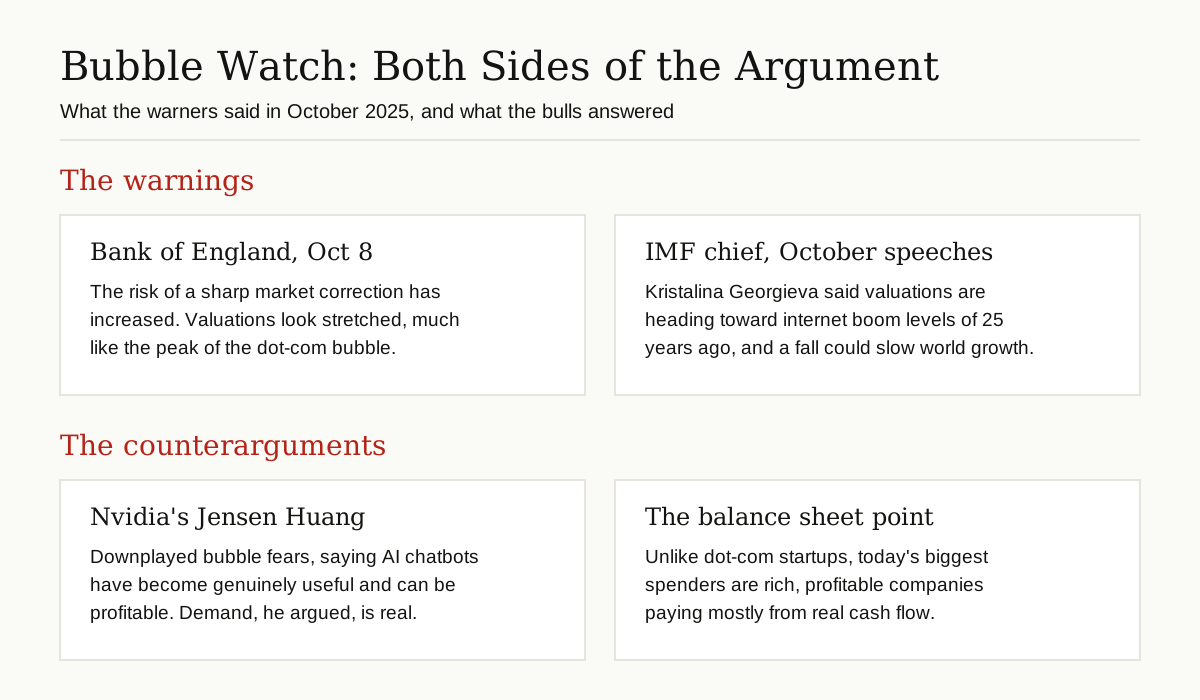
Not everyone watching ai industry news in October 2025 was celebrating. On October 8, the Bank of England’s Financial Policy Committee said the risk of a sharp market correction had increased. On a number of measures, it said, equity valuations appear stretched, particularly for technology companies focused on AI, at levels comparable to the peak of the dot-com bubble. The warning landed mid month and colored the rest of it, as our news snapshot for the week of October 12 noted at the time.
Kristalina Georgieva, head of the International Monetary Fund, sounded the same alarm in her October speeches. Today’s valuations, she said, are heading toward levels seen during the bullishness about the internet 25 years ago, and if a sharp correction occurs, tighter financial conditions could drag down world growth, with developing countries hit hardest. The Bank of England also listed practical risks that could disappoint investors: shortages of electricity, data or chips, or a technical shift that makes today’s expensive infrastructure less necessary. Oxford Economics economist Adam Slater, quoted by the Associated Press, summed up the uncertainty: you have an incredibly wide range of possibilities, and nobody really knows where it is going to land.
The bulls had answers, and a fair roundup should print them. Huang of Nvidia downplayed bubble fears, arguing that AI chatbots and tools have become genuinely useful and profitable, so the demand is real. Analysts quoted across the month’s coverage made a second point: unlike the dot-com era, today’s biggest spenders are rich, profitable companies funding the buildout mostly from real cash flow, not borrowed hope. Skeptics replied that this is exactly how circular the money has become, with chip makers investing in the same AI labs that buy their chips. Both sides can point to October numbers, which is why the argument will not settle soon.
Industrial AI: Robots Get a $5.4 Billion Vote
The month’s clearest piece of industrial ai news came from Switzerland and Japan. On October 8, SoftBank agreed to buy the robotics business of Swiss engineering group ABB for $5.4 billion, Reuters reported. ABB scrapped its earlier plan to spin the unit off as a separate listed company and took SoftBank’s cash offer instead.
The division makes factory robots that compete with Japan’s Fanuc and Yaskawa and Germany’s Kuka. It employs about 7,000 people and had sales of $2.3 billion in 2024. SoftBank founder Masayoshi Son called robotics the company’s next frontier and framed the deal as a push into Physical AI. That term means AI that moves machines in the real world, welding, lifting and sorting, rather than producing text on a screen. The deal is expected to close in mid to late 2026, after regulatory approvals.
For factories, the logic is plain. Manufacturers in rich countries struggle to hire enough workers, and robots that can learn new tasks from AI software are more flexible than the fixed, single job machines of the past. When a buyer pays $5.4 billion for that idea, industrial ai news has clearly moved from trade shows to the boardroom.
What It Means for Workers and Smaller Companies
The jobs story of October 2025 ran in two directions at once.
On October 28, the same day OpenAI finished its restructuring, Amazon confirmed it will cut about 14,000 corporate jobs. Amazon’s head of human resources, Beth Galetti, told staff the company needs to run with fewer layers and more ownership, and warned that more cuts could follow in 2026 as the company finds efficiency gains. Back in June, chief executive Andy Jassy had told employees plainly that AI would mean fewer people doing some of the jobs done today. Reuters reported the total reduction could reach as many as 30,000 roles as the cuts continue, out of a corporate workforce of roughly 350,000.
Set against that are the building sites. Every data center and restarted power plant means construction crews, electricians and engineers, like the Iowa jobs attached to the Duane Arnold restart. And Mercor’s daily payouts show a new category of work appearing: highly paid experts hired by the hour to teach AI systems their professions. The honest summary from ai industry news today is that AI is deleting some office jobs, creating some physical and expert jobs, and nobody yet knows the net number.
For smaller companies, the buildout cuts both ways. More capacity in the big clouds should, over time, make AI computing cheaper and easier to rent. But the giants are also bidding up the price of chips, power and skilled people, and a small firm cannot sign a 25 year nuclear contract to secure its supply. The practical advice from October’s news: build on rented capacity, avoid long fixed commitments, and watch the cloud price pages, because the giants’ spending war is what will set your costs.
What to Watch After October
Four threads from this month will decide whether ai industry news in October 2025 reads, in hindsight, like a peak or a platform.
First, OpenAI’s next move. Late in October, Reuters reported the company is laying the groundwork for a stock market listing that could value it at up to $1 trillion. A filing would force it to publish real financial numbers for the first time.
Second, delivery dates. The first gigawatt of AMD chips is due in the second half of 2026, and the Broadcom racks start arriving the same year. Slippage would feed every bubble argument.
Third, power approvals. The Duane Arnold restart still needs federal licensing, and dozens of similar projects are queuing behind it. Follow the silicon side of the story in our AI chip news coverage.
Fourth, the warnings. The Bank of England and the IMF have now said their piece in writing. Every earnings season from here is a test of whether profits are catching up with the spending, or the gap is still growing.
Conclusion
October 2025 compressed a decade of industry change into four weeks: a $500 billion startup, a $5 trillion chip maker, a $250 billion cloud contract, a nuclear restart, a $5.4 billion robot deal and an official bubble warning, all in the same month. The money is real, the machines are real, and so are the risks the regulators named. That tension is the whole story of ai industry news right now, and it is why this category keeps moving. You can follow every development in our AI News and Regulation section.