Most companies now have an AI policy. Far fewer can answer a much simpler question: what AI is actually running inside the business today?
That gap is where problems grow. A policy written in a boardroom describes the company leaders wish they had. The real company has staff signing up for free AI tools on their own, vendors quietly adding AI features to old software, and one serious system making decisions nobody at the top has ever looked at.
This is why AI governance in business context, with strategic visibility at its center, matters more than the policy document itself. Governance only works when leaders can see the systems they are governing: what each one does, what data it uses, who owns it, and how much damage it could do if it went wrong.
This guide explains the three ideas in plain words, shows why generic rules break, and lays out a practical framework any company can start in the next 90 days.
What the Three Ideas Mean in Plain Words
The phrase sounds heavy, so let us take it apart. Each part is simple on its own.
AI governance is the set of rules, owners, and habits a company uses to keep its AI under control. It answers questions like: who approved this system, what is it allowed to do, and who gets called when it makes a mistake?
Business context means the real situation around a system: the department it sits in, the decision it supports, the data it touches, and the people affected by its output. Context is the difference between a chatbot that suggests gift ideas and a chatbot that handles medical questions.
Strategic visibility means leadership can see all of this clearly, at any time, without sending someone to dig through spreadsheets. If a CEO asked tomorrow, “Which AI systems do we run, and which ones worry you?”, a company with strategic visibility can answer in minutes, with facts.
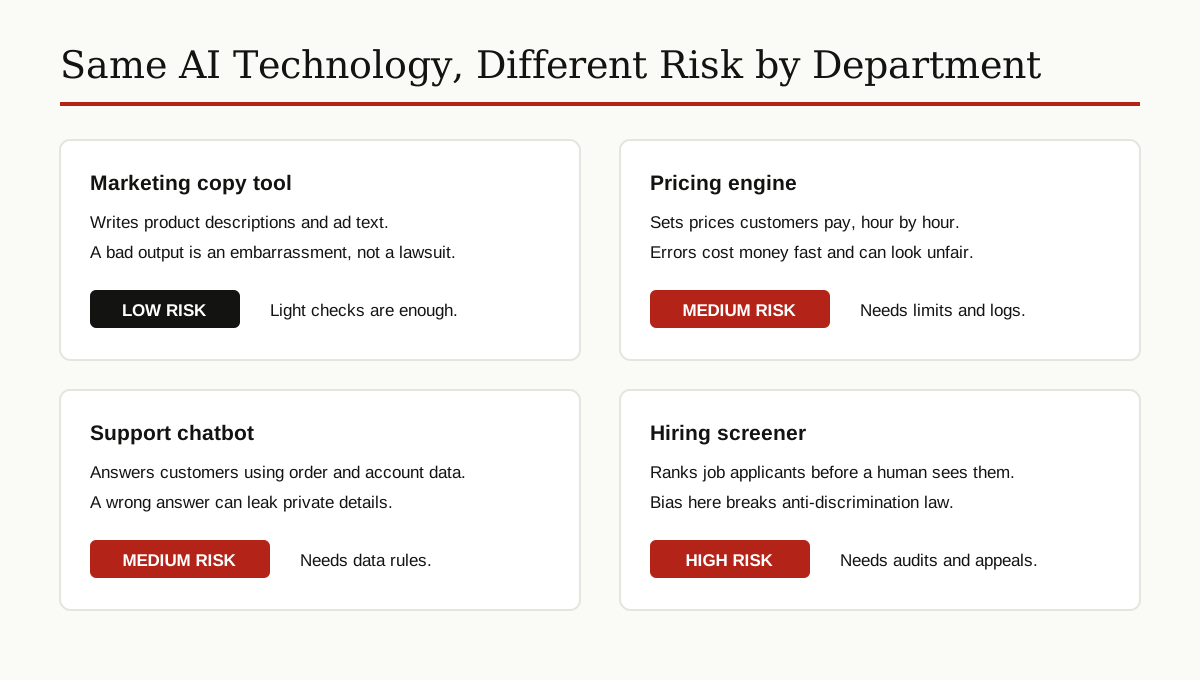
Here is one running example we will use through this guide. A mid-size retailer runs three AI systems. A pricing engine changes product prices hour by hour. A support chatbot answers customer questions using order and account data. A hiring tool ranks job applicants before a human sees them. Same company, same broad technology, three completely different risk profiles. Governing all three with one generic rule is like giving a bicycle and a truck the same speed limit sign and calling it a safety plan.

Why Generic AI Policies Break
Generic policies usually fail in one of two directions.
Too strict for everyone. Worried about the hiring tool, the company bans staff from using any AI without a long approval process. The marketing team, whose copy tool is harmless, waits six weeks for permission to write product descriptions. People get frustrated and quietly use personal accounts instead. Now the company has less visibility than before, not more.
Too loose for the risky systems. The policy says “use AI responsibly” and leaves it there. The marketing team is fine. But the hiring tool is now ranking thousands of applicants with no bias testing, no record of how it decides, and no way for a rejected applicant to appeal. That is exactly the kind of system regulators focus on. Our coverage of the EU AI Act shows how the law sorts AI by risk level and puts the heaviest duties on systems that affect jobs, credit, and safety.
The deeper problem is that a generic policy treats AI as one thing. In reality, risk lives in the context: the decision, the data, and the people on the receiving end.
The Contextual Framework, Step by Step
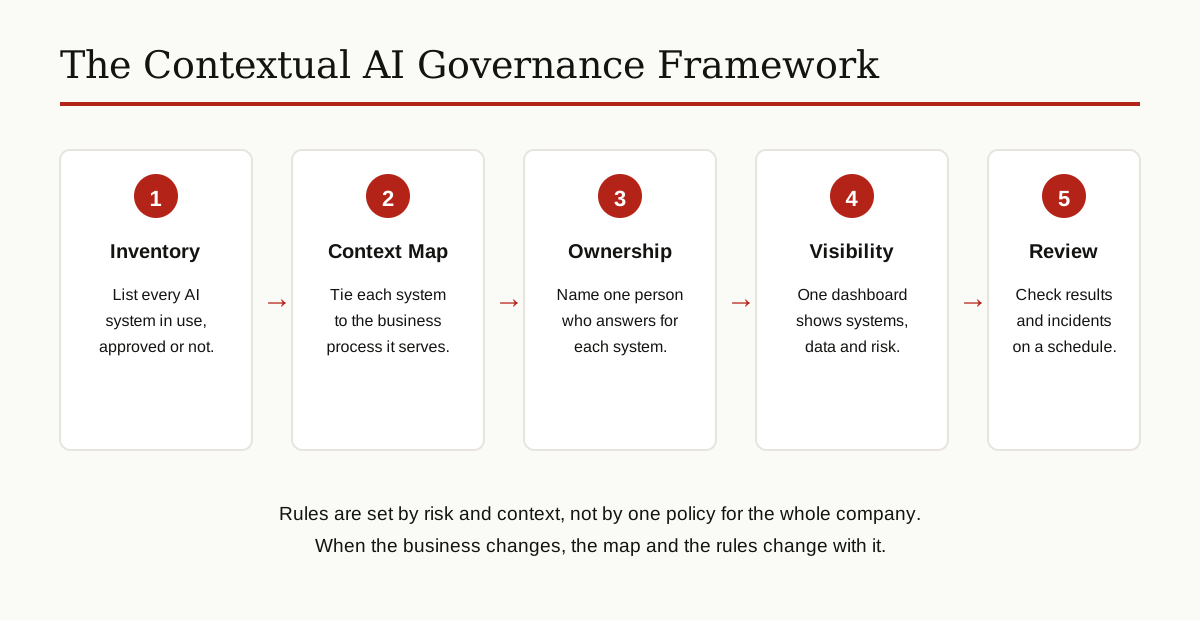
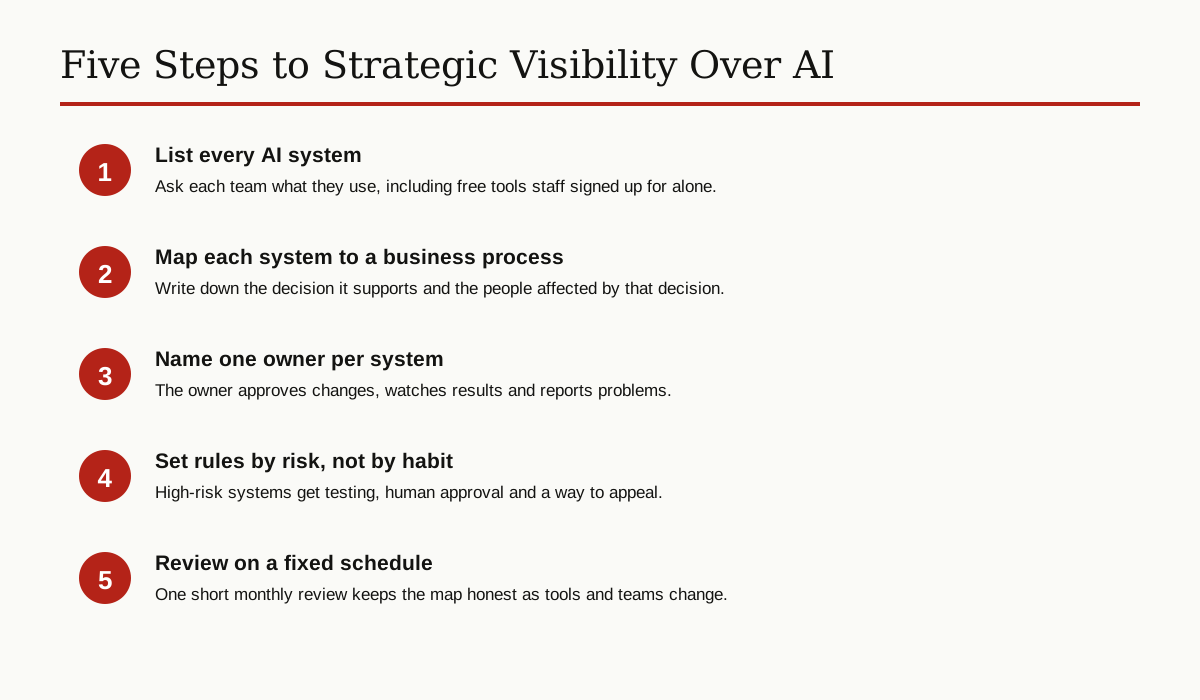
An ai contextual governance framework fixes this by building visibility first and rules second. IBM describes AI governance as the guardrails that help companies manage AI safely and ethically across the whole business. The framework below turns that idea into five working steps.
Step 1: Build the AI Inventory
List every AI system in use, including the ones nobody officially approved. Ask each team directly, check software bills for AI features, and look at browser tools staff rely on. For our retailer, the first honest list usually surprises everyone: the three known systems, plus a forecasting tool in finance and two free writing tools in marketing.
Step 2: Map Each System to Its Business Process
For every system on the list, write one plain sentence: what decision does it support, and who is affected? “The pricing engine sets prices shoppers pay.” “The hiring tool ranks applicants for warehouse jobs.” This map is the business context, written down. It is also where leaders spot the systems they did not know were making serious decisions.
Step 3: Name One Owner per System
Every system gets one named person who approves changes, watches results, and reports problems. Not a committee, and not “the IT department.” When the support chatbot invents a refund policy that does not exist, someone specific should already know it is their job to act.
Step 4: Set Rules by Risk, Not by Habit
Now sort systems into low, medium, and high risk, based on the decision and the people affected. Low-risk tools get light checks. High-risk systems get testing before launch, human approval on important actions, records of decisions, and a way for affected people to appeal. The NIST AI Risk Management Framework follows the same logic, organizing the work into governing, mapping, measuring, and managing risk.
This matters even more as companies adopt agents that act on their own. Our guide to agentic AI use cases shows how fast these systems are spreading into daily operations, and every agent that can send emails, move money, or change records raises the value of clear visibility.
Step 5: Review on a Fixed Schedule
Visibility fades fast. Vendors update models, teams adopt new tools, and owners change jobs. A short monthly review, with the inventory and the incident log on one screen, keeps the picture honest.
The Retailer, Six Months Later
Let us go back to our retailer and see what changes when AI governance, business context, and strategic visibility come together.
The pricing engine now has an owner in the commercial team, a floor and a ceiling it may never cross, and a log of every price change. When a pricing error hits a local news site one Saturday, the owner spots it in the log within hours, rolls the prices back, and reports exactly what happened at the monthly review. Painful, but handled.
The support chatbot has clear data rules. It can see order status, but not payment details, and any answer about refunds above a set amount goes to a human first. Complaints about the chatbot are counted in the incident log, so leaders can see whether it is improving or quietly getting worse.
The hiring tool gets the strictest treatment, because its context demands it. It is tested for bias before each hiring season, a human reviews its top and bottom ranked applicants, and rejected candidates can ask for a human review. The rule is not stricter because the technology is different. It is stricter because the decision is different.
Nobody in this story bought special governance software or hired a new department. The change was simpler: every system became visible, every system got context, and every system got an owner. That is the whole ai governance business context strategic visibility idea, working in practice instead of sitting in a policy file.
What Leaders Should Be Able to See at Any Moment
Strategic visibility becomes real when it lives on one simple dashboard or report that leaders actually read. It does not need special software. A shared page, updated monthly, is enough for most companies. This is where AI governance in business context stops being a slogan and becomes a working habit.
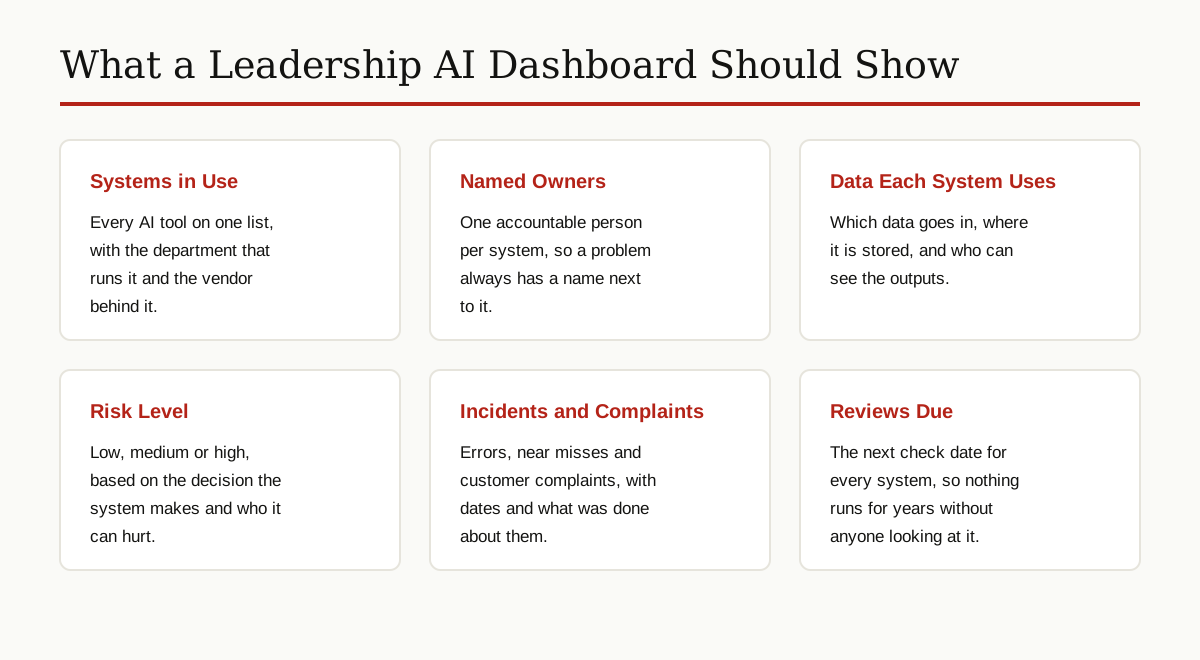
The test is whether leadership can answer these questions quickly:
| Question | Where the answer lives | How often it is checked |
|---|---|---|
| Which AI systems do we run? | The AI inventory | Updated every month |
| What decision does each one make? | The context map | At every change |
| What data does each system use? | The data register | Every quarter |
| Who owns each system? | The owner list | At every change |
| What went wrong recently? | The incident log | Monthly review |
| When is each system next reviewed? | The review calendar | Monthly review |
If any answer takes more than a day to find, visibility is weaker than it looks. This is the same weakness behind the failures described in our article on why AI transformation is a problem of governance: companies buy the technology first and try to see it clearly later.

Common Mistakes That Kill Visibility
A few patterns show up again and again.
The policy PDF nobody reads. A 40-page document is not governance. If staff cannot explain the rules for their own tools in one minute, the rules do not exist in practice.
The one-time inventory. A list made once, during a workshop, is out of date within a quarter. AI tools spread through a company the way apps spread on a phone: quietly and constantly.
The dashboard nobody opens. Visibility that leaders never look at is decoration. Tie the dashboard to a meeting that already exists, and keep it to one page.
Rules copied from another company. A bank and a retailer face different risks, different regulators, and different customers. Borrowed rules miss your context, which is the whole point.
Governance owned only by IT. Technical teams know how systems work, but the risk sits in business decisions: prices, answers, hiring. Business leaders must own the picture, with technical support.
Waiting for the perfect tool. Some companies delay everything until they buy a governance platform. The platform can help later, but visibility starts with a list, a map, and a meeting. A spreadsheet that leaders actually read beats an expensive dashboard they ignore.
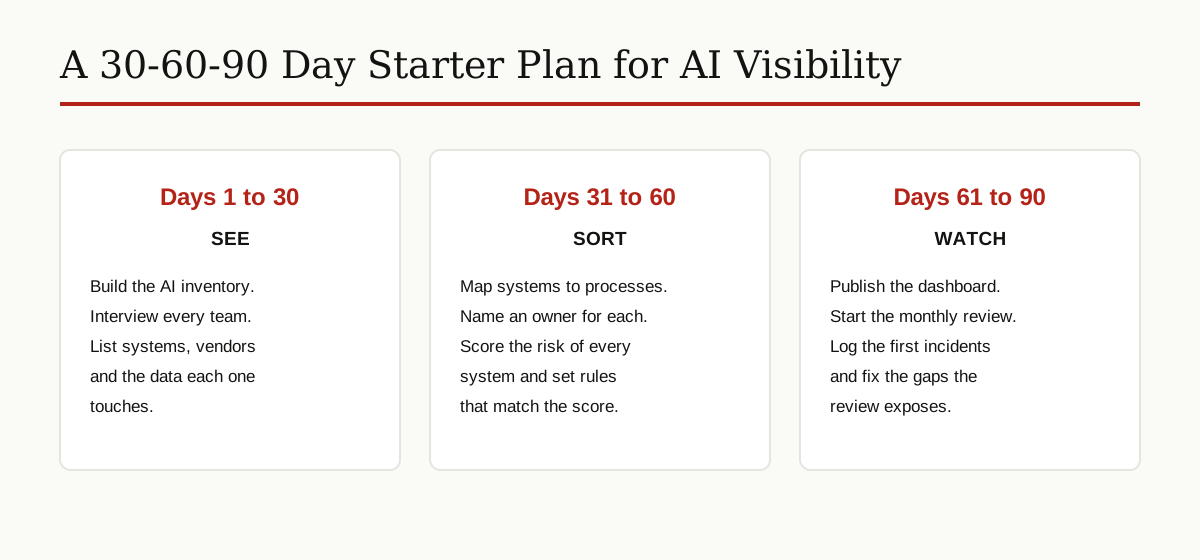
A 30-60-90 Day Starter Plan
You do not need a new department to begin. Ninety days is enough to go from guessing to seeing clearly.
Days 1 to 30: See. Build the inventory. Interview every team, list systems, vendors, and the data each one touches. Expect to find tools leadership never approved. That discovery is the value of the month, not an embarrassment.
Days 31 to 60: Sort. Map each system to its process, name an owner, and score the risk. Write rules that match the scores: light for low risk, strict for high risk. Companies that later want a formal management system can build on this work with ISO/IEC 42001, the international standard for managing AI.
Days 61 to 90: Watch. Publish the first dashboard, hold the first monthly review, and log the first incidents properly. Fix the biggest gaps the review exposes, starting with any high-risk system that has no owner or no testing.
Conclusion
AI governance business context strategic visibility is a long phrase for a short idea: you cannot govern what you cannot see, and you cannot judge a system without knowing the job it does.
The companies that handle AI well are rarely the ones with the longest policies. They are the ones where a leader can ask, at any moment, which systems are running, what they decide, what data they use, and who is responsible, and get a straight answer.
Start with the inventory. The rest of the picture builds from there. For more coverage of AI rules and what they mean for business, browse our AI News and Regulation section.