Somewhere in your company there is a PDF that nobody opens anymore. It is the AI policy. A team wrote it with care, leadership approved it, and everyone felt covered. That was two years ago. Since then, the company has swapped AI vendors twice, the chatbot answers ten times more questions, and a tool that started as a side experiment now helps decide real prices.
The policy never changed. The business did. That gap is where AI trouble usually starts.
The fix is not a bigger policy. The fix is a different idea: rules that fit each AI use, plus a living habit of updating them as things change. That pairing is the heart of ai contextual governance, business evolution and adaptation treated as one job instead of three. This article explains how it works in plain words, and how any business can start, even with a small team.
If you want the companion view on frameworks and leadership visibility, start with our guide to AI governance in business context and strategic visibility. This article covers the other half: keeping the rules alive over time.
What Contextual Governance Actually Means
Context is a simple word hiding in a fancy phrase. It just means the situation around something. Contextual governance means the rules for an AI tool depend on its situation: what the tool does, who it affects, what data it touches and how much damage a wrong answer can do.
Here is one example. Imagine a mid-sized retailer with two AI tools. The first tool tidies up product descriptions on the company website. If it writes a clumsy sentence, someone fixes it and nothing else happens. The second tool answers customer questions about refunds and delivery. If it invents a generous refund promise, real customers will hold the company to it, and real money walks out the door.
One company, two tools, two very different levels of risk. Giving both tools the same rulebook makes no sense. The writing tool would drown in checks it does not need, and the refund tool would run with checks that are far too weak. As IBM explains in its overview of AI governance, governing AI well means directing and monitoring each system based on the job it actually does. Context is what tells you how tight the rules should be.
The phrase ai contextual governance business evolution adaptation sounds heavy, but it breaks into two simple promises. First, the rules fit the use. Second, the rules keep changing as the business evolves. Miss the first promise and you get chaos or red tape. Miss the second and you get that forgotten PDF.
Why AI Governance Goes Stale So Fast
Most business rules age slowly. A dress code written in 2019 still works in 2026. AI rules are different, because three things keep moving under them.
The models change. AI vendors improve their models several times a year, and sometimes the model behind your tool is swapped without any visible change on your screen. The new model may answer faster, but it can also fail in new ways. Tests you ran on the old model say little about the new one. Rules written for last year’s model quietly stop describing reality.
The laws change. AI law is still being written, and it arrives in pieces. The EU AI Act phases in duties over several years, and states in the US keep passing their own rules on chatbots, hiring tools and deepfakes. A policy that was fully legal when written can miss a new duty within a year, simply because nobody was watching the calendar.
The use grows. This is the quiet one. A pilot tool with fifty users becomes a company-wide system with fifty thousand. A writing helper starts touching customer data. A small experiment becomes part of how the business earns money. The risk grows step by step, while the rules stay frozen at the pilot stage.
This is why experienced practitioners treat governance as ongoing work, not a launch task. The NIST AI Risk Management Framework is built around continuous habits: govern, map, measure and manage, repeated over the life of a system. As we have argued before, AI transformation is mostly a problem of governance, not of buying the right tool. Keeping the rules current is that problem in daily form.
The Adaptation Loop, Step by Step
Adaptation sounds vague until you turn it into a loop. Here is the loop that keeps an ai contextual governance framework alive, in four steps any business can run.
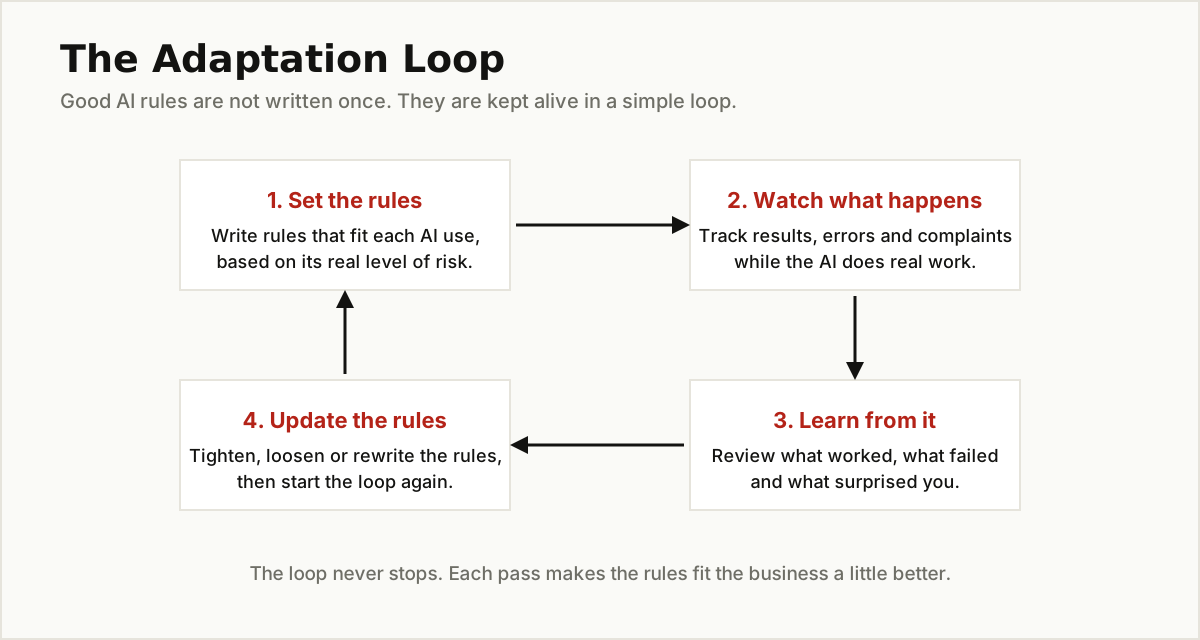
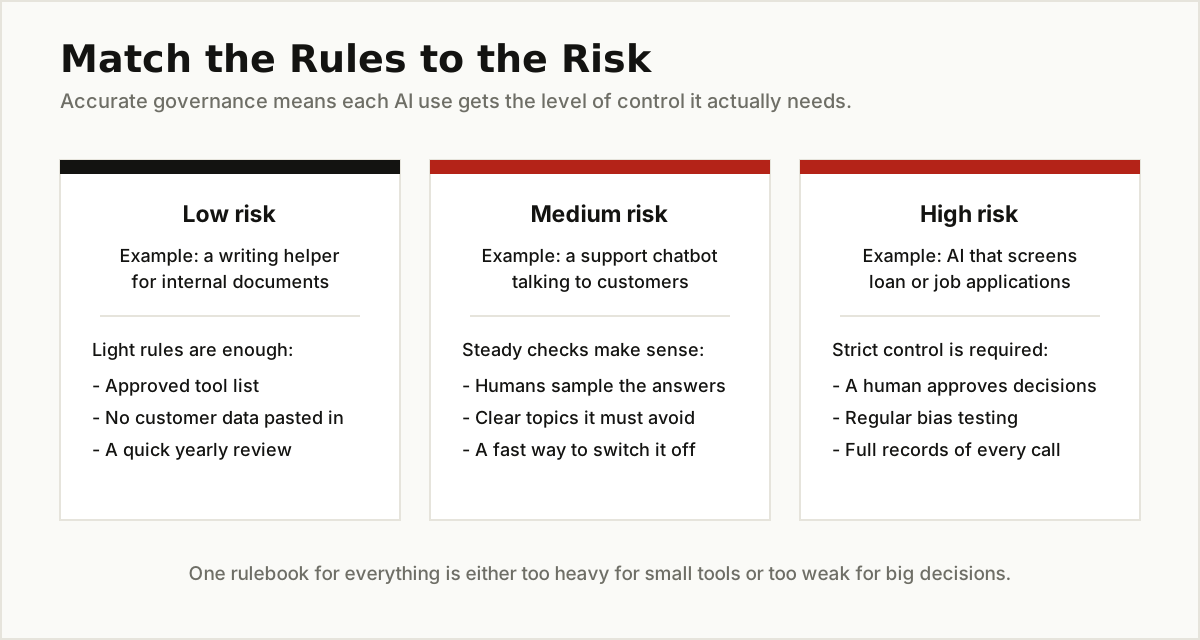
Step 1: Set rules per use case. List every AI tool the company uses. For each one, write down what it does, what data it touches and the worst realistic mistake it could make. Group the tools into low, medium and high risk. Then set rules per group: light checks for low risk, human review and logging for high risk. This matching of control to risk is what people mean by ai governance contextual accuracy. It is also where international guidance points: ISO/IEC 42001, the AI management system standard, asks companies to keep improving their AI controls over time rather than setting them once.
Step 2: Watch what happens. Rules without feedback are guesses. Keep simple records: error reports, customer complaints about the AI, samples of its answers reviewed by a human, and notes whenever a vendor announces a model change. None of this needs fancy software. A shared folder and a monthly habit will do at the start.
Step 3: Learn on a schedule. Once a month for busy tools, or once a quarter for quiet ones, the owners sit down with those records and ask three questions. What went wrong? What almost went wrong? What changed around the tool? Write the answers down. A one page review note beats a long meeting that produces nothing.
Step 4: Update and publish. Change the rules that the evidence points to. Add a check where errors keep happening. Loosen a rule that blocks harmless work. Then publish the new version in one known place, with a short changelog, so nobody works from an old copy. Version your policy the way software teams version code.
Then the loop starts again. Each pass is small, and that is the point. Ten small updates a year keep rules close to reality. One heroic rewrite every three years never does.
Governance at Four Growth Stages
Business evolution is the other half of the story, because the right level of oversight depends on how far AI has spread inside the company. A startup testing its first tool does not need a compliance department. A bank whose AI helps approve loans cannot run on trust and a wiki page.
Use this table as a rough map. Find the stage your company is in today, and check whether your oversight matches it. Then look one stage ahead, because that is where you are heading.
| Stage | Typical AI use | Right level of oversight |
|---|---|---|
| Experiments | A few teams test writing and coding tools | Short ground rules and an approved tool list |
| Early adoption | Departments use AI daily for drafts and support | A named owner per tool and monthly spot checks |
| Scaled use | Chatbots and tools serve many customers | Monitoring, audit logs and a clear incident process |
| Core operations | AI helps decide prices, loans or care plans | Executive oversight, bias testing and tested backup plans |
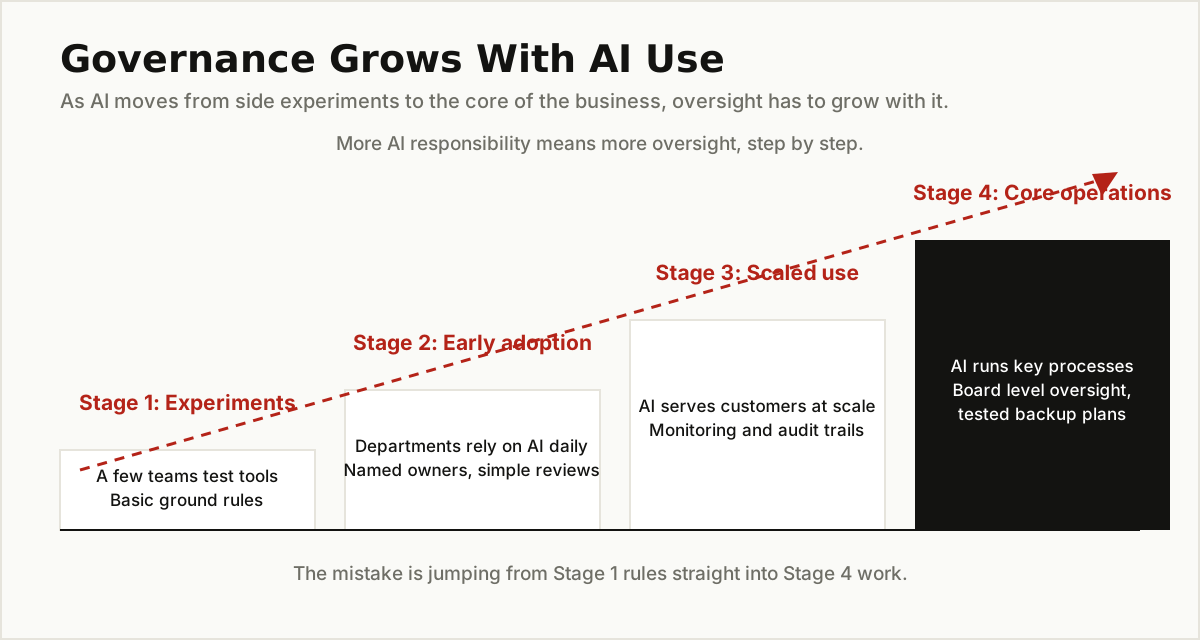
The common failure is a stage mismatch: Stage 3 usage running on Stage 1 rules. The tool grew up, the rulebook did not. Adaptation means moving your oversight up one stage as soon as the usage moves, not a year later when something breaks.
Review Triggers: When to Check the Rules Again
Scheduled reviews are the floor, not the whole system. Real life sends its own signals. Smart companies keep a short list of triggers: events that automatically start a focused review of the rules for the tool involved, without waiting for the calendar.
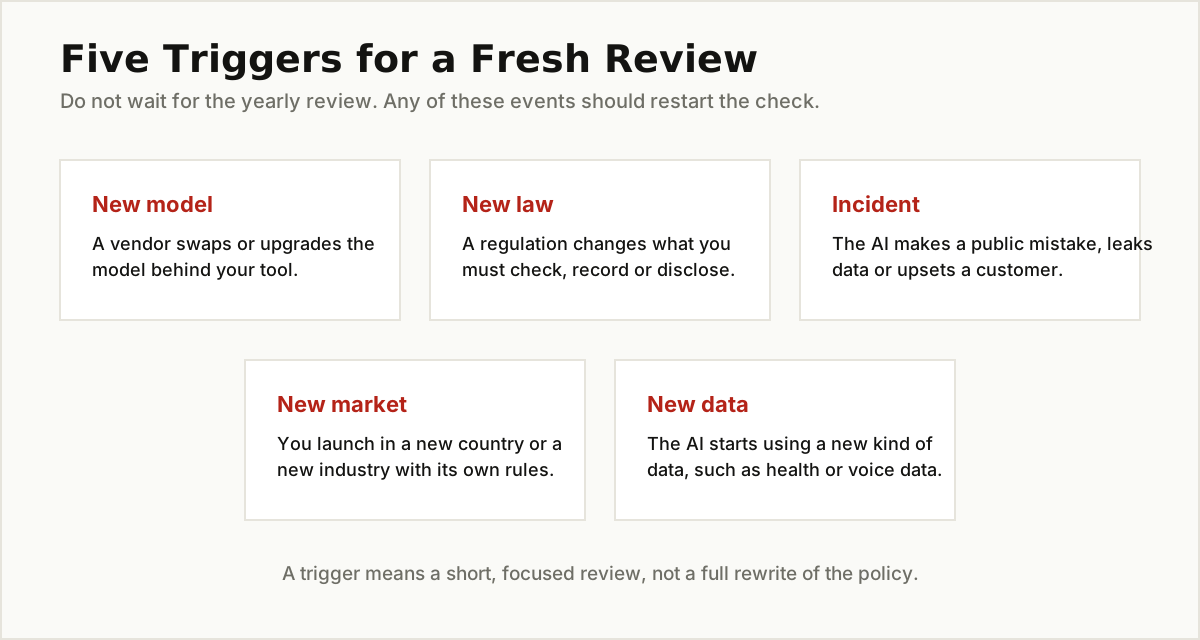
- A new model arrives. The vendor upgrades or replaces the model. Re-run your basic tests and check whether old limits still hold.
- A new law lands. A rule changes in a country or state where you operate. Check what you must record, disclose or stop doing.
- An incident happens. The AI leaks data, invents a policy or insults a customer. Review the rules for that tool within days, while the details are fresh.
- A new market opens. You launch in a new country or a regulated industry. Local rules and customer expectations may differ sharply from home.
- New data flows in. The tool starts using health data, voice recordings or children’s data. Sensitivity just jumped, and so should the checks.
A trigger review is short and narrow. It looks at one tool and one change. Most take an hour, not a week. That small size is what makes the habit stick, and it is the practical core of ai governance business context refinement: the context changed, so the rules get refined.

Learning From Incidents Without the Blame Game
Incidents are the best teachers a governance system gets, and the easiest ones to waste. When an AI tool makes a public mistake, the instinct is to find who approved it and make an example of them. That instinct feels satisfying and teaches the company nothing. Worse, it teaches staff to hide the next incident, and hidden incidents cannot improve any rules.
Run incident reviews like engineers run postmortems. Ask what happened, in plain sequence. Ask what the rules at the time allowed, and what they missed. Ask what a reasonable person with the same information would have done. Then change the system: a new check, a clearer limit, a better test, a human approval step for the risky corner. Write the change into the rulebook and share the lesson with every team that uses a similar tool.
A well-known example shows why this matters. A major airline was held responsible after its support chatbot invented a refund rule that did not exist, because the company argued the bot was a separate entity. It was not, and the lesson travelled across the industry: your AI speaks for your company, so your rules must cover what it can promise. Companies that read incidents like that, including other people’s, update their chatbot limits before the same thing happens to them. That is adaptation working exactly as it should.
The Roles People Forget
Rules do not update themselves, and “the company” is not a person. When an update has no named owner, it joins the forgotten PDF. Four roles cover most of the work, and in a small business one person can hold two of them.
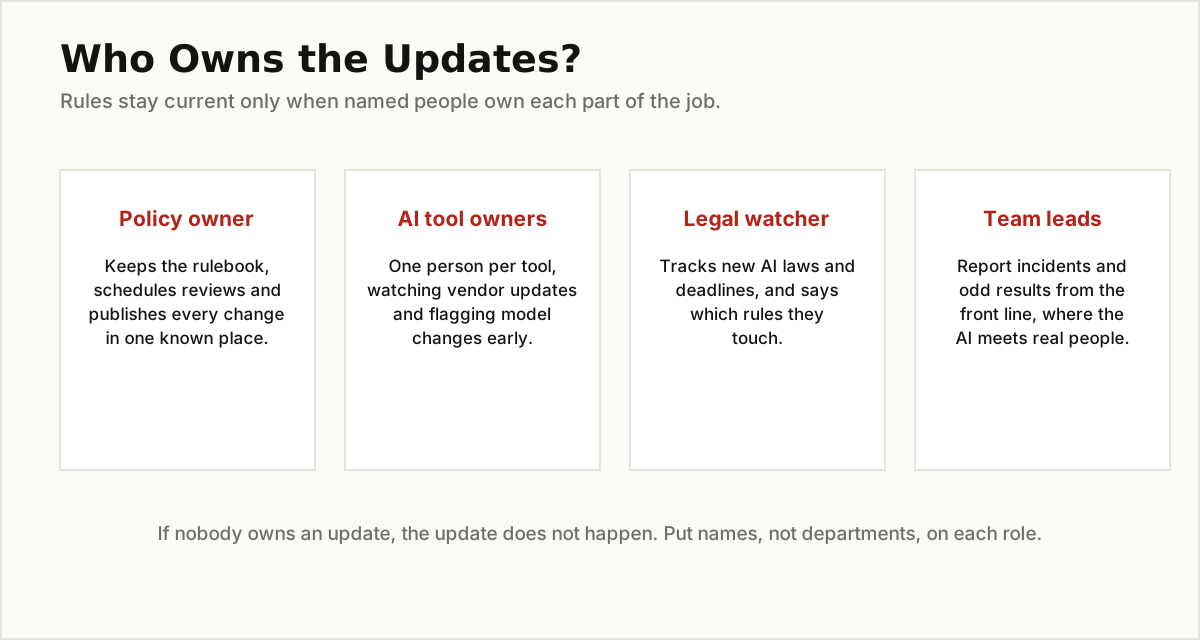
- The policy owner keeps the rulebook itself: schedules reviews, collects changes, publishes new versions in one place and retires old copies.
- The tool owners watch their own AI tools day to day. They are the first to hear about vendor model changes and odd behaviour, and they raise the flag.
- The legal watcher tracks AI laws and deadlines in the places the company operates, and translates each new duty into a plain list of what must change.
- The team leads report from the front line. Their staff see the AI fail in real conversations first, long before any dashboard does.
Write the names down next to the roles. Review the names twice a year, because people change jobs and orphaned roles are how governance quietly dies.
Common Mistakes That Keep Rules Frozen
A few patterns show up again and again in companies whose governance went stale.
- One giant rulebook for everything. Treating a spelling tool like a loan decision engine either buries the small tool in paperwork or leaves the big one under-protected. Split the rules by risk, as the accuracy cards below show.
- Copying a vendor or a template. Borrowed policies describe someone else’s tools, data and risks. They are a fine starting draft and a poor finished product.
- Reviewing only after something breaks. If incidents are the only trigger, the rules always arrive one failure too late.
- Hiding the rules. A policy that staff cannot find in thirty seconds does not exist in practice. One page, one link, one owner.
- Measuring nothing. If nobody samples the AI’s answers or counts its errors, reviews become opinion contests. Small numbers beat big opinions.
Conclusion
AI governance fails quietly. Nothing explodes on the day the rules go stale. The tools just keep changing, the laws keep moving and the business keeps growing, until one day the gap between the rulebook and reality shows up as a fine, a headline or a lost customer.
The way out is a habit, not a document. Fit the rules to each use. Watch what the AI actually does. Review on a schedule and on triggers. Learn from incidents without hunting for someone to blame. Put names on the work. Do that, and ai contextual governance, business evolution and adaptation stop being three heavy phrases and become one ordinary routine that keeps your AI useful and your company safe.
Start this week with the smallest useful step: list your five most important AI tools, name an owner for each, and pick your review triggers. For more coverage of AI rules and the laws behind them, browse our AI news and regulation section.