Ask a question in Google, ChatGPT or Perplexity today and you often get one written answer, not a list of links to choose from. If your brand is named inside that answer, you win the click before it even happens. If a competitor is named instead, you lose a customer you never even saw.
Here is the problem: classic SEO reports cannot tell you any of this. They show where your pages rank in the blue links, but the answer above those links stays invisible to them. That blind spot created a new kind of tool called AI search analytics, and one of the earliest names in it is ZipTie.
This guide explains what ZipTie is, which AI platforms it watches, what it measures, and who it is built for. It is part of the bigger shift known as generative engine optimization, where the goal is to be cited inside AI answers, not just ranked under them.
What Is ZipTie AI Search Analytics?
ZipTie is an AI search analytics platform. In plain words, it checks how AI search engines talk about your brand, and it shows you the gaps worth fixing.
It works like this. You give it the questions your buyers actually ask, things like “best invoicing tool for freelancers” or “which CRM is easiest to learn”. These questions are called prompts. ZipTie runs those prompts into the AI engines on a schedule, reads the full answers, and records whether your brand is named, whether your pages are cited as sources, how you are described, and which competitors show up instead.
One detail confuses many people, so let us clear it up. There are two ZipTie products, built by the same team. The original product lives at ziptie.dev and, in the company’s words, keeps running for its existing users. The newer platform is ziptie.ai, which is where the current feature set lives. The two run on separate accounts, so a login for one does not work on the other. Most of this guide describes ziptie.ai, and we say so wherever the older product differs.
ZipTie says its answers are captured from the live consumer products, meaning the same ChatGPT or Google screens your buyers see, rather than from model API stubs. SEO publications covering this category also note that the team behind ZipTie runs Onely, a technical SEO agency, which explains the tool’s practical, fix-it tone.
Which AI Platforms Does ZipTie Track?
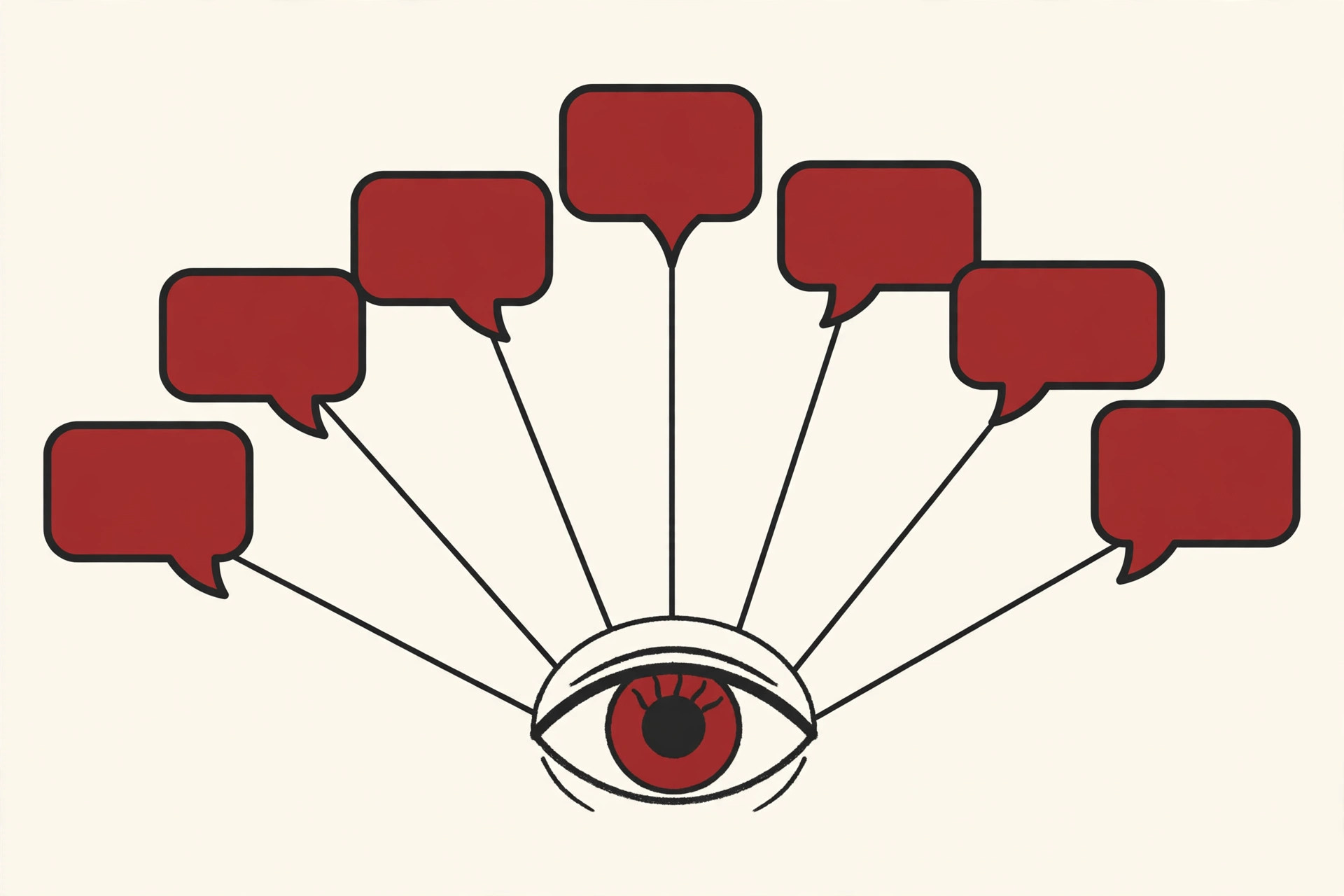
According to ZipTie’s own site, the ziptie.ai platform monitors seven AI search engines:
- ChatGPT, the most widely used AI assistant
- Google AI Overviews, the AI summaries at the top of Google results
- Perplexity, the AI native search engine
- Google AI Mode, Google’s conversational search view
- Microsoft Copilot, Microsoft’s AI assistant
- Bing AI Overview, the AI summary inside Bing results
- Google Gemini, Google’s standalone AI assistant
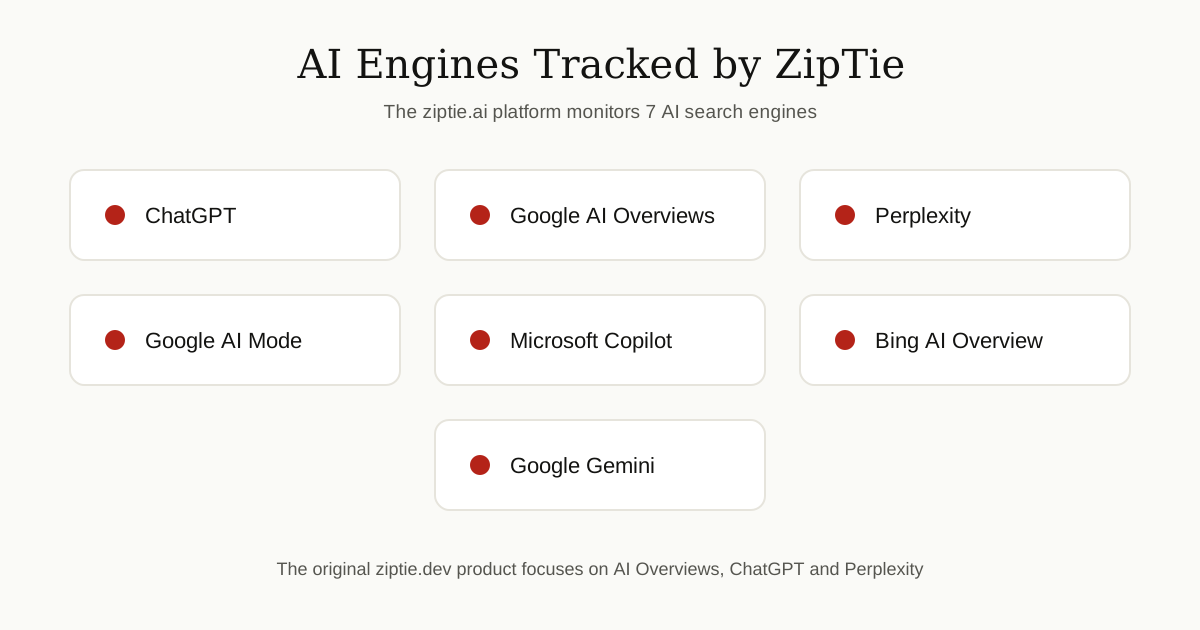
The original ziptie.dev product covers a smaller set: Google AI Overviews, ChatGPT and Perplexity. On the newer platform, each project runs its prompts in one country you pick, at a daily, weekly or monthly pace, and the company says its checks run in nearly every country. That matters because the same question can produce a very different answer in the United States than it does in Germany or India.
What Does ZipTie Measure?
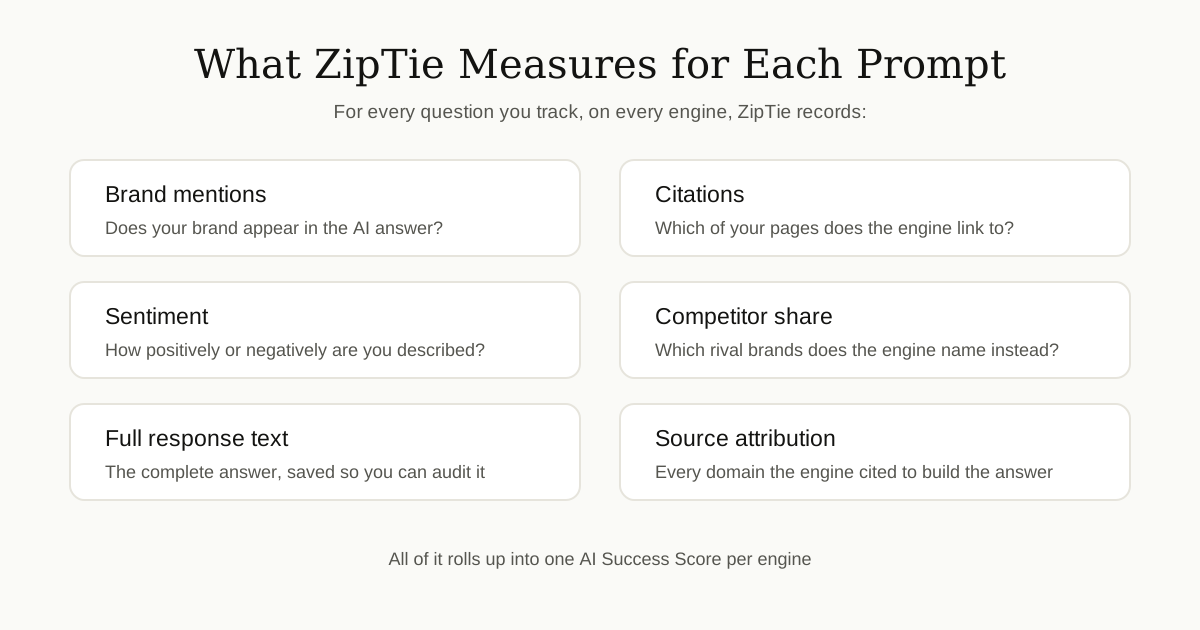
ZipTie’s own FAQ page lists exactly what it captures for every prompt, on every engine:
- Brand mentions: whether your brand appears in the answer at all
- Citations: which of your URLs the engine links to as a source
- Sentiment: how positively or negatively the answer describes you
- Competitor share: which other brands the engine recommends instead
- AI Overview coverage: whether an AI answer is generated for that question in the first place
- Full response text: the complete answer, archived so you can audit what was actually said
- Source attribution: every domain the engine cited to build the answer, yours or anyone else’s
These data points roll up into one headline number ZipTie calls the AI Success Score. The company presents it as a per engine score that helps you decide what to optimize first: a prompt where you are absent but a close competitor wins is a bigger opportunity than one where you already lead.
There is one honest detail worth knowing, and ZipTie states it openly on its site: there is no fixed rank inside an AI answer. The order of brands inside an answer changes from run to run, so the tool reports how often you are named and cited across many prompts and many checks, instead of pretending you hold “position 2 in ChatGPT”. That is a more truthful way to measure something this fluid.
Inside the Tool: The Main Modules
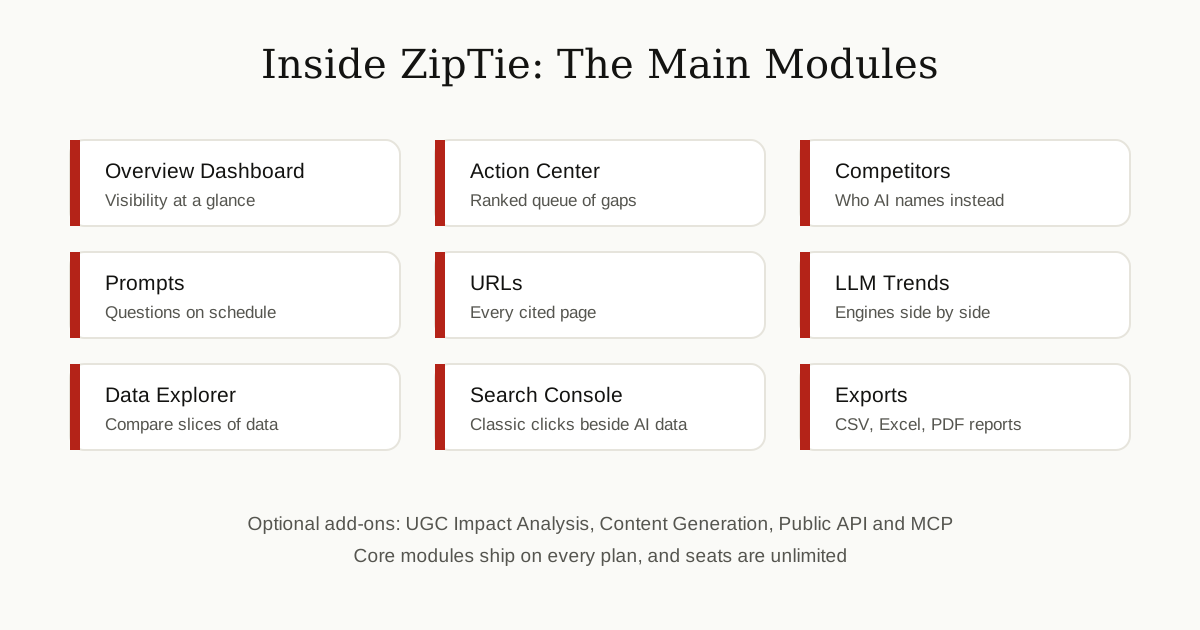
ZipTie groups its platform into modules, and each one answers a single question:
- Overview Dashboard: your visibility at a glance, including whether your AI Success Score gained or lost ground
- Prompts: the questions you track, monitored on schedule
- Competitors: who the AI recommends instead of you, and why
- URLs: every page the engines cite, yours and your competitors’, every time it happens
- LLM Trends: performance shifts across engines, side by side
- Data Explorer: slices of one project compared, such as branded questions against unbranded ones
- Action Center: one ranked queue of gaps to fix, ordered by severity, with each item linked to the screen where you act on it
- Search Console: your classic Google clicks, impressions and positions shown next to your AI search data, so the two worlds sit in one view
- Exports: CSV and Excel files, a PDF snapshot, and white label client reports for agencies
Setup is handled by a Project Wizard, a guided chat that reads your site and proposes the right prompts, written the way your buyers ask. ZipTie also offers three optional add-ons: UGC Impact Analysis, which studies the Reddit threads and YouTube videos the engines cite; Content Generation, which drafts content aimed at AI search with a built in fact check step; and a Public API and MCP add-on, which lets other tools and AI agents query your data directly.
Nothing needs to be installed on your website to start. There is no tracking tag and no code change. The only optional connection is Google Search Console, linked in read only mode through the standard sign in flow.

How Teams Use It: Discover, Prepare, Verify
The company’s product tour describes the workflow as one loop in three steps.
Discover. What do the engines say about you, and why? You approve a prompt set, the checks run, and you read the answers, the sources behind them, and how you are portrayed.
Prepare. What should we change? The Action Center turns weak spots into a ranked work queue: a prompt no engine answers with you in it, an engine that stopped naming you, a competitor that passed you. With the Content Generation add-on, a gap can become a brief and then a draft.
Verify. Did the answer move? You record where a new or updated page went live, watch which engines start citing it, and mark the date on your AI Success Score trend, with Search Console clicks alongside.
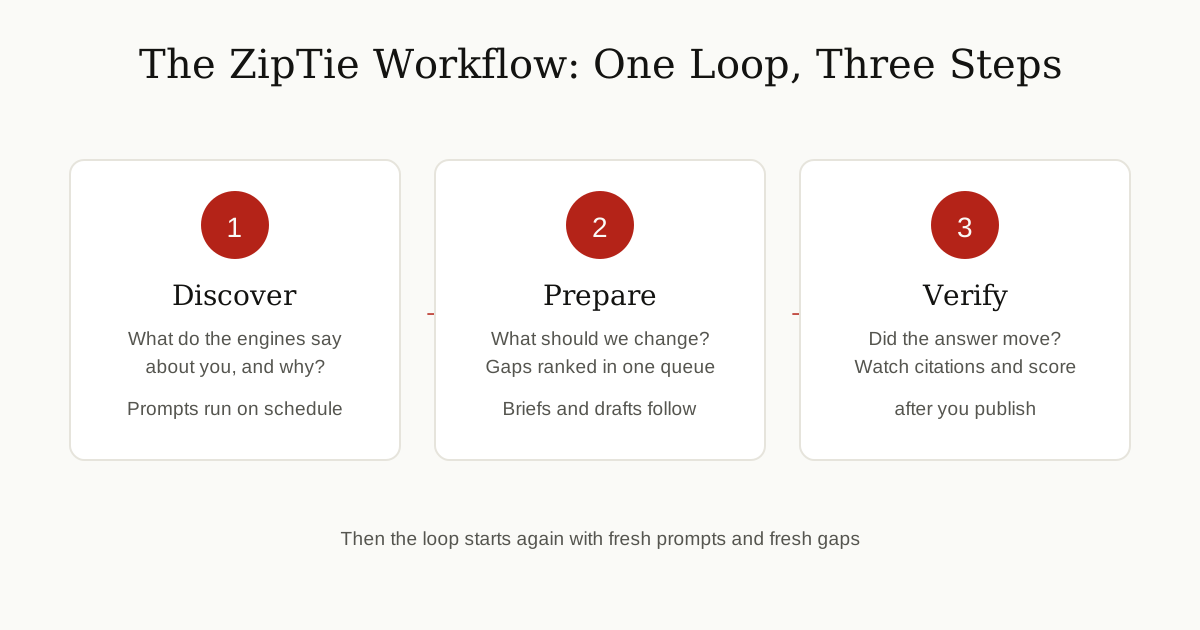
Then the loop starts again, because the sources the engines read keep moving, and so do your competitors.
One practical point sits underneath all three steps: everything depends on the prompts you choose. Track questions nobody asks and the prettiest dashboard in the world tells you nothing. ZipTie’s wizard proposes an initial set from your site, and the company says you can grow it later from AI suggestions, a CSV import, or Search Console queries you are not tracking yet. Good prompt sets mix buying questions, comparison questions and problem questions, because those are the moments where being named in the answer wins real business.
ZipTie vs Classic Rank Tracking
It helps to see ZipTie next to the tools SEO teams already know. Classic platforms such as Semrush track your position in the blue link results, your backlinks, and your estimated traffic, while skills like search operators help you dig into those results by hand. That work still matters, because AI engines often build their answers from pages that search engines already trust.
But the surface ZipTie measures is different in four ways:
- A rank tracker reads a list of links. ZipTie reads one written answer.
- A rank tracker reports a position number. ZipTie reports whether you were named, cited, or missing.
- A rank tracker checks keywords. ZipTie checks prompts, the full questions people type into AI tools.
- Rankings are fairly stable. AI answers are rewritten on every run, so frequency across many checks means more than any single snapshot.
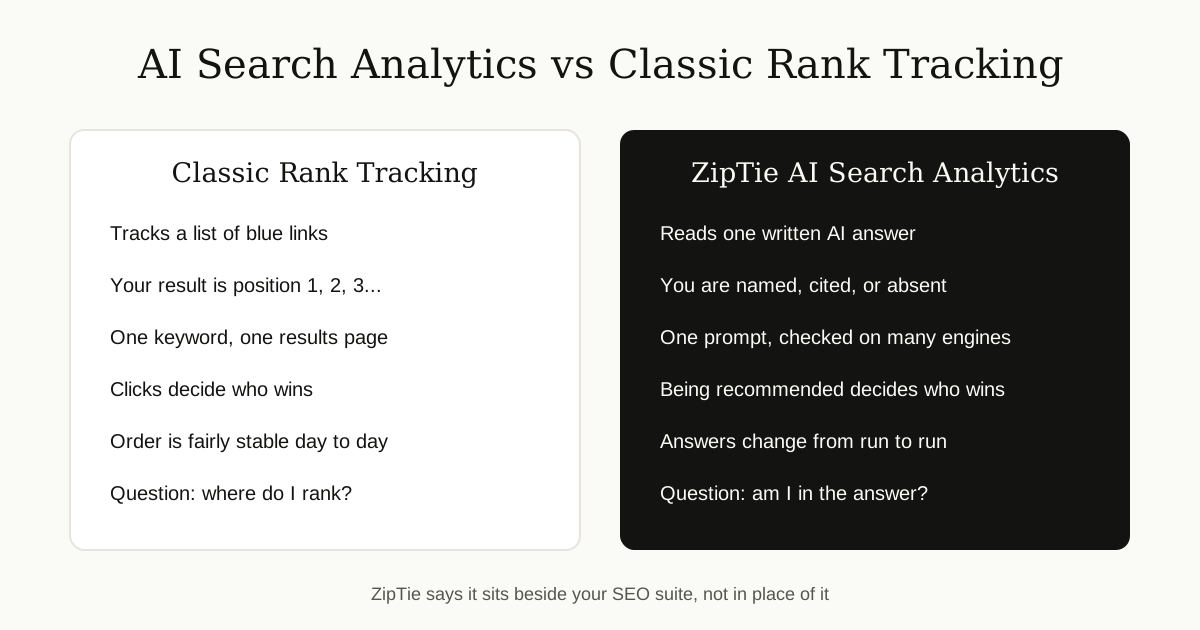
ZipTie is clear about its place in the stack: in its own words, the platform “sits beside your SEO suite rather than replacing it”. Independent roundups of AI search visibility tools describe ZipTie the same way, as a focused tracker that is strongest on AI Overviews, ChatGPT and Perplexity coverage. In practice, most teams keep their classic suite for rankings and links, and add a tool like ZipTie for the answer layer those suites cannot see.
Who Is ZipTie For?
Based on the company’s own description, ZipTie is built for:
- SEO and content teams who need to understand and influence how AI engines describe their brand and products
- Agencies, which use it to report on AI visibility for their clients, often with one project per client
- In-house teams, which use the data to brief content writers and decide which site changes come first
- Founders, who want to know whether AI is recommending them, or quietly handing their customers to a competitor
You probably do not need it yet if your buyers never use AI tools to research purchases, or if your classic SEO basics, like indexation and content quality, are still broken. Fix the foundation first. AI search analytics pays off once your pages are good enough to deserve a citation and you need to know whether they are getting one.
Getting Started, Trial and Pricing
Getting started takes minutes for a single project, according to the company: the Project Wizard reads your site, proposes prompts, and sets your country and language, and you are collecting data the same day.
ZipTie offers a 7 day free trial with 25 daily prompts across ChatGPT, Google AI Overviews and Microsoft Copilot, with no card required and no auto billing, per its site. On pricing, the ziptie.ai platform uses usage based pricing, and the company’s product page lists a starting price of 42.75 USD, with the final cost following how many engines and prompts you run. The older ziptie.dev product runs on fixed plans instead. Prices across this whole category change often, so treat any number, including this one, as a starting point and check the live pricing page before you budget.
The Bottom Line
So, what is ZipTie AI search analytics? It is a tool that answers a question classic SEO software cannot: when buyers ask AI engines about your category, does the answer name you, cite your pages, and describe you fairly, or does it hand the moment to a competitor?
ZipTie tracks that across seven AI engines, records mentions, citations, sentiment and competitor share for every prompt, rolls it into an AI Success Score, and turns the gaps into a ranked list of fixes. It does not replace your SEO suite, and it is honest about the limits of measuring answers that change daily. For brands and SEO teams adjusting to AI search, that honesty, plus the data itself, is the product.
Keep going with our other SEO and Search guides, where we break down search operators, classic SEO tools, and AI search the same plain English way.