
If you typed something like “best api search companys homepage” into a search engine, the wording is messy but the goal is clear. You want to find the companies that sell search APIs, land on the right homepages, and figure out which one deserves your project.
Here is the honest shortcut. There is no single best search API company for everyone, whatever the ads say. There are a handful of serious names, each strong at a different kind of job. This guide explains what a search API actually is, walks through the leading providers using facts from their own official sites, and ends with the questions that make the choice easy.
One quick note before the list. Most people behind this search want a search box for their own website, store or app. That is what this guide focuses on. A smaller group wants SEO data instead, and there is a short section for them too.
What Is a Search API?
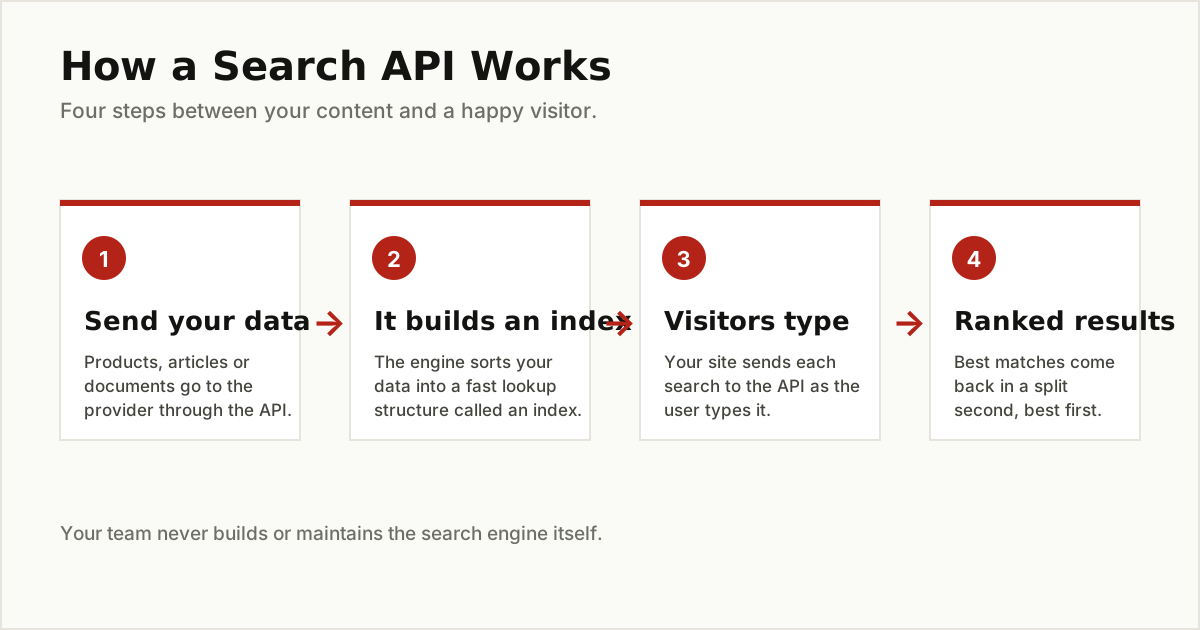
A search API is a service that gives your website or app a professional search box, without your team building a search engine from scratch.
API stands for application programming interface. In plain words, it is a way for two pieces of software to talk to each other. Your site talks to the search service through the API.

It works in two simple stages. First, you send your content, such as products, help articles or documents, to the provider. The provider organizes that content into an index, which is a pre-sorted lookup structure built for speed. Second, when a visitor types into your search box, your site sends the words to the API, and the API answers with the best matching items, already ranked, usually in a split second.
Why not just use the search built into your database or website platform? Because basic built-in search is usually slow and dumb. It often cannot forgive a typo, cannot rank the most useful result first, and slows down as your content grows. A dedicated search service handles typos, synonyms, ranking and speed as its whole job. Algolia, one of the biggest names below, describes its product as an API-first search platform, which is exactly this idea: search delivered as a service you plug in.
First, Know the Two Families of Search APIs
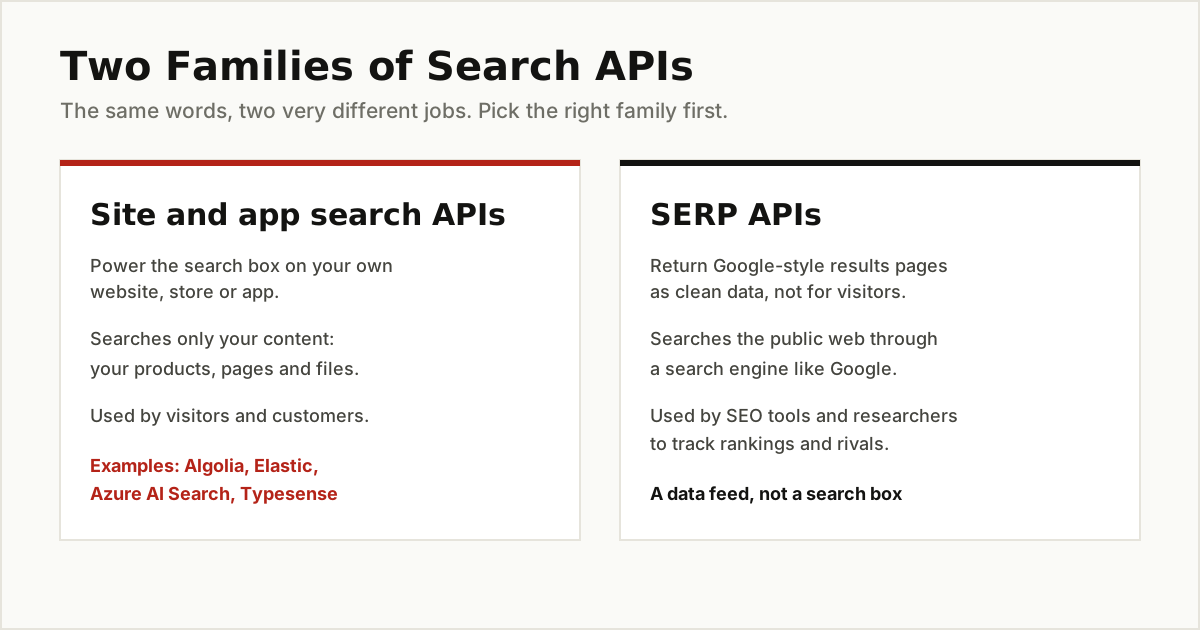
The words “search API” cover two different products, and mixing them up wastes hours.
Site and app search APIs power the search box inside your own product. They search only your content: your products, your pages, your files. Algolia, Elastic and the rest of the main list below live here.
SERP APIs do something else entirely. SERP stands for search engine results page. A SERP API runs a search on a public engine like Google and returns that results page as clean, structured data. No visitor ever sees it. SEO tools use this data behind the scenes.
The Other Family: SERP APIs in One Minute
If your job is SEO rather than building a product, this is your section, and it is short on purpose.
Rank tracking tools, competitor research platforms and keyword tools all need fresh Google results at scale. They cannot open a browser for every check, so they buy SERP API access from data providers. The API returns the titles, links and positions on a results page as data the tool can store and chart.
You can do small checks yourself for free with search operators, the special commands that sharpen a normal Google search. And the newest tools go one step further, tracking how brands show up inside AI generated answers, which is the job of tools like ZipTie AI search analytics. The other half of that work is making your own pages easy to find in the first place, which starts with basics like image search techniques.
For everyone else, the real question is the first family: who should power your site’s own search box? Here are the main companies.
The Leading Site Search API Companies

Algolia: The Hosted Specialist
Algolia is the name most people meet first, and it is a pure hosted service. You sign up, send your data, and Algolia runs everything on its own servers. There is nothing to install and nothing to maintain.
It is best known for very fast search as you type, strong typo tolerance, and tools that let marketing teams adjust rankings and promote products without asking developers. Online stores and media sites are its home ground. Algolia says more than 18,000 customers use the platform, a figure from its own website, and its whole design is built around developers plugging search into a site quickly through clean APIs and ready made interface components.
Pick Algolia when you want hosted search that feels instant and your team does not want to run any search infrastructure at all.
Elastic: The Power Tool Behind Elasticsearch
Elastic is the company behind Elasticsearch, one of the most widely used search engines in the world. Elastic’s own documentation describes Elasticsearch as a distributed search and analytics engine built on Apache Lucene, the classic search library underneath many search products.
Elasticsearch does far more than website search. The same engine is used for digging through log files, security data and business analytics, and it handles very large amounts of data spread across many servers. Elastic sells it as Elastic Cloud, a hosted service, and you can also run it yourself. Elasticsearch started as an open source project, and its licensing today includes an open source AGPL option alongside Elastic’s own license terms.
Pick Elastic when search is only part of a bigger data job, or when your data is huge and your team has the engineers to match.

Microsoft Azure AI Search: The Microsoft Cloud Option
Azure AI Search is Microsoft’s fully managed search service, sold as part of its Azure cloud. Microsoft’s documentation describes it as a cloud hosted service for building search into web and mobile apps and, more recently, for feeding company data to AI assistants.
It offers full text search, vector search, which means searching by meaning rather than exact words, and a hybrid of both. It also has built in AI skills that can pull text out of documents and images while indexing. If your company already runs on Azure and Microsoft tools, this is the natural fit, because your data, security rules and billing already live in one place.
Pick Azure AI Search when your world is already Microsoft and you want search that plugs into it without a second vendor relationship.
Amazon OpenSearch Service: The AWS Option
Amazon OpenSearch Service is Amazon’s managed way to run OpenSearch in the AWS cloud. OpenSearch is a fully open source search and analytics engine that Amazon leads, created from the last open source version of Elasticsearch. AWS handles the servers, updates and backups, and you get the open source engine’s APIs.
Like Elasticsearch, it doubles as a log analytics tool, so AWS shops often use one service for both jobs. One honest warning if you go researching on your own: Amazon’s older enterprise search product, Amazon Kendra, is no longer open to new customers as of July 30, 2026, according to AWS. Do not start a new project on it. For new AWS search projects, OpenSearch Service is the door Amazon points you to.
Pick Amazon OpenSearch Service when your product already runs on AWS and you want open source search without running the clusters yourself.
The Open Source Engines You Can Host Yourself
Hosted services are not the only route. Three open source engines let you run search on your own servers, free as software, and each also sells a cloud version if you later want someone else to run it.
Typesense is an open source engine built for instant search as you type, with typo tolerance at its center. Its own documentation presents it as an easier to use alternative to the bigger engines, and developers like it because a working setup takes minutes rather than days.
Meilisearch is an open source engine written in the Rust programming language, known for fast, forgiving search that behaves well with very little tuning. It aims at the same instant search job as Algolia, in a package you control, and its company also runs Meilisearch Cloud for teams that outgrow self hosting.
Elasticsearch and OpenSearch, covered above, are the heavy end of this family. They scale furthest and do the most, but they ask the most from the team running them.
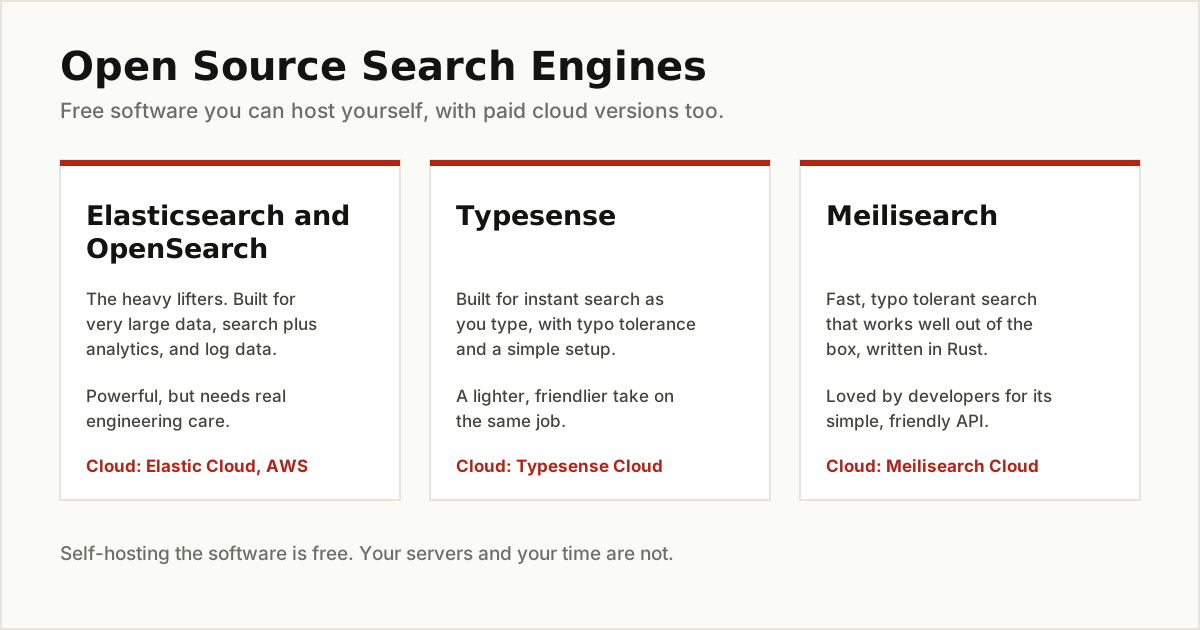
The honest trade is simple. Self hosting makes the software free, but your servers and your engineers’ time are not. For a small team, a hosted bill is often cheaper than the hours spent keeping a search cluster healthy at 2 a.m.
Hosted vs Self-Hosted: The Real Decision
Most shortlists come down to one question: who runs the servers?
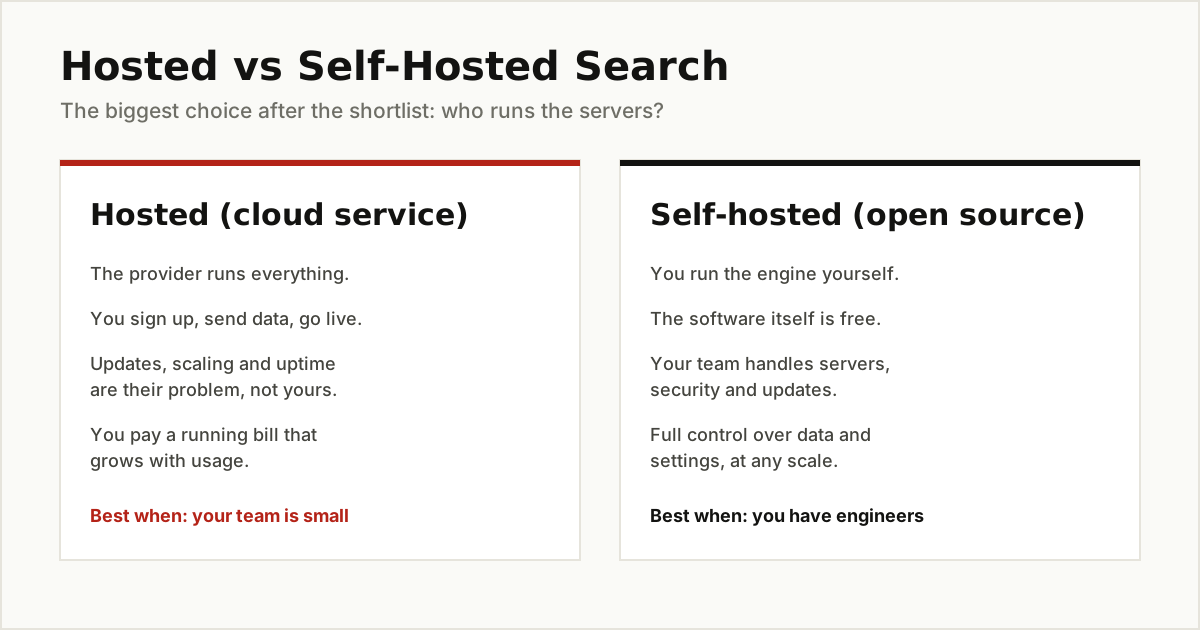
With a hosted service, you pay a running subscription and the provider owns speed, uptime, security patches and scaling. With a self hosted engine, you pay nothing for the software and keep full control of your data, but every one of those jobs lands on your team.
Neither answer is wrong. Small teams and stores usually win with hosted. Companies with strict data rules, very large scale, or engineers who enjoy this work often win with self hosted, sometimes starting hosted and moving later.
How to Choose: Five Questions
Forget rankings for a moment and answer these five questions honestly. The right company usually falls out of the answers.
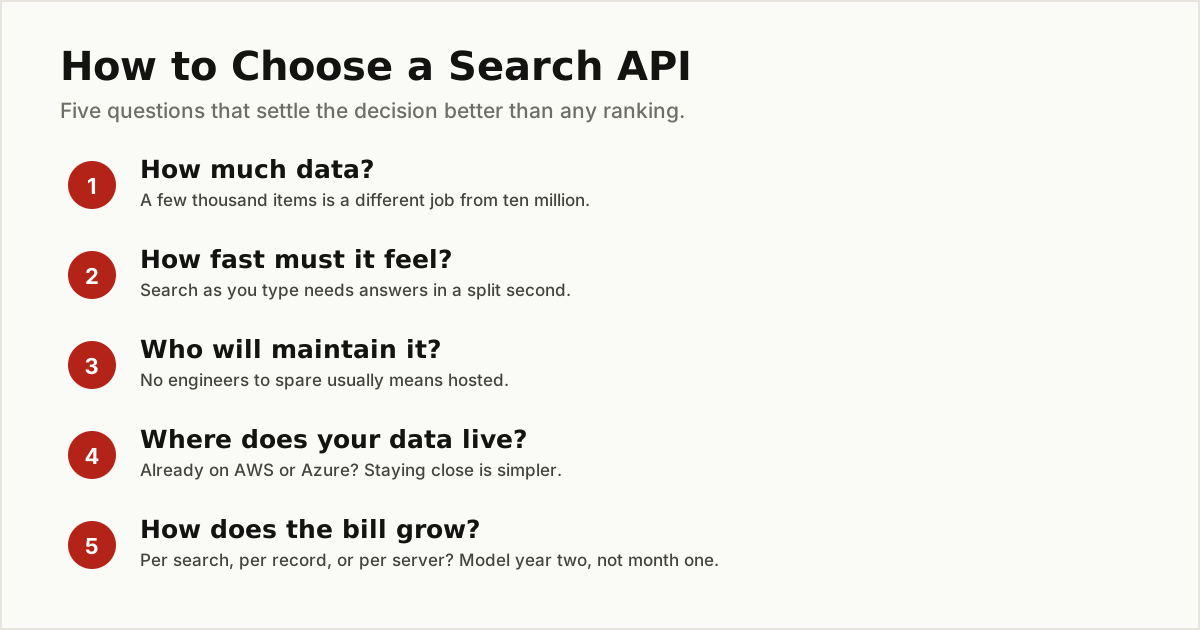
- How much data do you have? A few thousand products is a light job that any provider here handles easily. Tens of millions of documents push you toward Elastic, OpenSearch or a serious hosted plan.
- How fast must it feel? If visitors expect results with every keystroke, speed is the product. Algolia and the open source instant search engines were built for exactly that feel.
- Who will maintain it? If nobody on your team can own servers, updates and backups, choose hosted and do not feel bad about it.
- Where does your data already live? A company deep in AWS usually finds OpenSearch Service simplest. A Microsoft shop finds Azure AI Search simplest. Staying close to home removes integration pain.
- How does the bill grow? Pricing models differ in shape, not just size. Hosted plans usually charge based on usage, such as how many searches run and how many records you store. Cloud services usually charge for the size of the service you keep running. Self hosted software charges nothing, but the servers and staff time are real costs. Compare what year two looks like, not the free first month.
The Bottom Line
The search that started this guide, “best api search companys homepage”, hides a simple truth: the best search API company is the one that fits your data, your team and your cloud, not the one with the loudest homepage. Algolia leads for plug in hosted site search, Elastic and OpenSearch lead for scale and heavy data work, Azure AI Search and Amazon OpenSearch Service fit teams already living in those clouds, and Typesense and Meilisearch give smaller teams a free, friendly engine of their own.
Pick your family first, answer the five questions, then test the top two with your real data. Search quality is easy to judge once your own products and your own typos are in the box.
Keep going with our other SEO and Search guides, where we break down search operators, SEO tools, and how search engines work in the same plain English way.