For years, one name came up again and again whenever sports fans talked about watching games for free online: StreamEast. It was not an app, and it was not a company you could call. It was a network of websites that showed live sports taken from paid television broadcasts, free for anyone willing to put up with the ads.
In September 2025, that network was shut down, in what the Alliance for Creativity and Entertainment (ACE) called the largest illegal live sports streaming operation in the world. Less than a year later, its two operators were convicted in an Egyptian court. Yet searches for the name have not stopped, because copy sites keep using it.
This guide explains what StreamEast actually was, how it was taken down, whether using sites like it is legal, what risks come with them, and the legal ways to watch live sports instead, including the free ones.
What Is StreamEast?
StreamEast was a free sports streaming network. Its pages listed the day’s live events, and when you picked one, a video player appeared with the match already on. There was no account to create and nothing to pay. The streams covered almost every sport fans usually have to pay for, from Sunday football to championship boxing.
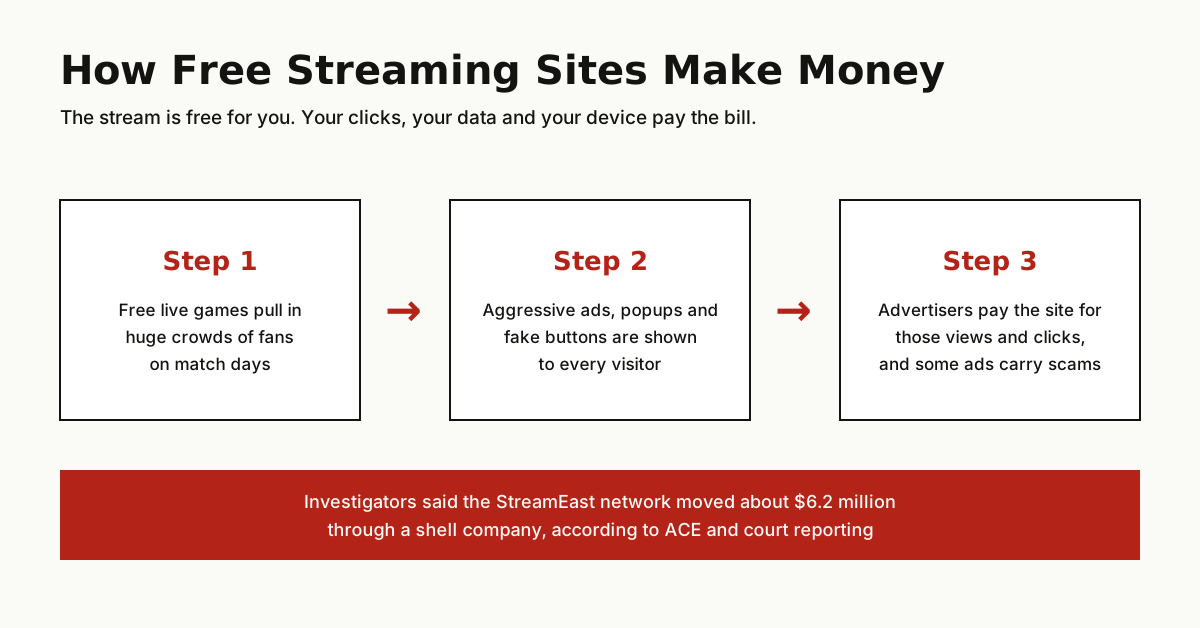
The network did not own cameras, hold broadcast rights, or employ commentators. It took feeds that belonged to leagues and broadcasters and republished them on its own pages, wrapped in advertising. That advertising was the whole business. Every visitor saw wave after wave of ads and popups, and those ads paid the operators.
Using the sites day to day was a mixed experience, which regular users accepted as the price of free. Picture quality swung from sharp to barely watchable, streams froze or died in the middle of games, and the same event was listed on page after page of sister sites so that if one address stopped working, another usually had it.
According to ACE, the anti-piracy coalition backed by major studios, streaming services and sports broadcasters, the network ran 80 associated domains and logged more than 1.6 billion visits in its final year, an average of about 136 million visits a month. Most of that traffic came from the United States, Canada, the United Kingdom, the Philippines and Germany.
What Could You Watch on It?
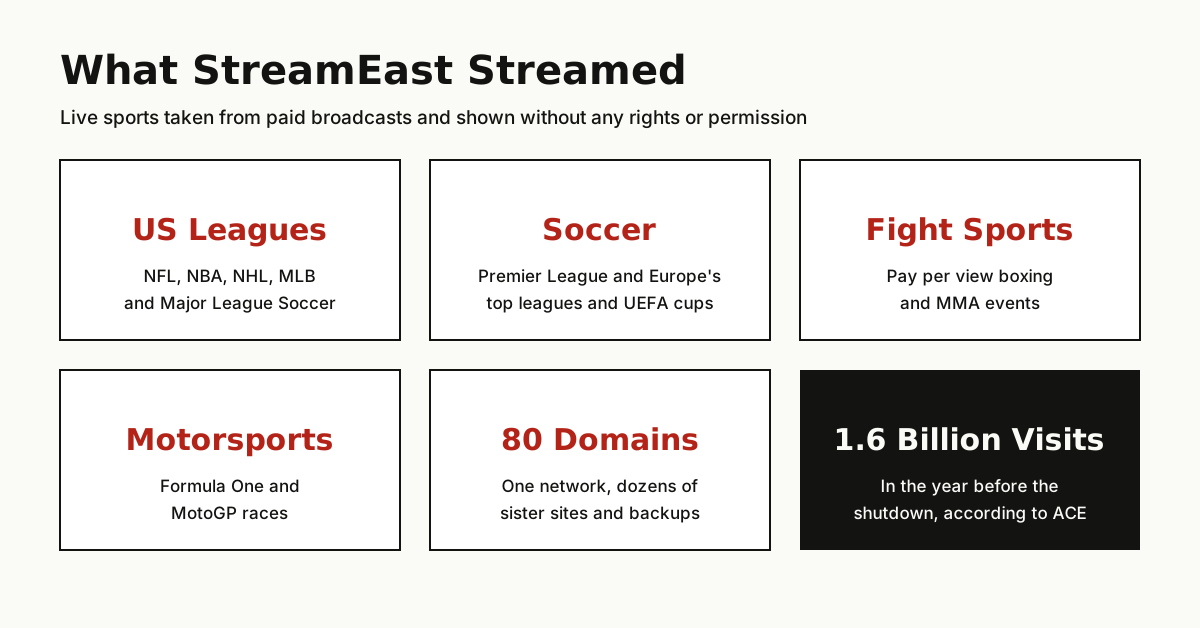
The menu was the main reason for the traffic. ACE listed unauthorized access to Europe’s top soccer leagues, including the Premier League, La Liga, Serie A, the Bundesliga and Ligue 1, plus UEFA competitions such as the Champions League. American sports were covered just as heavily: the NFL, NBA, NHL and Major League Baseball, along with Major League Soccer, pay per view boxing, mixed martial arts and motorsports such as Formula One and MotoGP.
In plain terms, it offered in one place what legal viewers can only get by paying for several different services. That gap between what fans wanted and what legal options cost is the demand the network lived on, and it is still the demand that copy sites chase today.
The Shutdowns: Seized Domains, a Raid, and a Court Case
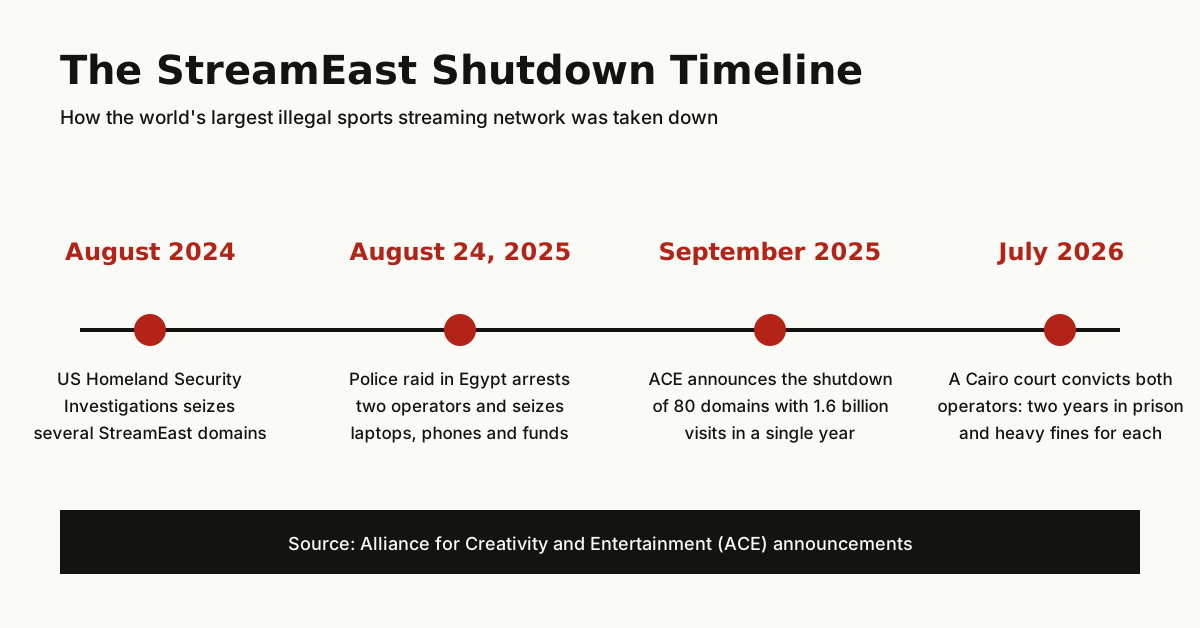
The takedown happened in stages. In August 2024, US Homeland Security Investigations seized several StreamEast domains, and visitors who tried those addresses found an official seizure notice instead of a stream. The network answered within days by moving to backup addresses. Its administrators said they had more than 400 alternative domain names ready, according to reporting by The Athletic at the time.
Domain seizures alone did not finish the job, so investigators went after the people. An investigation that ran for more than a year, led by ACE with Egyptian authorities, ended on August 24, 2025, when police raided homes in El Sheikh Zaid, near Cairo, and arrested two men accused of running the network. An ACE spokesperson told CyberScoop that 22 officers took part and that police seized three laptops, four smartphones and bank cards holding about 123,000 dollars, along with crypto wallets reported to hold about 200,000 dollars. Investigators also pointed to a shell company in the United Arab Emirates allegedly used to launder about 6.2 million dollars in advertising revenue.
On September 3, 2025, ACE announced the network was shut down and said the seized domains would redirect visitors to its Watch Legally page. ACE chairman Charles Rivkin called it a resounding victory against, in his words, the largest illegal live sports platform anywhere.
The legal story did not end there. In July 2026, ACE announced that the Cairo Economic Court had convicted both operators of copyright infringement. Each man was sentenced to two years in prison and fined about 110,000 dollars, and the court ordered the confiscation of the equipment and assets used in the operation and the formal closure of the network’s domains.
Why Do StreamEast Copies Keep Appearing?
If the network was dismantled and its operators jailed, why do sites using the StreamEast name still show up in search results? An ACE spokesperson gave the short answer to CyberScoop after the shutdown: copycat operations commonly appear after a big takedown, and ACE keeps monitoring for them.
Three things make copies easy. First, the name itself is famous, so a new site using it starts with free traffic from fans searching for it. Second, the technology is cheap: pirate sites mostly collect streams hosted elsewhere rather than running their own video, so a convincing copy can be put together quickly. Third, the demand never went away. Legal sports coverage is split across many paid services, and every fan priced out of that system is a potential visitor for whoever grabs the name next.
None of these copies is the original service back from the dead, and none of them has any connection to the leagues whose games they show. They are new operations borrowing a known brand, and they carry the same legal and safety problems described below.
Is StreamEast Legal?
The short answer is no. The streams were broadcasts that leagues had sold to television networks and streaming services for very large sums of money. StreamEast had no rights to any of it. Showing those broadcasts to the public without permission is copyright infringement, which is why the case against its operators was a criminal one and why it ended with prison sentences.
A legal review of the crackdown from the University of Richmond’s Journal of Law and Technology explains the framework: unauthorized retransmission of copyrighted broadcasts counts as infringement under US law, and the enforcement tools include domain forfeiture and criminal prosecution of the people distributing the content.
What about the person who only watches? Every enforcement action in this story targeted the operators, the money and the domains, not individual viewers, and the rules for viewers differ from country to country. Some countries treat knowingly watching pirated streams as an offense, others focus on the people providing them, and civil claims by rights holders are possible in some places. The honest summary is this: the sites are illegal operations, watching is not a safe gray area to rely on, and anyone using them is also exposed to the security risks in the next section. This article is general information, not legal advice.
The Safety Risks of Sites Like This
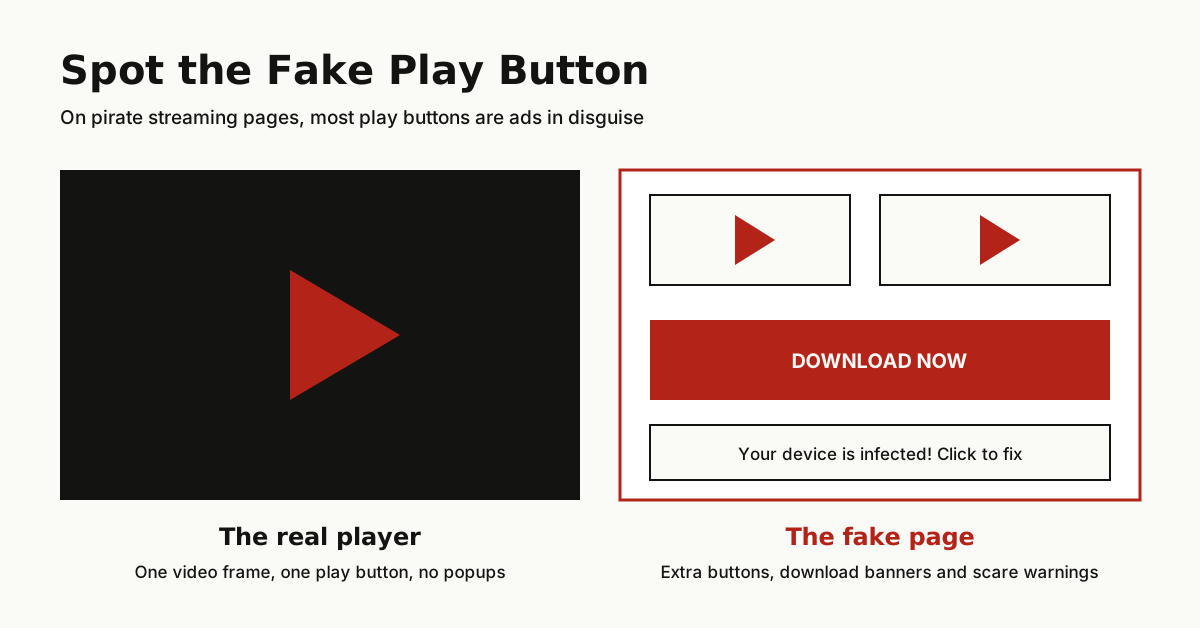
Free is the bait, and the visitors are the product. Because pirate networks cannot sell subscriptions or attract respectable advertisers, their pages are filled with the bottom tier of online advertising: popups, fake download buttons, misleading play buttons and redirects to scam pages. ACE itself said the operation was putting fans across the world at risk, and consumer and security agencies have warned about the same pattern on pirate sites for years.
The US Federal Trade Commission has warned that pirate streaming apps and add ons frequently carry malware, and that malicious software can steal login details and banking information or spread from one device to others on the same home network. Some pirate pages also ask visitors to register with a credit card for a free account. The FTC’s position on that is blunt: never hand payment details to a site whose whole business is illegal.
Even when nothing obviously bad downloads, the pages can log who visited, push browser notifications that later turn into scam alerts, and steer fans toward rigged betting and crypto schemes built to look like part of the game coverage.
The warning signs are easy to learn. A real video player has one play button. A page that opens new tabs when you click anywhere, asks you to install a player or a browser extension, displays its own virus warnings, or demands notification permissions is not a streaming site with a glitch. The traps are the point of the page.
If you have already clicked around on pages like these, our guide to computer virus prevention walks through the cleanup steps and the habits that keep a machine safe. The same healthy suspicion applies to the tools you browse with, as our explainer on browser agent security risk shows: any tool that acts on what a page displays can be fooled by a page that was built to deceive.
Legal Ways to Watch Live Sports

The good news is that watching legally does not have to mean paying for everything. It does mean picking the option that fits the sports you actually follow.
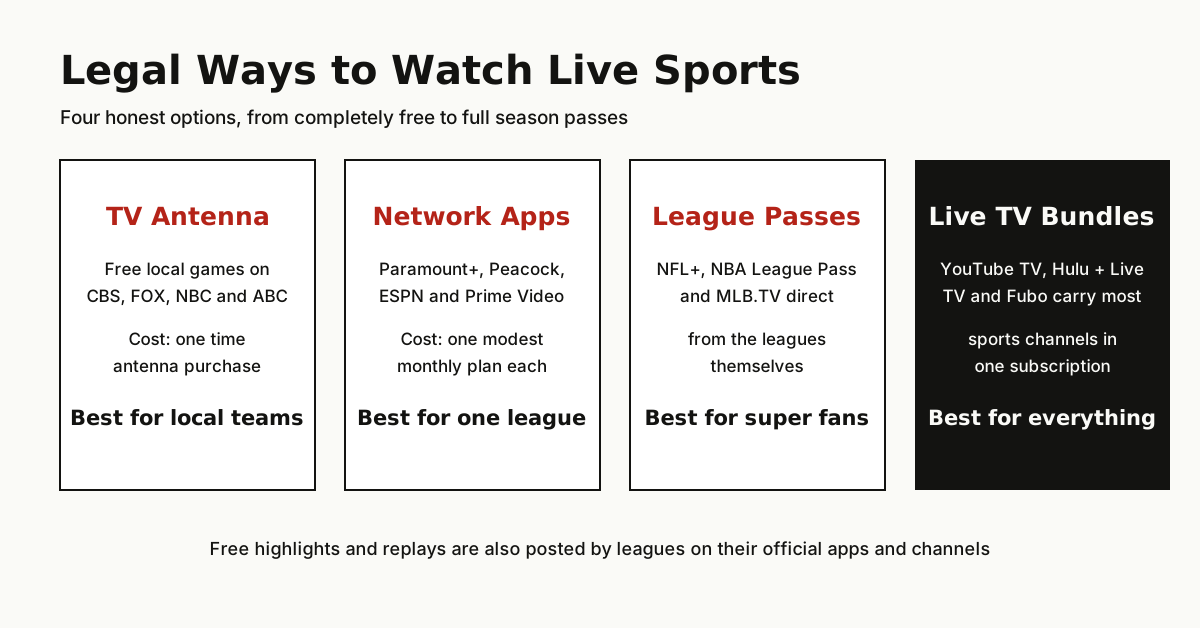
Start with free over the air television. In the United States, NFL games and many other big events still air on local CBS, FOX, NBC and ABC stations. A simple indoor antenna, bought once, picks those broadcasts up for free in most areas, in full high definition, with no subscription and no popups.
Use broadcaster apps for the leagues you follow. The networks that hold the rights also stream them: NFL games on CBS stream on Paramount Plus, Sunday night games stream on Peacock, and Thursday night games are on Prime Video. Our Paramount Plus guide breaks down what that service carries and what it costs. Soccer fans in the US will find the Premier League on Peacock and USA Network, and the Champions League on Paramount Plus.
Go straight to the leagues. League run services such as NFL+, NBA League Pass and MLB.TV sell direct access, often team by team or month by month, which can work out far cheaper than a full bundle for a fan who follows one sport. Live TV streaming bundles such as YouTube TV, Hulu + Live TV and Fubo remain the closest legal match to the old everything in one place promise, at prices closer to cable.
Do not overlook the free extras. Leagues post extended highlights, condensed games and classic matches on their official apps and video channels, free to everyone. For a fan who mainly wants to keep up rather than watch every minute live, those official sources cover a surprising amount of the season.
One habit ties it all together: before any big game, check the league’s official site or app, which lists exactly where that game airs in your country. Thirty seconds there beats an hour of dodging popups.
The Bottom Line
StreamEast was the biggest pirate sports network the industry had ever measured, and it still fell: first its domains, then its operators, then their freedom. The copies trading on its name today are smaller, riskier imitations of an operation that has been shut down and prosecuted.
The legal options ask for either a little money or a little planning, and in return they give you a picture that does not freeze in the final minute, commentary that stays in sync, and a device that stays yours. For more practical guides like this one, browse the tips and tricks category.