When other big economies wrote AI laws, they reached for bans, risk tiers and heavy fines. Japan did something very different. On May 28, 2025, its parliament, the Diet, passed the AI Promotion Act, a law whose main job is to promote artificial intelligence, not to punish the people building it.
Anyone tracking Japan AI regulation news today will notice the same pattern again and again: no fines, no banned uses and no license needed before you launch. Instead, it sets up a headquarters led by the Prime Minister, orders a national AI Basic Plan and asks businesses to cooperate.
Why would a country choose promotion over punishment? Japanese officials argued that the country was falling behind. A flash report by the Tokyo law firm ZeLo pointed to figures showing Japan attracted about 700 million dollars in private AI investment in 2023, twelfth in the world, while the United States drew 67.2 billion. With an aging population and a shrinking workforce, the government decided that slow AI adoption was the bigger danger.
This explainer pulls the Japan AI regulation news of 2025 into one place, from the law itself to what it means for companies and for health care. It is part of our wider AI news and regulation coverage.
The New AI Law, Explained in Plain English
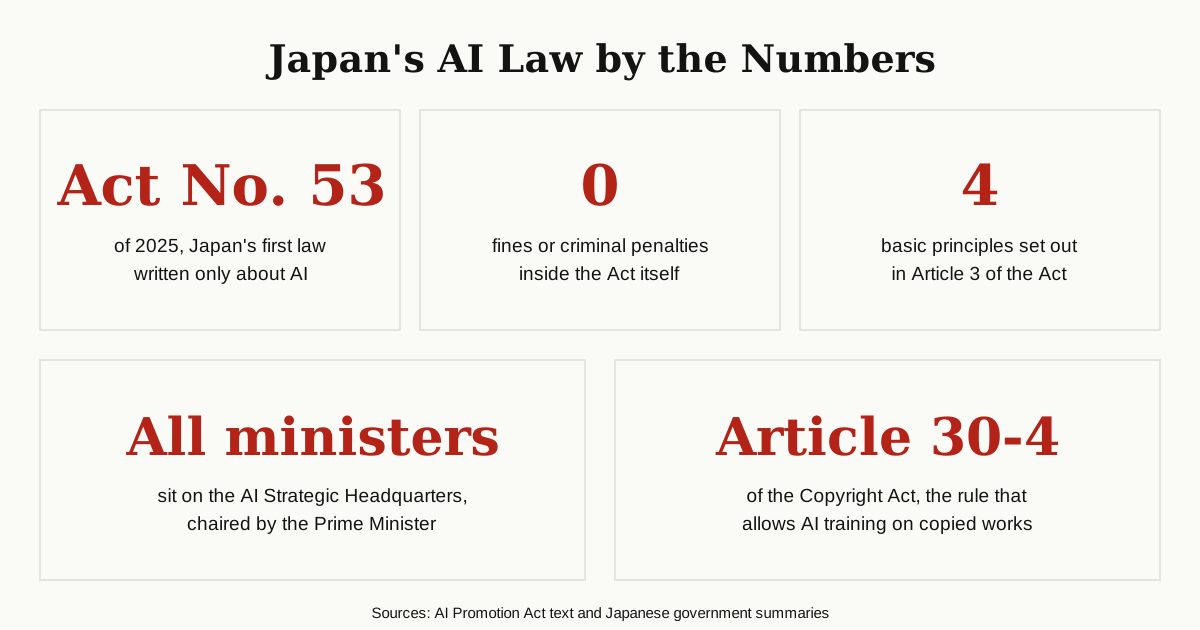
The law’s full name is the Act on Promotion of Research and Development, and Utilization of Artificial Intelligence-Related Technology, known in short as the AI Promotion Act (Act No. 53 of 2025). It is the first Japanese statute written only about AI.
Here is what the Act actually does:
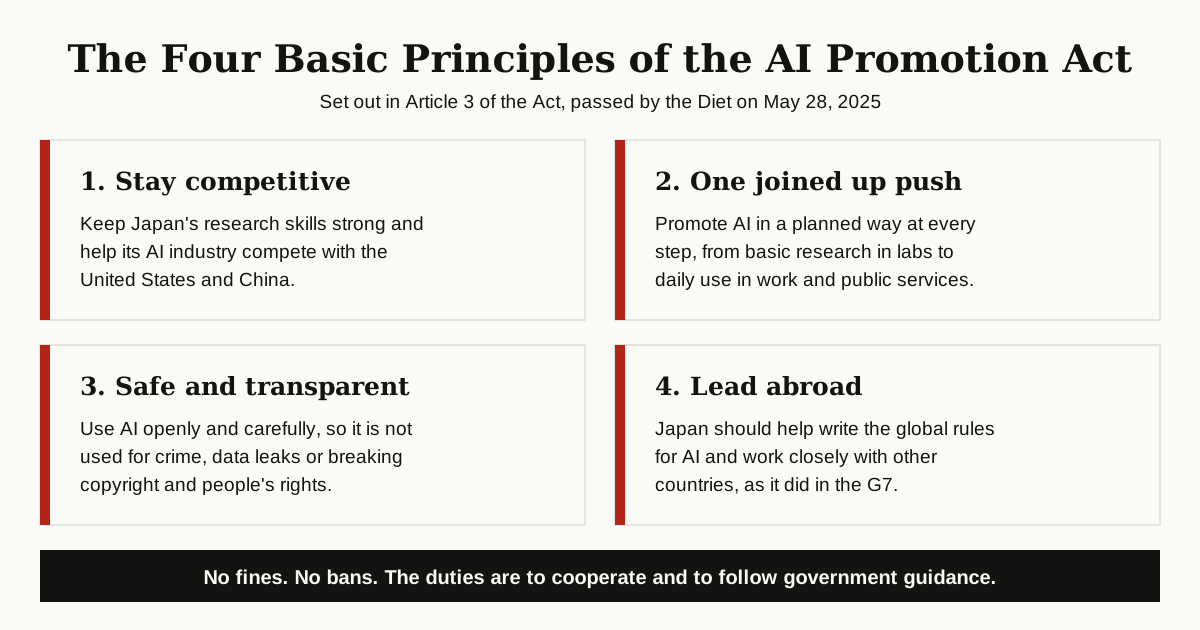
- It sets four basic principles. Article 3 says AI policy should keep Japan’s research skills strong and its industry competitive, promote AI in a planned way from basic research to daily use, make sure AI is used openly and carefully, and give Japan a leading role in international cooperation.
- It creates an AI Strategic Headquarters. This new body sits inside the Cabinet, is chaired by the Prime Minister and includes every Cabinet minister.
- It orders an AI Basic Plan. The plan sets out the measures the government will take to promote AI research, development and use.
- It tells the government to write guidelines. Under Article 13, the government must prepare guidelines, in line with international norms, to keep AI use appropriate, with attention to transparency, fairness and safety.
- It lets the government investigate harm. Under Article 16, the government can collect information, study cases where AI use infringed people’s rights, and offer guidance and advice.
And here is what it asks of companies. Article 7 says AI developers, providers and business users should make reasonable efforts to use AI in line with the basic principles, and should cooperate with measures from national and local governments. Lawyers call this a duty to cooperate, not a checklist of rules.
Just as important is what the law does not do. There are no fines and no criminal penalties anywhere in the Act. There is no list of banned AI uses, no risk tiers, and no approval process before a product can launch. Commentators and officials have noted one softer weapon: in a serious case, the government may make the name of the operator public, a reputational hit that can hurt more than a small fine.
The official government summary in Highlighting Japan also confirms the Act reaches beyond Japan’s borders, covering foreign operators whose AI work is aimed at Japanese businesses or citizens.
Japan AI Regulation Timeline: How 2025 Unfolded
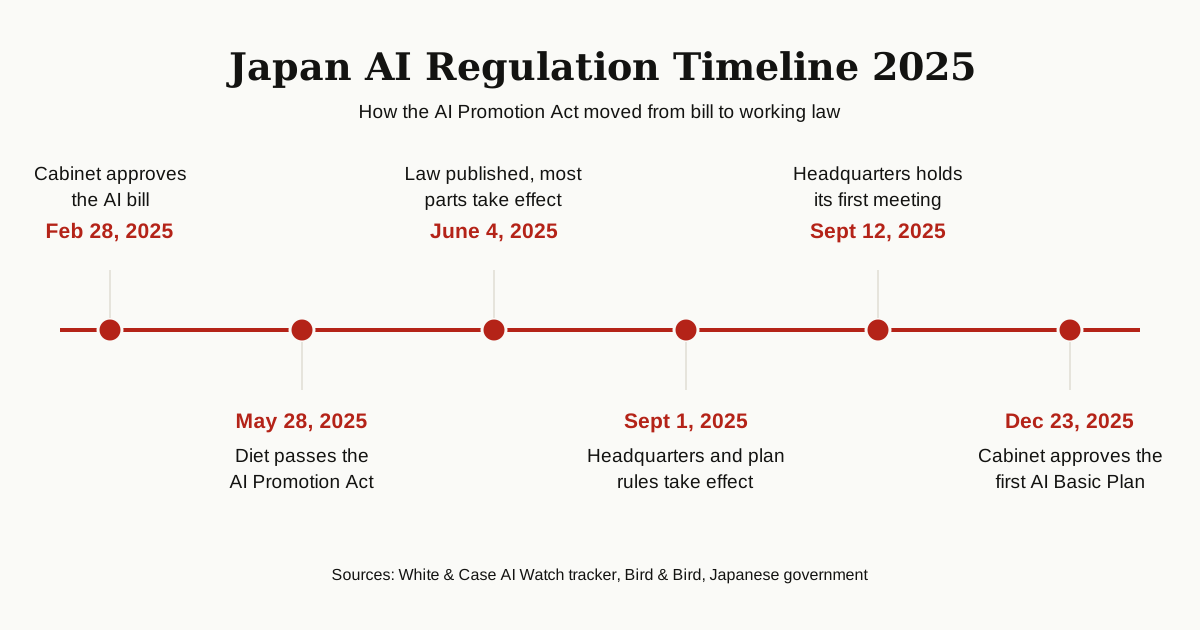
Japan AI regulation news in September 2025 was the moment the law became fully real, but the story started months earlier. Here is the sequence:
| Date | What happened |
|---|---|
| February 28, 2025 | The Cabinet approves the AI bill |
| March 28, 2025 | METI and MIC publish Version 1.1 of the AI Guidelines for Business |
| May 28, 2025 | The Diet passes the AI Promotion Act |
| June 4, 2025 | The Act is promulgated and most of it takes effect |
| September 1, 2025 | The Headquarters and Basic Plan parts take effect, putting the law into full effect |
| September 12, 2025 | The AI Strategic Headquarters holds its first meeting |
| December 19, 2025 | The Headquarters publishes guidelines on appropriate AI use under Article 13 |
| December 23, 2025 | The Cabinet approves the first AI Basic Plan |
For readers following japan ai regulation news september 2025, the key facts are these: the headquarters chapters took effect on September 1, and the Prime Minister’s team met for the first time on September 12, according to the White & Case AI Watch tracker. By year’s end, both follow up documents, the Article 13 guidelines and the first AI Basic Plan, were in place.

How Japan Compares With the EU and the US
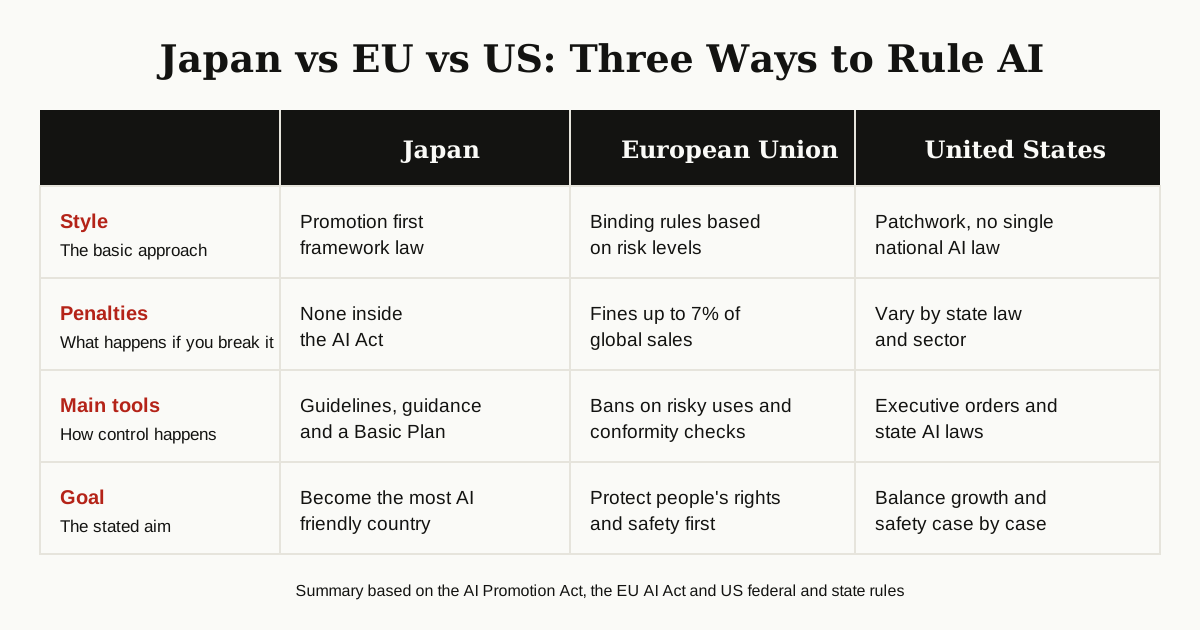
The easiest way to understand Japan’s choice is to put it next to the other big approaches.
The European Union went first and went hardest. Its AI Act sorts AI systems by risk, bans a short list of practices, and backs the rules with fines of up to 7 percent of global sales for the worst breaches. You can read the full picture in our guide to EU AI Act news.
The United Kingdom sits in the middle. It has no single AI law and instead asks its existing regulators to apply shared principles sector by sector, as our explainer on UK AI regulation news today 2025 shows.
The United States has no single federal AI law. Policy shifts with executive orders and agency guidance, while states such as Colorado have passed their own AI statutes.
Japan combined pieces of all three and still ended up with the lightest touch of any major economy. The Bird & Bird comparison of the two laws notes that Japan defines the roles of government, business, academia and citizens, and relies on guidelines and strategic plans rather than direct regulation and penalties.
| Japan | European Union | United States | |
|---|---|---|---|
| Style | Promotion first framework law | Binding rules based on risk | Patchwork of federal and state rules |
| Penalties | None inside the AI Act | Fines up to 7% of global sales | Vary by state and sector |
| Main tools | Guidelines, guidance and a Basic Plan | Bans and conformity checks | Executive orders and state laws |
| Stated goal | Become the most AI friendly country | Protect rights and safety | Balance growth and safety case by case |
Generative AI Rules and the Copyright Question
Readers looking for generative ai regulation japan today often expect one big rulebook. In Japan, the day to day rules for generative AI live outside the Promotion Act, in older laws and in voluntary guidelines.
The most famous is copyright. Article 30-4 of the Copyright Act, in force since January 1, 2019, allows anyone to use copyrighted works without permission when the purpose is not to enjoy the work itself. Feeding books, images or music into a model for data analysis normally counts as non enjoyment use, which is why AI researchers call Japan one of the most training friendly countries in the world.
It is not a free pass. In 2024, the Agency for Cultural Affairs published its General Understanding on AI and Copyright, which draws clear lines. Copying from pirated collections can break the rules. Using a database that is sold for AI training, without paying, can unfairly harm the seller. Training a model on one creator’s work so it can copy that creator’s style can cross into enjoyment purpose. And if an AI output looks too much like a protected work it learned from, normal copyright infringement rules apply to the output.
On top of the law sit the guidelines. The AI Guidelines for Business, published jointly by the Ministry of Economy, Trade and Industry (METI) and the Ministry of Internal Affairs and Communications (MIC), first appeared on April 19, 2024, with Version 1.1 following on March 28, 2025. They set ten shared principles, including human centricity, safety, fairness, privacy and transparency, and they assign homework to three roles: AI developers, AI providers and AI business users. They are voluntary, but companies treat them as the standard they will be judged against.
Japan has also tried to export its soft approach. At the G7 summit in Hiroshima in May 2023, Japan launched the Hiroshima AI Process. In October 2023, G7 leaders agreed on international guiding principles and a voluntary code of conduct for developers of advanced AI systems. A Friends Group followed in May 2024, and Japan set up its own AI Safety Institute in 2024 to work on testing and evaluation.

AI in Health Care in Japan
Health care is where Japan’s light touch meets strict sector law, and it is one of the most searched corners of japan ai regulation healthcare news today.
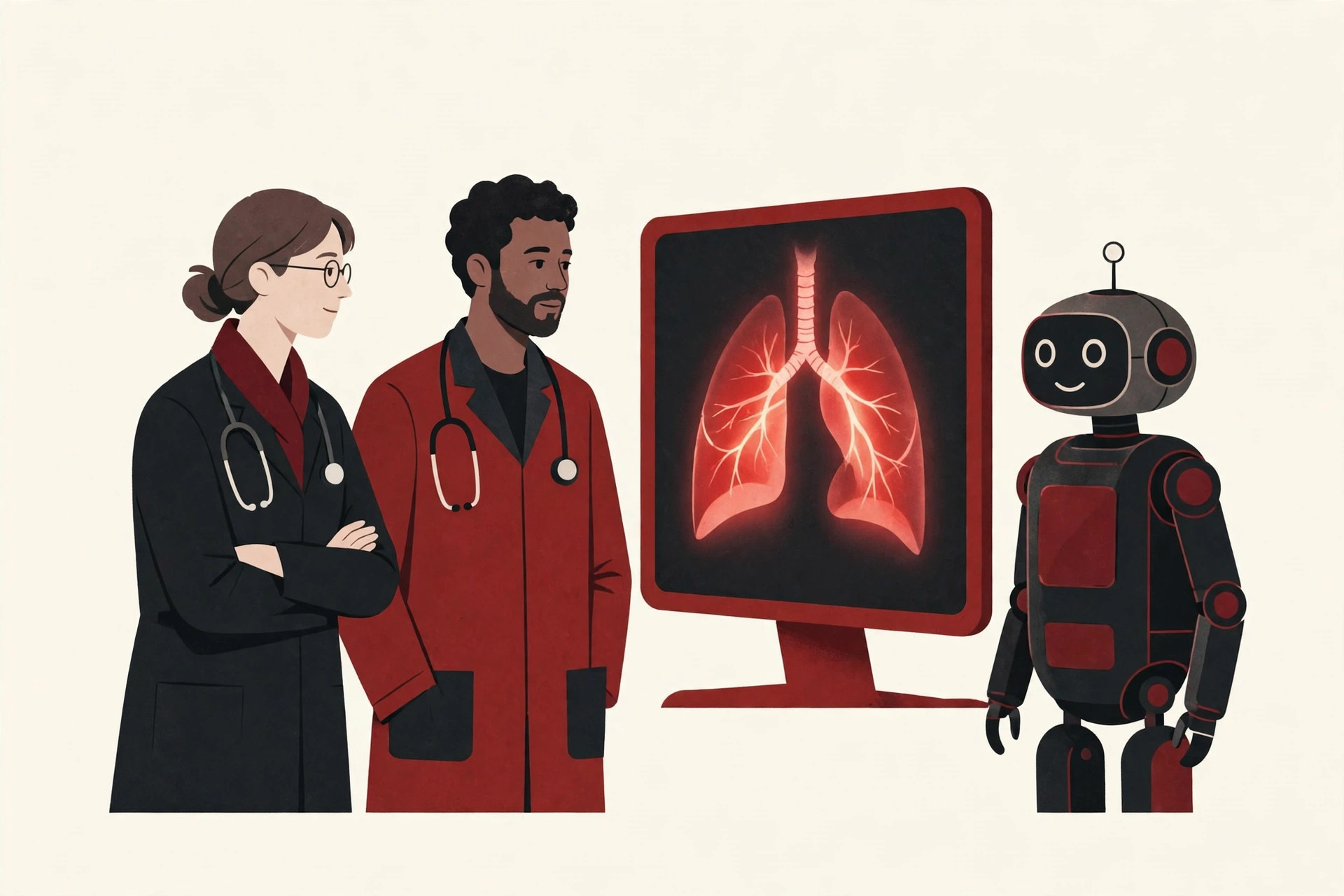
The AI Promotion Act does not regulate medical AI directly. Instead, software that helps diagnose or treat patients is handled as a medical device under the Pharmaceuticals and Medical Devices Act. This software as a medical device, often shortened to SaMD, is sorted into risk classes I to IV. The Pharmaceuticals and Medical Devices Agency (PMDA) reviews these products, and the health ministry approves the higher risk ones before they can be sold.
Regulators have tried to make that path faster without making it weaker. Japan uses a two step approach for some AI devices, where a first approval can be followed by confirmation of real world benefit, and a system called IDATEN lets makers file a change plan in advance so an AI model can keep improving after approval without starting over. The steady practical work continues: on March 17, 2025, officials updated their questions and answers on testing diagnostic devices with existing medical image data, according to the law firm TMI Associates.
Privacy adds a second layer. Under the Act on the Protection of Personal Information (APPI), medical history counts as special care required personal information, which generally needs a person’s consent before a company can collect it. In June 2023, Japan’s Personal Information Protection Commission cautioned OpenAI and warned businesses about putting personal data into generative AI services, a warning that still shapes how hospitals handle patient data today.
An aging population and a shortage of doctors make health care one of the clearest cases where the government wants AI used more, as long as device and privacy rules are respected.
What It Means for Companies Doing Business in Japan
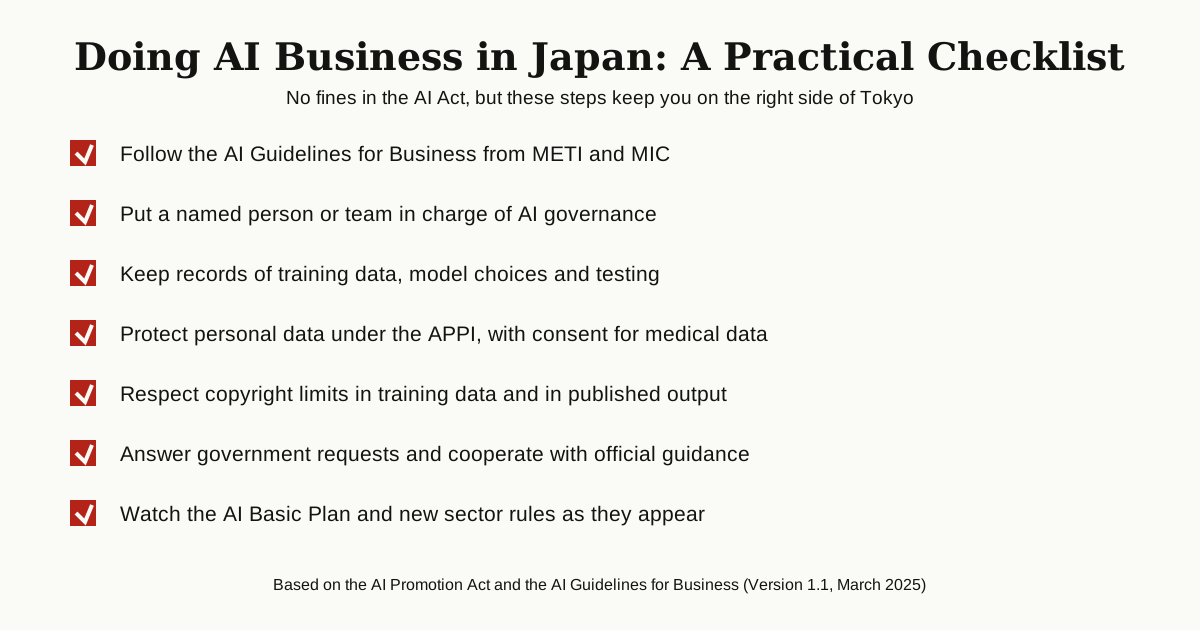
For most companies, the practical message of Japan AI regulation news today is calm but not lazy. There is no AI Act fine to fear, yet there is real homework:
- Follow the guidelines. Treat the AI Guidelines for Business as your default rulebook, and be ready to explain how you applied them.
- Document your choices. Keep records of training data sources, testing and human oversight. If something goes wrong, the government’s first move under Article 16 is to ask questions.
- Respect the old laws. Privacy under the APPI, copyright under Article 30-4 and its limits, and sector rules in finance, health and employment all carry real penalties.
- Cooperate early. The Act expects businesses to work with government measures. Companies that engage early tend to hear about new guidance first.
- Watch the Basic Plan. The plan approved on December 23, 2025 steers budgets and ministry priorities, and it signals where tighter sector rules may appear next.
Note that the Act covers AI business aimed at Japan even when the company sits abroad. Global firms still need to meet strict EU or US rules at home: Japan is the friendly door, not the only door.
Criticism and Open Questions
Not everyone is convinced. The law firm Hogan Lovells noted that the Act sets no specific enforcement mechanism for its transparency principle, and called it an area likely to evolve through future legislation. Critics ask whether guidance without penalties can stop a truly harmful system, such as a widely shared deepfake or a biased hiring tool.
Supporters answer that the hard edge already exists elsewhere. Fraud, discrimination, privacy abuse and unsafe medical products are all illegal under older Japanese laws, with or without an AI label. The Promotion Act, they argue, avoids adding a new layer of paperwork on top of those laws.
Creator groups have also kept pressure on the copyright question. Many manga artists, writers and musicians worry that Article 30-4 is too generous to AI developers, while researchers warn that narrowing it would push training abroad. The 2024 Agency for Cultural Affairs guidance tried to calm both sides, and the debate is not finished.
What to Watch Next
Several threads will decide whether Japan’s experiment works:
- The AI Basic Plan in action. Budgets, computing infrastructure and talent programs will show how serious the promotion push is.
- Sector rules. Finance, transport and health regulators may turn guideline language into firmer requirements.
- The December 2025 guidelines. If companies ignore the Article 13 guidance, pressure for penalties will grow.
- AI on devices. As more AI runs locally on phones and machines, regulators will need answers on privacy and safety at the edge, a trend we track in our on-device AI news coverage.
Conclusion
Japan AI regulation news in 2025 tells one clear story. Faced with the same technology as everyone else, Japan chose trust, guidance and promotion over bans and fines. The AI Promotion Act asks companies to cooperate, gives the government tools to investigate and advise, and bets that speed will bring more benefit than strict control.
Whether that bet pays off depends on the Basic Plan, on the guidelines written under Article 13, and on how the first hard cases are handled. For the rest of the story as it develops, keep an eye on our AI news and regulation section.