Generative AI moves so fast that the headlines blur together. One week brings a new model, the next brings a new law, and somewhere in between a security flaw quietly makes the whole industry nervous. Sorting the signal from the noise is the real job of GenAI news.
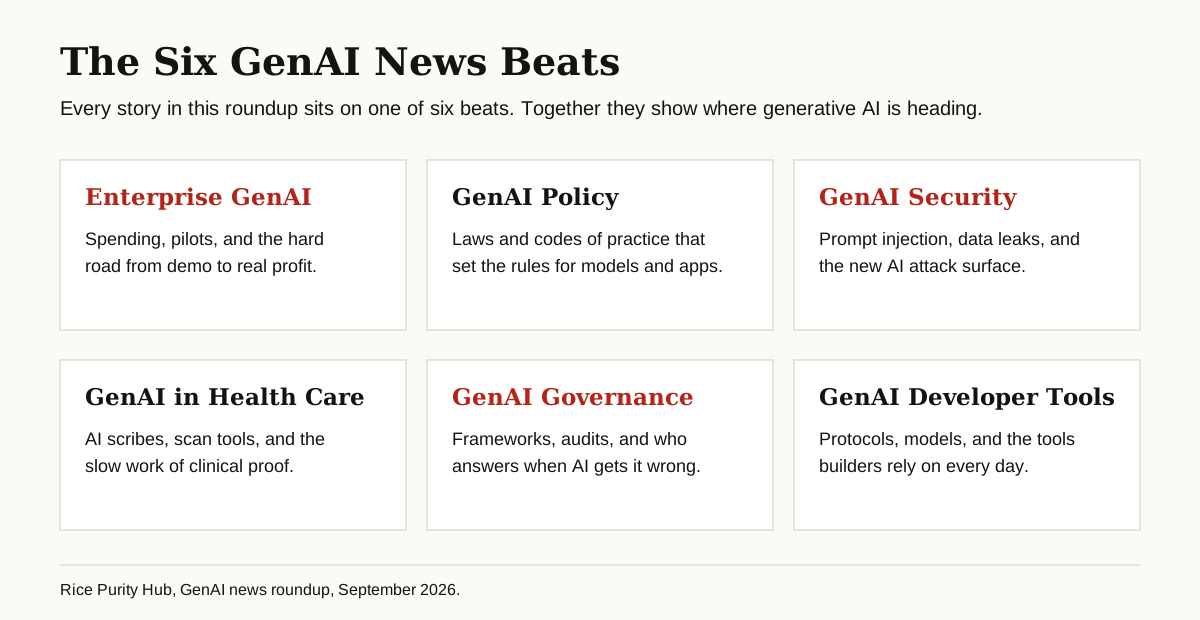
This roundup does that sorting for you. We follow six beats, the same six areas our readers search for again and again: enterprise GenAI, GenAI policy, GenAI security, GenAI in health care, GenAI governance, and GenAI developer tools. On each beat we picked the most significant verified stories, checked the dates, and named the source, so you can see exactly where every claim comes from.

If you only read one section, read the enterprise one. It explains why the other five beats exist at all.
Enterprise GenAI: Spending Big, Proving Value Slowly
The most quoted piece of genai enterprise news in 2025 was not a product launch. It was a warning.
The MIT report everyone argued about
In the summer of 2025, MIT’s Project NANDA published The GenAI Divide: State of AI in Business 2025, a study based on interviews, surveys, and a review of 300 public AI deployments. Its headline finding was blunt: despite roughly 30 to 40 billion dollars of enterprise investment, about 95 percent of organizations were getting zero measurable return from generative AI.
The report was careful about why. Tools like ChatGPT and Copilot were widely used and did make individuals faster. But company-wide systems, the expensive custom builds, mostly stalled. Only about 5 percent of integrated pilots reached real production value. The researchers pointed at systems that do not retain feedback, workflows that break under real conditions, and budgets aimed at shiny sales demos instead of dull back-office work where savings are easier to prove.
Why it matters: the report reset expectations. Boards stopped asking “are we using AI?” and started asking “which project pays for itself?”
Walmart puts shopping inside ChatGPT
In October 2025, Walmart announced a partnership with OpenAI that lets customers shop and check out inside ChatGPT, using its Instant Checkout feature. Walmart described it as a shift from search bars to AI-first shopping, where the assistant plans a meal or restocks basics and the customer approves the cart.
Why it matters: when the world’s largest retailer treats a chatbot as a storefront, genai news stops being a tech story and becomes a retail story. Every large merchant now has to decide whether its own store is where customers will start shopping.

GenAI Policy: The Rulebooks Arrive
Policy moved from speeches to paperwork in 2025, and paperwork has deadlines.
Europe writes the first detailed rulebook
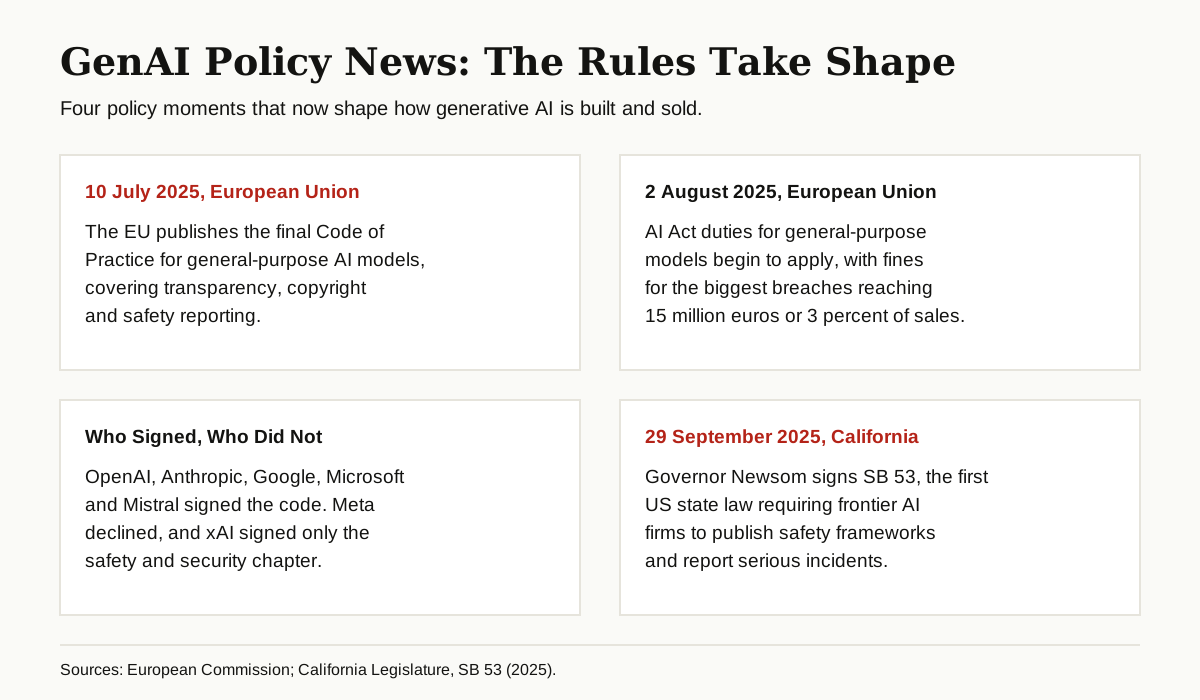
On 10 July 2025, the European Commission published the final General-Purpose AI Code of Practice, a voluntary code that helps model makers show they follow the EU AI Act. It has three chapters: transparency, copyright, and safety and security for the most powerful models. The legal duties behind it began to apply on 2 August 2025 for new models.
The signatory list became news by itself. OpenAI, Anthropic, Google, Microsoft, and Mistral signed. Meta publicly declined, arguing the code went too far, and xAI signed only the safety chapter. You can follow the full timeline in our EU AI Act news coverage.
Why it matters: fines for the worst GPAI breaches can reach 15 million euros or 3 percent of global turnover. The code turned “trust us” into checklists, templates, and deadlines.
California passes the first US frontier AI law
On 29 September 2025, Governor Gavin Newsom signed SB 53, the Transparency in Frontier Artificial Intelligence Act. It requires the largest AI developers to publish safety frameworks and report serious incidents to the state. It was the first law of its kind in the United States, arriving while federal policy leaned toward executive orders instead of new statutes.
Why it matters: with no single federal AI law, state rules like SB 53 are where US genai policy news is actually being written.
GenAI Security: The Year Prompt Injection Got Real
Every security team knows phishing. In 2025 they learned a new word: prompt injection, hiding instructions inside content an AI reads, so the AI follows orders from the wrong person.
EchoLeak: one email, no clicks, data gone
In June 2025, researchers at Aim Security disclosed EchoLeak, tracked as CVE-2025-32711 with a severity score of 9.3 out of 10. A single crafted email could trick Microsoft 365 Copilot into pulling sensitive data from a victim’s chats, files, and meetings, then leaking it out, without the victim clicking anything. Microsoft patched the flaw and said there was no evidence it had been exploited in the wild. The OWASP GenAI incident round-up for that quarter catalogued it alongside a fast-growing list of similar cases.
Why it matters: EchoLeak was the first zero-click AI leak with a CVE number attached. It proved prompt injection is not a lab trick. It is an enterprise risk with a patch cycle.
The GitHub MCP leak
A month earlier, in May 2025, Invariant Labs showed how an AI assistant connected through the Model Context Protocol could be steered by a poisoned GitHub issue into leaking data from a user’s private repositories into a public one. The tools worked as designed. The failure was that one agent held the keys to both the public and the private side.
Why it matters: as agents gain access to more systems, genai security news keeps returning to one lesson. What an AI can reach matters as much as what it can say.

GenAI in Health Care: Paperwork First, Patients Carefully
Health care adopted generative AI fastest where the stakes are clerical, not clinical: the visit note.
Microsoft launches Dragon Copilot
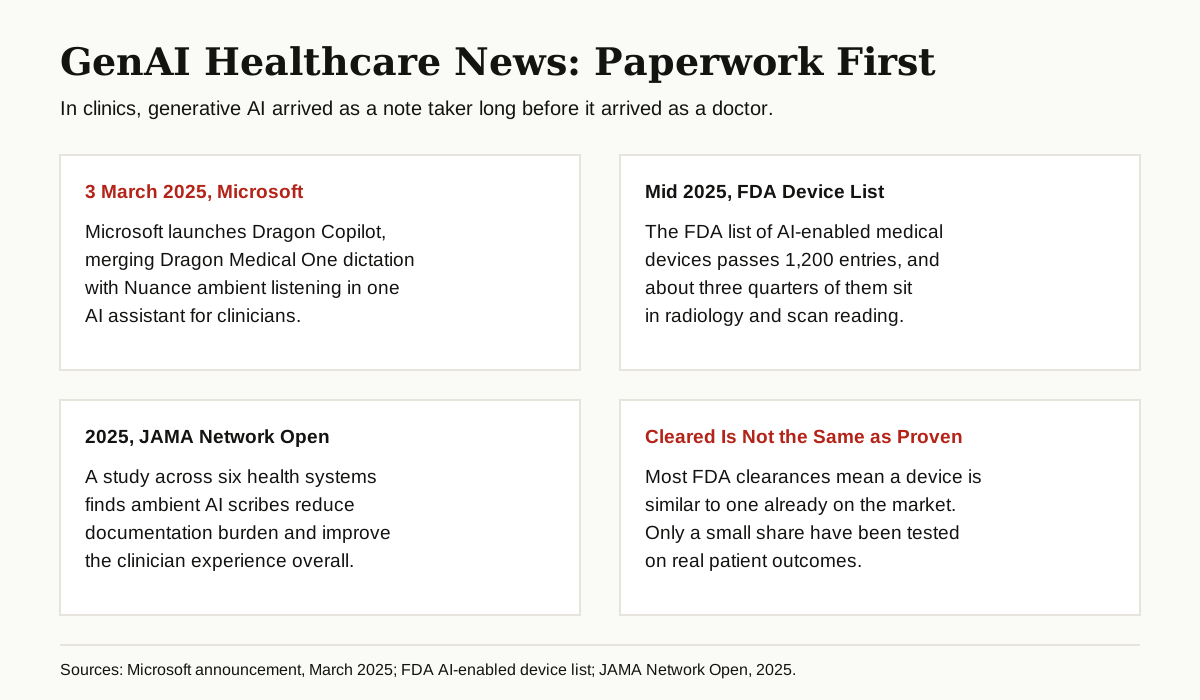
On 3 March 2025, Microsoft launched Dragon Copilot, merging its Dragon Medical One dictation software with the ambient listening technology of Nuance DAX Copilot. The assistant listens to a patient visit, drafts the clinical note, and helps with summaries and referrals, so doctors spend less of the evening finishing charts. Microsoft had bought Nuance, the company behind the technology, in a deal first announced in 2021.
Why it matters: documentation burden is a top driver of doctor burnout. A scribe that works is the rare AI product whose benefit a clinician can feel on day one.
The device list grows, the proof lags
By mid 2025, the US Food and Drug Administration’s list of authorized AI-enabled medical devices had passed 1,200 entries, with roughly three quarters of them in radiology. A 2025 study in JAMA Network Open, covering six health systems, found that ambient AI scribes reduced documentation burden and improved clinician experience overall. But researchers keep noting the gap: most clearances rest on a device being similar to an older one, and only a small share of tools have been tested on patient outcomes.
Why it matters: genai healthcare news splits into two speeds. Adoption is fast. Evidence is slow, and in medicine the evidence is the part that counts.
GenAI Governance: Guardrails Grow Up
Governance used to mean a policy PDF nobody read. The rise of autonomous agents changed that, because an agent that acts on its own needs rules that run at machine speed.
Gartner predicts a wave of cancellations
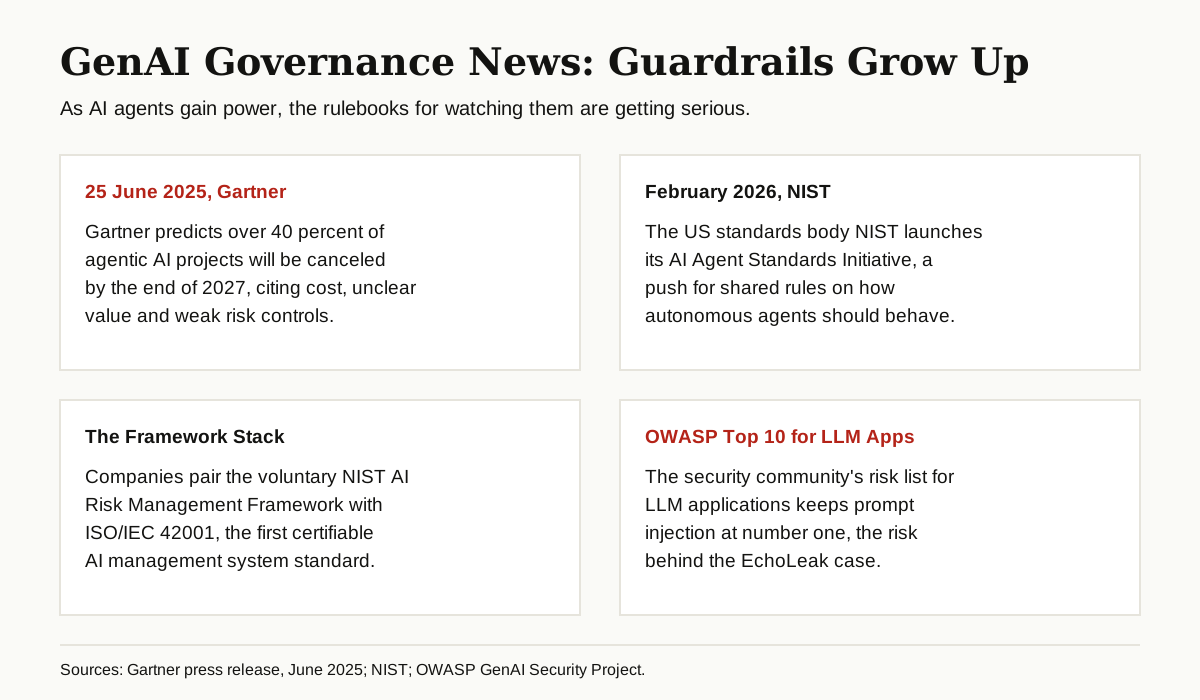
On 25 June 2025, Gartner predicted that over 40 percent of agentic AI projects will be canceled by the end of 2027. The reasons it gave were practical: rising costs, unclear business value, and inadequate risk controls. Gartner also warned about “agent washing,” vendors relabeling old chatbots and robotic process automation as agents.
Why it matters: it is the governance version of the MIT report. Spending is easy to announce. Proving value, with controls in place, is the part that decides which projects survive.
Standards bodies move on agents
In February 2026, the US National Institute of Standards and Technology launched its AI Agent Standards Initiative, a federal push for shared standards on how autonomous agents identify themselves, communicate, and stay within safe limits. In parallel, more companies adopted the governance stack auditors now expect: the voluntary NIST AI Risk Management Framework for structure, paired with ISO/IEC 42001, the first certifiable management standard for AI.
Why it matters: genai governance news is where “we should be careful” turns into inventories, named owners, audit trails, and certifications a customer can ask to see.
GenAI Developer Tools: One Plug for Every Model
The biggest developer story of the period was not a model. It was a plug.
OpenAI adopts a rival’s standard
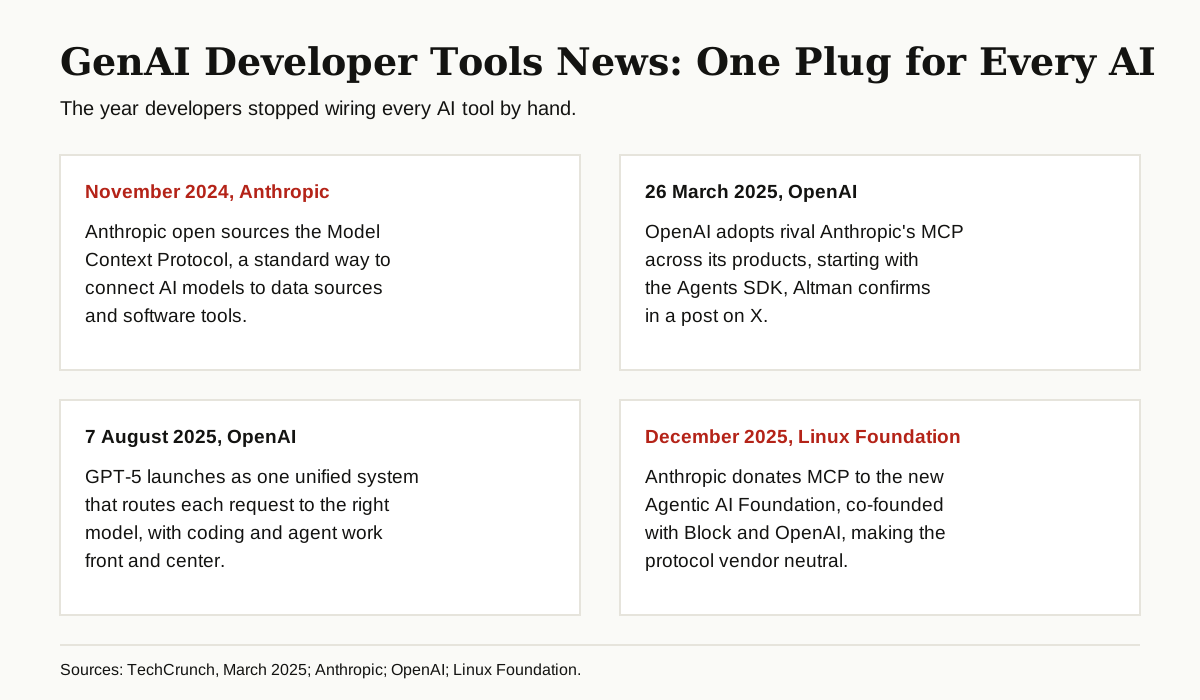
Anthropic released the Model Context Protocol, or MCP, as an open standard in November 2024. MCP gives AI apps one standard way to connect to data sources and tools, instead of a custom wire for every pairing. On 26 March 2025, OpenAI CEO Sam Altman announced that OpenAI would adopt MCP across its products, starting with the Agents SDK. “People love MCP and we are excited to add support across our products,” Altman wrote, in a post covered by TechCrunch. In December 2025, Anthropic donated MCP to the new Agentic AI Foundation under the Linux Foundation, co-founded with Block and OpenAI, making the protocol vendor neutral.
Why it matters: standards are where rivals quietly agree. MCP’s spread means a tool built once can plug into many assistants, which is exactly the kind of plumbing that turns experiments into products. Our LLM news coverage tracks the model launches that ride on top of it.
GPT-5 and the agentic coding turn
On 7 August 2025, OpenAI launched GPT-5 as a unified system that routes each request to the right model behind the scenes, with coding and multi-step agent work as headline strengths. Through the same period, coding assistants shifted from autocomplete toward agents that plan, edit across files, and run tests.
Why it matters: developer tools are where generative AI earns its keep today, and the competition has moved from raw model scores to workflow: context, tools, and trust.
The Threads That Connect Every Beat
Read across the six beats and three threads keep showing up in genai news today.
First, proof beats promises. The MIT report, the Gartner cancellation forecast, and the thin outcome evidence in health care all say the same thing in different accents: the field is being asked to show receipts.
Second, access is the new attack surface. EchoLeak and the GitHub MCP case were not model failures. They were permission failures, and they pushed security and governance teams into the same room.
Third, standards beat slogans. The EU code of practice, California’s SB 53, MCP, and the NIST agent initiative are all attempts to write down shared rules before the technology outruns them.
What to Watch Next
Three things will shape the next round of genai news. Watch whether the EU’s GPAI enforcement powers, active from August 2026, produce their first fines or quiet settlements. Watch the NIST agent standards work, because agent identity and authorization rules will decide how far autonomous tools get inside real companies. And watch enterprise renewals: the pilots signed in the 2025 spending wave will either expand with numbers attached or join the cancellation statistics.
One more signal is easy to miss and worth tracking: hiring. When companies quietly shift job posts from “AI experimentation” to named roles like AI governance lead, agent operations manager, or clinical AI reviewer, it usually means the technology has moved from the demo budget to the operating budget. Job boards rarely make headlines, but they often tell the truth about adoption a full season before the press releases do.
Conclusion
GenAI news looks chaotic from the headline feed, but the beats tell a calmer story. Companies are spending and learning where the value hides. Regulators are writing rules with dates on them. Attackers are probing the seams, and the standards world is racing to close them. Follow the beats, check the dates, and the noise turns into a map. For more coverage, browse the full AI News and Regulation category.