Rice Purity Test vs. Innocence Test vs. Purity Test: What's the Difference?
📋 Table of Contents
You took the "Rice Purity Test," your friend swears they took the "Innocence Test," and someone in the group chat is calling the whole thing a "Purity Test" — and you all got different results on different websites. So which one did you actually take? Here's the part almost nobody explains: these three names are used interchangeably, but they don't all point to the same quiz. One is a checklist. One is a personality-style questionnaire built by psychology researchers. And one is really just an umbrella term that's been floating around for a hundred years. Once you see the difference, your score suddenly makes a lot more sense.
Let's clear it up — no judgment, no gatekeeping, just the actual story.
Quick Snapshot
- What it is: Three overlapping names for self-assessment quizzes that measure "innocence vs. experience."
- The key difference: Format and origin. The Rice Purity Test is a binary checklist; some "innocence" and "purity" tests use agreement scales or shorter viral formats.
- Who it's for: Mainly 17+ college-age users, though adults retake it for nostalgia.
- How it works: You respond to a list of life experiences; your score reflects how many you've had.
- Why it matters: The name you use often decides which version — and which scoring system — you actually get.
- Fun fact: The original 1924 Rice survey had just 10 questions and was published in the student newspaper under the headline "Rice Girls Not Quite Half Bad."
⚡ Fast Facts: Rice vs. Innocence vs. Purity Test
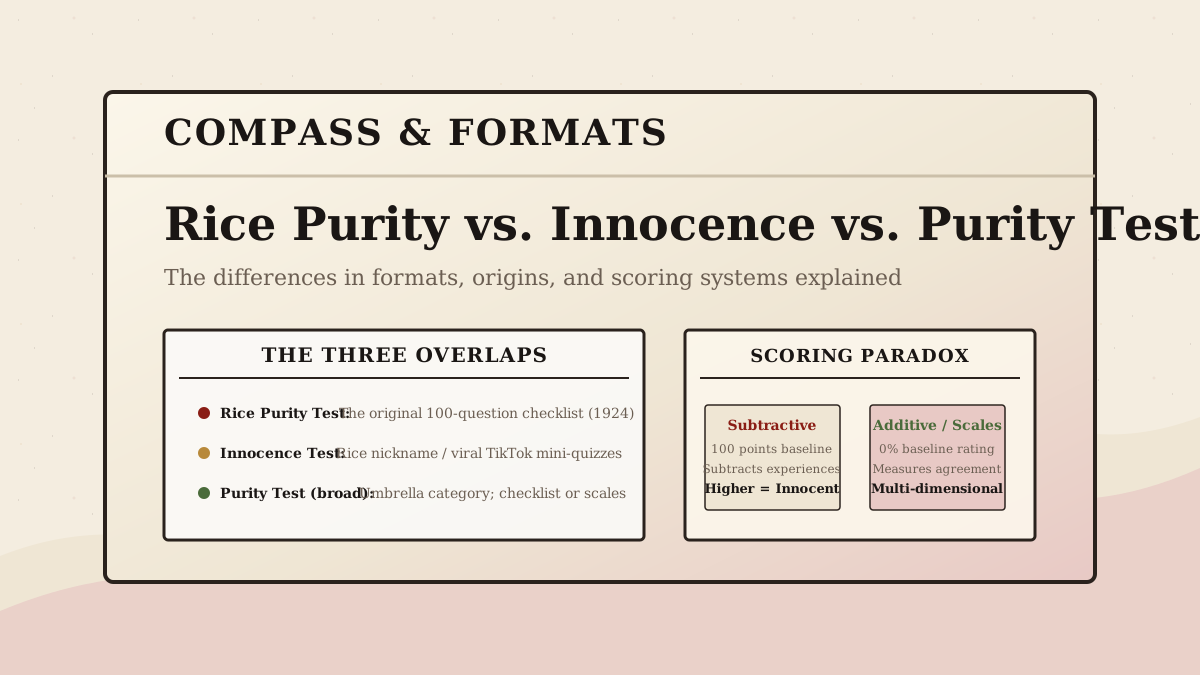
The standard 100-item checklist from Rice University. Subtracts points for experiences.
Commonly a nickname for the Rice test, or a short (20–30 item) TikTok video spin-off.
The century-old umbrella category. Includes checklists and multi-dimensional attitude scales.
The Rice Purity Test: The Original 100-Question Checklist
The Rice Purity Test is the specific one everyone's thinking of. It started at Rice University in Houston, Texas, back in 1924 as a short 10-question survey, and grew into the 100-question format most people know today by the 1980s. It began as an Orientation Week ("O-Week") bonding activity — a low-stakes way for nervous freshmen to break the ice and compare notes on life experiences.
Here's how it works: you're given 100 statements about relationships, social life, substances, and personal conduct. You check every box that applies to you. The more boxes you check, the lower your score — and a lower score signals more "experience," while a higher score signals more "innocence." A perfect 100 means you checked nothing; a 0 means you checked everything.
The crucial thing to understand: it's not scientific, and there's no official version. Rice University's student association keeps its own internal edition but doesn't endorse the dozens of websites hosting public copies. Any site claiming to be "the official Rice Purity Test" is making that up. It's entertainment and self-reflection — nothing more.
Ready to see your own number? You can take the full, private Rice Purity Test on RicePurityHub.com — no sign-up, no data collection.
⏳ Evolution of the Purity Test Concept
The Print Beginnings
A 10-question survey published in the Rice Thresher student newspaper, titled "Rice Girls Not Quite Half Bad."
The 100-Question Era
Expanded into the legendary 100-item O-Week checklist to break the ice among incoming college freshmen.
TikTok & Digital Scales
Viral mini-checklists take over social media, alongside psychology-flavored multidimensional agreement scales.
The Innocence Test: Same Quiz, Different Nickname (Usually)
Here's where it gets slippery. For most people, "Innocence Test" is simply a nickname for the Rice Purity Test. Many quiz sites literally label it "Rice Purity Test (aka the Innocence Test)." If a friend says they took an innocence test and got a score out of 100, they almost certainly took a Rice-style checklist.
But there's a catch worth knowing about. Because "innocence test" is a generic descriptor rather than a trademarked name, it also gets attached to shorter, punchier viral spin-offs — the kind that circulate on TikTok as 20- or 30-item versions designed to be finished in under a minute and screenshotted for a duet. These trimmed-down "innocence tests" keep the vibe of the Rice test but ditch the depth.
So the practical rule: if the "innocence test" you took had roughly 100 checkbox items, it's the Rice Purity Test wearing a different hat. If it was short and built for a 30-second video, it's a lighter viral cousin.
The Purity Test: The Century-Old Umbrella Term
"Purity Test" is the oldest and broadest label of the three. Before the internet, "the purity test" simply meant any checklist that measured your experiences against a baseline of innocence. The Rice version is the most famous member of this family — but it's not the only one.
This is where you hit a genuinely different animal. Some psychology-styled sites (like IDRlabs) offer a Purity/Impurity Test that doesn't use a checklist at all. Instead of "check what you've done," it asks you to rate your agreement with statements — measuring your attitude toward things like alcohol, morality, and risk across several dimensions, then plotting you on a spectrum. It's built to feel more like a personality profile than a scoreboard, and its makers frame it as informed by psychology research rather than by dorm-room tradition.
That's the distinction most articles miss entirely: a "purity test" can be a behavioral checklist or an attitude-based questionnaire, and the two produce completely different kinds of results.
🔄 Action Processing: Checklist vs. Agreement Scale
How a single experience (e.g., "Drinking Alcohol") is handled in different formats:
"Have you ever consumed alcohol?"
✔️ Yes / ❌ No (Binary)
Subtracts 1 point from your 100-point total
"I believe drinking alcohol is morally acceptable."
1 (Strongly Disagree) to 5 (Strongly Agree)
Shifts your position on the "Moral Absolutism" dimension
Side-by-Side: How They Actually Differ
⚖️ Side-by-Side Comparison Matrix
| Feature | Rice Purity Test | Innocence Test | Purity Test (broad) |
|---|---|---|---|
| What it is | The original 100-item checklist | Usually a nickname for the Rice test | Umbrella term for the whole category |
| Origin | Rice University, 1924 | Follows the Rice test | Pre-internet college culture |
| Format | Check the box if you've done it | Checklist (or short viral version) | Checklist *or* agreement-scale |
| Scoring | 0–100 (higher = more innocent) | Same as Rice, unless a spin-off | Varies by version |
| Purpose | Bonding, self-reflection, fun | Same, plus TikTok trends | Ranges from fun to pseudo-psychological |
| Official? | No official authority | No | No |
The Insight Most Articles Skip: The Name Chooses Your Scoring System
Here's the original takeaway worth remembering. Because none of these tests are standardized, the label you search for quietly determines the scoring logic you get — and that's why two friends can "take the same test" and end up with scores that aren't really comparable.
Search "Rice Purity Test," and you'll almost always land on a subtractive checklist: you start at 100 and lose points for experiences. Search "purity test" on a psychology-flavored site, and you might get an additive attitude scale that maps you onto a personality-style graph instead. A "47" on a checklist and a "47%" on an agreement scale are measuring different things through different math.
Think of it like music charts. Billboard, Spotify, and your local radio countdown all rank "the top songs," but each uses its own formula — so comparing your friend's number one to yours only works if you're both reading the same chart. Same energy here. The scores only mean something relative to the exact version you took — and that's genuinely liberating, because it means no single number is "the truth" about you.
📊 The Scoring Paradox: Checklist vs. Scale
Baseline: Start with a perfect 100 points.
Action: Tick a box for every experience had. Deduct 1 point per checkbox.
Result: Higher = Less experienced (innocent); Lower = More experienced.
Baseline: Start at 0% baseline value.
Action: Rate how much you agree with moral or behavioral choices.
Result: Plots you on multi-dimensional axes (e.g., hedonism vs. restraint).
Who These Tests Are For (and a Few Honest Caveats)
The heaviest users are 16–24, concentrated among 18–22-year-old college students, though plenty of adults revisit the test for nostalgia. Because the questions touch on mature themes, the content is best suited to 17+.
A few things worth holding onto:
- Your score is not a moral report card. A low number isn't "bad" and a high one isn't "better" — they're just different snapshots of a life so far.
- It's a conversation starter, not a diagnosis. These quizzes aren't psychological assessments, and no score should shape how you feel about your worth.
- Never treat it as a bucket list. The test itself warns against this, and that warning exists for a reason.
- If comparing scores ever stops being fun and starts feeling like pressure or judgment, that's your cue to close the tab. Healthy curiosity, not competition.
Want a deeper read on interpreting your number? See our Rice Purity Test score meaning guide or check how you stack up in average scores by age.
💡 Healthy Mindset Rules for Purity Testing
Not a moral card
A score of 40 does not make you 'worse' than an 80. They are tallies, not value judgments.
Not a bucket list
The 100 questions are items of folklore, not goals to check off for personal experience.
Stop if pressure hits
If looking at friends' scores creates peer pressure, remember it's time to close the browser tab.
Frequently Asked Questions
Is the Innocence Test the same as the Rice Purity Test?
Most of the time, yes — "Innocence Test" is just a popular nickname for the Rice Purity Test, and both usually mean the 100-question checklist. The only exception is short, TikTok-style "innocence tests" with far fewer questions, which are lighter spin-offs of the original.
What's the difference between a Purity Test and a Rice Purity Test?
"Purity Test" is the broad umbrella term for any innocence-measuring quiz, while the Rice Purity Test is the specific 100-item version from Rice University. Some purity tests use an agreement scale and a psychology-style profile instead of a simple checklist, which changes what the score even means.
Which version is the "real" or official one?
None of them are official. There's no governing authority, and Rice University doesn't endorse the public websites hosting the test. Any site claiming to be the one true version is marketing, not fact — treat every version as unofficial and just for fun.
Do all three tests use the same scoring?
No, and this trips people up. Checklist-style tests subtract points for experiences (higher = more innocent), while some purity tests use an agreement scale that plots you on a spectrum. That's why scores from different sites often can't be compared directly.
Are these tests accurate?
Not in any scientific sense. They're informal self-assessments meant for reflection and bonding, not clinical evaluation. Your results depend entirely on which version you took and how honestly you answered — so accuracy isn't really the point.
How many questions are on each one?
The classic Rice Purity Test has 100 questions. Innocence-test spin-offs can be much shorter (sometimes 20–30). Broader purity tests vary widely depending on the site and format.
Is my score private?
On reputable sites, yes — your answers are graded in your browser and nothing is stored or shared. Always check that a site doesn't ask for personal details before you take any version.
The Bottom Line
If you remember one thing, make it this: the Rice Purity Test, the Innocence Test, and the Purity Test are less like three different quizzes and more like three names pointing at an overlapping family — with a couple of genuinely different formats hiding inside. The Rice test is the 100-item checklist, "innocence test" is usually just its nickname, and "purity test" is the century-old umbrella that occasionally hands you something entirely different. Once you know which version you took, your score stops being a mystery — and stops being something to stress about.
So take it for what it is: a playful, no-judgment snapshot of your story so far, not a verdict on who you are. Curious where you land today?
Take the Rice Purity Test on RicePurityHub.com → — 100 questions, instant private results, zero judgment.
Suggested authoritative references: Rice University / The Rice Thresher archives for the 1924 headlines; Psychology Today for the psychology of social comparison; Pew Research Center for Gen Z online habits; IDRlabs for agreement scale purity models; and the APA for the separation of self-assessments from clinical evaluation.
📖 Read Our Latest Published Blogs
Explore more in-depth history, psychology, and score interpretations from our team:
Is the Test Accurate?
Psychologists explain what self-report scores actually measure and why comparisons are misleading.
Viral HistoryHow It Went Viral
The 100-year evolution of the test from campus print to global TikTok meme.
OriginsWhat Is Rice University?
The origin story detailing why residential dorm colleges created this icebreaker.
TimelineComplete History of the Test
A full milestone-by-milestone breakdown from 1924 print to TikTok video duets.