The Complete History of the Rice Purity Test: 1924 to 2026
📋 Table of Contents
A quiz written for 119 college women in 1924 is now being screenshotted in group chats from Houston to Seoul. That's not an exaggeration — the history of the Rice Purity Test spans more than a century, two world wars, the birth of the internet, and at least three generations of students who all asked the same question: "Wait, what did you get?"
Most articles about the test's history give you one recycled paragraph — "it started at Rice University in 1924" — and skip straight to TikTok. This guide walks through the full timeline: the newspaper survey that started it all, the strange headline that announced it, how Usenet nerds in the 1980s turned it into an internet artifact, and why a 100-year-old quiz refuses to die in 2026.
Quick Snapshot
- What it is: A 100-question self-graded survey measuring life experiences, scored from 0 to 100
- Where it started: Rice University, Houston, Texas — first published in 1924
- Original format: Just 10 questions, given only to female students
- First average score: Roughly 62 in 1924 — almost identical to modern global averages
- Modern era: Standardized as a 100-question quiz in the late 1980s, went globally viral on TikTok in the 2020s
- Fun fact: The test predates sliced bread, which wasn't sold commercially until 1928
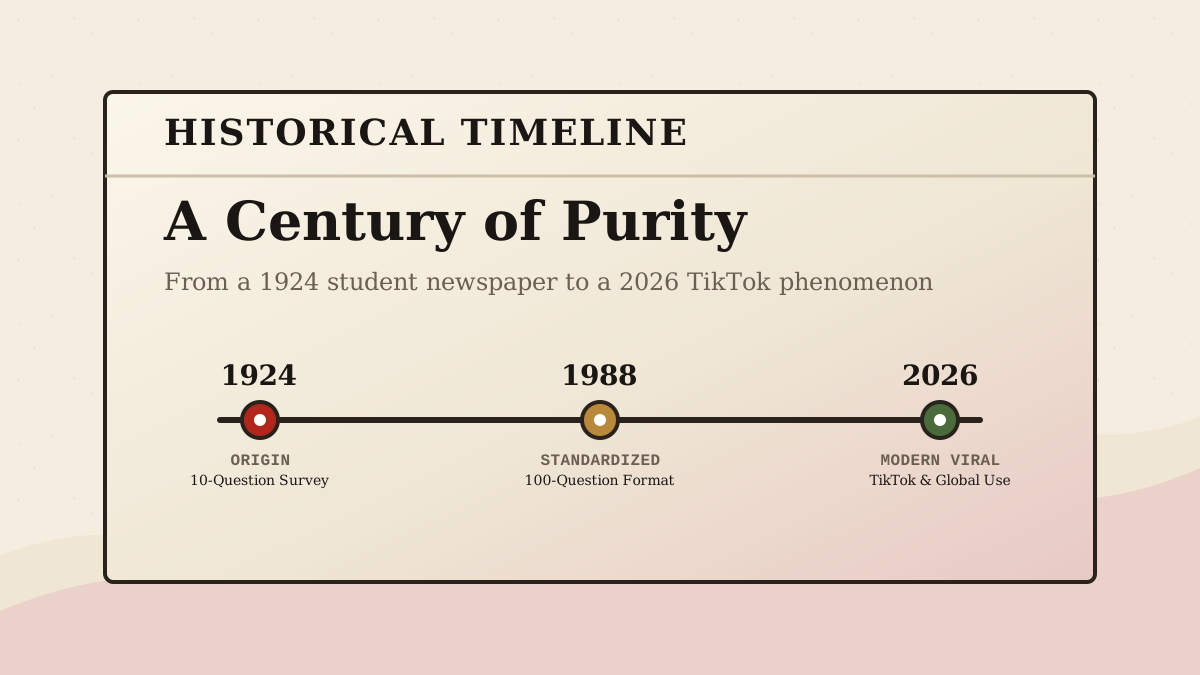
📜 Timeline of Key Milestones
First Edition
10-question satire printed in the student newspaper of Rice University.
The "Virtue Test"
Spreads across campuses like Indiana University on mimeographed sheets.
100-Question Standard
Modern standardized version takes shape and meets the early internet (Usenet).
Global Data Audit
Data of 124,000+ entries is analyzed, putting average score at 61.46.
TikTok Era
Millions share screenshots, turning the test into a global mobile phenomenon.
1924: A Satirical Survey in a Student Newspaper
The story begins not with a website but with a printing press. In 1924, the Rice Thresher — the student newspaper of Rice University — published the results of an informal ten-question survey given to 119 female undergraduate students.
The questions sound almost quaint today: "Have you ever been drunk?", "Did you ever dance conspicuously?", and the timeless "Have you ever done anything that you wouldn't tell your mother?"
Context matters here. Rice had only opened in 1912, and campus life in 1924 came with curfews, dress codes, and chaperones — especially for women. The survey wasn't a moral inquisition. It ran as campus satire, poking fun at the gap between the university's strict official rules and how students actually lived.
The average score of that first cohort? Roughly 62. Hold onto that number — it becomes one of the most surprising facts in this entire history.
⚖️ Then vs. Now: The Scale of Purity
- Format: 10 questions on printed newsprint
- Target: 119 female undergrads only
- Themes: Curfews, dancing, first sips of alcohol
- Averages: 62 / 100
- Context: Strict chaperones & rules
- Format: 100 questions on web browsers
- Target: Millions of students globally (all genders)
- Themes: Modern relationships, laws, social habits
- Averages: 61.46 / 100
- Context: Digital sharing & peer connection
1930s–1960s: The Purity Test Goes to College (Everywhere)
The idea didn't stay in Houston. By 1939, a similar questionnaire called the "Virtue Test" was circulating at Indiana University, and campus purity surveys became a recognizable feature of American university culture. Each school had its own version, passed around on mimeographed sheets like an analog meme.
The format even escaped campus entirely. A 1966 purity test appeared in the famous Ask Ann Landers advice column — and in 1976, a Texas high school teacher was fired for handing it out to students. The test was already controversial half a century before TikTok existed.
Through this era, the quiz served the same social function it does today: a semi-anonymous way to compare experiences without having to say anything out loud. The checkbox did the confessing for you.
1980s: The Thresher Revival and the 100-Question Standard
The Thresher periodically revisited and expanded the test over the decades, usually on its satirical Backpage. In 1988, it published a 150-question version students could score themselves — and around the same era, the now-familiar 100-question format took shape.
This is also when the test met its most important distribution channel yet: the early internet. Purity tests spread across Usenet newsgroups in the late 1980s, where they mutated into massive 400- and 500-question versions traded between university computer labs. If you've ever wondered why the test feels like an internet artifact even though it predates the internet by decades — this is why. It was one of the first pieces of college culture to go digital.
At Rice itself, the test settled into a specific tradition: taken during O-Week (Orientation Week) as a bonding ritual for incoming freshmen. Take it on day one, take it again senior year, compare. A before-and-after snapshot of college.
📊 Evolution of Quiz Length
1990s–2010s: The Quiet Web Years
As the web replaced Usenet, the test moved onto simple HTML pages and quiz sites. It never fully disappeared, but it lived in a kind of internet background radiation — resurfacing every autumn with each new freshman class, then going quiet again.
One data point from this era stands out. A large-scale analysis of over 124,000 responses in 2018 put the global average score at 61.46.
Read that again next to the 1924 number: the average score was about 62 a century ago, and about 61 in the modern era. Across one hundred years of radical social change — women's liberation, the sexual revolution, the internet, dating apps — the average barely moved. Students in every generation think they're wilder than the last one. The data says otherwise. That might be the single most humbling fact in the entire history of the Rice Purity Test.
📈 100 Years of Score Stability
Despite monumental shifts in culture, rules, and technology, student averages have stayed within less than 1% variance over a span of 94 years.
2020–2026: The TikTok Century Mark
The pandemic era gave the test its biggest audience ever. Stuck at home and starved for social games, Gen Z rediscovered the quiz on TikTok, where score-reveal videos, duets, and "rating my friends' scores" formats racked up hundreds of millions of views. The screenshot became the new mimeograph.
By its 100th anniversary in 2024, the test had fully globalized — versions now circulate among students in Turkey, Brazil, South Korea, and beyond, translated and adapted for local culture. In 2026, it remains one of the rare pieces of pre-internet college culture that every generation independently rediscovers.
Why does it keep coming back? Psychologists point to social comparison theory: we understand ourselves partly by measuring against peers. The Rice Purity Test packages that instinct into a single shareable number. It's Spotify Wrapped for your life experience — a snapshot, not your whole playlist.
Curious where you'd land against a century of test-takers? Take the Rice Purity Test and see your score in under five minutes.
🔄 Evolution of Media Platforms
What the Test's History Teaches Us
Three takeaways hide inside this timeline:
Scores have always been satire, not judgment. From the 1924 Backpage onward, the test was framed as humor. Treating a score as a moral report card misses the entire point of its origin.
Averages are remarkably stable. Whether it's 1924 or 2026, most young adults cluster in the same middle band. If you're comparing your number to your group chat, know that a century of data says "normal" is a very wide range. (For a full breakdown, see our score meaning guide.)
The format outlives every platform. Newspapers, mimeographs, Usenet, web forums, TikTok — the test has survived them all. Whatever replaces TikTok, expect the quiz to be there too.
FAQs
When was the Rice Purity Test created?
The first version was published in 1924 by the Rice Thresher, the student newspaper of Rice University in Houston, Texas. It began as a satirical ten-question survey of 119 female students, decades before the 100-question online version existed.
Why is it called the Rice Purity Test?
It's named after Rice University, where it originated — not the food. The Thresher revisited and expanded the test over the decades, and the university's O-Week tradition kept the name attached as it spread online.
How many questions did the original test have?
Just 10. The test grew over time — the Thresher published a 150-question version in 1988, and massive 400–500 question variants circulated on Usenet — before settling into today's standard 100-question format.
Has the average score changed over 100 years?
Barely. The 1924 cohort averaged roughly 62, and a 2018 analysis of over 124,000 responses found a global average of 61.46. Despite huge social change, the typical score has stayed remarkably consistent. Compare your result on our average scores by age page.
Was the test always taken by everyone?
No. The 1924 original was given only to female students. Over the following decades it opened to all students and became a co-ed O-Week bonding ritual at Rice before going global online.
Is the Rice Purity Test official?
There's no single "official" online version. The tradition originated with the Rice Thresher, but the versions people take today are independent adaptations. Any site claiming exclusive official status is overstating it.
Is the test meant to be taken seriously?
No — and it never was. It began as newspaper satire and works best as entertainment and a conversation starter. Your score isn't a measure of your worth, morality, or maturity, and it never has been.
A Century Old and Still Trending
The history of the Rice Purity Test is really a history of how young people talk about growing up — from a satirical newspaper page in 1924 to a global TikTok trend in 2026. The platforms changed. The questions evolved. The human curiosity underneath never did.
Whether you're a freshman taking it during orientation or just settling a group chat debate, remember the spirit it was born in: lighthearted, anonymous, and judgment-free. Your score is a snapshot of experiences, not a verdict on who you are.
Ready to add your number to a hundred years of data? Take the Rice Purity Test now — it takes five minutes, it's completely private, and the group chat is waiting.
📖 Read Our Latest Score Guides
Analyze your results with our comprehensive breakdowns of other common score tiers:
What a Score of 90 Means
Read about the innocent tier and what to expect as your score changes over time.
80 ScoreWhat a Score of 80 Means
Explore the transition boundaries and context for an 80 score.
70 ScoreWhat a Score of 70 Means
Explore the crossover zone and how it compares across age groups.
60 ScoreWhat a Score of 60 Means
Discover why a score of 60 is the ultimate average college experience.