How the Rice Purity Test Went From a College Tradition to a Global Meme
📋 Table of Contents
You take the test, screenshot the number, and drop it in the group chat. Within minutes everyone's arguing over whether an 82 is "boring" or a 34 is "unhinged." That single number out of 100 has quietly become one of the internet's most reliable icebreakers — but the rice purity test viral history is far stranger, older, and more accidental than the version you'll find on most sites.
Here's the part almost nobody mentions: Rice University didn't actually invent the purity test. It branded it. The quiz that 2026 teenagers take in Houston, London, Seoul, and São Paulo descends from a folk tradition that was already floating around North American campuses a century ago. The story of how it went from a private freshman ritual to a global meme is really a story about one perfect design choice — and the internet's obsession with a number.
Quick Snapshot
- What it is: A self-graded, 100-question checklist that estimates your "innocence" from 0 (most experienced) to 100 (most innocent).
- Where it started: Rice University, Houston, Texas — first surfacing in the campus newspaper The Rice Thresher in 1924.
- Who takes it: Mostly 17–24-year-olds, with college students the biggest group — though adults retake it for nostalgia.
- Why it matters: It's one of the clearest examples of how a pre-internet campus tradition mutated into short-form viral culture.
- Fun fact: The very first published version surveyed only female students and ran under the tongue-in-cheek headline "Rice Girls Not Quite Half Bad."
⚡ Fast Facts: Rice Purity Test Dashboard
Rice University (Houston, TX). Popularized during Orientation Week (O-Week).
1924 in The Rice Thresher newspaper with only 10 questions.
0 to 100 Score. Lower score indicates more experienced lifestyle.
Globally shared via TikTok, group chats, and social profile bios.
Where the Rice Purity Test Actually Came From
The origin story you've probably read — "invented in the 1980s at Rice" — is only half right, and it papers over a messier truth.
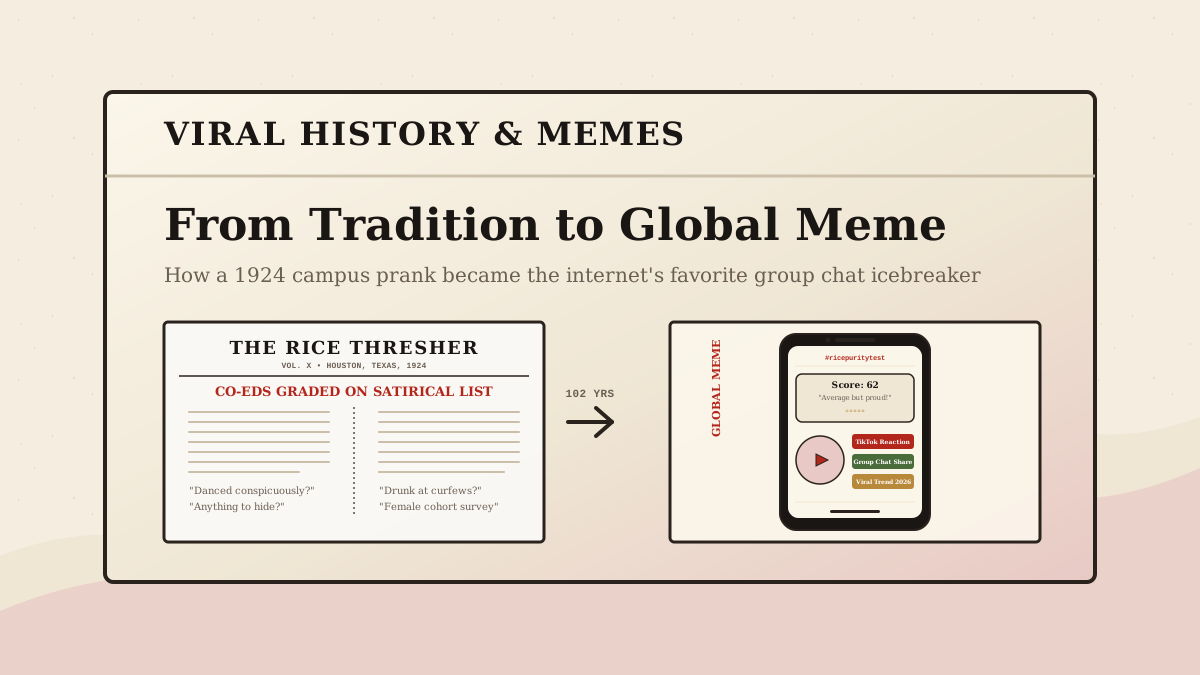
The earliest documented version appeared in The Rice Thresher in 1924, reporting the results of a short survey of around 119 female undergraduates. It wasn't 100 questions; it was roughly ten, and its purpose was campus satire — a wink at the gap between Rice's strict social codes and how students actually behaved. Men weren't folded into the tradition until the 1970s, and after Rice desegregated in 1963, questions about crime and police contact were added — a detail that later critics, including a Rice honors thesis on the test, have flagged as far from neutral.
The 100-question format most people picture today didn't lock in until the 1980s, when Rice students expanded the checklist into the version that spread beyond campus. So when sources fight over whether the "real" origin is 1924, the 1960s, or the 1980s, they're all sort of right — they're just describing different chapters of the same object.
Curious how your own number stacks up against those early averages? You can take the Rice Purity Test here and compare.
The Detail Everyone Skips: Rice Didn't Invent the Format
This is where the rice purity test history gets genuinely surprising — and where most competitor articles go silent.
The idea of a scored "purity questionnaire" was already circulating on other campuses in the 1930s. Columbia's humor magazine reported on a purity test run at Barnard College in 1935. In 1936, an Indian newspaper described University of Toronto students taking a nearly identical "purity ratio" quiz — subtract points for smoking, drinking, and kissing, then see what's left of 100. Folklorists Alan Dundes and Carl Pagter even catalogued these "questionnaire parodies" in their 1975 study of office-and-campus folklore.
Translation: the purity test was a folk genre, passed hand to hand like a chain letter, long before it belonged to any one school. Rice's version won the naming war for a simple reason — as the quiz moved onto Usenet and early websites in the 1990s, digital copies restored the "Rice" attribution that paper photocopies had stripped away. An institutional name made a silly quiz feel official. The brand stuck. The competitors were forgotten.
📜 The Purity Quiz Family Tree: Pre-Rice Ancestors
The format existed as a campus folklore genre long before it was tied exclusively to Rice University:
Barnard College
Columbia's humor magazine records a scored purity checklist used on campus.
Univ. of Toronto
Students take a "purity ratio" quiz subtracting points for drinking and kissing.
Folklore Study
Dundes & Pagter study "questionnaire parodies" passed around by students.
Why Rice Won
Early Usenet posts credited "Rice University" which cemented the official brand online.
How It Actually Went Viral
For decades the test lived on paper, then on clunky message boards. The real inflection points came in three waves.
Wave one — the web (late 1990s–2000s). Once the checklist moved online, you no longer counted boxes by hand; a page did it instantly. That single convenience — click, click, here's your number — quietly removed all the friction. MySpace, Facebook, and Reddit did the rest.
Wave two — lockdown (2020). Stuck indoors, bored, and online, Gen Z rediscovered it. Two friends, Grace Wetsel and Ella Menashe, even built a modernized "Innocence Test" remake that added distinctly 2020s items, and it took off on TikTok.
Wave three — the TikTok explosion (2023–2024). This is when the rice purity test meme truly globalized. Videos tagged #ricepuritytest racked up hundreds of millions of views: creators filming their reactions, couples comparing scores, people documenting how their number "dropped" after a relationship. Search interest now spikes every August and September, right on cue with college orientation season.
🔄 The Three Waves of Virality
The Web Shift
Manual paper checks are replaced by instant HTML scripts. Early forums spread the code.
The Innocence Test
Gen Z redesigns the questions. Isolating teens take and share it out of sheer boredom.
TikTok Reactions
Hundreds of millions of views on videos comparing couple scores and freshman reactions.
Why This Quiz Became a Meme (When Thousands Don't)
Here's the original-analysis heart of it. Millions of online quizzes never escape their moment. The Rice Purity Test did — because of one design decision made a century ago.
It outputs a single, universal number. A "34" needs zero explanation. Unlike a personality type or a paragraph of results, a purity score is instantly comparable across any platform, friend group, or country. That makes it perfect meme fuel:
- Frictionless comparison — "what'd you get?" is a built-in reply mechanic.
- Dramatic reactions — a shocking question generates a shareable face on camera.
- A tag-and-challenge loop — one shared score pulls in five more takers.
- Legitimacy — a real 100-year history makes it feel like a rite of passage, not just another BuzzFeed quiz.
Think of the purity score like a Spotify Wrapped for your life choices: a snapshot everyone understands at a glance, endlessly screenshot-able, and just personal enough to spark a conversation. That's the meme's genetic code — and it was accidental.
🧠 Anatomy of the Meme: Why the Quiz Succeeded
1. The Score Output
A single, universal integer (0-100) that requires no reading time. Perfect for group chat screenshots.
2. Reaction Value
Confessing to wild questions on video generates visual drama, which drives TikTok algorithms.
3. Social Comparison
Built-in peer check-ins. "What did you get?" is a natural conversation loop among friends.
4. Vintage Authority
A 100-year history transforms it from a cheap internet click-bait page to a historic college ritual.
What the Score Really Says About You
Very little, mathematically. It isn't a psychological instrument, a morality gauge, or a bucket list — the test itself literally warns against treating it as one. What it does capture is a low-stakes way to compare life experiences and spark honest conversation, which is exactly why it's survived a hundred years of changing norms.
If you want the actual breakdown, our Rice Purity Test score meaning guide explains what each range tends to signal, and our average scores by age page shows how numbers shift across generations.
📊 Purity Score Tier Spectrum
Most young adults fall in the average college range (89-60) by their graduation year, aligning with the historic average score of 62.
A Few Honest Caveats
The test is entertainment, and it's genuinely best treated as an 18+, for-fun activity taken privately or among friends who won't judge. A couple of things worth keeping in mind:
- A number isn't a verdict. Broadcasting a low score can pressure others; broadcasting a high one can shame them. Neither reflects worth.
- Don't chase the checklist. The one thing the test explicitly discourages is treating it as things you should go do.
- It's opt-in and imperfect. No official body runs it, and its older questions carry real historical baggage around gender and race.
⚖️ Mindful Taking: DOs vs. DONTs
- Treat the score as a fun conversation starter.
- Take it privately and score at your own pace.
- Respect your friends' choices to not share their scores.
- Recognize that norms change over decades.
- Treat the number as a verdict on your character.
- Use the questions as a bucket list of things to do.
- Shame others for high or low scores.
- Peer pressure anyone into taking the checklist.
FAQs
What is the rice purity test viral history in one sentence?
It's the roughly 100-year arc of a Rice University survey — first published in 1924 — evolving through campus tradition, the early web, and finally TikTok into a globally recognized quiz.
Who invented the Rice Purity Test?
Rice University students popularized and named it, but scored "purity questionnaires" existed at other campuses (Barnard, Toronto) in the 1930s. Rice branded the format rather than inventing it.
When did the Rice Purity Test go viral on TikTok?
It resurged during 2020 lockdowns and exploded across 2023–2024, with #ricepuritytest videos gathering hundreds of millions of views.
Is the Rice Purity Test accurate?
No. It's a self-graded, unscientific bit of fun — not a psychological or moral assessment. Treat the number as a conversation starter, nothing more.
How many questions are on the Rice Purity Test?
The modern version has 100 questions, a format that solidified in the 1980s from much shorter early editions.
The Takeaway
The rice purity test viral history isn't really about Rice, or even about purity. It's about how a clever, century-old format — turn your life into one comparable number — happened to be the perfect shape for the internet age. A 1924 campus in-joke survived flappers, floppy disks, and Facebook to land on your For You page.
So take it for what it is: a playful mirror, not a scorecard. Take the Rice Purity Test, compare with your friends, laugh at question 47 — and then remember you're infinitely more than a two-digit number.
Sources & further reading: The Rice Thresher (1924 archives); Wikipedia, "Purity test" (folklore genre and 1930s campus history); The Independent (Gen Z TikTok coverage); The Trail, "The Impure Truth About the Rice Purity Test" (historical critique and honors-thesis context); Her Campus (Gen Z quiz psychology).
📖 Read Our Latest Published Blogs
Explore more in-depth history and score interpretations from our team:
What Is Rice University?
The origin story detailing why residential dorm colleges created this icebreaker.
TimelineComplete History of the Test
A full milestone-by-milestone breakdown from 1924 print to TikTok video duets.
Score 60What a Score of 60 Means
Analyze why a score of 60 hits the exact student average with balanced experience.
Score 70What a Score of 70 Means
Understand the crossover boundaries, social contexts, and averages by age.