What Is Rice University and Why Did Students Create a Purity Test?
📋 Table of Contents
Introduction
Every time someone screenshots their Rice Purity Test score and drops it in a group chat, they're unknowingly reviving a tradition that started nearly a century ago in a Houston dorm room. The rice university purity test origin isn't some corporate marketing gimmick or a random internet quiz factory creation — it's a genuine piece of American college culture that predates TikTok, predates the internet, and even predates most of our grandparents.
So what actually is Rice University, and why did its students invent a self-assessment quiz that would eventually take over group chats worldwide? The short answer: tight-knit residential culture, a tradition of dry humor, and a need to break the ice among strangers who'd be living together for four years. The longer answer — the one that actually explains why this specific quiz, from this specific school, is the one that stuck — is more interesting than most competing articles bother to explain.
Quick Snapshot
- What it is: A self-graded, 100-item checklist quiz that started as a college icebreaker
- Where it began: Rice University, a private research university in Houston, Texas
- When: Most historical accounts trace the tradition to residential college culture in the early-to-mid 20th century
- Who it's for: Originally incoming freshmen; now a global Gen Z and Gen Alpha social phenomenon
- How it works: Participants check off items they've experienced; fewer checks means a "higher" purity score
- Fun fact: Rice's residential college system — small, self-governing houses students are assigned to for life — is exactly the kind of close-knit environment that tends to produce inside jokes and shared traditions like this one
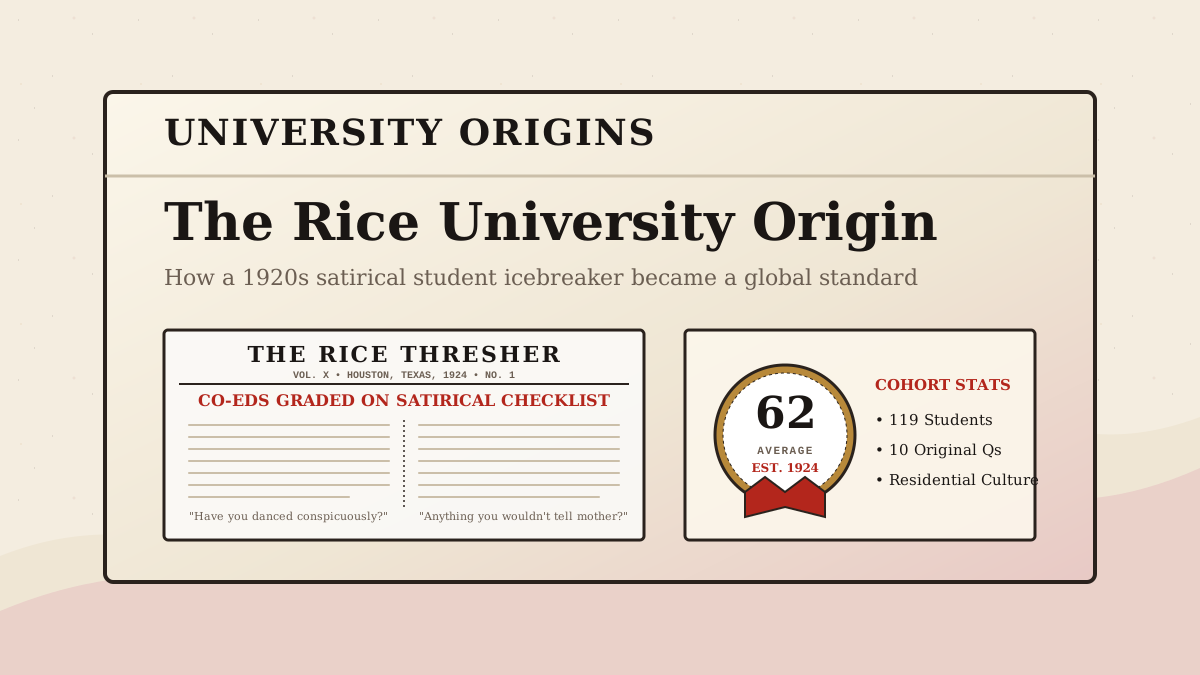
🏛️ Rice University Profile & Origins
- Location: Houston, Texas
- Founded: 1912 (Test started ~1924)
- Campus System: Residential Colleges (Oxford-style)
- Student Culture: Collaborative, quirky, tradition-driven
- Original Target: 119 female students
Understanding Rice University's Culture
Rice University isn't a huge state school where you could disappear into the crowd. It's a small, highly selective private research university, and its social life has always revolved around its residential college system — a structure borrowed loosely from schools like Oxford and Cambridge, where students are sorted into one of several residential colleges for their entire undergraduate career rather than just their freshman year.
That distinction matters more than most articles about the quiz's history acknowledge. When you live, eat, and socialize with the same 200–300 people for four straight years, traditions calcify fast. Icebreakers that would fade after one semester at a bigger school become institutional at a place like Rice, passed down class to class almost like folklore. The purity test wasn't dreamed up by a marketing team — it was almost certainly built the way most dorm traditions are: informally, communally, and revised year after year by whoever happened to be writing that year's orientation packet.
🔄 The Cycle of Dorm traditions
How Rice's unique residential model turned a simple dorm game into a 100-year-old campus institution:
Incoming freshmen get assigned to one of the residential colleges for life.
Eating, sleeping, and socializing in a close group of 250 students.
Freshmen take the checklist to break boundaries and share secrets.
Seniors edit the list for the next cohort, calcifying the tradition.
Why a Checklist, Specifically?
Here's the piece most competitor articles skip entirely: the checklist format itself tells you something about why it worked so well as a social tool. A checklist is low-effort, self-paced, and — critically — self-graded. Nobody's watching you fill it out. That privacy is what made it safe enough to be funny rather than invasive, and it's the same psychological mechanism that makes today's Buzzfeed-style personality quizzes and Instagram "put a percentage" polls so addictive: low social risk, high social payoff when you compare results with friends.
Social psychologists have long pointed to social comparison theory — the idea that people evaluate themselves by measuring against others — as a core driver of quiz culture. A purity test doesn't just ask "what have you done," it invites a comparison the moment you share your number. That built-in comparison loop is arguably the real reason this specific quiz outlived thousands of other campus traditions that never left their home campus.
🧠 Anatomy of a Checklist: Why It Works
Self-paced and self-graded. You fill it out on your own terms. This keeps the barrier to entry extremely low.
Because it's presented with humor, checked boxes feel like confessions, but without the judgment of a face-to-face quiz.
Sharing a single, neat score (e.g., "78") triggers immediate peer comparison and group chat interactions.
From Dorm Tradition to Viral Phenomenon
For most of its life, this quiz stayed exactly where it started: photocopied packets passed between Rice students, maybe traded with friends at other Texas schools. The leap to mainstream visibility happened with the internet — first through early web forums and personal sites in the late 1990s and 2000s, then through a second, much bigger wave once mobile-friendly quiz sites and social sharing made it effortless to post a score alongside a screenshot.
What's notable is that the quiz didn't need to be reinvented to go viral — it just needed a frictionless way to share results. That's a pattern worth noting for anyone studying internet culture: analog traditions with a built-in comparison mechanic are often the ones most primed to explode once you remove the friction of physically sharing them.
Generational Differences in How the Test Is Used
- Millennials largely encountered the test through early internet forums and treated it as a novelty to email or IM to friends
- Gen Z turned it into a full social ritual — TikTok duets reacting to scores, Instagram Story polls, and dating-app bio flexes
- Gen Alpha, still mostly teenagers, is inheriting the test almost entirely through short-form video rather than word of mouth, which changes how quickly variations and spinoff versions spread
This generational shift matters for how you should read your own score: a 62 shared quietly between two college roommates in 2004 carried a very different social weight than a 62 posted publicly with a reaction video today.
👥 The Generational Split
- Channel: Web Forums & Email chains
- Social Dynamic: Private, shared with close friends
- Tone: Sarcastic internet novelty
- Channel: TikTok & IG Story Polls
- Social Dynamic: Public flex, bio descriptors
- Tone: Self-deprecating identity marker
- Channel: YouTube Shorts & TikTok Duets
- Social Dynamic: Interactive short-form video
- Tone: Gamified meme challenge
Common Misconceptions, Debunked
"It's an official psychological assessment." It isn't, and it was never meant to be. There's no clinical validity, no standardized scoring body, and no institutional endorsement from Rice University itself.
"A low score means something's wrong with you." The test measures a list of specific, mostly unrelated experiences — it doesn't measure character, maturity, or worth. Treating it as a moral scoreboard misses the point of an icebreaker.
"Rice University still uses it in official orientation." Most evidence suggests the test spread organically through student culture rather than official programming, and its presence in any current orientation materials would vary by year and by residential college.
⚖️ Fact vs. Fiction
Clinical Validity
Believing the test is a valid indicator of psychological development or mental maturity.
Satirical Icebreaker
It was created entirely for campus humor and boundary-pushing jokes between roommates.
Who This Is For — and a Few Honest Caveats
This quiz works best as exactly what it started as: a low-stakes, private way to laugh at your own life choices with people you trust. A few things worth keeping in mind:
- It's designed for adults reflecting on their own experiences — younger teens should approach it, if at all, with caution and context
- Scores are not a mental health metric, and using them that way can encourage unhealthy comparison
- It's meant for private reflection or sharing among friends, not public shaming of yourself or others
Take the Test Yourself
Now that you know where the tradition actually comes from, you can take the Rice Purity Test and see how your score fits into the bigger cultural picture. If you're curious how your number stacks up, check out our guide to what your score actually means or see average scores broken down by age group.
📊 Purity Score Tier Spectrum
Most college students cluster in the average range (89-60) by their senior year, matching the historic average score of 62.
FAQs
What is the Rice Purity Test?
It's a 100-item, self-graded checklist quiz that originated among Rice University students as a college icebreaker. Participants check off experiences they've had, and fewer checked items result in a higher "purity" score.
Did Rice University officially create the test?
The test grew out of Rice's residential college culture rather than any official university program. It spread through students themselves, which is typical of dorm traditions rather than institutional initiatives.
Why is it called a "purity" test if it's not really about purity?
The name reflects its original tone — a mostly tongue-in-cheek measure of "innocence" among incoming students — rather than any serious moral or clinical framing.
Is the Rice Purity Test accurate?
It's accurate only in the sense that it reflects the specific items you've checked. It has no scientific validity as a personality or character assessment.
How many questions are on the Rice Purity Test?
The standard version has 100 questions, though some viral variations circulating online trim or expand that list.
Is it safe and private to take?
Reputable versions of the test are self-scored and don't require personal identifying information, though you should always check a site's privacy practices before entering any personal data.
Can I retake the test?
Yes — nothing stops you from retaking it, though your score should decrease over time as you accumulate more life experiences, not increase.
Why did this specific college tradition go viral instead of others?
Its self-paced, self-graded, checklist format made it low-risk to complete privately but high-payoff to share, which lines up closely with what drives most viral quiz content today.
Final Takeaway
The Rice Purity Test isn't just a quiz that happened to go viral — it's a genuine artifact of Rice University's close-knit residential culture, built by students, for students, decades before anyone could have predicted TikTok. Understanding that origin doesn't just satisfy curiosity; it reframes your own score as part of a much longer, much more human tradition of using shared experience as a way to connect. Take it in that spirit, compare notes with friends, and remember: the number was always meant to start a conversation, not end one.
Ready to add your number to a hundred years of data? Take the Rice Purity Test now — it takes five minutes, it's completely private, and the group chat is waiting.
Suggested High-Authority References:
- Rice University institutional archives — for verified historical and residential-college details
- American Psychological Association (APA) — for social comparison theory and quiz-taking psychology
- Pew Research Center — for generational social media behavior data
- Peer-reviewed social psychology journals — for research on self-assessment and peer comparison
📖 Read Our Latest Score Guides & History
Explore our latest educational score tier breakdowns and historical research:
The Complete History of the Test
Trace every single milestone of the test from its 1924 newspaper survey to Usenet and TikTok.
90 ScoreWhat a Score of 90 Means
Read about the innocent tier and what to expect as your score changes over time.
80 ScoreWhat a Score of 80 Means
Explore the transition boundaries and context for an 80 score.
70 ScoreWhat a Score of 70 Means
Explore the crossover zone and how it compares across age groups.